SUPERCOMPUTING NEWS SUPERCOMPUTING NEWS
    • MEDIA KIT
    • MOST READ
    • RSS FEED
    • ACADEMIA
    • AEROSPACE
    • APPLICATIONS
    • ASTRONOMY
    • AUTOMOTIVE
    • BIG DATA
    • BIOLOGY
    • CHEMISTRY
    • CLIENTS
    • CLOUD
    • DEFENSE
    • DEVELOPER TOOLS
    • EARTH SCIENCES
    • ECONOMICS
    • ENGINEERING
    • ENTERTAINMENT
    • GAMING
    • GOVERNMENT
    • HEALTH
    • OIL & GAS
    • INDUSTRY
    • INTERCONNECTS
    • MANUFACTURING
    • MIDDLEWARE
    • MOVIES
    • NETWORKS
    • PHYSICS
    • PROCESSORS
    • RETAIL
    • SCIENCE
    • STORAGE
    • SYSTEMS
    • VISUALIZATION
    • AcyMailing subscription form

    • ADD YOUR VIDEOS
    • MANAGE VIDEOS
    • CONVERSATION INBOX
    • SOCIAL ADVERTISER
    • SOCIAL NETWORK VIDEOS
    • SURVEYS
    • GROUPS
    • PAGES
    • MARKETPLACE LISTINGS
    • APPLICATIONS BROWSER
    • PRIVACY CONFIRM REQUEST
    • PRIVACY CREATE REQUEST
    • LEADERBOARD
    • POINTS LISTING
      • BADGES
    • TRADE SHOWS
Sign In

FEATURED

AI infrastructure financing fears shake semiconductor sector
Featured

AI infrastructure financing fears shake semiconductor sector

Tyler O'Neal, Staff Editor LATEST July 27, 2026, 5:00 pm
The semiconductor industry faced a significant selloff this week as investors questioned whether the rapid expansion of AI infrastructure is driven by sustainable end-user demand or a self-reinforcing cycle of investment. This uncertainty pushed Nvidia shares down nearly 5%, triggering a broader decline across the AI hardware sector and intensifying debates regarding the economic viability of massive supercomputing projects. Central to these concerns are reports that Nvidia may be providing financial guarantees for large-scale data-center initiatives involving OpenAI. While these arrangements reportedly stop short of Nvidia directly purchasing its own chips, investors fear the company is becoming excessively entangled in financing the very infrastructure that sustains its hardware sales.

The rise of "circular financing"

The term "circular financing" refers to a situation in which hardware vendors, investors, cloud providers, and AI developers become financially dependent on one another to sustain rapid expansion. Rather than infrastructure growth being driven solely by customer demand, critics fear that financing mechanisms could create a feedback loop where continued investment depends on ever-larger future investments.
 
Although these arrangements are not uncommon in large infrastructure industries, the AI boom has accelerated at an unprecedented pace. Multi-billion-dollar GPU clusters are now being planned across North America, Europe, and Asia, requiring financing packages that rival those used for airports, power plants, and telecommunications networks.
 
For investors, the concern is straightforward: if AI revenue growth slows, the financial obligations supporting these massive facilities could become increasingly difficult to justify.

Supercomputing's new economics

From the perspective of high-performance computing, the developments illustrate just how dramatically the industry has evolved.
 
Traditional supercomputers were typically funded through governments, universities, or national laboratories with long-term scientific objectives. Today's largest AI systems are often privately financed hyperscale computing facilities whose primary mission is training foundation models containing trillions of parameters.
 
These facilities require:
  • Hundreds of thousands of GPUs
  • Exabytes of high-speed storage
  • Massive InfiniBand and Ethernet fabrics
  • Gigawatts of electrical capacity
  • Advanced liquid cooling systems
Each new AI supercomputer represents an investment measured not in millions, but often tens or even hundreds of billions of dollars.

Nvidia's position in the ecosystem

Nvidia remains the dominant supplier of accelerators powering modern AI supercomputers. Its GPUs underpin many of the world's fastest AI clusters, making the company's financial health closely tied to the pace of AI infrastructure deployment.
 
However, investors are now asking whether Nvidia is transitioning from being primarily a hardware supplier to becoming an active participant in financing AI expansion itself. Reports indicate discussions for guarantees associated with a major OpenAI data-center initiative, adding another layer of financial exposure beyond chip sales.
 
While such agreements could help accelerate deployment of next-generation AI systems, they also introduce additional financial risk if anticipated demand fails to materialize.

Ripple effects across the semiconductor industry

The market reaction extended well beyond Nvidia.
 
The semiconductor sector experienced a broad market retreat as investors scrutinized the sustainability of current AI infrastructure spending. Beyond Nvidia, the decline impacted a wide range of companies, including memory manufacturers and semiconductor equipment suppliers, as market sentiment shifted toward reevaluating future demand for AI hardware. South Korean memory producers faced particularly significant pressure, struggling with the dual concerns of cooling AI capital expenditure and rising competitive threats from the Chinese semiconductor industry.
 
The selloff highlights the growing interconnectedness of the AI hardware supply chain. GPU manufacturers, memory vendors, networking companies, cooling providers, and data-center builders now depend on sustained investment in AI infrastructure.

Implications for high-performance computing

For the HPC community, the situation represents both a challenge and an opportunity.
 
The enormous investments flowing into AI infrastructure continue to accelerate innovation in:
  • GPU architectures
  • High-bandwidth memory
  • High-speed interconnects
  • Power-efficient computing
  • Advanced cooling technologies
These technologies frequently migrate into traditional scientific computing environments, benefiting researchers running climate simulations, molecular dynamics, astrophysics, computational fluid dynamics, and digital twin applications.
 
However, if financing concerns slow private-sector AI investment, the pace of hardware innovation could moderate, affecting the broader supercomputing ecosystem.

Looking ahead

The current debate centers less on the necessity of enormous computational resources for AI and more on the long-term sustainability of the financing models supporting them. For the supercomputing industry, this shift highlights that building exaFLOPS infrastructure is no longer solely a technological challenge; financial engineering has become as critical as processor design, network performance, and software optimization. As AI supercomputers continue to scale, the industry's success will depend on establishing robust economic frameworks supporting the next generation of computational infrastructure.

Intel’s AI supercomputing revival: Q2 financial surge signals new era for CPU-powered HPC infrastructure
Featured

Intel’s AI supercomputing revival: Q2 financial surge signals new era for CPU-powered HPC infrastructure

Tyler O'Neal, Staff Editor LATEST July 24, 2026, 4:00 pm
Intel’s latest financial results are sending a powerful signal that the global supercomputing industry is entering a new phase, one in which artificial intelligence, high-performance computing, and advanced semiconductor manufacturing converge into a single economic engine.
 
The company’s second-quarter 2026 earnings report reveals more than a financial rebound. It demonstrates that the infrastructure required to power next-generation AI and scientific computing is becoming one of the most strategically important markets in technology.
 
For SC Online readers, the significance extends beyond quarterly revenue numbers. Intel’s performance reinforces a central theme explored in this year’s most-read SuperComputing story: the evolving role of Intel’s processors and partnerships in the AI supercomputing era. The article, “Intel, Google’s latest AI pact: A boost for supercomputing, or a strategic rebrand?” examined whether Intel’s renewed AI strategy represented a fundamental shift or a repositioning of its traditional strengths.
 
The latest financial results suggest the answer may be increasingly clear: Intel’s CPU-centered computing foundation remains a critical component of the world’s expanding AI and HPC infrastructure.

A supercomputing-driven financial turnaround

Intel reported second-quarter 2026 revenue of $16.1 billion, representing a 25% year-over-year increase and marking one of the company’s strongest growth periods in more than a decade. The company also reported non-GAAP earnings per share of $0.42, significantly exceeding expectations.
 
The results were driven by stronger demand across Intel’s computing portfolio, including the processors, networking technologies, advanced packaging capabilities, and manufacturing infrastructure that increasingly serve AI and HPC workloads.
 
Intel CEO Lip-Bu Tan emphasized that AI demand is creating unprecedented requirements for compute capacity, positioning Intel to capture growth across CPUs, ASICs, advanced packaging, and its semiconductor foundry network.
 
For the supercomputing community, that message carries important implications.
 
The AI revolution is not replacing traditional high-performance computing architectures; it is expanding them.
 
Modern AI supercomputers require enormous amounts of heterogeneous computing power. GPUs and specialized accelerators deliver massive parallel processing, but CPUs remain essential for:
  • System orchestration
  • Data preparation pipelines
  • Simulation workloads
  • Memory management
  • Scheduling and resource coordination
  • Scientific workflows combining AI and traditional HPC
The future of supercomputing is not a single processor architecture. It is a carefully balanced ecosystem.

The return of the CPU in AI supercomputing

Earlier this year, SC Online News examined Intel and Google’s expanded AI collaboration and questioned whether the partnership represented a meaningful advancement for HPC or primarily a strategic repositioning of Intel’s market narrative. The financial results provide new context.
 
Intel’s renewed momentum suggests that the company’s strategy is built around a broader vision: AI infrastructure will require multiple forms of computing, not just accelerator-heavy architectures.
 
The industry’s largest AI systems increasingly resemble supercomputers more than traditional data centers. They combine:
  • Massive accelerator clusters
  • High-performance CPUs
  • Advanced networking
  • Specialized memory architectures
  • Large-scale storage systems
  • Intelligent software orchestration
In this environment, Intel’s long-standing expertise in general-purpose computing becomes an advantage rather than a legacy limitation. The CPU is not disappearing. It is becoming the coordinator of increasingly complex computational ecosystems.

AI infrastructure becomes a financial growth engine

Intel’s Q2 financial performance underscores a historic shift in the economics of computing. For decades, high-performance computing was predominantly confined to government laboratories, academic institutions, and specialized scientific research. Today, however, the rise of artificial intelligence has propelled supercomputing principles into the core of mainstream business strategy.
 
Organizations are now allocating billions of dollars toward AI training clusters, inference infrastructure, digital twins, scientific AI platforms, autonomous systems, and industrial simulation environments. This transition has redefined computing capacity as a critical strategic asset. As SC Online has documented throughout 2026, highlighting the surging importance of AI infrastructure investment and the commercialization of HPC technologies, Intel’s financial recovery reflects this broader industry trend. The company is uniquely positioned to capitalize on a market where the global demand for computation is accelerating at a rate that significantly outpaces traditional technology cycles.

Foundry ambitions and the next supercomputing supply chain

One of the most important aspects of Intel’s strategy is its continued investment in semiconductor manufacturing. The AI era has exposed a fundamental challenge: the world needs dramatically more advanced chips, but manufacturing capacity has become a strategic bottleneck. Intel’s foundry ambitions position the company as more than a processor supplier. The company is attempting to become a critical manufacturing partner for future computing platforms. For supercomputing, this matters because next-generation systems will depend on:
  • More advanced process technologies
  • Improved power efficiency
  • Faster chip-to-chip communication
  • Advanced packaging
  • Specialized compute architectures
The race for AI leadership is increasingly becoming a race for semiconductor manufacturing capability.

Optimism returns, but execution remains critical

Intel’s Q2 results represent a significant milestone, but the company’s long-term success will depend on continued execution. The semiconductor industry remains intensely competitive, with companies investing unprecedented amounts into AI infrastructure.
 
Intel must continue delivering:
  • Competitive processor roadmaps
  • Reliable manufacturing execution
  • Strong developer ecosystems
  • Efficient AI solutions
  • Customer adoption of its foundry capabilities
However, the direction is encouraging. The company’s financial improvement demonstrates that demand for computing infrastructure is broad enough to support multiple technology approaches. The AI supercomputing revolution does not belong exclusively to one type of chip. It belongs to complete systems.

The supercomputing opportunity ahead

Intel’s Q2 financial results signal a promising shift for the future of high-performance computing (HPC). This recovery reflects a broader transformation: supercomputing is no longer merely a niche scientific pursuit, but the bedrock of artificial intelligence, scientific discovery, and industrial innovation. The primary takeaway from Intel’s performance is that the future of computing will be defined by architectural collaboration rather than competition. While accelerators remain vital for driving AI performance, it is the synergy of CPUs, advanced manufacturing, networking, and memory that will ultimately determine system scalability. As AI demands unprecedented computational power, Intel’s resurgence confirms that the next generation of supercomputing will require a holistic approach to innovation. The era of AI-driven supercomputing has only just begun, and the firms that provide the foundational infrastructure will be the ones to define the future of technology.
Supercomputers push neural quantum simulation beyond previous limits
Featured

Supercomputers push neural quantum simulation beyond previous limits

Tyler O'Neal, Staff Editor LATEST July 23, 2026, 8:00 am

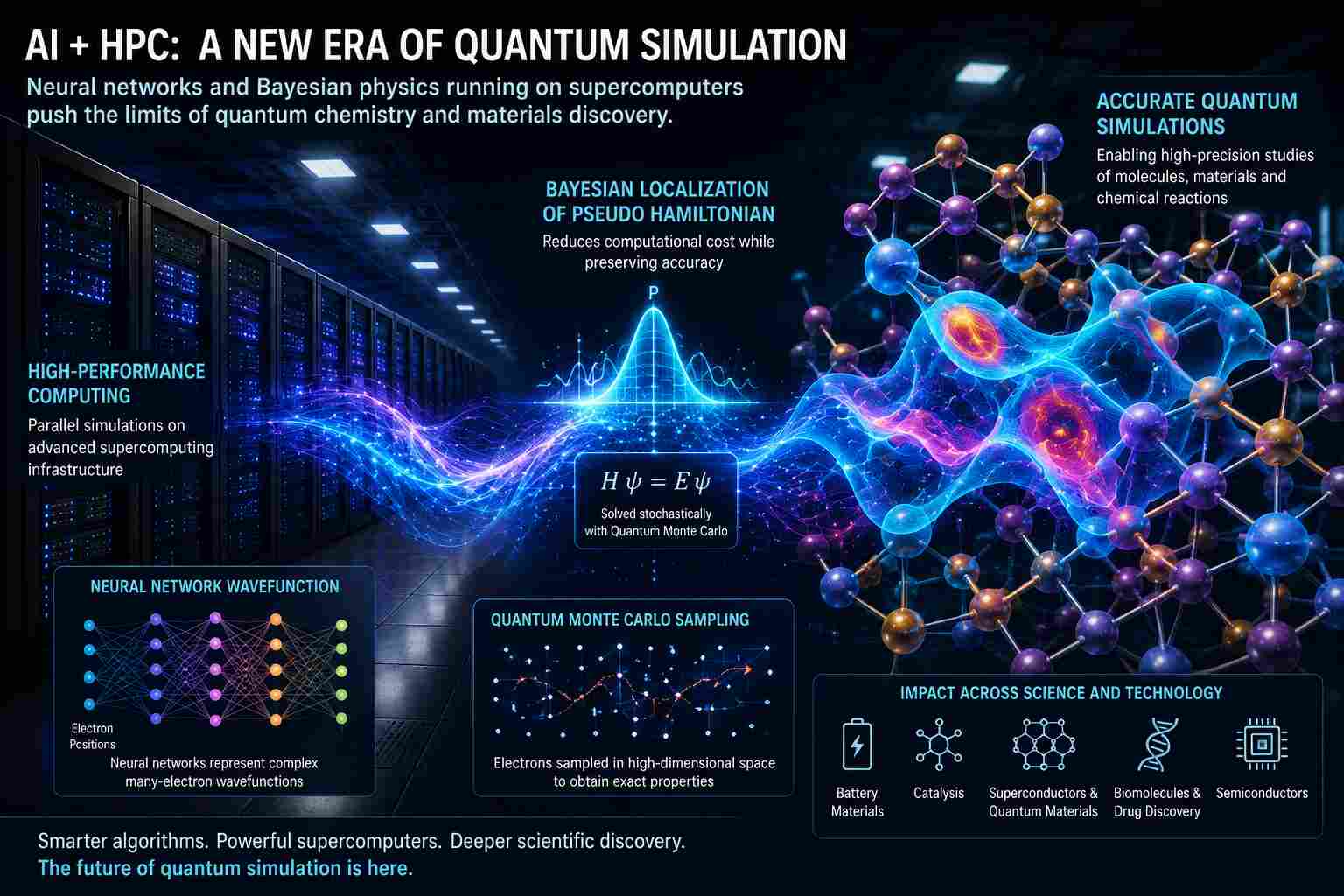
JAIST researchers combine artificial intelligence, Bayesian physics, and high-performance computing to make quantum Monte Carlo practical for larger molecular systems.

For decades, quantum chemists have grappled with a significant hurdle: the most precise methods for simulating molecular electronic behavior are also the most computationally demanding, limiting their use to small systems. Researchers from the Japan Advanced Institute of Science and Technology (JAIST), in collaboration with China’s ByteDance Seed and other institutions, have developed a solution.
 
As detailed in Nature Computational Science, their new framework integrates neural-network quantum Monte Carlo with a novel Bayesian localization technique. This innovation significantly lowers computational costs while maintaining the high accuracy required for first-principles simulations. Beyond the AI application, this work highlights the growing synergy between machine learning and high-performance computing, demonstrating how hybrid workflows can solve complex scientific problems that neither approach could effectively address in isolation.

Quantum Monte Carlo meets artificial intelligence

Quantum Monte Carlo (QMC) methods are widely regarded as among the most accurate computational techniques for solving the Schrödinger equation governing interacting electrons.
 
Unlike conventional density functional theory, QMC explicitly samples the quantum behavior of electrons using stochastic methods, often producing benchmark-quality predictions for molecular energies and material properties. The tradeoff has always been computational expense.
 
In recent years, neural-network wavefunctions have dramatically improved the expressive power of QMC calculations, allowing machine learning models to represent extremely complex electronic structures. However, training and evaluating these neural networks has introduced a new bottleneck: enormous computational requirements that restricted practical simulations to relatively modest molecular systems.
 
The JAIST-led team set out to remove that bottleneck.

A Bayesian shortcut for quantum physics

The researchers developed what they call Bayesian Localization of the Pseudo Hamiltonian, a mathematical framework that replaces computationally expensive nonlocal pseudopotential evaluations with localized approximations while maintaining high physical fidelity.
 
Rather than sacrificing accuracy for speed, the Bayesian framework intelligently estimates the localized interactions needed during quantum Monte Carlo sampling.
 
The result is a neural-network quantum simulation workflow that remains highly accurate while requiring substantially fewer computational resources. According to the researchers, the approach enables high-precision simulations of significantly larger molecular and materials systems than were previously practical.
 
For computational scientists, this represents the kind of algorithmic innovation that often produces larger performance gains than incremental hardware improvements alone.

Supercomputers still do the heavy lifting

Although artificial intelligence plays a central role, the research is fundamentally an HPC achievement.
 
The study relies on large-scale numerical simulation rather than replacing physics with machine learning. Neural networks become one component inside a much larger quantum computational pipeline that still demands substantial parallel computing resources.
 
The authors note that some of the calculations were performed using the facilities of the Center for Advanced Scientific Computing at JAIST, underscoring that state-of-the-art AI models continue to depend on advanced scientific computing infrastructure for both development and validation.
 
This reflects a growing trend across computational science: AI increasingly accelerates scientific simulation, but supercomputers remain the engines that make those simulations possible.

The rise of AI-augmented scientific computing

The new methodology belongs to a rapidly expanding class of hybrid computational techniques.
 
Rather than asking AI to replace traditional numerical simulation, researchers are embedding machine learning directly into established scientific algorithms.
 
In this study, neural networks improve the representation of electronic wavefunctions while Bayesian inference reduces the computational burden of evaluating pseudopotentials. The surrounding quantum Monte Carlo framework continues to enforce the underlying laws of quantum mechanics.
 
This philosophy differs fundamentally from purely data-driven AI.
 
Instead of learning chemistry from experimental databases alone, the algorithm performs physics-based simulations whose efficiency is enhanced by modern machine learning.
 
That distinction is increasingly defining next-generation scientific computing.

From molecules to materials

Reducing computational cost has implications far beyond faster benchmark calculations.
 
Many technologically important systems, including battery materials, heterogeneous catalysts, superconductors, semiconductor defects, and complex biomolecules, remain difficult to model accurately because of their electronic complexity.
 
The authors suggest their framework opens opportunities for investigating larger materials systems, more complicated chemical reactions, and biological phenomena that have previously remained beyond the practical reach of neural-network quantum Monte Carlo methods. Future extensions are expected to include broader elemental coverage, solid-state physics, and excited-state calculations.
 
For materials discovery, each increase in computational efficiency translates directly into larger searchable design spaces and more realistic simulations.

Algorithmic innovation as a performance multiplier

The history of supercomputing has often been told through faster processors and larger machines.
Yet many of the greatest advances have come from mathematics rather than hardware.
 
Multigrid solvers transformed computational fluid dynamics.
 
Fast Fourier Transforms revolutionized signal processing.
 
Sparse linear algebra enabled simulations that once seemed impossible.
 
The Bayesian localization strategy introduced in this work belongs to that same tradition.
 
Instead of waiting for future hardware generations, the researchers redesigned part of the quantum simulation itself, allowing existing HPC systems to solve substantially larger scientific problems.

Curiosity at the intersection of AI and HPC

As exaflops supercomputing continues to mature, researchers increasingly recognize that scientific progress will depend on both larger machines and smarter algorithms. The JAIST collaboration offers a compelling example of that convergence. Artificial intelligence contributes expressive neural representations. Bayesian statistics streamline quantum calculations. High-performance computing provides the computational foundation on which both operate. Together, they form a workflow capable of pushing neural-network quantum computation into scientific regimes that were previously impractical. For the HPC community, that may be the study’s most important lesson.
 
The next breakthroughs in computational chemistry are unlikely to come from AI alone or from faster supercomputers alone; they will emerge from carefully engineered collaborations between advanced algorithms and advanced computing infrastructure, where every improvement in mathematics unlocks more science from every available processor.
  • Supercomputers replace ‘bathtub’ flood maps with physics-based digital twins of Britain’s coastline
  • 1
  • 2
Page 1 of 2
POPULAR RIGHT NOW
  • The next challenge for supercomputing isn’t faster AI, it’s public trust
    The next challenge for supercomputing isn’t faster AI, it’s public trust
  • Supercomputers trace a cosmic chain reaction from primordial black holes to the elements of life
    Supercomputers trace a cosmic chain reaction from primordial black holes to the elements of life
  • Supercomputers challenge the origin story of cosmic explosions
    Supercomputers challenge the origin story of cosmic explosions
  • IBM’s sub-1 nanometer chip breakthrough: A genuine revolution, or another semiconductor science project?
    IBM’s sub-1 nanometer chip breakthrough: A genuine revolution, or another semiconductor science project?
  • The mathematical breakthrough that could free millions of supercomputer hours
    The mathematical breakthrough that could free millions of supercomputer hours
  • How HPC is connecting natural fusion in thunderstorms to the future of clean energy
    How HPC is connecting natural fusion in thunderstorms to the future of clean energy
  • Meta’s next frontier may not be social media; it may be supercomputing
    Meta’s next frontier may not be social media; it may be supercomputing
  • The future of cancer research runs on supercomputers
    Jill Mesirov, PhD
    Jill Mesirov, PhD
  • Rebuilding a lost continent: Supercomputers reveal Antarctica before the ice
    Antarctic ice meets the rocky coastline. Researchers traced landscape features from the two-kilometre-high coastal escarpment of Dronning Maud Land to the subglacial Gamburtsev Mountains, buried beneath 1–3 km of ice  Credit Matt Palmer
    Antarctic ice meets the rocky coastline. Researchers traced landscape features from the two-kilometre-high coastal escarpment of Dronning Maud Land to the subglacial Gamburtsev Mountains, buried beneath 1–3 km of ice Credit Matt Palmer
  • Supercomputers uncover a new class of cosmic explosions hidden in plain sight
    Supercomputers uncover a new class of cosmic explosions hidden in plain sight
THIS YEAR'S MOST READ
  • When stars fall apart: Supercomputing reveals the hidden physics of black holes
    When stars fall apart: Supercomputing reveals the hidden physics of black holes
  • Tiny whirlpools, massive potential: How skyrmions could reshape supercomputing memory
    Tiny whirlpools, massive potential: How skyrmions could reshape supercomputing memory
  • Cosmic ambition at scale: UK’s supercomputer unlocks a 2.5 petabytes universe
    Cosmic ambition at scale: UK’s supercomputer unlocks a 2.5 petabytes universe
  • Riding invisible waves: How open-source code transforms space weather science
    Riding invisible waves: How open-source code transforms space weather science
  • Intel's Q1 results signal supercomputing surge driving Xeon momentum
    Intel's Q1 results signal supercomputing surge driving Xeon momentum
  • Multi-layer simulations reveal the hidden supply chain of solar prominences
    Multi-layer simulations reveal the hidden supply chain of solar prominences
  • Hidden order, revealed at scale: Supercomputing, electron ptychography uncover the inner workings of relaxor ferroelectrics
    Hidden order, revealed at scale: Supercomputing, electron ptychography uncover the inner workings of relaxor ferroelectrics
  • Japanese scientists decode dolphin speed with supercomputing: Turbulence, vortices, and the hidden physics of propulsion
    Japanese scientists decode dolphin speed with supercomputing: Turbulence, vortices, and the hidden physics of propulsion
  • Wall Street wants to trade supercomputing power like oil
    Wall Street wants to trade supercomputing power like oil
  • Modeling life at the microscopic scale: A computational breakthrough in oxygen transport
    Modeling life at the microscopic scale: A computational breakthrough in oxygen transport
POPULAR RIGHT NOW
  • The next challenge for supercomputing isn’t faster AI, it’s public trust
  • Supercomputers trace a cosmic chain reaction from primordial black holes to the elements of life
  • Supercomputers challenge the origin story of cosmic explosions
  • IBM’s sub-1 nanometer chip breakthrough: A genuine revolution, or another semiconductor science project?
  • The mathematical breakthrough that could free millions of supercomputer hours
  • How HPC is connecting natural fusion in thunderstorms to the future of clean energy
  • Meta’s next frontier may not be social media; it may be supercomputing
  • The future of cancer research runs on supercomputers
  • Rebuilding a lost continent: Supercomputers reveal Antarctica before the ice
  • Supercomputers uncover a new class of cosmic explosions hidden in plain sight
  • FRONTPAGE
  • LATEST
  • POPULAR
  • REGISTER
  • SOCIAL
  • EVENTS
  • VIDEO
  • SUBSCRIPTION
  • RSS
  • GUIDELINES
  • PRIVACY
  • TOS
  • ABOUT
  • +1 (816) 799-4488
  • editorial@supercomputingonline.com
© 2001 - 2026 SuperComputingOnline.com, LLC. All rights reserved. This material may not be published, broadcast, rewritten or redistributed without permission.
Sign In
  • FRONT PAGE
  • LATEST
    • MEDIA KIT
    • MOST READ
    • RSS FEED
    • ACADEMIA
    • AEROSPACE
    • APPLICATIONS
    • ASTRONOMY
    • AUTOMOTIVE
    • BIG DATA
    • BIOLOGY
    • CHEMISTRY
    • CLIENTS
    • CLOUD
    • DEFENSE
    • DEVELOPER TOOLS
    • EARTH SCIENCES
    • ECONOMICS
    • ENGINEERING
    • ENTERTAINMENT
    • HEALTH
    • INDUSTRY
    • INTERCONNECTS
    • GAMING
    • GOVERNMENT
    • MANUFACTURING
    • MIDDLEWARE
    • MOVIES
    • NETWORKS
    • OIL & GAS
    • PHYSICS
    • PROCESSORS
    • RETAIL
    • SCIENCE
    • STORAGE
    • SYSTEMS
    • VISUALIZATION
  • VIDEOS
    • ADD YOUR VIDEOS
    • MANAGE VIDEOS
  • COMMUNITY
    • TRADE SHOWS
    • SOCIAL NETWORK VIDEOS
    • SURVEYS
    • APPLICATIONS BROWSER
    • CONVERSATION INBOX
    • SOCIAL ADVERTISER
    • GROUPS
    • MARKETPLACE LISTINGS
    • PAGES
    • LEADERBOARD
    • POINTS LISTING
      • BADGES
    • PRIVACY CONFIRM REQUEST
    • PRIVACY CREATE REQUEST

Hey there! We noticed you’re using an ad blocker.