

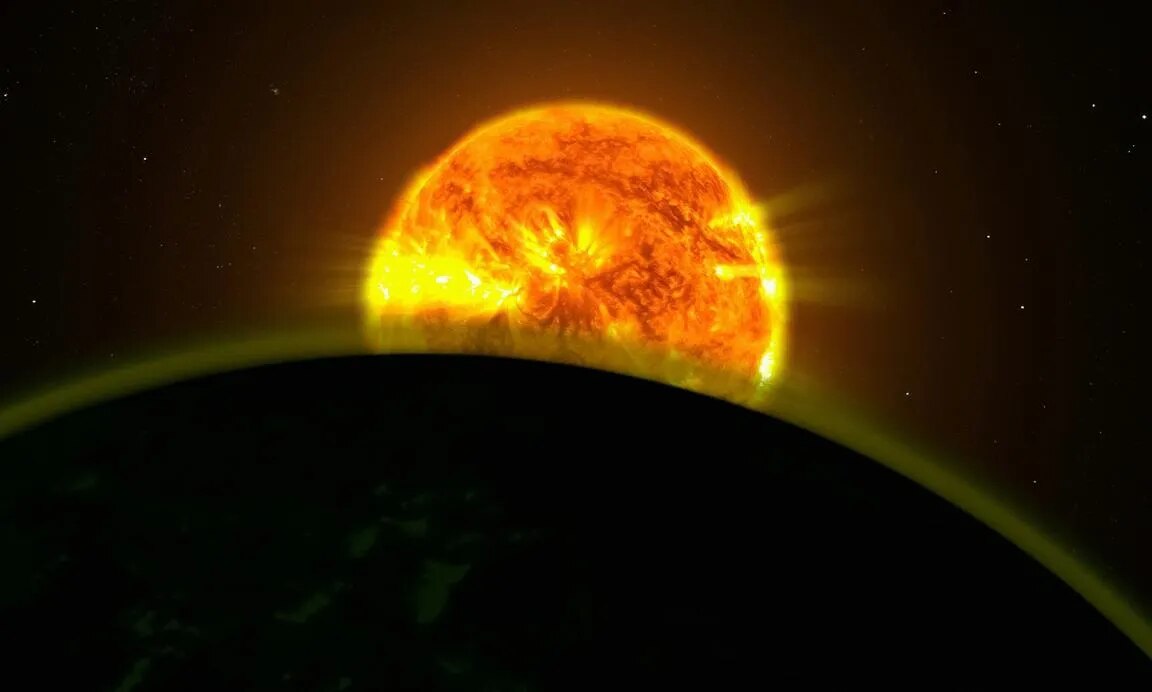
Far above Earth, a hidden storm perpetually swirls.
Charged particles spiral along magnetic field lines while electromagnetic waves ripple through the vastness of space. Energetic electrons accelerate, scatter, and occasionally dive into Earth’s atmosphere, disrupting satellites, communications, and navigation systems.
We call it space weather. But understanding it has never been simple.
Now, a new generation of open-source tools is beginning to change that, turning one of the most complex environments in physics into something scientists can explore, test, and even predict.
A problem hidden in equations
At the center of this transformation is a deceptively difficult challenge: modeling how waves and particles interact in space.
The research published in Earth and Space Science introduces a Python-based software package designed to calculate diffusion coefficients, a key ingredient in understanding how energetic particles evolve in near-Earth space.
These coefficients describe how particles scatter in both energy and direction as they resonate with electromagnetic waves. It is a process that determines whether particles remain trapped in Earth’s radiation belts or cascade into the atmosphere.
But calculating these interactions is notoriously complex.
It requires solving competing theoretical models, integrating across multiple dimensions, and handling subtle physical effects that can dramatically change outcomes. Historically, this complexity has made such calculations difficult, time-consuming, and inaccessible to many researchers.
The new software, known as PIRAN, changes that by packaging these calculations into an open, extensible Python framework, allowing scientists to compute both local and bounce-averaged diffusion using multiple established formalisms.
It is, in essence, a toolkit for exploring how space itself behaves under stress.
From code to community
What makes this development especially intriguing is not just the physics but the philosophy behind it.
PIRAN is open-source.
That means researchers anywhere can access, modify, and extend it. It includes documented modules, reproducible workflows, and built-in flexibility for testing different theoretical approaches.
This openness is becoming an increasingly defining feature of modern computational science.
This is echoed in parallel efforts, such as a newly announced Python-based space weather modeling tool from the University of Birmingham, designed to simplify the simulation of how electromagnetic waves influence high-energy particles in space.
That software emphasizes accessibility and collaboration, lowering the barrier to entry so more scientists can contribute to modeling efforts that were once the domain of specialized teams.
Together, these tools signal a shift: from isolated models to shared platforms, from closed systems to open ecosystems.
Where supercomputing comes in
But open-source alone is not enough.
The physics of space weather operates across enormous scales, from microscopic particle interactions to planetary magnetic fields. To simulate these systems accurately, researchers must run vast numbers of calculations, often exploring multiple scenarios and parameter spaces.
This is where supercomputing becomes essential.
High-performance computing systems allow scientists to:
- Run large ensembles of simulations.
- Compare competing theoretical models at scale.
- Resolve fine-grained particle dynamics over long timescales.
Even with efficient Python-based tools, the underlying calculations, especially diffusion modeling, can be computationally intensive. Scaling them up requires parallel processing, distributed systems, and optimized workflows.
In short, open-source software provides access.
Supercomputing provides the power.
A more curious kind of forecasting
What emerges from this convergence is a new kind of scientific process, one that feels less like prediction and more like exploration.
Instead of relying on a single model, researchers can now test multiple physical assumptions side by side. They can tweak parameters, swap theoretical frameworks, and observe how outcomes diverge.
Why do two models produce different diffusion rates?
What happens when wave properties shift slightly?
How sensitive are predictions to initial conditions?
These are not just technical questions. They are invitations to curiosity.
And increasingly, they are answered not in isolation, but through shared codebases running on powerful machines.
Toward a more resilient future
The stakes are not purely academic.
Space weather affects real-world systems, GPS navigation, satellite operations, aviation, and even power grids. Better models mean better forecasts. And better forecasts mean more resilient infrastructure.
Tools like PIRAN and the Birmingham modeling suite represent steps toward that goal, enabling scientists to move from reactive analysis to proactive understanding.
They also hint at something larger.
The quiet revolution in computational science
There is a quiet revolution underway in how science is done.
It is happening in GitHub repositories, in Python scripts, and in the vast architectures of supercomputers. It is driven not just by faster processors, but by a commitment to openness, collaboration, and curiosity.
In this new landscape:
- Code becomes a shared language.
- Models become living systems.
- And supercomputers become engines of collective discovery.
Space weather, once an opaque and unpredictable force, is gradually becoming something we can map, simulate, and understand.
Not perfectly. Not completely.
But enough to ask better questions.
And sometimes, that is where the real breakthroughs begin.