

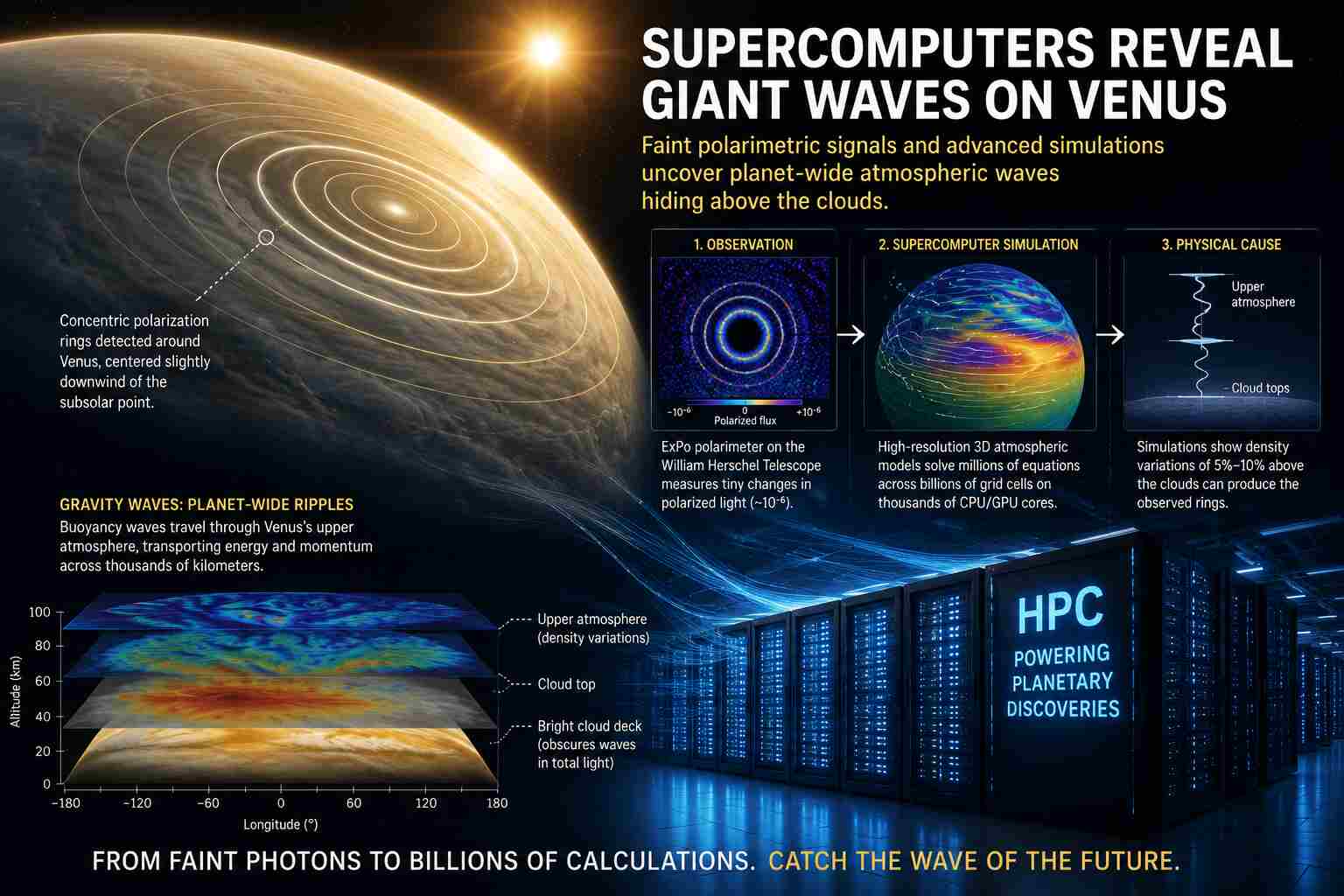
Planetary-scale simulations reveal giant atmospheric gravity waves on Earth’s sister planet, showcasing how high-performance computing is becoming one of the most powerful instruments in planetary science.
Every era of scientific discovery has arrived on a new wave. The Age of Sail carried explorers across unknown oceans. Radio waves connected continents. Gravitational waves opened an entirely new window into the universe.
Today, another wave is carrying science forward, one driven not by wind or water, but by billions of mathematical calculations flowing through the world’s most powerful supercomputers.
Researchers have uncovered compelling new evidence of enormous atmospheric gravity waves rippling through Venus’ dense atmosphere, revealing previously hidden processes that transport energy across an entire planet. While the observations came from spacecraft and telescopes, the discovery itself belongs equally to computational science. Without sophisticated numerical modeling and high-performance computing, these planetary-scale waves would have remained little more than intriguing patterns hidden within complex datasets.
For the supercomputing industry, the study offers a powerful reminder that today’s fastest machines are no longer simply processing data; they are becoming scientific instruments capable of reconstructing worlds that humans cannot directly observe.
Beyond observation: Reconstructing an alien atmosphere
Venus has often been described as Earth’s twin. Similar in size and composition, it instead evolved into a world cloaked beneath a thick carbon dioxide atmosphere where surface temperatures exceed 460°C and atmospheric pressures are more than 90 times those found on Earth.
Understanding such an extreme environment presents a formidable scientific challenge.
The planet’s global cloud deck obscures direct observation of atmospheric dynamics below, forcing researchers to infer the underlying physics from subtle changes in cloud brightness, temperature, and wind patterns observed by orbiting spacecraft.
Those observations are only the beginning.
Transforming faint signatures into a physical understanding requires solving the coupled equations governing atmospheric motion nonlinear systems that describe fluid dynamics, thermodynamics, radiative transfer, turbulence, and planetary rotation across scales ranging from meters to thousands of kilometers.
These equations cannot be solved analytically.
They must be computed.
Riding the computational wave
The newly identified atmospheric gravity waves represent massive oscillations generated when buoyancy acts as a restoring force within Venus’ stratified atmosphere. Similar phenomena occur on Earth, where mountain ranges, thunderstorms, and jet streams produce atmospheric gravity waves that redistribute momentum and energy throughout the atmosphere.
On Venus, however, the phenomenon operates on an entirely different scale.
Researchers found evidence that giant wave structures propagate through the cloud layers, transporting energy vertically while influencing global circulation patterns that remain among planetary science’s greatest mysteries.
Understanding how these waves evolve requires numerical simulations that can reproduce Venus’ atmospheric physics over enormous spatial domains and extended timescales.
Every simulated timestep requires solving millions of coupled equations describing momentum, pressure, density, temperature, and energy transport.
As model resolution increases, computational requirements grow dramatically.
This is precisely where leadership-class supercomputers become indispensable.
Across thousands of processor cores, computational fluid dynamics solvers divide Venus into millions of discrete computational cells. Each processor calculates local atmospheric behavior while exchanging information with neighboring cells at every timestep, allowing researchers to reconstruct the evolution of a planetary atmosphere with extraordinary fidelity.
The physical waves propagating through Venus are mirrored by computational waves moving across high-speed interconnects inside modern supercomputers.
High-performance computing becomes a scientific instrument.
For decades, planetary exploration depended primarily upon larger telescopes and more capable spacecraft.
Today, a third instrument has joined that toolkit.
High-performance computing.
Modern planetary science increasingly relies on numerical models that integrate spacecraft observations with advanced simulation frameworks capable of recreating atmospheric behavior under conditions impossible to reproduce in terrestrial laboratories.
Rather than asking what spacecraft observed, scientists increasingly ask whether computational models can reproduce those observations from first principles.
If the simulations match reality, researchers gain confidence that they have identified the underlying physical mechanisms.
This represents a profound shift in scientific methodology.
Supercomputers are no longer supporting observations.
They are testing competing theories of planetary evolution.
The business use case for bigger simulations
For readers of Supercomputing News, the Venus study also highlights an important industry trend.
Demand for leadership-class computing is expanding well beyond traditional HPC disciplines such as weather forecasting, nuclear physics, and computational chemistry.
Planetary science has become a major consumer of advanced computational infrastructure.
Atmospheric circulation models require massively parallel algorithms.
Radiative transfer calculations demand extensive floating-point performance.
Data assimilation workflows increasingly incorporate artificial intelligence and machine learning to compare observational datasets with simulation outputs.
Future missions to Venus, Mars, Europa, Titan, and the icy moons of the outer Solar System will generate unprecedented volumes of scientific data.
Interpreting those observations will require computational ecosystems built upon GPU acceleration, high-bandwidth memory architectures, low-latency interconnects, scalable storage, and AI-assisted analysis.
In other words, every new planetary mission creates new demand for supercomputing.
Waves beyond Venus
The implications extend far beyond one planet.
The same numerical methods used to simulate Venusian gravity waves are increasingly applied to Earth’s atmosphere, exoplanet climate systems, gas giant circulation, stellar convection, and even plasma dynamics within fusion reactors.
Computational fluid dynamics has become one of the foundational technologies of twenty-first century science.
As exaFLOPS computing continues to mature, researchers will simulate planetary atmospheres at resolutions once considered impossible.
Artificial intelligence will identify emerging wave structures automatically.
Digital twins of entire planets may eventually operate continuously alongside spacecraft observations, providing real-time predictions of atmospheric behavior across the Solar System.
The next wave of planetary exploration will be driven as much by algorithms as rockets.
Catching the wave of the future
The discovery of giant atmospheric gravity waves on Venus is more than another planetary science headline.
It illustrates a broader transformation occurring across scientific computing.
Every year, supercomputers become faster.
But more importantly, they become more capable of answering questions once thought beyond humanity’s reach.
They allow researchers to reconstruct invisible atmospheric currents, simulate climates that evolved over billions of years, and explore environments no human will visit for generations.
The waves flowing through Venus’ atmosphere may have traveled unnoticed for millennia.
Today, thanks to high-performance computing, scientists can follow those waves back to the physical processes that created them.
For the supercomputing industry, that is the true story.
Every scientific breakthrough generates another wave of computational demand. Every new simulation pushes hardware, software, networking, storage, and algorithms to new limits. Every advancement in HPC expands the frontier of discovery.
As exascale systems, AI-enhanced modeling, and next-generation numerical methods reshape scientific research, one thing is becoming increasingly clear: the future of exploration will be written not only by spacecraft, but by supercomputers.
At Supercomputing News, that’s the wave we’re watching.
And we invite our readers to Catch the Wave of the Future.