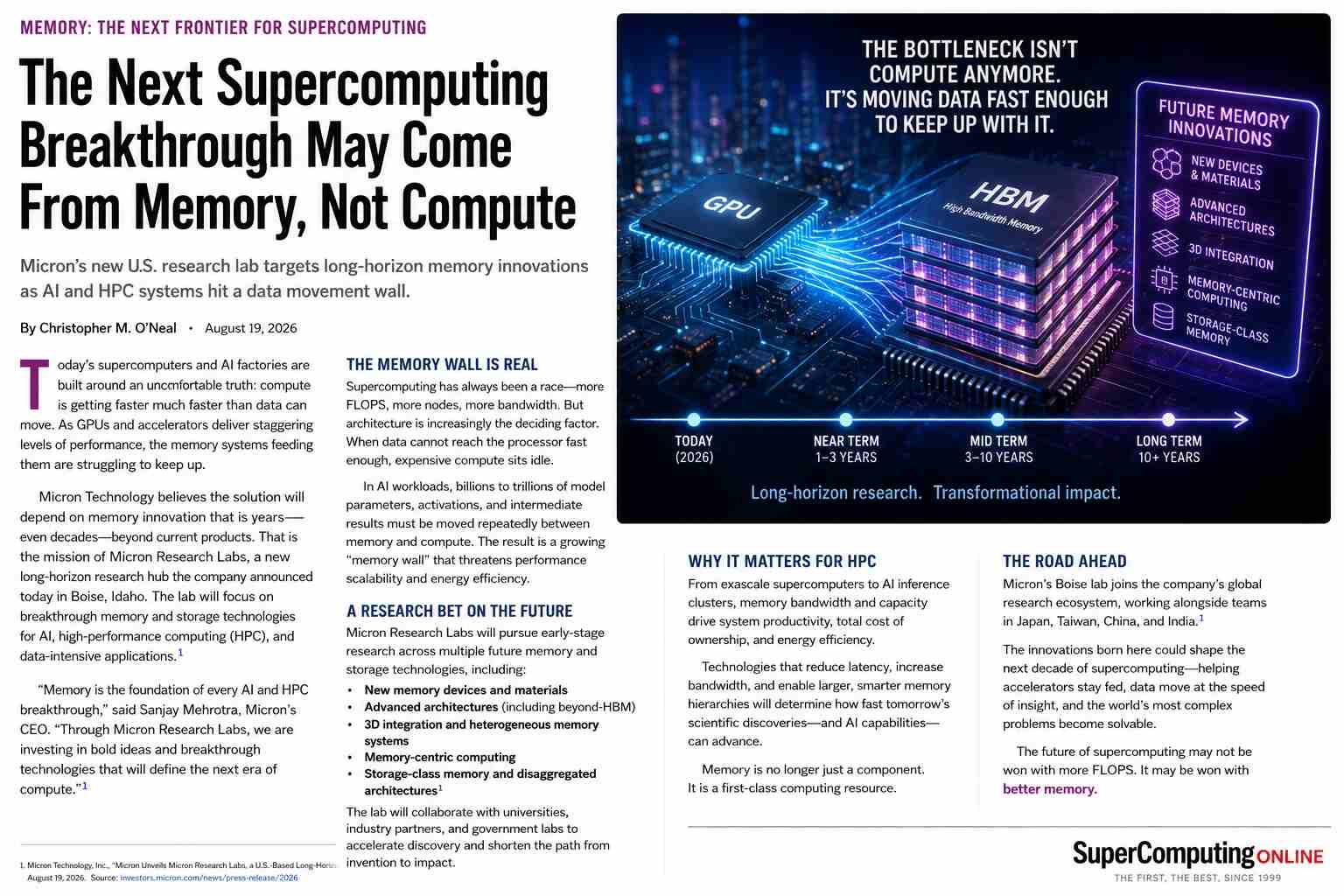
Micron's new U.S. research initiative highlights a fundamental shift in AI and HPC: as accelerators become extraordinarily powerful, the ability to move, store, and feed data efficiently is becoming just as important as raw compute.
The race to build faster supercomputers has traditionally been measured in familiar numbers: FLOPS, accelerator counts, memory capacity, interconnect bandwidth and power consumption.
But the next major performance breakthrough may come from somewhere less glamorous.
Memory.
As artificial intelligence and high-performance computing workloads become increasingly data-intensive, the limiting factor is no longer necessarily how many calculations a processor can perform. Increasingly, it is whether the system can deliver the right data to the processor quickly enough to keep those calculations running.
That makes Micron Technology's announcement of Micron Research Labs, a U.S.-based long-horizon innovation hub, particularly relevant to the future of supercomputing. The initiative is designed to pursue research beyond today's memory products, including new memory devices and materials, advanced architectures, three-dimensional integration, heterogeneous systems, memory-centric computing and storage-class memory.
For SuperComputing News, the important story isn't simply that Micron is opening another research operation.
The architecture of future supercomputers may increasingly be determined by what happens between the processor and the data.
The memory wall Is becoming a supercomputing problem
A modern accelerator can perform an extraordinary number of operations every second.
But computational throughput is useful only when the processor has data to work on.
This creates one of the fundamental challenges in computer architecture: the memory wall.
Processor performance has historically increased faster than memory latency. Meanwhile, AI workloads have introduced enormous quantities of parameters, activations, intermediate results and cached context that must constantly move through the system.
Micron itself now describes AI system performance as increasingly dependent on memory subsystem performance and capacity, elevating memory from a supporting component to a strategic element of the architecture.
That shift has profound implications for HPC.
A supercomputer can contain thousands of GPUs, but if those GPUs spend too much time waiting for data, theoretical compute performance becomes increasingly disconnected from delivered application performance.
The question changes from: How many FLOPS can we build?
to: How efficiently can we feed those FLOPS?
AI has made the problem much bigger
Artificial intelligence has accelerated the memory challenge.
Training increasingly large models requires enormous amounts of compute and data.
Inference introduces a different problem: models must respond continuously to users and applications, often while maintaining increasingly large contexts.
Agentic AI pushes the requirements further by maintaining state and performing multiple operations over extended periods.
Micron says that as AI workloads evolve from training toward large-scale inference and agentic systems, memory capacity and bandwidth are becoming increasingly important.
That matters to supercomputing because many of the same architectural pressures are appearing in scientific AI.
A climate model enhanced by machine learning.
A molecular simulation coupled with an AI surrogate.
A scientific foundation model analyzing astronomical observations.
A digital twin running continuously against real-time sensor data.
All of these workloads depend on moving enormous amounts of information efficiently.
From FLOPS to data movement
The conventional supercomputing race has often centered on floating-point performance.
But real applications rarely achieve theoretical peak performance.
Memory bandwidth, latency, cache behavior, interconnect performance, synchronization, and data locality can determine how much of the processor's theoretical capability actually reaches the scientific application.
This makes memory hierarchy increasingly important.
At one level are registers and caches.
Then comes high-bandwidth memory.
Then system DRAM.
Then increasingly sophisticated storage and data-management layers.
The challenge is to place the right data at the right level at the right time.
That sounds straightforward.
At exascale, it isn't.
HBM is only the beginning
High-bandwidth memory, or HBM, has become a critical technology for AI accelerators because it places large amounts of extremely high-bandwidth memory close to the processor.
Micron's current AI portfolio includes HBM3E and HBM4, alongside DRAM, LPDDR, GDDR and high-performance SSD technologies.
The company's current HBM4 technology is positioned for next-generation AI data centers, with Micron citing up to 2.8 TB/s of bandwidth per stack.
But the bigger question is what comes after today's HBM architectures.
That is where long-horizon research becomes important.
Micron Research Labs is intended to investigate technologies beyond current generations, including new materials and devices, advanced architectures, and three-dimensional integration.
Why 3D memory matters
The physical distance between compute and memory matters.
The farther data must travel, the greater the latency and energy cost.
Three-dimensional integration offers one potential answer by allowing memory and compute technologies to be stacked or integrated more tightly.
Instead of treating the processor and memory as physically separate components communicating across a board, future architectures can increasingly bring them together.
For HPC, that could mean:
- higher effective bandwidth;
- lower data-movement latency;
- improved energy efficiency;
- greater memory density; and
- potentially new ways of distributing computation.
The important point is that future performance may come not just from making transistors faster, but from shortening the distance between computation and information.
Memory-centric computing changes the architecture
Micron's research agenda explicitly includes memory-centric computing.
That phrase deserves attention.
Traditional computer architecture is fundamentally compute-centric.
Data is moved to the processor.
The processor performs an operation.
The result is moved somewhere else.
But moving data can consume substantial energy and bandwidth.
Memory-centric approaches explore architectures in which computation occurs closer to where the data resides, reducing unnecessary movement.
For data-intensive scientific workloads, this could be transformative.
Imagine a simulation processing enormous arrays of data.
Instead of repeatedly moving those arrays between memory and distant processing units, some operations could potentially occur closer to the memory itself.
The result could be less traffic, lower energy consumption and greater effective application performance.
Supercomputing has an energy problem, too
Performance isn't the only issue.
Data movement consumes energy.
As HPC systems scale, energy efficiency becomes increasingly important because operating a massive supercomputer is ultimately constrained by power, cooling and facility infrastructure.
That creates a three-way optimization problem: Compute performance + memory performance + energy efficiency.
A processor that delivers twice the theoretical performance isn't necessarily twice as useful if feeding it requires disproportionately more energy.
Memory technologies therefore have the potential to improve computing efficiency without simply increasing the number of processors.
That could be especially important for future exascale and post-exascale systems.
Storage is moving closer to the compute conversation
The memory hierarchy also extends beyond DRAM and HBM.
Modern AI systems increasingly depend on fast storage for data ingestion, checkpointing, model loading and inference.
Micron's AI portfolio includes high-performance data-center NVMe SSDs designed for these workloads.
That matters because the distinction between "memory" and "storage" is increasingly becoming an architectural question rather than a simple hardware category.
Large AI models may not fit entirely into the fastest memory.
Scientific datasets can be vastly larger than system memory.
Checkpointing enormous simulations can create substantial I/O loads.
Future systems therefore need intelligent movement of information across the entire hierarchy.
The HPC memory hierarchy of the future
The supercomputer of the future may look less like a collection of CPUs and GPUs connected to memory and more like an integrated data-processing fabric.
At the accelerator:
HBM → extremely high bandwidth
At the node:
DRAM → larger working capacity
Across the system:
network fabric → distributed memory and communication
Below the compute layer:
NVMe and emerging storage → massive datasets and persistent state
And surrounding all of it:
software → deciding where data should live and when it should move.
That final element is critical.
Hardware alone cannot solve the memory problem.
Compilers, runtimes, operating systems and application frameworks will have to understand increasingly complex memory hierarchies.
Micron itself identifies software-driven optimization as an important part of the future memory and storage landscape.
Research today for systems that may not exist yet
This is where Micron's long-horizon strategy becomes particularly interesting.
The company says the new research organization will focus on technologies that could take years or even decades to reach commercial impact.
That is exactly the kind of research needed for next-generation supercomputing.
Today's systems were shaped by research decisions made years ago.
The architecture of tomorrow's exascale and post-exascale machines is being influenced by research happening now.
Materials scientists, device engineers, computer architects and software researchers are therefore working on problems whose eventual importance may not be obvious from today's products.
The memory system inside a future supercomputer may depend on ideas that are still laboratory experiments today.
The supercomputer is becoming a system of systems
There is a broader lesson here for the HPC community.
The processor can no longer be viewed in isolation.
Neither can memory.
Neither can networking.
Neither can storage.
The performance of a scientific application emerges from the interaction among all of them.
That is why the industry's attention is shifting toward system-level optimization.
Micron has described this explicitly, arguing that AI requires memory and compute to be designed together rather than treated as independent technologies.
That principle applies equally to HPC.
A different definition of supercomputing performance
Suppose two systems have identical GPUs.
One has significantly better memory bandwidth and data locality.
The other has more powerful theoretical compute but spends more time waiting for data.
Which is the faster supercomputer?
For a real scientific application, the answer may be the first.
This is why benchmarks based solely on peak FLOPS can tell only part of the story.
Researchers increasingly care about time to solution, energy to solution and cost to solution.
Memory performance directly affects all three.
A better memory architecture can therefore make a system effectively more powerful without increasing its nominal compute capability.
Micron's Research bet fits a larger industry shift
Micron is not alone in recognizing the importance of memory.
The broader semiconductor industry is moving toward increasingly heterogeneous architectures in which CPUs, GPUs, specialized accelerators, HBM, networking and storage are engineered together.
Micron's recent work with AI infrastructure partners reflects the same trend. In June, the company announced a strategic agreement with Anthropic spanning memory and storage architecture design, supply and AI infrastructure.
And Micron's current research agenda includes not only memory devices but architectures capable of supporting future AI and data-intensive computing.
The direction is unmistakable.
Memory is becoming an architectural differentiator.
The next supercomputing race may be about moving less data
There is an intriguing possibility emerging from all of this.
The next generation of supercomputers may not win primarily by moving data faster.
They may win by moving less data in the first place.
That could mean:
- computation closer to memory;
- larger local memory pools;
- smarter caching;
- 3D integration;
- compressed representations;
- intelligent data placement;
- memory-aware algorithms;
- processing-in-memory techniques; and
- tighter integration between compute, memory and storage.
The objective is simple:
Keep the computation close to the information it needs.
That could become one of the defining principles of post-exascale computing.
From more FLOPS to more useful FLOPS
The history of supercomputing is filled with breathtaking increases in theoretical performance.
But the ultimate goal has never been FLOPS for their own sake.
It is solving scientific problems faster.
If better memory architecture allows a climate simulation, molecular model or AI workload to complete in half the time while consuming less energy, that may be more valuable than simply adding another layer of compute.
This is why Micron's research initiative deserves attention from the HPC community.
It points toward a future in which memory is treated as part of the computing engine itself.
The road ahead
Micron's new research initiative is ultimately a bet on technologies that may define computing long after today's GPUs and accelerators have been replaced.
The company is investing in research spanning new materials and devices, advanced architectures, 3D integration, heterogeneous systems, memory-centric computing and storage-class memory.
Not all of those technologies will necessarily become mainstream.
Some will fail.
Some will evolve into entirely different technologies.
But that is what long-horizon research is supposed to do: explore possibilities before the market knows which ones it will need.
And the need is becoming increasingly clear.
AI and HPC systems are producing extraordinary amounts of computation.
The next challenge is getting information to that computation efficiently enough to matter.
The future of supercomputing may depend on what happens between the FLOPS
The race for supercomputing supremacy has entered a transformative new phase. For years, the industry’s primary metric was raw computational capacity, how many operations a system could perform per second. Today, however, the focus has shifted toward efficiency: how much useful work can be accomplished per byte moved, per watt consumed, and per dollar invested. This transition places memory directly at the heart of the architectural conversation.
Micron’s investment in long-horizon memory research is more than just a semiconductor story; it is a fundamental bet on the future of computing architecture. While next-generation supercomputers will undoubtedly feature an unprecedented number of accelerators, those processors will only achieve their true potential if the underlying architecture can reliably supply them with data. In the emerging era of AI and post-exaFLOPS computing, the next major performance breakthrough may not come from building a faster engine, but from building a better, more efficient road to deliver data to that engine. Ultimately, memory is that road.