

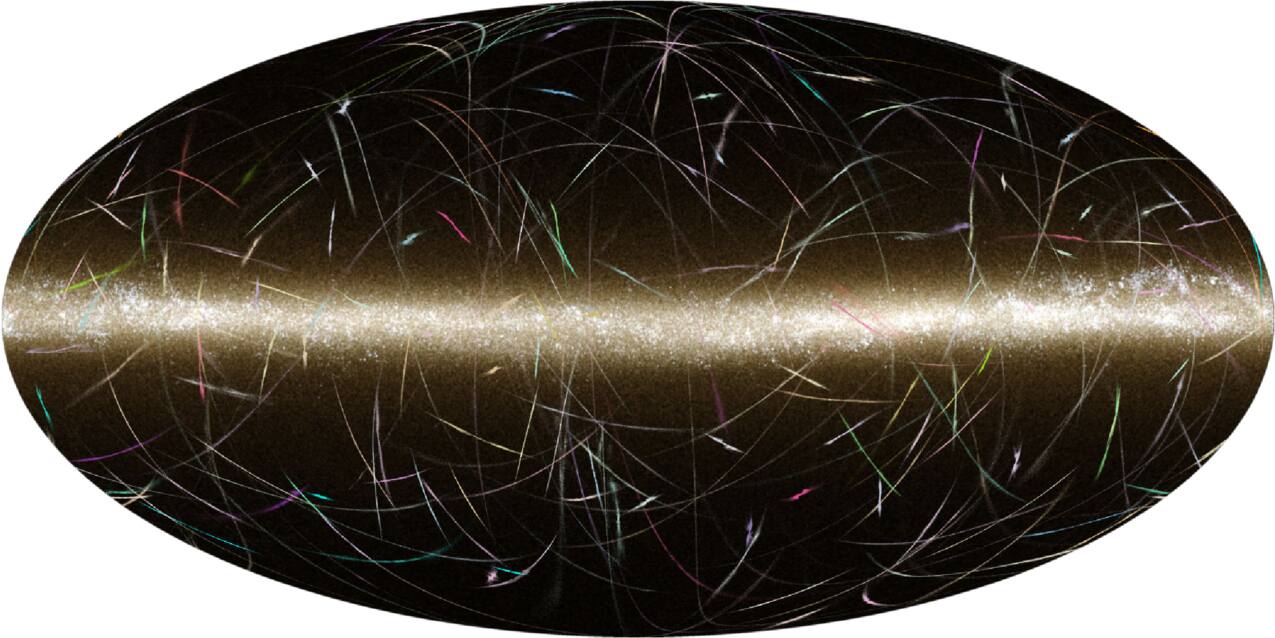
A massive computational experiment involving nearly 15,000 simulated stellar streams finds that the Milky Way’s evolving disk, halo, mergers and gravitational structure can generate spurs, kinks, gaps and other features often treated as evidence for invisible dark-matter subhalos.
For years, astronomers have identified the thin stellar streams surrounding the Milky Way as some of the most promising detectors for dark matter. The logic is compelling: as the Milky Way’s gravitational influence gradually disrupts a globular cluster, its stars form a long, coherent, and dynamically cold structure. Consequently, even minor gravitational disturbances, such as a passing dark-matter subhalo, can leave distinct signatures, including gaps, spurs, or positional displacements.
However, a recent computational study challenges the assumption that dark matter is the sole cause of these disruptions, suggesting that the Milky Way itself produces far more substructure than previously recognized. In a sophisticated numerical experiment, researchers simulated approximately 15,000 stellar streams across four galaxies modeled after the Milky Way, utilizing evolving gravitational potentials derived from FIRE-2 cosmological simulations. Notably, these simulations excluded small-scale perturbers, such as dark-matter subhalos and giant molecular clouds.
Despite these exclusions, approximately 75% of the streams exhibited complex morphological features, including kinks, spurs, and cocoon-like envelopes. Furthermore, streams classified as relatively smooth showed significant variations in width, with gaps and overdensities appearing at the same two-degree angular scale typically associated with dark-matter subhalo encounters. These findings do not invalidate dark matter as a phenomenon, but they do impose a rigorous requirement for future research: astronomers must now demonstrate that observed stream irregularities cannot be attributed to the Milky Way’s intrinsic gravitational dynamics before concluding that they provide evidence of invisible objects. This underscores the essential role of advanced supercomputing in disentangling these complex galactic influences.
The Dark-Matter Detector With a Built-In Confounder
Stellar streams have become increasingly important in the search for low-mass dark-matter structures.
A cold stream is essentially a gravitational test particle stretched across thousands of light-years. If a dark-matter subhalo passes nearby, its gravity can disturb the stream, potentially producing gaps, density fluctuations, and off-track features.
That makes streams attractive because dark-matter subhalos are expected to exist at masses too small to contain stars.
But the traditional picture contains an assumption:
the undisturbed stream should be relatively smooth.
The new study challenges that assumption.
The Milky Way is not a static, spherical gravitational potential.
It has a massive rotating disk, spiral structure, a central bar, an asymmetric dark-matter halo, and satellite galaxies. The Large Magellanic Cloud is currently interacting with the Milky Way, while previous mergers and accretion events have left the galaxy dynamically disturbed.
The paper emphasizes that the Milky Way is a dynamically evolving system, with its disk, halo, and satellite interactions changing the gravitational environment on timescales comparable to stellar-stream orbital periods.
That creates a fundamental problem for dark-matter inference.
If the background gravitational field itself produces gaps and kinks, then a stream feature isn’t automatically a dark-matter detection.
The Computational Experiment: Remove the Dark Matter Subhalos
The researchers approached the problem in an unusually useful way.
Instead of asking:
“What does a dark-matter subhalo do to a stream?”
they first asked:
“What does the Milky Way do to a stream when we deliberately remove the small-scale perturbers?”
That creates a computational control experiment.
The researchers selected four Milky Way-mass galaxies, designated m12i, m12f, m12m and m12b, from the LATTE suite of zoomed-in cosmological baryonic simulations within the FIRE-2 project.
These galaxies span different assembly histories and structural properties.
Their total masses range from approximately 1.1 to 1.5 trillion solar masses. The simulations resolve dark matter with initial particle masses of approximately 35,000 solar masses and baryonic matter with approximately 7,100-solar-mass particles.
The four galaxies were deliberately chosen because they were not identical.
One is relatively isolated.
Another has a massive disk.
Two experienced significant mergers.
The researchers could therefore investigate whether stellar-stream morphology depends on the particular history of the host galaxy.
It does.
15,000 Streams Instead of One
This is where the computational scale becomes particularly important.
Rather than simulate one or two representative streams, the team generated a statistical population of globular-cluster streams.
Each stream was represented by 10,000 test particles, evolved for 5 billion years in a time-dependent gravitational potential.
The final catalog contained 14,787 streams:
- 3,909 in m12i;
- 4,093 in m12m;
- 3,493 in m12b; and
- 3,292 in m12f.
The merger hosts retain fewer streams because their stronger tidal environments produce greater disruption and shorter-lived coherent debris.
That scale changes the scientific question.
The researchers are no longer asking whether one carefully selected simulation can reproduce an observed feature.
They are asking:
How common are these structures in a realistic population of galaxies and stellar streams?
Turning Cosmological Simulations Into a Stellar-Stream Laboratory
There is a computational trick behind the experiment.
The underlying FIRE-2 cosmological simulations contain enormous numbers of particles representing the evolving galaxy.
But directly calculating gravitational forces from every particle for every stream particle throughout thousands of simulated systems would be extraordinarily expensive.
The researchers therefore construct basis-function expansion (BFE) representations of the evolving gravitational potential.
The method decomposes the gravitational field into mathematical basis functions capable of representing the dominant structures of the galaxy.
The spherical components capture the large-scale halo, while Fourier-harmonic components represent structures such as the disk, spiral arms, and other non-axisymmetric features.
The resulting coefficients are interpolated in time to produce a continuously evolving gravitational potential for orbit integration.
This is an important HPC lesson.
The computational challenge is not merely generating a galaxy.
It is compressing a complicated gravitational field into a representation that can be repeatedly interrogated by thousands of synthetic stellar systems without throwing away the physics that matters.
The Galaxy Becomes a Time-Dependent Computational Object
Many simplified galaxy models assume that the gravitational potential is static.
That is computationally convenient.
It is also potentially misleading.
The FIRE-2-based models used in this work evolve with time.
Snapshots are separated by approximately 25 million years, and the researchers focus on the final five billion years when integrating their stream populations.
The gravitational potential therefore changes as the galaxy evolves.
Satellite galaxies interact with it.
The disk changes.
The halo responds.
Large-scale structures generate non-axisymmetric gravitational forces.
A stellar stream moving through this environment does not experience the same gravitational field at every point in its orbit, or necessarily on every orbital passage.
That history accumulates.
The Simulation Does Not Need a Dark-Matter Subhalo to Make a Mess
The headline result is difficult to ignore.
Approximately three-quarters of the simulated streams developed complex features generated by the host potential alone.
Those features include:
- spurs;
- kinks;
- off-track extensions;
- broad envelopes;
- density variations;
- gaps; and
- width fluctuations.
No small dark-matter subhalos were required.
That does not eliminate dark matter.
It establishes a complexity floor, the amount of structure the host galaxy can generate before adding the specific small-scale perturbers researchers want to detect.
That baseline could become critically important for future dark-matter studies.
Only 26% Were Completely Smooth
The distribution is even more striking when the streams are classified quantitatively.
The researchers define several morphological categories.
A stream is considered smooth when its global disturbance metric is at or below one.
A stream with an isolated strong feature can be classified as smooth + feature.
More strongly disturbed systems enter intermediate or messy categories.
Across the complete simulated population:
- 26% were classified as smooth;
- 13% were smooth but contained a significant localized feature;
- 27% were intermediate; and
- 34% were messy.
In other words, only about one-quarter of the simulated streams were truly free of detectable off-track structure under the study’s criteria.
That is a surprisingly high background level.
And remember:
These simulations intentionally excluded dark-matter subhalos and giant molecular clouds.
The Inner Milky Way Is Particularly Hostile
The simulations reveal a strong relationship between stream morphology and pericentric distance, the closest approach of the stream’s progenitor to the galactic center.
Streams that plunge deeper into the Milky Way encounter a much more complicated gravitational environment.
The disk contributes.
The bar contributes.
Spiral structure contributes.
The stream also experiences more frequent orbital passages through the inner galaxy during the five-billion-year integration.
The simulations show a clear trend: smaller pericenters correspond to systematically greater morphological disturbance.
A rough transition occurs around 15 kiloparsecs.
Streams with larger pericenters tend to be cleaner.
Those venturing deeper into the galaxy are more likely to become morphologically complicated.
The Galaxy’s History Is Written Into Its Streams
The four simulated galaxies do not produce identical results.
That is precisely what the researchers wanted to see.
The relatively isolated m12i galaxy reaches the smooth regime at around 15 kpc and has approximately 80% smooth streams beyond 20 kpc.
The massive-disk m12m galaxy reaches the comparable threshold closer to 20 kpc.
The merger hosts M12B and M12F remain more disturbed at intermediate distances and show greater scatter.
The implication is important.
Two streams with apparently similar orbital parameters might not have equivalent backgrounds if their host galaxies have different assembly histories.
The gravitational environment is not merely a function of where the stream is now.
It also reflects how the galaxy got there.
A Dark-Matter-Like Gap Without Dark Matter
Perhaps the most uncomfortable result concerns angular scale.
Dark-matter subhalo searches often focus on stream gaps and density variations because a passing subhalo can create characteristic disturbances.
But the simulations produce host-generated density structures at approximately two-degree scales.
Those scales fall directly inside the 1°–5° range expected for some subhalo-induced gaps.
That creates a serious degeneracy.
If an astronomer observes a two-degree-scale gap, the feature’s size alone may not identify its origin.
It could be caused by an invisible subhalo.
Or it could be the accumulated result of the visible and large-scale gravitational structure of the Milky Way.
Or both.
The GD-1 Problem Gets More Interesting
The famous GD-1 stellar stream has often been described as a particularly promising target for dark-matter substructure searches.
Its morphology includes a prominent spur and a gap.
Those features have been interpreted in previous work as possible evidence for an encounter with a dark-matter subhalo in the approximate mass range of (10^6)–(10^8) solar masses.
The new simulations complicate that interpretation.
The researchers find a simulated stream whose morphology is qualitatively similar to the observed GD-1 spur, even though the simulation contains no small-scale dark-matter subhalo encounter.
The simulated stream has a pericenter of approximately 10 kpc and apocenter near 24 kpc, compared with GD-1’s observed values of approximately 14 kpc and 22 kpc.
That does not prove that GD-1’s spur was produced by the Milky Way.
It demonstrates something more cautious:
A GD-1-like spur is not, by itself, proof of a dark-matter subhalo.
ATLAS–Aliqa Uma Offers Another Warning
The same computational experiment produced a stream with a kink qualitatively resembling the feature observed in the ATLAS–Aliqa Uma stream.
The observed stream contains a prominent kink and larger-scale asymmetries that have previously been connected to the Large Magellanic Cloud.
Again, the simulation can produce a similar morphological feature without invoking a small dark-matter subhalo.
The point is not that every observed feature has now been explained.
It is that morphological similarity is not equivalent to causal identification.
The Supercomputing Challenge: Numerical Artifacts Can Look Like Physics
This is where the study becomes particularly valuable for computational scientists.
If the entire conclusion rests on simulated gravitational structure, the researchers must demonstrate that the structures aren’t numerical artifacts.
They therefore subjected the computational framework to extensive validation.
The BFE gravitational representation was compared with direct gravitational-force calculations from the FIRE-2 particle distribution.
Using a GPU-based Barnes–Hut tree algorithm, the researchers evaluated accelerations at 12 fixed locations spanning approximately 5–35 kpc from the galactic center.
The BFE representation reproduced the tree-based acceleration to better than approximately 2% outside 7 kpc, with the largest discrepancies confined to the innermost region.
That is significant.
The researchers weren’t simply trusting their compressed gravitational representation.
They checked it against a more direct calculation.
Even the Force-Field Noise Was Tested
The finite number of particles in the underlying cosmological simulations introduces statistical noise.
If that noise were strong enough, it could potentially create artificial stream structure.
The team tested this too.
They generated 50 bootstrap realizations of the BFE coefficients and evaluated the resulting force fields over a spatial grid containing 50,000 directions across 15 logarithmically spaced radial shells between 10 and 30 kpc.
The measured fractional force noise was only around (10^{-3}) at full decorrelation, approximately three orders of magnitude below the mean force.
The authors conclude that this shot noise contributes negligibly to the stream morphology.
In other words, the complexity is not simply the computer making things noisy.
The gravitational environment itself is doing the work.
Five Billion Years Requires Numerical Discipline
Orbit integration over billions of years is another potential source of trouble.
Small numerical errors can accumulate.
The researchers therefore compared several integration schemes, including adaptive eighth-order Runge–Kutta methods and a fixed-step leapfrog integrator.
Across 16 test orbits integrated backward for five billion years, the maximum position residual had a median of approximately 0.002 kpc, with a worst case of 0.03 kpc, well below the typical stream width of roughly 0.1 kpc.
The median maximum velocity residual was approximately 0.014 km/s, with a worst case of 0.23 km/s.
The tests found no evidence that the time-interpolation boundaries were generating artificial kinks in the trajectories.
That matters enormously when the scientific conclusion itself concerns tiny kinks.
The 10,000-Particle Stream Shortcut
There is another computational compromise worth understanding.
The cosmological simulations do not directly resolve individual globular-cluster streams at the required resolution.
The FIRE-2 baryonic particle mass is approximately 7,000 solar masses, far too coarse to directly represent the stellar populations of individual globular clusters.
The researchers therefore inject the streams as test-particle populations into the simulated gravitational potential.
Their stream formation model uses a particle-spray approach.
Each synthetic stream can then be evolved efficiently without performing a full self-gravitating N-body calculation for every globular cluster.
This is a classic computational-science tradeoff: sacrifice some microscopic detail to make a massive statistical experiment possible.
But They Checked the Shortcut
The team did not simply assume that the particle-spray model was adequate.
They compared it against direct collisionless N-body simulations.
For a test progenitor with a mass of (2.7\times10^4) solar masses and scale radius of 4 pc, the direct calculation used 25,000 particles, a GPU-based collisionless N-body code, a 0.3-pc gravitational softening and a (10^{-5})-Gyr timestep.
The resulting N-body stream was compared with the particle-spray representation in the same evolving potential.
The large-scale phase-space structures agreed within the statistical uncertainty of a single realization across the tested progenitor configurations.
Again, the objective is not to eliminate approximation.
It is to quantify whether the approximation matters for the question being asked.
A Better Definition of “Dark-Matter Signal”
The implications for dark-matter searches are potentially significant.
The study argues that researchers need a baseline describing what a stream looks like before small-scale dark-matter encounters are added.
That baseline can then become part of the inference process.
Instead of:
Observed feature = dark-matter subhalo
the calculation becomes something more like:
Observed feature = host potential + known perturbers + uncertain background + possible subhalo contribution.
That is much harder.
It is also much more scientifically defensible.
The Milky Way May Be the Confounding Experiment
The ironic part is that astronomers chose stellar streams because the Milky Way provides a gravitational laboratory.
Now the laboratory itself is proving difficult to calibrate.
The disk isn’t perfectly symmetric.
The halo isn’t spherical.
The Large Magellanic Cloud is disturbing the system.
Past mergers have altered the gravitational field.
The bar and spiral structure influence stellar orbits.
And every one of those effects can leave signatures in stellar streams.
The paper notes that an ordinary Milky Way-like bar could actually make the inner-halo complexity floor even higher than measured in these simulations because the four FIRE-2 hosts lack a strong, long-lived bar.
That is a sobering caveat.
The simulations may actually be conservative.
This Does Not Make Dark Matter Go Away
It is important not to overinterpret the result.
The study does not demonstrate that observed stream gaps are caused by ordinary Milky Way gravity instead of dark matter.
It does not disprove dark matter.
It does not show that dark-matter subhalos do not exist.
And it does not establish the origin of every observed stream feature.
Instead, it demonstrates that host-galaxy dynamics create a substantial false-positive background for a particular class of dark-matter searches.
That distinction is critical.
The authors themselves describe the goal as establishing a baseline against which subhalo-induced perturbations can be measured.
The dark-matter search therefore becomes harder, but potentially more rigorous.
The Computational Work Is Far From Finished
The researchers identify several important limitations.
Their four simulated galaxies do not encompass every possible Milky Way assembly history.
None contains a strong, long-lived bar.
The particle-spray stream model is efficient but does not replace a full statistical N-body calculation.
And the analysis intentionally removes small-scale perturbers in order to isolate the host-driven component.
The authors point out that a full decomposition of the individual contributions from disk structure, halo evolution, bars, satellite interactions, and other components remains a subject for future work.
That next step could become computationally formidable.
The Next Generation of Surveys Will Make the Problem Bigger
Ironically, better telescopes could make this computational problem more urgent.
The Vera C. Rubin Observatory’s Legacy Survey of Space and Time, ESA’s Euclid mission and NASA’s Nancy Grace Roman Space Telescope are expected to dramatically expand the number of known stellar streams and improve the resolution of their structure.
The study notes that these surveys should make it possible to examine density fluctuations, width variations, and off-track features on subdegree scales across dozens or even hundreds of streams.
That will produce an enormous amount of observational data.
But better observations don’t automatically produce better dark-matter constraints.
They produce better constraints if the models are good enough to interpret them.
Otherwise, astronomers may simply become better at detecting features whose origins they cannot confidently identify.
Supercomputers Become the Necessary Skeptic
This is perhaps the most important lesson from the work.
The supercomputer isn’t being used to confirm an exciting hypothesis.
It is being used to challenge one.
That is a powerful role for computational science.
The researchers deliberately remove the phenomenon they want to detect, small-scale dark-matter perturbers, and ask whether the remaining physics can reproduce similar observational signatures.
And it can.
That is precisely the kind of computational experiment that can prevent scientists from mistaking correlation for causation.
The Stream as a Gravitational Recorder
A stellar stream records the gravitational environment through which it travels.
But the recording is not simple.
A kink may represent a satellite encounter.
A spur may indicate a subhalo.
A density variation may be caused by a perturbation.
Or the feature may have been generated by the disk.
Or the halo.
Or a merger.
Or the combined effect of several structures acting over billions of years.
The simulation suggests that these possibilities cannot always be separated simply by looking at the final shape of the stream.
The history matters.
From One Simulation to a Statistical Universe
This is where the study’s scale provides its greatest advantage.
A single simulation can demonstrate possibility.
Nearly 15,000 simulated streams can begin to quantify probability.
The researchers can ask:
How often does a spur appear?
At what pericenter?
At what angular scale?
How does eccentricity matter?
How does the host’s merger history change the result?
How frequently do apparently smooth streams contain smaller-scale structure?
And, crucially:
How unusual does a feature need to be before it becomes genuinely interesting as a dark-matter candidate?
Those are statistical questions.
They require statistical computation.
A New Standard for Dark-Matter Forensics
The study ultimately argues for a more demanding standard.
Before treating a stream feature as evidence for an invisible subhalo, researchers should first understand the distribution of structures generated naturally by a realistic, evolving host galaxy.
That means moving beyond idealized static potentials.
It means incorporating galaxy evolution.
It means modeling disk structure.
It means including satellite interactions.
It means testing numerical errors.
And it means running enough synthetic streams to understand the background population.
That is a supercomputing problem.
The Universe May Be Hiding Dark Matter Behind the Galaxy
The irony is almost perfect. Astronomers developed stellar streams as extraordinarily sensitive gravitational detectors. Now computational astrophysics is showing that the detector itself has a complicated gravitational environment. The Milky Way may be producing some of the very signatures researchers hoped would reveal dark matter. That doesn’t make the search pointless. It makes the search more interesting. Because the challenge is no longer simply to find a gap. It is to determine why the gap exists. And that requires a much more sophisticated computational model of the galaxy.
The Skeptical Bottom Line
The new simulations don’t tell us that dark matter is hiding in plain sight. They tell us something more useful: We may not yet understand how much structure a realistic Milky Way naturally creates in the first place.
Nearly 15,000 simulated streams evolved in four cosmological Milky Way analogs suggest that the host galaxy alone can generate a remarkable range of features normally considered interesting for dark-matter searches. Only about 26% of the simulated streams were completely smooth under the study’s criteria, while roughly three-quarters exhibited some off-track complexity.
Some host-generated structures even resemble features observed in famous streams such as GD-1 and ATLAS–Aliqa Uma. The skeptical interpretation is therefore straightforward: A strange stellar-stream feature is not yet a dark-matter discovery. It is a question. And increasingly, the only practical way to answer that question is computational.
The next generation of astronomical surveys will deliver hundreds of increasingly detailed stellar streams. The challenge will be to build equally sophisticated virtual galaxies against which those observations can be tested. That means more simulations, better gravitational models, more realistic galaxy evolution and vastly larger statistical samples. The supercomputer may ultimately determine whether a tiny gap in a ribbon of stars is the footprint of an invisible dark-matter subhalo, or simply another reminder that the Milky Way itself is far more gravitationally complicated than our simplified models have allowed. And perhaps that is the most encouraging result of all. The search for dark matter is not becoming easier. It is becoming more scientifically honest.