

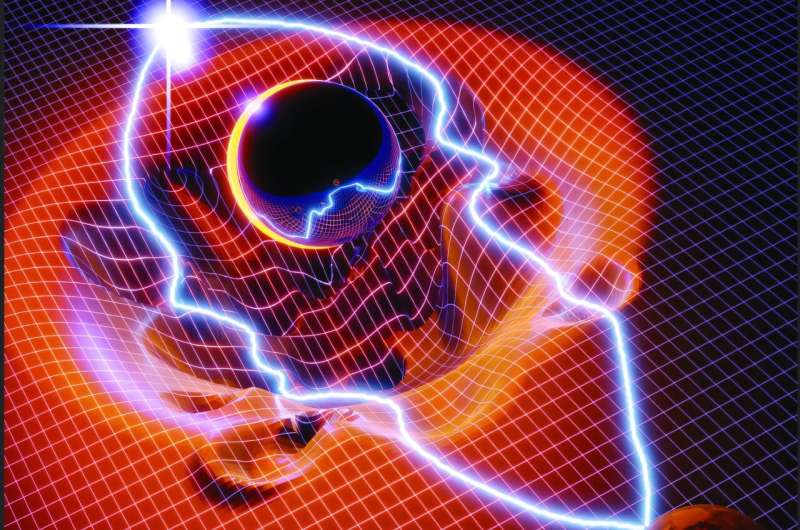
Direct Schrödinger–Poisson simulations generate 1,000 three-dimensional fuzzy-dark-matter halos and demonstrate how high-performance computing can turn an exotic particle hypothesis into an observational test
Determining the nature of dark matter, specifically whether it consists of conventional cold, massive particles or ultralight quantum waves, remains one of the most formidable and computationally intensive challenges in modern cosmology.
A recent study published in The Astrophysical Journal Letters (https://iopscience.iop.org/article/10.3847/2041-8213/ae9a9e) demonstrates how high-performance numerical simulations can transition this inquiry from theoretical speculation to an observationally testable framework. Jiajun Zhou and his collaborators conducted the first calculations of gravitationally lensed images derived directly from three-dimensional fuzzy-dark-matter (FDM) density fields, evolved via the Schrödinger–Poisson equations. By computationally evolving the dark-matter wave field rather than relying on statistical approximations, the researchers were able to predict how these quantum structures perturb the images of distant, gravitationally lensed quasars.
This work marks a significant computational milestone, as it effectively tests whether the intricate structures generated by quantum wave evolution persist through numerical processing to produce observable consequences that align with astronomical measurements. While these findings provide encouraging support for the fuzzy-dark-matter hypothesis, the authors emphasize that further research is essential to fully validate these results.
From particles to waves
Fuzzy dark matter, also called wave dark matter, proposes that dark matter is composed of extremely light particles whose quantum-mechanical de Broglie wavelengths can become comparable to astrophysical scales.
For a particle mass of 10⁻²² electronvolts, the characteristic de Broglie wavelength in the simulated galaxy-scale system is roughly 100 parsecs. That is an extraordinary scale for a quantum effect: roughly hundreds of light-years.
At these scales, the dark-matter halo cannot be treated simply as a collection of classical particles.
It must be treated as a coherent wave field.
That changes the computational problem fundamentally.
The researchers solve the coupled Schrödinger–Poisson equations, in which the complex wave function describes the FDM field while the gravitational potential is obtained from the density generated by that field.
The density is proportional to the squared magnitude of the wave function:
[
\rho = M|\psi|^2.
]
The gravitational field generated by that density then feeds back into the evolution of the wave itself.
This creates a nonlinear, self-gravitating wave problem.
It is precisely the kind of problem for which numerical resolution and algorithmic efficiency become inseparable from the scientific result.
A 512³ computational grid
The researchers employ a global Fourier pseudospectral method.
The choice is important from an HPC perspective.
Pseudospectral methods represent the field in Fourier space and can achieve high spectral accuracy for smooth wave fields while reducing numerical diffusion. The paper states that this approach is particularly suitable for the galaxy-scale lensing problem being investigated.
The production calculations use a 512³ grid, equivalent to more than 134 million spatial cells.
The simulation volume is a cube approximately 40 kiloparsecs on a side, and each realization is evolved for approximately 3.3 billion years of physical evolution time. The simulations use a total dark-matter mass of approximately 4 × 10¹¹ solar masses and investigate particle masses of 10⁻²² and 10⁻²³ eV.
The grid resolution is not arbitrary.
The researchers require the computational cell size to be smaller than the de Broglie wavelength, with several cells needed across the wavelength to resolve the interference pattern.
The grid must also resolve the physical scale corresponding to the observed tens-of-milliarcsecond positional anomalies in the gravitationally lensed system.
This is a classic HPC constraint: the physics dictates the resolution, and the resolution dictates the computational cost.
Reducing the cell size increases the number of grid points in three dimensions rapidly. A modest increase in linear resolution therefore produces a much larger increase in memory requirements and computational work.
1,000 universes inside the computer
Perhaps the most revealing computational figure in the study is not 512³.
It is 1,000.
The researchers generated 1,000 independent initial conditions, each constructed from five randomly distributed three-dimensional Gaussian wave packets.
Every realization was then evolved through the full Schrödinger–Poisson calculation to produce an independent three-dimensional fuzzy-dark-matter halo.
This transforms the project from a single numerical experiment into a statistical computational campaign.
The objective is not merely to produce one halo that happens to resemble the observations.
Instead, the researchers ask how often the structures naturally generated by the underlying equations produce lensing configurations compatible with the observed system.
That distinction is important.
A single simulation can demonstrate possibility.
A large ensemble begins to address probability.
The computer must preserve the wave physics
Numerical integration becomes particularly important because the researchers are not simply tracking the motion of individual particles.
They are evolving a wave field whose phase and interference structure matter.
The simulations therefore use a split-step pseudospectral method. During each time step, the kinetic and gravitational-potential operators are applied separately. The time step is constrained by the fastest phase oscillations associated with the kinetic and gravitational terms, with a safety factor imposed to avoid phase aliasing.
That is an HPC issue as much as a physics issue.
A simulation can run faster by taking larger time steps or using lower spatial resolution.
But if those shortcuts erase physically relevant wave structure, the resulting gravitational lensing prediction can become numerically precise but physically wrong.
The researchers instead make the numerical resolution part of the physical model.
From a three-dimensional supercomputer field to a two-dimensional sky
The computational workflow does not end when the dark-matter halo has been evolved.
The researchers then have to turn the three-dimensional simulation into an observable lens.
For each simulated halo, they determine its principal axis and rotate the three-dimensional density field through representative viewing directions.
The density is projected along the line of sight to generate a two-dimensional convergence map, after which the gravitational lens equation is solved to generate simulated image positions. The open-source lenstronomy package performs the lensing calculations.
This creates a computational pipeline that can be summarized as: wave equation → gravitational potential → three-dimensional density field → viewing geometry → projected mass → lens equation → multiple images → statistical comparison with observations.
The researchers sample 103 representative viewing directions and 10⁴ source positions during the forward-modeling process.
At this point, the project begins to resemble a modern scientific computing workflow more than a conventional analytic astronomy calculation.
The supercomputer is effectively generating synthetic observations from first-principles numerical evolution.
Matching the geometry without fitting away the physics
The study introduces another computationally interesting element.
The researchers compare the simulated and observed four-image configurations using pairwise-distance invariants and Procrustes alignment.
This allows translations, rotations, and reflections that do not represent physical differences to be removed from the comparison.
For four images, the six pairwise distances provide a complete set of geometric invariants for the relative configuration. The researchers use these distances to identify the source position that best reproduces the observed geometry and then apply Procrustes alignment to quantify the remaining image-position anomaly.
That is an important numerical safeguard.
Without it, the calculation could incorrectly interpret a simple coordinate-frame difference as evidence that the dark-matter model is wrong.
The computational machinery therefore has to be careful not only about solving the equations, but also about comparing the output with observational data in a statistically meaningful way.
The result: wave simulations reproduce the observed lens
The target is HS 0810+2554, a quadruply lensed quasar system containing two compact radio sources.
High-resolution radio observations have measured eight lensed radio images with sufficient astrometric precision to expose discrepancies between the observations and smooth conventional lens models.
For fuzzy dark matter with a particle mass of 10⁻²² eV, the wave-evolved halos produce median image-position anomalies of approximately 12 and 6 milliarcseconds for the two radio components.
Some realizations produce anomalies below approximately 3 milliarcseconds, within the roughly 3σ observational uncertainty level used in the analysis.
The comparison is particularly interesting because the simulations are not tuned to force the halos into the observed configuration.
The halos evolve from randomly generated initial conditions.
The researchers report that the wave simulations can reproduce the observed image positions to within approximately 3σ without fitting the internal state of the simulated halo to the observations.
By comparison, the Gaussian-random-field approximation generally produces larger positional fluctuations, while the best-fit smooth NFW model produces substantially larger discrepancies for most of the observed images.
Particle mass becomes a computationally observable quantity
One of the most important results is the sensitivity to the assumed particle mass.
When the researchers reduce the FDM particle mass from 10⁻²² to 10⁻²³ eV, the de Broglie wavelength increases and the resulting density fluctuations occur on larger physical scales.
The simulated lensing position anomaly rises to a median of approximately 50 milliarcseconds, roughly four times the value produced in the 10⁻²²-eV case.
This is precisely where HPC becomes scientifically powerful.
The computer is not merely illustrating a theory.
It is establishing a mapping: particle mass → wave scale → density structure → gravitational potential → image displacement.
That mapping gives astronomers a route toward constraining the mass of a hypothetical dark-matter particle through observations.
The paper concludes that future high-angular-resolution lensing observations could narrow the allowed FDM mass range.
Why Gaussian approximations are not enough
Previous FDM lensing calculations have often relied on Gaussian random fields because they are computationally efficient.
The approach can reproduce broad statistical characteristics of the fluctuations.
But it does not actually evolve the underlying three-dimensional wave system.
The distinction becomes important at higher precision.
The full Schrödinger–Poisson calculation naturally retains spatial correlations, mode coupling, and non-Gaussian higher-order structure generated during the evolution.
The researchers find that Gaussian random fields remain useful as efficient statistical approximations for moderate-precision calculations.
But for precision gravitational-lensing predictions, the direct wave calculation becomes increasingly important.
This is a familiar pattern in computational science.
Reduced-order models can provide enormous computational savings.
But as observational precision improves, the approximations that were once adequate can become the dominant source of error.
The HPC challenge is about to become larger
The authors explicitly acknowledge that full three-dimensional wave simulations are computationally expensive.
Future work will investigate larger simulation boxes and more efficient numerical approaches while preserving sufficient accuracy in the strong-lensing region.
That points directly toward the next generation of HPC requirements.
The current calculation uses a 512³ grid.
Moving toward larger physical volumes while maintaining comparable spatial resolution would increase the number of grid cells dramatically.
Increasing the resolution from 512³ to 1024³, for example, increases the number of spatial cells by a factor of eight.
Moving to 2048³ would increase it by another factor of eight.
And the problem is not simply memory.
Every time step requires large-scale numerical operations, including Fourier transforms and repeated evaluation of the gravitational potential. The long physical integration time compounds the workload.
An ensemble of thousands of realizations would turn the problem into a substantial distributed-computing campaign.
This is precisely where modern HPC architectures, large memory systems, high-bandwidth interconnects, accelerators, distributed FFT libraries and efficient parallel I/O, become critical.
China’s expanding computing ambitions
The scientific work is also part of a broader Chinese computational environment that is placing increasing emphasis on large-scale intelligent and scientific computing.
The research itself includes authors from Beijing Normal University and Tsinghua University, while the paper acknowledges support from China’s National Key Research and Development Program, the National Natural Science Foundation of China and the Strategic Priority Research Program of the Chinese Academy of Sciences.
That institutional investment exists alongside a much broader national effort to expand computing infrastructure.
In June 2026, China’s State Council called for accelerating breakthroughs in key AI technologies and specifically urged construction of ultra-large-scale intelligent computing clusters.
In September, a separate State Council meeting emphasized that computing networks provide fundamental support for artificial intelligence and called for improved computing infrastructure, coordination between computing capacity and electricity supply, and integration of computing and communications networks.
China’s information and communications development plan released this month sets a 2030 target of 9,800 EFLOPS of intelligent computing capacity and calls for continued development of a nationwide integrated computing-power network.
Those targets concern AI and national computing infrastructure rather than the specific astrophysical simulations described in the paper. Nevertheless, they illustrate the scale of the computing environment China is attempting to develop.
For scientific HPC, that matters.
The same fundamental infrastructure required for enormous AI workloads, high-bandwidth memory, accelerators, high-speed networking, storage, and large-scale parallel computing, can also expand the computational envelope available to astronomy, cosmology and fundamental physics.
Supercomputing as an instrument for dark-matter physics
The significance of this work extends beyond the study of fuzzy dark matter, representing a pivotal shift in the field of computational astrophysics. As modern instrumentation provides observations of unprecedented precision, capable of distinguishing between physical models previously obscured by measurement uncertainty, simulations must evolve to achieve commensurate realism. In the context of fuzzy dark matter, this necessitates moving beyond statistical approximations in favor of the direct evolution of the underlying wave field.
In this framework, the supercomputer functions as a laboratory where candidate universes are constructed, simulated, and observed. The study by Zhou et al. illustrates a rigorous numerical pipeline: evolving three-dimensional dark-matter halos, applying varied viewing geometries, projecting these into gravitational lenses, and benchmarking the results against milliarcsecond-scale astronomical data. This approach underscores a fundamental reality of contemporary high-performance computing: scientific advancement increasingly relies not merely on scaling computational capacity, but on resolving governing equations with sufficient fidelity to generate observationally testable predictions.
Because the universe does not permit direct experimental manipulation of dark-matter particles, researchers must instead construct numerical proxies to evaluate theoretical consequences. By demonstrating that wave-driven gravitational structures produce measurable shifts in quasar images, this research establishes a vital mapping between particle properties and observable phenomena. Future progress will require simulations that are not only larger in scale but also more robust, statistically comprehensive, and deeply integrated with observational data. Ultimately, the trajectory of dark-matter research may depend on the extent to which the current computational frontier can be expanded.