

For decades, the supercomputing industry has defined performance primarily through advancements in processors, accelerators, memory, interconnects, and storage. A new metric, however, is rapidly ascending to the forefront of this hierarchy: megawatts.
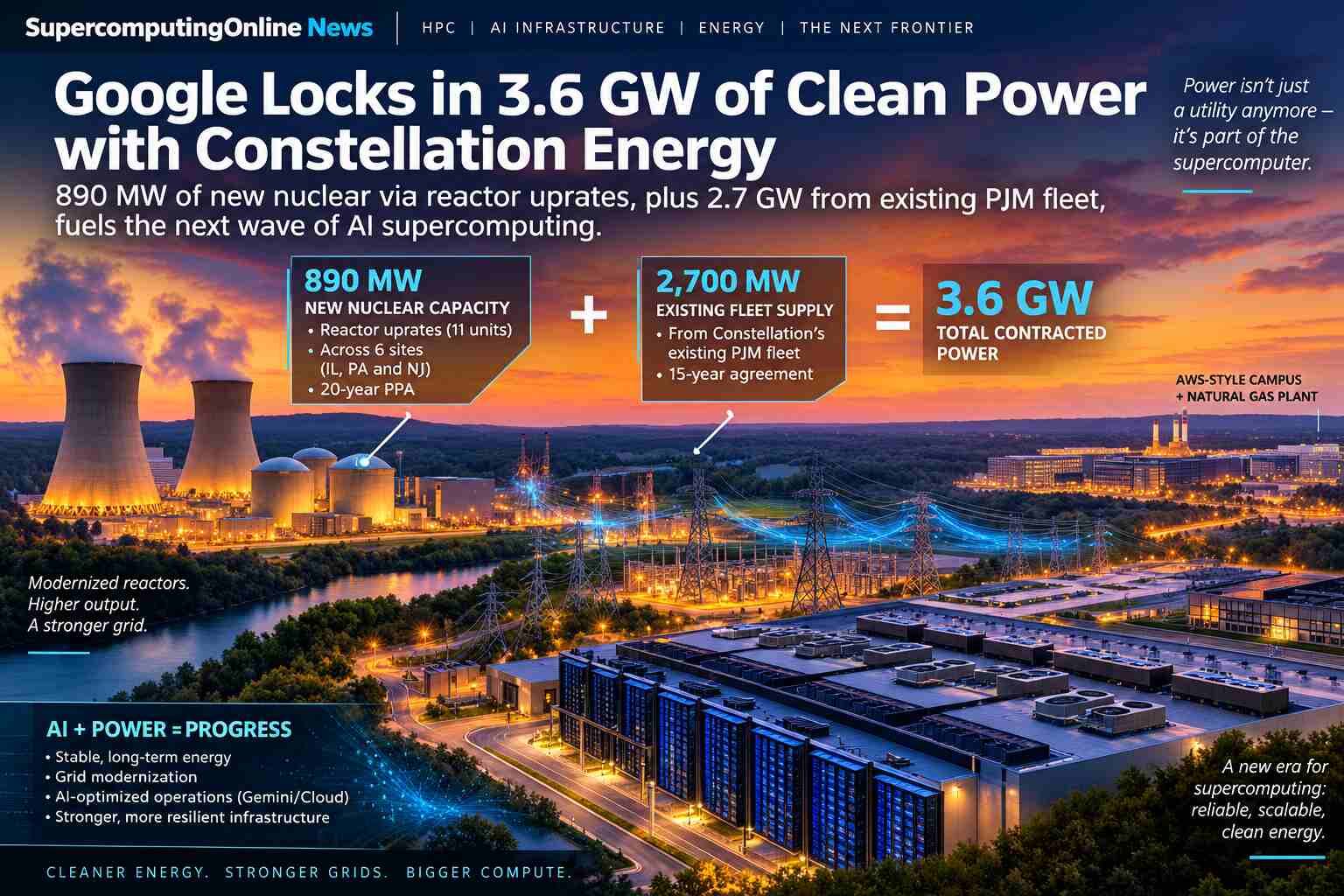
Google’s recent agreement with Constellation Energy exemplifies how the AI infrastructure boom is fundamentally reshaping the relationship between computing and electrical power. Announced on October 6, the agreement encompasses 3,590 megawatts, approximately 3.6 gigawatts, of long-term power arrangements within the PJM Interconnection region. It is essential to distinguish between these components: 890 MW represents genuinely new nuclear capacity derived from plant uprates, while the remaining 2,700 MW is secured through a long-term agreement covering Constellation’s existing PJM generation fleet. This distinction adds both credibility and strategic depth to the initiative from a supercomputing perspective.
Google and Constellation are effectively positioning electricity infrastructure as an enabling layer of the modern computing platform. Constellation intends to invest over $4.3 billion to upgrade 11 nuclear units across Illinois, Pennsylvania, and New Jersey, with the initial delivery of additional power anticipated by 2028. The implication for high-performance computing (HPC) and AI infrastructure is clear: the race for increased computational power has evolved into a competition for reliable, dependable energy.
890 MW without building a new reactor
The centerpiece of the agreement is a 20-year power purchase agreement supporting 890 MW of new nuclear capacity.
The additional generation will come from uprates at 11 existing nuclear units across six sites. The projects involve modernizing equipment including turbines, steam generators and digital control systems to extract additional electrical output from operating reactors. No new reactor is being constructed under this particular program.
That is an enormously important concept for the data-center industry.
Building a new nuclear plant remains a long-cycle undertaking. A nuclear uprate, by contrast, starts with infrastructure that already exists: the site, reactor, grid connection, operating organization and much of the supporting infrastructure.
Constellation describes the 890 MW as entirely new electricity added to the PJM system, with the first uprate expected in 2028 and the projects completed by 2032.
For AI supercomputing, that makes uprates particularly attractive.
An additional 890 MW can represent an enormous amount of new computational capacity without requiring the industry to wait for an entirely new generation plant.
The 2.7 GW question
The other major component is the 2,700 MW, 15-year energy supply agreement covering Constellation’s existing PJM fleet.
That power should not be described as 2.7 GW of new generation.
The arrangement instead provides Constellation with long-term revenue certainty for existing assets and helps ensure those operating resources continue serving the PJM market. In other words, it is fundamentally different from the 890 MW nuclear expansion.
That distinction is critical when discussing AI infrastructure.
A hyperscale operator does not simply need a large number printed in a press release. It needs dependable electricity that can actually support compute loads, cooling systems, power conversion, networking and all of the other infrastructure required to keep a modern AI cluster running.
The practical value of the agreement is therefore not just its headline capacity.
It is long-term energy certainty combined with incremental new generation.
Electricity is becoming part of the compute architecture
The biggest shift may be conceptual.
Traditional supercomputing architecture could largely separate the machine from the electrical system supporting it. Facility engineers certainly worried about power density and cooling, but electricity was generally treated as an infrastructure input.
At AI scale, that separation is collapsing.
A modern GPU cluster can require extraordinary quantities of continuous electrical power. Cooling loads rise with rack density. Electrical distribution becomes more complex. Backup systems become larger. Grid interconnection can become one of the biggest constraints on deployment.
The result is a new hierarchy: Compute capacity depends on power capacity.
That means the energy system increasingly has to be planned alongside the silicon.
Google’s strategy with Constellation is an early example of that transformation. Rather than simply signing a conventional electricity contract, Google is helping create the financial conditions under which existing nuclear infrastructure can be upgraded to produce additional electricity.
The hyperscaler is no longer merely purchasing compute infrastructure.
It is helping finance the infrastructure that makes compute possible.
PJM is becoming an AI battleground
The significance becomes even greater when viewed through PJM Interconnection.
PJM serves 67 million people across 13 states and the District of Columbia, making it one of the most consequential electricity markets in the United States. At the same time, it is increasingly confronting massive new electricity demand from data centers, manufacturing, and electrification.
That puts AI infrastructure and grid infrastructure on the same battlefield.
The emerging “Bring Your Own Power” framework is particularly important because hyperscalers can help finance generation and capacity rather than simply waiting for utilities and regulators to build everything around them.
For the supercomputing sector, this could represent a structural change.
The data center becomes an anchor customer.
The energy developer obtains long-term certainty.
The grid receives investment.
And the AI operator gains a clearer path to scaling compute.
Google is trying to build an AI-energy feedback loop
There is another fascinating component to the agreement.
Constellation is also adopting Google Cloud and Gemini Enterprise under a five-year technology alliance intended to create an “AI for Energy” blueprint. The companies say the technology will be used to help accelerate capacity delivery, optimize plant operations and protect critical infrastructure.
The practical details are still emerging, and the companies have not yet demonstrated a fully deployed AI-controlled energy system. This material treats the alliance as announced intent rather than an established production platform.
But the direction is compelling.
AI is increasing electricity demand.
AI can also help optimize electricity infrastructure.
More efficient energy infrastructure can support more AI.
That creates a potential feedback loop in which supercomputing becomes both the largest new customer for the power system and a tool for making the power system more intelligent.
DOE is pouring billions into the same nuclear strategy
Google’s agreement arrives at a remarkable moment for the U.S. nuclear fleet.
On October 5, 2026, the U.S. Department of Energy announced a conditional loan commitment of up to $4.2 billion for Vistra’s nuclear fleet in Pennsylvania and Ohio. DOE says the projects will preserve nearly 4 GW of existing baseload generation while adding 433 MW of new nuclear capacity through uprates and modernization.
The projects include work at Beaver Valley in Pennsylvania and Davis-Besse and Perry in Ohio. DOE says the investments can increase electricity production from existing nuclear plants without requiring new transmission corridors or equivalent new generating resources. The projects are expected to support roughly 3,000 project-related jobs while preserving thousands of permanent positions.
Importantly, DOE describes the commitment as conditional. Vistra must meet technical, legal, environmental, and financial requirements before final financing documents are executed and the funds are provided.
Still, the strategic direction is unmistakable.
Within 48 hours, the U.S. energy landscape produced two major signals pointing toward the same solution: Get more electricity out of nuclear infrastructure that already exists.
Google and AWS are taking different roads to the same destination
The Google-Constellation deal becomes even more revealing when placed alongside Amazon Web Services’ enormous Homer City development in Pennsylvania.
AWS has filed plans for a 36-building data-center campus at the Homer City Energy Campus, associated with a massive new natural-gas generation project with approximately 4.5 GW of power capacity.
The contrast is striking.
Google is supporting nuclear uprates and long-term access to existing PJM generation.
AWS is pursuing a model in which hyperscale data-center development is closely associated with dedicated generation infrastructure.
One architecture emphasizes grid-connected nuclear baseload and modernization of existing generation.
The other emphasizes large-scale dedicated gas generation co-located with the computing campus.
Both are attempts to solve the same fundamental supercomputing problem: Where do the megawatts come from?
That may become one of the defining questions of the AI era.
The power architecture may matter as much as the silicon architecture
For years, the major competitive questions in HPC centered on GPU architecture, CPU performance, HBM bandwidth, network fabrics, storage and software efficiency.
Those battles are not going away.
But increasingly, another architectural decision is arriving before the first server is even installed: What powers the machine?
Nuclear power offers steady, around-the-clock generation.
Natural gas can provide dispatchable capacity and can be deployed at locations tied directly to major loads.
Renewables can contribute enormous amounts of energy, particularly when paired with storage and flexible workloads.
Batteries can help manage peaks.
Demand response can provide additional flexibility.
Transmission expansion can open access to distant generation.
The future will likely involve combinations of all of these technologies.
That is why the Google-Constellation agreement matters so much to supercomputing.
It is not merely a story about a hyperscaler buying electricity.
It is a story about energy architecture becoming part of compute architecture.
The next generation of supercomputers may begin at the power plant
This broader trend should be viewed with optimism, as the technology industry now possesses a significant financial incentive to accelerate the development of energy infrastructure. The requirements of hyperscalers for reliable electricity, the need for utilities to secure long-term capital, and the demand for nuclear modernization and grid expansion have created a convergence of interests.
Initiatives such as Google’s $4.3 billion Constellation-backed modernization program, the AWS Homer City strategy, and the DOE’s $4.2 billion conditional commitment to Vistra underscore a singular emerging reality: the digital economy is inextricably linked to the physical energy systems that support it. Rather than presenting a challenge, this reliance represents a pivotal opportunity catalyzed by the AI boom. The industry's immense computational requirements are necessitating a direct engagement with foundational infrastructure, spanning power generation, transmission, and cooling systems.
Consequently, supercomputing is evolving beyond the confines of the traditional data center into an expansive infrastructure ecosystem. America’s existing nuclear fleet, once regarded as legacy capacity, is increasingly recognized as a strategic pillar for the next generation of computing. Ultimately, the architecture of future supercomputers will be defined as much by reactor uprates, transmission capabilities, and reliable energy procurement as by silicon. In the AI era, power is no longer merely a utility for the supercomputer; it has become an integral component of the compute architecture itself.