

SUPERCOMPUTING NEWS SUPERCOMPUTING NEWS
    • MEDIA KIT
    • MOST READ
    • RSS FEED
    • ACADEMIA
    • AEROSPACE
    • APPLICATIONS
    • ASTRONOMY
    • AUTOMOTIVE
    • BIG DATA
    • BIOLOGY
    • CHEMISTRY
    • CLIENTS
    • CLOUD
    • DEFENSE
    • DEVELOPER TOOLS
    • EARTH SCIENCES
    • ECONOMICS
    • ENGINEERING
    • ENTERTAINMENT
    • GAMING
    • GOVERNMENT
    • HEALTH
    • OIL & GAS
    • INDUSTRY
    • INTERCONNECTS
    • MANUFACTURING
    • MIDDLEWARE
    • MOVIES
    • NETWORKS
    • PHYSICS
    • PROCESSORS
    • RETAIL
    • SCIENCE
    • STORAGE
    • SYSTEMS
    • VISUALIZATION
    • AcyMailing subscription form

    • ADD YOUR VIDEOS
    • MANAGE VIDEOS
    • CONVERSATION INBOX
    • SOCIAL ADVERTISER
    • SOCIAL NETWORK VIDEOS
    • SURVEYS
    • GROUPS
    • PAGES
    • MARKETPLACE LISTINGS
    • APPLICATIONS BROWSER
    • PRIVACY CONFIRM REQUEST
    • PRIVACY CREATE REQUEST
    • LEADERBOARD
    • POINTS LISTING
      • BADGES
    • TRADE SHOWS
Sign In
Tyler O'Neal, Staff Editor APPLICATIONS April 22, 2022, 3:00 pm

UCI scientists turn a hydrogen molecule into a quantum sensor

New technique enables precise measurement of electrostatic properties of materials

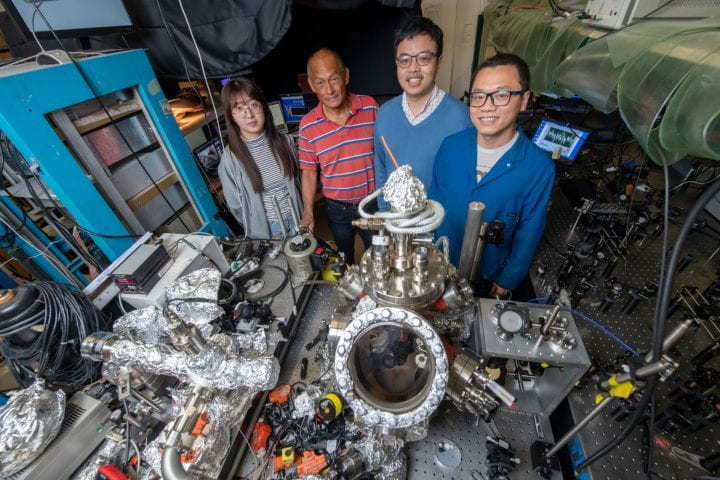
Physicists at the University of California, Irvine have demonstrated the use of a hydrogen molecule as a quantum sensor in a terahertz laser-equipped scanning tunneling microscope, a technique that can measure the chemical properties of materials at unprecedented time and spatial resolutions. The UCI team responsible for the assembly and use of the terahertz laser-equipped scanning tunneling microscope pictured here are, from left to right, Dan Bai, UCI Ph.D. student in physics & astronomy; Wilson Ho, Bren Professor of physics & astronomy and chemistry; Yunpeng Xia, Ph.D. student in physics & astronomy; and Likun Wang and Ph.D. candidate in chemistry. Steve Zylius / UCI
This new technique can also be applied to the analysis of two-dimensional materials which have the potential to play a role in advanced energy systems, electronics, and quantum supercomputers.

Today in Science, the researchers in UCI’s Department of Physics & Astronomy and Department of Chemistry describe how they positioned two bound atoms of hydrogen in between the silver tip of the STM and a sample composed of a flat copper surface arrayed with small islands of copper nitride. With pulses of the laser lasting trillionths of a second, the scientists were able to excite the hydrogen molecule and detect changes in its quantum states at cryogenic temperatures and in the ultrahigh vacuum environment of the instrument, rendering atomic-scale, time-lapsed images of the sample.

“This project represents an advance in both the measurement technique and the scientific question the approach allowed us to explore,” said co-author Wilson Ho, Bren Professor of physics & astronomy and chemistry. “A quantum microscope that relies on probing the coherent superposition of states in a two-level system is much more sensitive than existing instruments that are not based on this quantum physics principle.”

Ho said the hydrogen molecule is an example of a two-level system because its orientation shifts between two positions, up and down and slightly horizontally tilted. Through a laser pulse, the scientists can coax the system to go from a ground state to an excited state in a cyclical fashion resulting in a superposition of the two states. The duration of the cyclic oscillations is vanishingly brief – lasting mere tens of picoseconds – but by measuring this “decoherence time” and the cyclic periods the scientists were able to see how the hydrogen molecule was interacting with its environment.

“The hydrogen molecule became part of the quantum microscope in the sense that wherever the microscope scanned, the hydrogen was there in between the tip and the sample,” said Ho. “It makes for an extremely sensitive probe, allowing us to see variations down to 0.1 angstroms. At this resolution, we could see how the charge distributions change on the sample.”

The space between the STM tip and the sample is almost unimaginably small, about six angstroms or 0.6 nanometers. The STM that Ho and his team assembled is equipped to detect minute electrical current flowing in this space and produce spectroscopic readings proving the presence of the hydrogen molecule and sample elements. Ho said this experiment represents the first demonstration of chemically sensitive spectroscopy based on terahertz-induced rectification current through a single molecule.

The ability to characterize materials at this level of detail based on hydrogen’s quantum coherence can be of great use in the science and engineering of catalysts, since their functioning often depends on surface imperfections at the scale of single atoms, according to Ho.

“As long as hydrogen can be adsorbed onto a material, in principle, you can use hydrogen as a sensor to characterize the material itself through observations of their electrostatic field distribution,” said study lead author Likun Wang, UCI graduate student in physics & astronomy.

Optical scientist Berkson dishes up new method for measuring radio antennas

Tyler O'Neal, Staff Editor APPLICATIONS April 21, 2022, 2:03 pm

Joel Berkson, a third-year doctoral student in the University of Arizona James C. Wyant College of Optical Sciences and Steward Observatory, has developed a new way for precisely measuring the surfaces of radio antenna, which are used to collect and focus radio waves for astronomy and satellite communications.

These dish-shaped antennas, like the ones depicted in the 1997 movie "Contact" starring Jodie Foster, must be manufactured with an extremely high level of accuracy to work well. To ensure their accuracy, engineers measure the antenna surfaces using metrology, a technique that applies the science of measurement to manufacturing, instrumentation and calibration processes.

"People always want to make larger, more accurate antennas for radio telecscopes, and more of them," Berkson said. "If we can't figure out better ways to make them faster and more accurate, the cost and time it takes to measure each surface to ensure its quality will be prohibitive."

Existing methods for measuring curved surfaces of radio antennas and telescope mirrors involve placing stickers across the antenna or mirror surface and then using cameras to analyze the surface by looking at the stickers. Other methods involve physically probing the surface with a coordinate measuring machine. These techniques are limited to only measuring the number of points indicated by the stickers or touched by a physical probe; it is a manual, slow and often expensive process.

To make things even more complicated, sometimes the surfaces do not come out perfectly and need to be fixed and measured again, translating into more money and time spent.

Berkson's invention eliminates the need for stickers or physical touch. The method he developed uses a combination of laser projectors and cameras to create a 3D model of the surface. By rendering the actual surface shape as a computer model, the new process overcomes another limitation of the old methods; rather than being limited to measuring hundreds of points, it allows for the measurement of millions of points on a surface.

Tech Launch Arizona, the UArizona office that commercializes inventions stemming from university research, has worked with Berkson to patent the technology on behalf of the university and license it to Berkson's startup, Fringe Metrology. 

"It was particularly rewarding to see Joel's work, envisioning an approach to address a real-world challenge and transforming it into an elegant commercial solution," said Bruce Burgess, director of venture development at TLA. "Joel recognized the wealth of resources TLA offers researchers and was quick to work with our team."

"A lot of systems out there today are black-box systems and need customization to be useful in the field," Berkson said. "Ours is one system that can be easily configured to measure surfaces of different shapes and sizes. You can't do that with any other current technologies out there."

When Berkson realized existing metrology systems require the use of stickers to make measurements, he was inspired to take a problem-solving approach to simplifying the process.

"Stickers have been used across the board and are the standard and well-trusted," he said, "but as the demand for more accurate and complicated surfaces increases, the measurement requirements equally increase. The current methods are not as good as people want and need to be able to advance these systems."

Working with his co-inventor, Justin Hyatt, a senior research associate at Steward Observatory, Berskon began developing the invention with funding from the National Science Foundation to advance current methods for radio telescope manufacturing. He connected with the TLA commercialization team, which worked with him to develop the intellectual property for the invention. Berkson then started Fringe Metrology, licensed the invention from UArizona and has begun building a business around it.

The startup is developing specialized systems for a variety of surface metrology applications but initially will focus on the meticulous measurements needed for the manufacture of radio telescope panels.

"The radio telescopes like the ones you see in the movie 'Contact' are very precise and expensive to manufacture, and they need to be perfectly shaped to function correctly," Berkson said. "The company will initially focus on these high-value customers to develop the initial go-to-market product."

As Berkson focuses on growing his business, he hopes the technology can offer a solution for the current limitations in radio telescope manufacturing and contribute to the evolution of the industry.

"Ultimately," he said, "I'd like to see quicker, cheaper, higher quality measuring systems in every lab."

Esri commends European Union's Open Data Directive

Tyler O'Neal, Staff Editor APPLICATIONS July 15, 2021, 4:00 pm

New legal requirements enable collaboration among the EU GIS community

Esri has commended the European Union (EU) for its leadership in implementing Directive (EU) 2019/1024 (Open Data Directive), which aims to encourage cross-border use of reusable data in Europe. Committing to a standardized open data policy framework will make it easier for EU member states to access high-value datasets such as geospatial, earth observation, environmental, meteorological, statistical, mobility, and company ownership data in a trusted manner.

With open data, members can now use application programming interface (API) web services for access. At the unprecedented pace at which data is growing everywhere, the new model enables a European single market for open data that will benefit all members.

"We are grateful for the efforts of the European Commission for leading this directive, enabling transparent and free access to valuable geospatial data," said Jack Dangermond, Esri founder and president. "How we access, process and reuse data significantly influence technological development and improves our daily lives. This directive empowers European users to find solutions and enact data-driven policy to address challenges, from local to global."

As EU members finalize implementation of the Open Data Directive, geospatial tools must support data catalog interoperability requirements for open data portals across Europe. To broaden its support for the directive, Esri is expanding the capabilities of interoperable web service APIs, metadata, and ArcGIS Hub catalogs. Using international open standards such as Data Catalog Vocabulary Application profile (DCAT-AP), European customers can share data that conforms to the new Open Data Directive and more easily expose their open data catalog and web services for reuse.

ArcGIS Hub is a system of engagement that enables businesses, citizens, communities, universities, and nongovernmental organizations (NGOs) to leverage open data and spatial analytics for collaborative policy initiatives. Current EU member state users, such as in the case of the Ireland Sustainable Development Goals (SDGs) data hub, use ArcGIS Hub to report the country's progress toward the SDGs. The Ireland SDGs hub highlights spatial patterns, identifies trends, and shares community data to help achieve those goals.

The inclusion of DCAT-AP 2.0.1, along with an extendable architecture on ArcGIS Hub, will serve as a road map to support and guide geospatial technology users as they adopt the legal requirements of the Open Data Directive. Geospatial data is transformative, and the EU's Open Data Directive has paved the way for greater accessibility and transparency. The changes will inspire exciting opportunities for member state collaboration and innovation across Europe.

  1. University of Liverpool researchers discover a new inorganic material with the lowest thermal conductivity that can lead to lower energy supercomputing
  2. TU Munich prof simulates future forest fires in Yellowstone with artificial intelligence

Page 36 of 66

  • 31
  • 32
  • 33
  • 34
  • 35
  • 36
  • 37
  • 38
  • 39
  • 40
POPULAR RIGHT NOW
  • Supercomputers uncover a new class of cosmic explosions hidden in plain sight
    Supercomputers uncover a new class of cosmic explosions hidden in plain sight
  • AI supercharges the hunt for stronger magnets: Iowa State researchers launch a new era of intelligent materials discovery
    AI supercharges the hunt for stronger magnets: Iowa State researchers launch a new era of intelligent materials discovery
  • IBM's Historic stock collapse raises questions for the future of enterprise supercomputing
    IBM's Historic stock collapse raises questions for the future of enterprise supercomputing
  • Could a novel dark matter theory simultaneously resolve multiple cosmic enigmas? Supercomputer simulations provide a compelling, albeit currently unverified, potential solution
    Could a novel dark matter theory simultaneously resolve multiple cosmic enigmas? Supercomputer simulations provide a compelling, albeit currently unverified, potential solution
  • Melting icebergs may be reshaping Earth’s greatest ocean current
    Melting icebergs may be reshaping Earth’s greatest ocean current
  • Supercomputers replace ‘bathtub’ flood maps with physics-based digital twins of Britain’s coastline
    Supercomputers replace ‘bathtub’ flood maps with physics-based digital twins of Britain’s coastline
  • Supercomputers push neural quantum simulation beyond previous limits
    Supercomputers push neural quantum simulation beyond previous limits
  • Intel’s AI supercomputing revival: Q2 financial surge signals new era for CPU-powered HPC infrastructure
    Intel’s AI supercomputing revival: Q2 financial surge signals new era for CPU-powered HPC infrastructure
  • AI infrastructure financing fears shake semiconductor sector
    AI infrastructure financing fears shake semiconductor sector
  • AWS supercomputing investment reaches historic scale as Amazon’s AI strategy powers record financial results
    AWS supercomputing investment reaches historic scale as Amazon’s AI strategy powers record financial results
THIS YEAR'S MOST READ
  • Wall Street wants to trade supercomputing power like oil
    Wall Street wants to trade supercomputing power like oil
  • Cosmic ambition at scale: UK’s supercomputer unlocks a 2.5 petabytes universe
    Cosmic ambition at scale: UK’s supercomputer unlocks a 2.5 petabytes universe
  • Hidden order, revealed at scale: Supercomputing, electron ptychography uncover the inner workings of relaxor ferroelectrics
    Hidden order, revealed at scale: Supercomputing, electron ptychography uncover the inner workings of relaxor ferroelectrics
  • Beamforming the future: BeammWave's 6G push signals the rise of orbital-terrestrial wireless networks
    Joakim Axmon
    Joakim Axmon
  • Intel's Q1 results signal supercomputing surge driving Xeon momentum
    Intel's Q1 results signal supercomputing surge driving Xeon momentum
  • When stars fall apart: Supercomputing reveals the hidden physics of black holes
    When stars fall apart: Supercomputing reveals the hidden physics of black holes
  • Multi-layer simulations reveal the hidden supply chain of solar prominences
    Multi-layer simulations reveal the hidden supply chain of solar prominences
  • Japanese scientists decode dolphin speed with supercomputing: Turbulence, vortices, and the hidden physics of propulsion
    Japanese scientists decode dolphin speed with supercomputing: Turbulence, vortices, and the hidden physics of propulsion
  • Cosmic feedback at scale: Supercomputing reveals how quasars regulate the early Universe
    Cosmic feedback at scale: Supercomputing reveals how quasars regulate the early Universe
  • Modeling life at the microscopic scale: A computational breakthrough in oxygen transport
    Modeling life at the microscopic scale: A computational breakthrough in oxygen transport
MOST READ OF ALL-TIME
  • Largest Computational Biology Simulation Mimics The Ribosome
    Details
    112108
    The amino acid (green) slithers into the chemical reaction center, moving through an evolutionarily ancient corridor of the ribosome (purple). The amino acid is delivered to the reaction core by the transfer RNA molecule (yellow).
    The amino acid (green) slithers into the chemical reaction center, moving through an evolutionarily ancient corridor of the ribosome (purple). The amino acid is delivered to the reaction core by the transfer RNA molecule (yellow).
  • Silicon 'neurons' may add a new dimension to chips
    Details
    80994
    Silicon 'neurons' may add a new dimension to chips
  • Linux Networx Accelerators Expected to Drive up to 4x Price/Performance
    Details
    75538
  • Complex Concepts That Really Add Up
    Details
    73637
    Complex Concepts That Really Add Up
  • Blue Sky Studios Donates Animation SuperComputer to Wesleyan
    Details
    68141
    Each rack holds 52 Angstrom Microsystem-brand “blades,” with a memory footprint of 12 or 24 gigabytes each. (Photos by Olivia Bartlett Drake)
    Each rack holds 52 Angstrom Microsystem-brand “blades,” with a memory footprint of 12 or 24 gigabytes each. (Photos by Olivia Bartlett Drake)
  • Humanities, HPC connect at NERSC
    Details
    57947
  • TeraGrid ’09 'Call for Participation'
    Details
    54952
  • Turbulence responsible for black holes' balancing act
    Details
    52312
  • Cray Wins $52 Million SuperComputer Contract
    Details
    50140
  • SDSC Researchers Accurately Predict Protein Docking
    Details
    46080
  • FRONTPAGE
  • LATEST
  • POPULAR
  • REGISTER
  • SOCIAL
  • VIDEO
  • SUBSCRIPTION
  • RSS
  • GUIDELINES
  • PRIVACY
  • TOS
  • ABOUT
  • +1 (816) 799-4488
  • editorial@supercomputingonline.com
© 2001 - 2026 SuperComputingOnline.com, LLC. All rights reserved. This material may not be published, broadcast, rewritten or redistributed without permission.
Sign In
  • FRONT PAGE
  • LATEST
    • MEDIA KIT
    • MOST READ
    • RSS FEED
    • ACADEMIA
    • AEROSPACE
    • APPLICATIONS
    • ASTRONOMY
    • AUTOMOTIVE
    • BIG DATA
    • BIOLOGY
    • CHEMISTRY
    • CLIENTS
    • CLOUD
    • DEFENSE
    • DEVELOPER TOOLS
    • EARTH SCIENCES
    • ECONOMICS
    • ENGINEERING
    • ENTERTAINMENT
    • HEALTH
    • INDUSTRY
    • INTERCONNECTS
    • GAMING
    • GOVERNMENT
    • MANUFACTURING
    • MIDDLEWARE
    • MOVIES
    • NETWORKS
    • OIL & GAS
    • PHYSICS
    • PROCESSORS
    • RETAIL
    • SCIENCE
    • STORAGE
    • SYSTEMS
    • VISUALIZATION
  • VIDEOS
    • ADD YOUR VIDEOS
    • MANAGE VIDEOS
  • COMMUNITY
    • TRADE SHOWS
    • SOCIAL NETWORK VIDEOS
    • SURVEYS
    • APPLICATIONS BROWSER
    • CONVERSATION INBOX
    • SOCIAL ADVERTISER
    • GROUPS
    • MARKETPLACE LISTINGS
    • PAGES
    • LEADERBOARD
    • POINTS LISTING
      • BADGES
    • PRIVACY CONFIRM REQUEST
    • PRIVACY CREATE REQUEST

Hey there! We noticed you’re using an ad blocker.