

SUPERCOMPUTING NEWS SUPERCOMPUTING NEWS
    • MEDIA KIT
    • MOST READ
    • RSS FEED
    • ACADEMIA
    • AEROSPACE
    • APPLICATIONS
    • ASTRONOMY
    • AUTOMOTIVE
    • BIG DATA
    • BIOLOGY
    • CHEMISTRY
    • CLIENTS
    • CLOUD
    • DEFENSE
    • DEVELOPER TOOLS
    • EARTH SCIENCES
    • ECONOMICS
    • ENGINEERING
    • ENTERTAINMENT
    • GAMING
    • GOVERNMENT
    • HEALTH
    • OIL & GAS
    • INDUSTRY
    • INTERCONNECTS
    • MANUFACTURING
    • MIDDLEWARE
    • MOVIES
    • NETWORKS
    • PHYSICS
    • PROCESSORS
    • RETAIL
    • SCIENCE
    • STORAGE
    • SYSTEMS
    • VISUALIZATION
    • AcyMailing subscription form

    • ADD YOUR VIDEOS
    • MANAGE VIDEOS
    • CONVERSATION INBOX
    • SOCIAL ADVERTISER
    • SOCIAL NETWORK VIDEOS
    • SURVEYS
    • GROUPS
    • PAGES
    • MARKETPLACE LISTINGS
    • APPLICATIONS BROWSER
    • PRIVACY CONFIRM REQUEST
    • PRIVACY CREATE REQUEST
    • LEADERBOARD
    • POINTS LISTING
      • BADGES
    • TRADE SHOWS
Sign In
Tyler O'Neal, Staff Editor APPLICATIONS November 12, 2020, 6:46 am

European Commission launches EXPLORE project to develop AI, interactive visualization applications in astrophysics, planetary science

An international consortium has been awarded 2 million Euros by the European Commission to develop novel applications that use artificial intelligence (AI) and visual analytics to exploit the vast datasets generated by astrophysics and planetary missions. Over three years, the EXPLORE project will develop these tools on a new virtual platform to create services and enhanced scientific datasets focused on galactic and stellar research, linked to the European Space Agency’s Gaia mission, as well as lunar exploration. The tools will be made available to the community through different cloud science platforms using open source licenses to stimulate uptake and ensure sustainability.

The EXPLORE Consortium is led by the French company, ACRI-ST, and includes eight partners from six countries. The interdisciplinary project brings together astrophysicists, planetary scientists, computer scientists, IT engineers & software developers.

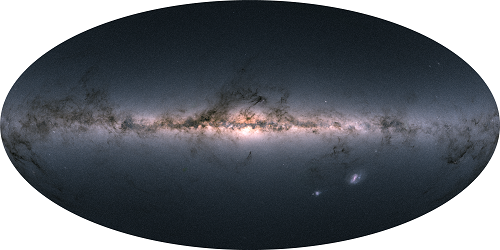
At today’s kick-off meeting, Dr Nick Cox, the EXPLORE Project Coordinator, said: “The sheer volume and increase in complexity of data from space science missions, as well as the need to combine multiple data sets, requires an increase in both data management and processing capabilities. AI-based solutions and interactive visualization techniques for big data are not just useful tools to explore the Universe but are becoming a necessity.” Gaia's all-sky view of our Milky Way Galaxy and neighbouring galaxies, based on measurements of nearly 1.7 billion stars. The map shows the total brightness and colour of stars observed by the ESA satellite in each portion of the sky between July 2014 and May 2016. Copyright: ESA/Gaia/DPAC, CC BY-SA 3.0 IGO{module INSIDE STORY}
EXPLORE will develop six scientific data applications to test methodologies and tools for space data exploitation on a collaborative cloud environment, the EXPLORE Thematic Exploitation Platform (EXPLORE-TEP).

Rather than focus on one main scientific topic, EXPLORE aims to foster synergies between different areas of space science. Four of the applications will leverage data primarily from Gaia, supplemented with data from other surveys, developing tools to help understand the evolution of our galaxy, the 3D distribution of interstellar matter, as well as to support the discovery, classification, and characterization of stars. The remaining two applications will integrate data from a range of international lunar missions to focus on the characterization of the Moon’s surface and potential human landing sites. A key objective will be to facilitate the integration and visualization of multiple datasets.

Prof Dovi Poznanski of Tel Aviv University, who leads EXPLORE’s AI methodology development, said: “By putting together different experiences and backgrounds we introduce diversity and interdisciplinarity in the analysis of space science data. Today’s big datasets in imagery, spectroscopy, and 3D mapping require sophisticated tools. However, there are common basic principles among the different fields, which means there is a vital need for cross-fertilization if we want to optimize the most advanced tools.”

EXPLORE-TEP builds on the heritage of a platform designed by ACRI-ST and funded by ESA to facilitate and expand the use and uptake of Copernicus-Sentinel Earth Observation mission data.

Dr Jeronimo Bernard-Salas, of ACRI-ST and Deputy Coordinator of EXPLORE, said: “For astronomers, it is becoming increasingly difficult to simply download all the data to their desktop and use their favorite analysis tools locally. Through EXPLORE, we aim to bring processing and analysis capabilities, accessible via existing and new collaborative working environments, to the data. This allows any user to exploit space mission and supporting ground-based data more efficiently and to effectively share their methods and results, thus ensuring science becomes more open.”

Ultimately, EXPLORE aims to apply the tools to other areas of space science, as well as to map business opportunities for potential market entry in other domains.

The UK spends £1.2 billion for the world’s most powerful weather, climate supercomputer

Tyler O'Neal, Staff Editor APPLICATIONS February 17, 2020, 7:14 pm

Predicting severe weather and the impacts of climate change will be faster and more accurate than ever before, thanks to the confirmation of £1.2 billion government funding to develop a state-of-the-art supercomputer, Business and Energy Secretary and COP26 President Alok Sharma announced today (17 February 2020).

Data from this new supercomputer – expected to be the world’s most advanced dedicated to weather and climate – will be used to help more accurately predict storms, select the most suitable locations for flood defenses and predict changes to the global climate.

The new supercomputer, to be managed by the Met Office, will also be used to help ensure communities can be better prepared for weather disruption, including through:

  • more sophisticated rainfall predictions, helping the Environment Agency rapidly deploy mobile flood defenses
  • better forecasting at airports so they can plan for potential disruption
  • more detailed information for the energy sector to help them mitigate against potential energy blackouts and surges

With the government announcing its Year of Climate Action, the news further demonstrates the UK is leading by example ahead of hosting UN climate conference COP26, where the world will meet to agree with more ambitious action. {module INSIDE STORY}

Business and Energy Secretary and COP26 President Alok Sharma said:

Over the last 30 years, new technologies have meant more accurate weather forecasting, with storms being predicted up to 5 days in advance.

Come rain or shine, our significant investment for a new supercomputer will further speed up weather predictions, helping people be more prepared for weather disruption from planning travel journeys to deploying flood defenses.

The new supercomputer will also strengthen the UK’s supercomputing and data technology capabilities, driving forward innovation and growing world-class skills across supercomputing, data science, machine learning and artificial intelligence.

Professor Penny Endersby, Met Office Chief Executive said:

This investment will ultimately provide earlier more accurate warnings of severe weather, the information needed to build a more resilient world in a changing climate and help support the transition to a low carbon economy across the UK.

It will help the UK to continue to lead the field in weather and climate science and services, working collaboratively to ensure that the benefits of our work help the government, the public and industry make better decisions to stay safe and thrive.

We welcome this planned investment from the UK government.

Chair of the Science Review Group Professor Ted Shepherd said:

The agreement to upgrade the Met Office high-performance computer is welcome news. The improved processing power will deliver a step-change in weather forecasting and climate modeling capability for the UK, such as the further development of the Earth Systems Model, which involves collaboration with the many UKRI-NERC funded research centers.

Improved daily to seasonal forecasts and longer-term climate projections will equip society with a greater ability to proactively protect itself against the adverse impacts of climate change.

The Met Office is at the forefront of supercomputing, using its current technology to drive advances in environmental forecasting.

As a result, detailed weather predictions for the UK now take place every hour instead of every 3 hours, providing crucial and timely updates when extreme weather is approaching.

The benefit of this has been felt recently: major storms Ciara and Dennis, and the ‘Beast from the East’ in 2018, were forecast 5 days in advance, enabling local councils and emergency services to prepare and instigate resilience plans. Similarly, the Environment Agency has used the Met Office’s latest UK climate projections to set out potential future flooding scenarios and how funding can be best allocated.

UK supercomputer breakthroughs

Today, the government also announced £30 million investment for advanced supercomputing services, providing researchers with access to the latest technology and expert software engineers. It will also help them speed up scientific breakthroughs like developing ‘food fingerprinting’ to detect chemical contaminants in food and improving drug design.

The funding will support 7 High-Performance Computing (HPC) services run by universities from across the UK, including Queen’s University Belfast, the University of Edinburgh, and Durham University. The services will provide researchers with invaluable access to powerful systems to support ground-breaking work in areas from Artificial Intelligence, energy storage and supply, and therapeutic drug design, as well as boosting the skills of UK scientists.

UK Government Minister for Scotland Douglas Ross said:

The UK government investment in Edinburgh’s supercomputers helps keep our capital at the forefront of cutting edge technology.

The University of Edinburgh facility will benefit scientists from across the UK as they are given the opportunity to use this new technology. This additional funding builds on the work of the Edinburgh and South East Scotland City Region Deal which is creating world-leading hubs for AI research.

The UK government is committed to combatting the impact of climate change on top of creating thousands of high-earning jobs and ensuring businesses and public services in the UK are the first to benefit from the latest innovations.
Supercomputer simulations visualize how DNA is recognized to convert cells into stem cells

Tyler O'Neal, Staff Editor APPLICATIONS February 14, 2020, 12:50 pm

Researchers of the Hubrecht Institute (KNAW - The Netherlands) and the Max Planck Institute in Münster (Germany) have revealed how an essential protein helps to activate genomic DNA during the conversion of regular adult human cells into stem cells. Their findings are published in the Biophysical Journal.

A cell's identity is driven by which DNA is "read" or "not read" at any point in time. Signaling in the cell to start or stop reading DNA happens through proteins called transcription factors. Identity changes happen naturally during development as cells transition from an undesignated cell to a specific cell type. As it turns out, these transitions can also be reversed. In 2012, Japanese researchers were awarded the Nobel prize for being the first to push a regular skin cell back to a stem cell.

A fuller understanding of molecular processes towards stem cell therapies

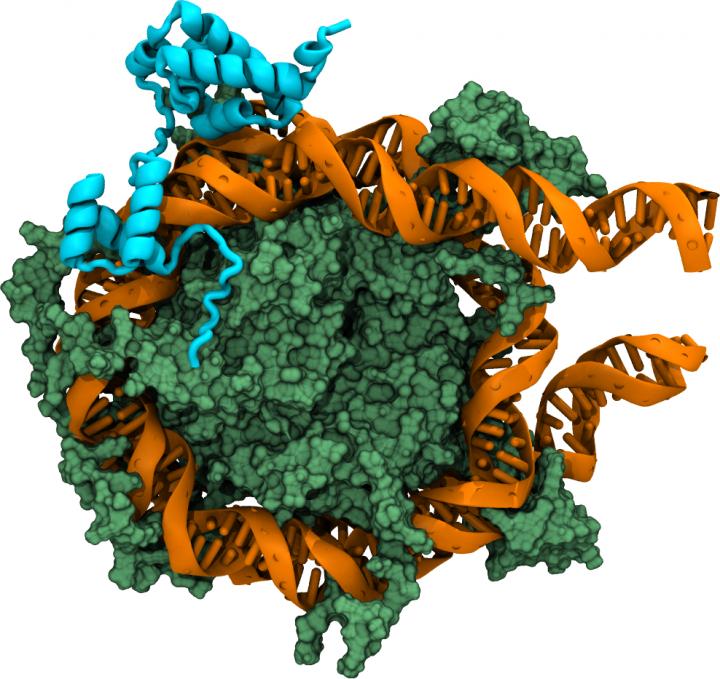
Until now, it is unknown how the conversion of a skin cell into a stem cell happens exactly, on a molecular scale. "Fully understanding the processes with atomic details is essential if we want to produce such cells for individual patients in the future in a reliable and efficient manner", says research leader Vlad Cojocaru of the Hubrecht Institute. "It is believed that such engineered cell types may in the future be part of the solution to diseases like Alzheimer's and Parkinson's, but the production process would have to become more efficient and predictable." CAPTION The pioneer transcription factor Oct4 (blue) binds to the nucleosome (a complex of proteins (green) and the DNA (orange) wrapped around these proteins).  CREDIT Jan Huertas and Vlad Cojocaru, ©MPI Münster, ©Hubrecht Institute{module INSIDE STORY}

Pioneer transcription factor 

One of the main proteins involved in stem cell generation is a transcription factor called Oct4. It induces gene expression, or activity, of the proteins that 'reset' the adult cell into a stem cell. Those genes induced are inactive in the adult cells and reside in tightly packed, closed states of chromatin, the structure that stores the DNA in the cell nucleus. Oct4 contributes to the opening of chromatin to allow for the expression of the genes. For this, Oct4 is known as a pioneer transcription factor.

The data from Cojocaru and his Ph.D. candidate - and the first author of the publication - Jan Huertas show how Oct4 binds to DNA on the so-called nucleosomes, the repetitive nuclear structures in chromatin. Cojocaru: "We modeled Oct4 in different configurations. The molecule consists of two domains, only one of which is able to bind to a specific DNA sequence on the nucleosome in this phase of the process. With our simulations, we discovered which of those configurations are stable and how the dynamics of nucleosomes influence Oct4 binding. The models were validated by experiments performed by our colleagues Caitlin MacCarthy and Hans Schöler in Münster."

One step closer to engineered factors

This is the first time computer simulations show how a pioneer transcription factor binds to nucleosomes to open chromatin and regulate gene expression. "Our computational approach for obtaining the Oct4 models can also be used to screen other transcription factors and to find out how they bind to nucleosomes", Cojocaru says.

Moreover, Cojocaru wants to refine the current Oct4 models to propose a final structure for the Oct4-nucleosome complex. "For already almost 15 years now, we know that Oct4 together with three other pioneer factors transforms adult cells into stem cells. However, we still do not know how they go about it. Experimental structure determination for such a system is very costly and time-consuming. We aim to obtain one final model for the binding of Oct4 to the nucleosome by combining supercomputer simulations with different lab experiments. Hopefully, our final model will give us the opportunity to engineer pioneer transcription factors for efficient and reliable production of stem cells and other cells needed in regenerative medicine."

  1. Kaneko Lab shows that leaking away essential resources isn't wasteful, actually helps cells grow
  2. The Antarctica Factor: model uncertainties reveal upcoming sea level risk

Page 46 of 66

  • 41
  • 42
  • 43
  • 44
  • 45
  • 46
  • 47
  • 48
  • 49
  • 50
POPULAR RIGHT NOW
  • Supercomputers uncover a new class of cosmic explosions hidden in plain sight
    Supercomputers uncover a new class of cosmic explosions hidden in plain sight
  • AI supercharges the hunt for stronger magnets: Iowa State researchers launch a new era of intelligent materials discovery
    AI supercharges the hunt for stronger magnets: Iowa State researchers launch a new era of intelligent materials discovery
  • IBM's Historic stock collapse raises questions for the future of enterprise supercomputing
    IBM's Historic stock collapse raises questions for the future of enterprise supercomputing
  • Could a novel dark matter theory simultaneously resolve multiple cosmic enigmas? Supercomputer simulations provide a compelling, albeit currently unverified, potential solution
    Could a novel dark matter theory simultaneously resolve multiple cosmic enigmas? Supercomputer simulations provide a compelling, albeit currently unverified, potential solution
  • Melting icebergs may be reshaping Earth’s greatest ocean current
    Melting icebergs may be reshaping Earth’s greatest ocean current
  • Supercomputers replace ‘bathtub’ flood maps with physics-based digital twins of Britain’s coastline
    Supercomputers replace ‘bathtub’ flood maps with physics-based digital twins of Britain’s coastline
  • Supercomputers push neural quantum simulation beyond previous limits
    Supercomputers push neural quantum simulation beyond previous limits
  • Intel’s AI supercomputing revival: Q2 financial surge signals new era for CPU-powered HPC infrastructure
    Intel’s AI supercomputing revival: Q2 financial surge signals new era for CPU-powered HPC infrastructure
  • AI infrastructure financing fears shake semiconductor sector
    AI infrastructure financing fears shake semiconductor sector
  • AWS supercomputing investment reaches historic scale as Amazon’s AI strategy powers record financial results
    AWS supercomputing investment reaches historic scale as Amazon’s AI strategy powers record financial results
THIS YEAR'S MOST READ
  • Wall Street wants to trade supercomputing power like oil
    Wall Street wants to trade supercomputing power like oil
  • Cosmic ambition at scale: UK’s supercomputer unlocks a 2.5 petabytes universe
    Cosmic ambition at scale: UK’s supercomputer unlocks a 2.5 petabytes universe
  • Hidden order, revealed at scale: Supercomputing, electron ptychography uncover the inner workings of relaxor ferroelectrics
    Hidden order, revealed at scale: Supercomputing, electron ptychography uncover the inner workings of relaxor ferroelectrics
  • Beamforming the future: BeammWave's 6G push signals the rise of orbital-terrestrial wireless networks
    Joakim Axmon
    Joakim Axmon
  • Intel's Q1 results signal supercomputing surge driving Xeon momentum
    Intel's Q1 results signal supercomputing surge driving Xeon momentum
  • When stars fall apart: Supercomputing reveals the hidden physics of black holes
    When stars fall apart: Supercomputing reveals the hidden physics of black holes
  • Multi-layer simulations reveal the hidden supply chain of solar prominences
    Multi-layer simulations reveal the hidden supply chain of solar prominences
  • Japanese scientists decode dolphin speed with supercomputing: Turbulence, vortices, and the hidden physics of propulsion
    Japanese scientists decode dolphin speed with supercomputing: Turbulence, vortices, and the hidden physics of propulsion
  • Cosmic feedback at scale: Supercomputing reveals how quasars regulate the early Universe
    Cosmic feedback at scale: Supercomputing reveals how quasars regulate the early Universe
  • Modeling life at the microscopic scale: A computational breakthrough in oxygen transport
    Modeling life at the microscopic scale: A computational breakthrough in oxygen transport
MOST READ OF ALL-TIME
  • Largest Computational Biology Simulation Mimics The Ribosome
    Details
    112108
    The amino acid (green) slithers into the chemical reaction center, moving through an evolutionarily ancient corridor of the ribosome (purple). The amino acid is delivered to the reaction core by the transfer RNA molecule (yellow).
    The amino acid (green) slithers into the chemical reaction center, moving through an evolutionarily ancient corridor of the ribosome (purple). The amino acid is delivered to the reaction core by the transfer RNA molecule (yellow).
  • Silicon 'neurons' may add a new dimension to chips
    Details
    80993
    Silicon 'neurons' may add a new dimension to chips
  • Linux Networx Accelerators Expected to Drive up to 4x Price/Performance
    Details
    75538
  • Complex Concepts That Really Add Up
    Details
    73637
    Complex Concepts That Really Add Up
  • Blue Sky Studios Donates Animation SuperComputer to Wesleyan
    Details
    68141
    Each rack holds 52 Angstrom Microsystem-brand “blades,” with a memory footprint of 12 or 24 gigabytes each. (Photos by Olivia Bartlett Drake)
    Each rack holds 52 Angstrom Microsystem-brand “blades,” with a memory footprint of 12 or 24 gigabytes each. (Photos by Olivia Bartlett Drake)
  • Humanities, HPC connect at NERSC
    Details
    57947
  • TeraGrid ’09 'Call for Participation'
    Details
    54952
  • Turbulence responsible for black holes' balancing act
    Details
    52311
  • Cray Wins $52 Million SuperComputer Contract
    Details
    50140
  • SDSC Researchers Accurately Predict Protein Docking
    Details
    46079
  • FRONTPAGE
  • LATEST
  • POPULAR
  • REGISTER
  • SOCIAL
  • VIDEO
  • SUBSCRIPTION
  • RSS
  • GUIDELINES
  • PRIVACY
  • TOS
  • ABOUT
  • +1 (816) 799-4488
  • editorial@supercomputingonline.com
© 2001 - 2026 SuperComputingOnline.com, LLC. All rights reserved. This material may not be published, broadcast, rewritten or redistributed without permission.
Sign In
  • FRONT PAGE
  • LATEST
    • MEDIA KIT
    • MOST READ
    • RSS FEED
    • ACADEMIA
    • AEROSPACE
    • APPLICATIONS
    • ASTRONOMY
    • AUTOMOTIVE
    • BIG DATA
    • BIOLOGY
    • CHEMISTRY
    • CLIENTS
    • CLOUD
    • DEFENSE
    • DEVELOPER TOOLS
    • EARTH SCIENCES
    • ECONOMICS
    • ENGINEERING
    • ENTERTAINMENT
    • HEALTH
    • INDUSTRY
    • INTERCONNECTS
    • GAMING
    • GOVERNMENT
    • MANUFACTURING
    • MIDDLEWARE
    • MOVIES
    • NETWORKS
    • OIL & GAS
    • PHYSICS
    • PROCESSORS
    • RETAIL
    • SCIENCE
    • STORAGE
    • SYSTEMS
    • VISUALIZATION
  • VIDEOS
    • ADD YOUR VIDEOS
    • MANAGE VIDEOS
  • COMMUNITY
    • TRADE SHOWS
    • SOCIAL NETWORK VIDEOS
    • SURVEYS
    • APPLICATIONS BROWSER
    • CONVERSATION INBOX
    • SOCIAL ADVERTISER
    • GROUPS
    • MARKETPLACE LISTINGS
    • PAGES
    • LEADERBOARD
    • POINTS LISTING
      • BADGES
    • PRIVACY CONFIRM REQUEST
    • PRIVACY CREATE REQUEST

Hey there! We noticed you’re using an ad blocker.