SUPERCOMPUTING NEWS SUPERCOMPUTING NEWS
    • MEDIA KIT
    • MOST READ
    • RSS FEED
    • ACADEMIA
    • AEROSPACE
    • APPLICATIONS
    • ASTRONOMY
    • AUTOMOTIVE
    • BIG DATA
    • BIOLOGY
    • CHEMISTRY
    • CLIENTS
    • CLOUD
    • DEFENSE
    • DEVELOPER TOOLS
    • EARTH SCIENCES
    • ECONOMICS
    • ENGINEERING
    • ENTERTAINMENT
    • GAMING
    • GOVERNMENT
    • HEALTH
    • OIL & GAS
    • INDUSTRY
    • INTERCONNECTS
    • MANUFACTURING
    • MIDDLEWARE
    • MOVIES
    • NETWORKS
    • PHYSICS
    • PROCESSORS
    • RETAIL
    • SCIENCE
    • STORAGE
    • SYSTEMS
    • VISUALIZATION
    • AcyMailing subscription form

    • ADD YOUR VIDEOS
    • MANAGE VIDEOS
    • CONVERSATION INBOX
    • SOCIAL ADVERTISER
    • SOCIAL NETWORK VIDEOS
    • SURVEYS
    • GROUPS
    • PAGES
    • MARKETPLACE LISTINGS
    • APPLICATIONS BROWSER
    • PRIVACY CONFIRM REQUEST
    • PRIVACY CREATE REQUEST
    • LEADERBOARD
    • POINTS LISTING
      • BADGES
    • TRADE SHOWS
Sign In
Tyler O'Neal, Staff Editor APPLICATIONS August 21, 2019, 10:37 am

Chinese researcher deploys machine learning in intelligent weather consultation

Weather forecasting is a typical problem of coupling big data with physical-process models, according to Prof. Pingwen Zhang, academician of Chinese Academy of Sciences, Director of the National Engineering Laboratory for Big Data Analysis and Application Technology, Director of the Center for Computational Science & Engineering, Peking University. Prof. Zhang is the corresponding author of a collaborated study by Peking University and Institute of Atmospheric Physics, Chinese Academy of Sciences. CREDIT Haochen Li{module In-article}
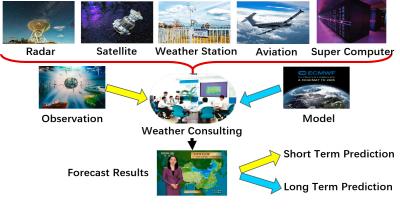
Generally speaking, weather forecasting is a largely successful practice in the geosciences and, nowadays, it is inseparable from numerical weather prediction (NWP). However, because the outputs of NWP and observations contain different systematic errors, a "weather consultation" is an indispensable part of the process towards further improving the accuracy of forecasts.

"In fact, the theory-driven physical model and data-driven machine learning are complementary tools. Combining these two approaches, an intelligent weather consultation system can be built to assist the current manual process of weather consultation," says Prof. ZHANG. "One of the challenges linked with this is to build appropriate feature engineering for both types of information to make full use of the data."

To solve these problems, Prof. ZHANG and his team have proposed the "model output machine learning" (MOML) method for simulating weather consultation, and this research has recently been published in Advances in Atmospheric Sciences.

MOML is a post-processing method based on machine learning, which matches NWP forecasts against observations through a regression function. To test the new approach for grid temperature forecasts, the 2-m surface air temperature in the Beijing area was employed. The MOML method, with different feature engineering, was compared against the ECMWF model forecast and modified model output statistics (MOS) method. MOML showed better numerical performance than the ECMWF model and MOS, especially for winter; the accuracy when using MOML increased by 27.91% and 15.52% respectively.

Weather consultation data are unique, and mainly include information contained in both NWP model data and observational data. They have different data structures and features, which makes feature engineering a complicated task. The quality of feature engineering directly affects the final result. Zhang's group has proposed several feature engineering schemes following extensive numerical experiments. These schemes ensure the calculation efficiency and were employed in meteorological studies for the first time. Prof. ZHANG points out that the MOML method allows the observational data to directly participate in the calculation, and uses both the high- and low-frequency information of the data to make the forecast results more accurate. The MOML method proposed in this study could be applied to forecasting the weather during the upcoming 2022 Winter Olympics, hopefully providing more accurate, intelligent and efficient weather forecasting services for this international event.

Machine learning and deep learning offer diverse tools for weather forecasts in the era of big data, but there are also many challenges in practical applications.

"It is an important future research direction to incorporate weather forecast data and coupled models into a hybrid computing framework to explore and study the structure and features of observational and NWP data, and propose data-driven machine learning algorithms suitable for weather forecasting," Prof. Zhang concludes.

Preventing privacy leaks when online data can be gathered publicly

Tyler O'Neal, Staff Editor APPLICATIONS August 20, 2019, 8:48 pm

MU researcher shares a $1.2 million grant from the National Science Foundation with the University of Illinois-Chicago and University of Illinois Urbana-Champaign

Protecting an individual's identity from cyber thieves can be a monumental task, especially when thieves can gather information about someone by just using public data sources. 

That's why Rohit Chadha, associate professor of electrical engineering and computer science in the College of Engineering at the University of Missouri, is working with researchers at the University of Illinois-Chicago and the University of Illinois Urbana-Champaign on a $1.2 million grant over 4 years from the National Science Foundation to study how to help prevent privacy leaks when there is a large amount of data that can be gathered publicly. 209179 web 260ed{module In-article}

"Differential privacy is a technique invented about fifteen years ago that ensures when someone asks questions of online databases -- census data, consumer trends or aggregated information such as salary range or average number of children of people living in a certain area -- the privacy of a person's digital records remains intact," Chadha said. "You still want to be able to grant access to these inquires because the data is important for businesses, researchers and governments. On the other hand, you also want to be able to protect an individual's privacy."

By asking enough valid questions of different databases, cyber thieves can build enough of a person's profile that they can use that information in nefarious ways. Chadha said researchers have already begun testing different methods to thwart cyber thieves trying to attempt this.

"The research community has been aware of the possibility of these attacks for some time," Chadha said.

Chadha, along with Aravinda Sistla of University of Illinois-Chicago and Mahesh Viswanathan of University of Illinois Urbana-Champaign, and their teams will use the grant to verify the quality of the current methods being used and work to improve those methods as needed.

Iowa State physicists use light flashes to discover, control new quantum states of matter

Tyler O'Neal, Staff Editor APPLICATIONS August 20, 2019, 7:43 pm

Jigang Wang can break his research goals into just a few words: "To discover and control quantum states of matter."

But, it takes paragraphs, analogies, illustrations, internet searches and a willingness to decipher talk about "non-equilibrium quantum phase discovery via non-thermal ultrafast quench near quantum critical points" to get a handle on those eight words.

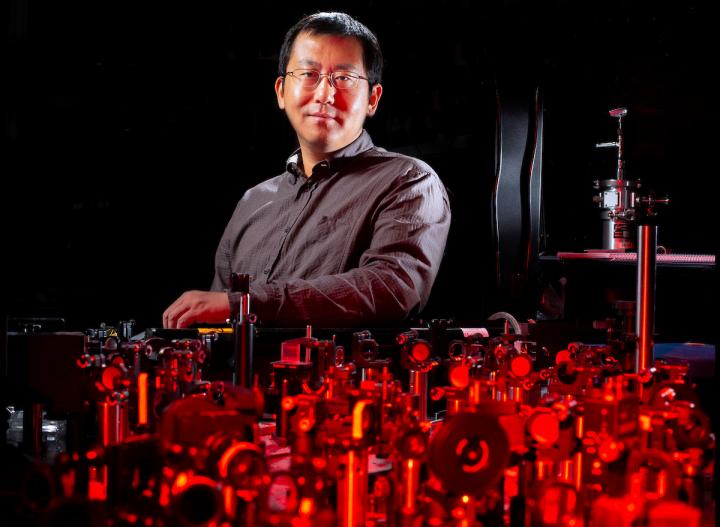
Even though it's a head-scratcher, Wang's work could be a big deal to all of us. CAPTION Jigang Wang and his research group use quantum terahertz spectroscopy to access, study and control quantum states of matter.  CREDIT Christopher Gannon/Iowa State University{module In-article}

Harnessing quantum physics - the particles and energy down at atomic scales - could lead to better supercomputing, sensing, communicating and data storing technologies. But first researchers such as Wang - a professor of physics and astronomy at Iowa State University and a physicist at the U.S. Department of Energy's Ames Laboratory - need to provide more answers about the quantum world.

In Wang's case, many of those answers are coming from quantum terahertz spectroscopy that can visualize and steer electrons.

A three-year, $465,000 grant from the U.S. Army Research Office has supported the spectroscopy studies by Wang and his research group.

Wang and his team have announced three discoveries based on those studies:

The first, reported in Nature Materials, describes how ultrafast pulses of photons - laser flashes at trillions of cycles per second - can switch on a state of matter hidden by superconductivity, the flow of electricity without resistance, usually at super-cold temperatures. The discovery demonstrates a new tuning knob - called "quantum quench" by the physicists - for non-equilibrium materials discovery such as switching on exotic, hidden states without temperature change.

The second, reported in Physical Review Letters, describes how the terahertz instrumentation can trace electron pairings in materials, revealing a new, light-induced, long-lived state of matter.

And the third, reported in Nature Photonics, describes how the ultrafast flashes of light Wang and his collaborators work with can be used like a knob to control and accelerate supercurrents. The flashes break equilibrium symmetry, thus triggering forbidden quantum oscillations that can't be achieved by any known means.

Wang has several collaborators who have contributed to the discoveries: the Ilias E. Perakis group at the University of Alabama at Birmingham contributed theoretical simulations; the Chang-Beom Eom group at the University of Wisconsin-Madison and the Paul Canfield group at Iowa State contributed high-quality superconducting materials and their characterizations.

High-speed potential

The Army Research Office sees potential in quantum technologies:

"Dr. Wang's work is revealing new physics and how we can use light to invoke new properties that are otherwise unavailable," said Marc Ulrich, physics division chief at the Army Research Office, an element of the U.S. Army Combat Capabilities Development Command's Army Research Laboratory. "Light-induced phases may enable technologies such as optical computing, novel sensors or unforeseen ways to control light or electrons."

The research in Wang's lab is mostly unexplored territory in condensed matter physics and materials science, Wang said. And so there's more work ahead to knock down knowledge barriers to help push development of quantum technologies and their high-speed communication capabilities.

"We'd like to use these tools - these fast flashes and high frequencies - to probe smaller scales, 1 to 10 nanometers (that's 1 to 10 billionths of a meter)," Wang said. "We'd also like to develop controls using terahertz light for the quantum computation community."

And how did all of this get started in Wang's lab? Where did these ideas about quantum discovery and control come from?

"I've always been fascinated by the discovery of new states of matter by developing new tools, especially those states that are difficult or even can't be accessed by conventional means," Wang said.

That means minimum changing of temperatures, pressures, chemical compositions or magnetic fields to get to these new states of matter that are typically unstable in equilibrium and often hidden by conventional measurement methods but have been stabilized in his experiments, Wang said.

Nor does he focus on accidental discoveries that sometimes happen by just trying something in the lab. Wang wants to develop and apply precise and powerful laboratory tools in a controlled, rational way to find these new states of matter hidden within superconducting and other complex materials.

By doing that, he said he's learning these intense terahertz flashes produced by his laboratory instruments really can be a control knob for finding, stabilizing, probing and potentially controlling these exotic states and their unique properties.

"We have established a new approach," he said, "to access and potentially control exotic states of matter."

  1. Brown shows why there's a sweet spot depth for underground magma chambers
  2. SAGUARO researchers use machine learning to locate first gravitational wave event of black hole mergers

Page 60 of 66

  • 55
  • 56
  • 57
  • 58
  • 59
  • 60
  • 61
  • 62
  • 63
  • 64
POPULAR RIGHT NOW
  • Supercomputers uncover a new class of cosmic explosions hidden in plain sight
    Supercomputers uncover a new class of cosmic explosions hidden in plain sight
  • AI supercharges the hunt for stronger magnets: Iowa State researchers launch a new era of intelligent materials discovery
    AI supercharges the hunt for stronger magnets: Iowa State researchers launch a new era of intelligent materials discovery
  • IBM's Historic stock collapse raises questions for the future of enterprise supercomputing
    IBM's Historic stock collapse raises questions for the future of enterprise supercomputing
  • Could a novel dark matter theory simultaneously resolve multiple cosmic enigmas? Supercomputer simulations provide a compelling, albeit currently unverified, potential solution
    Could a novel dark matter theory simultaneously resolve multiple cosmic enigmas? Supercomputer simulations provide a compelling, albeit currently unverified, potential solution
  • Melting icebergs may be reshaping Earth’s greatest ocean current
    Melting icebergs may be reshaping Earth’s greatest ocean current
  • Supercomputers replace ‘bathtub’ flood maps with physics-based digital twins of Britain’s coastline
    Supercomputers replace ‘bathtub’ flood maps with physics-based digital twins of Britain’s coastline
  • Supercomputers push neural quantum simulation beyond previous limits
    Supercomputers push neural quantum simulation beyond previous limits
  • Intel’s AI supercomputing revival: Q2 financial surge signals new era for CPU-powered HPC infrastructure
    Intel’s AI supercomputing revival: Q2 financial surge signals new era for CPU-powered HPC infrastructure
  • AI infrastructure financing fears shake semiconductor sector
    AI infrastructure financing fears shake semiconductor sector
  • AWS supercomputing investment reaches historic scale as Amazon’s AI strategy powers record financial results
    AWS supercomputing investment reaches historic scale as Amazon’s AI strategy powers record financial results
THIS YEAR'S MOST READ
  • Wall Street wants to trade supercomputing power like oil
    Wall Street wants to trade supercomputing power like oil
  • Cosmic ambition at scale: UK’s supercomputer unlocks a 2.5 petabytes universe
    Cosmic ambition at scale: UK’s supercomputer unlocks a 2.5 petabytes universe
  • Hidden order, revealed at scale: Supercomputing, electron ptychography uncover the inner workings of relaxor ferroelectrics
    Hidden order, revealed at scale: Supercomputing, electron ptychography uncover the inner workings of relaxor ferroelectrics
  • Beamforming the future: BeammWave's 6G push signals the rise of orbital-terrestrial wireless networks
    Joakim Axmon
    Joakim Axmon
  • Intel's Q1 results signal supercomputing surge driving Xeon momentum
    Intel's Q1 results signal supercomputing surge driving Xeon momentum
  • When stars fall apart: Supercomputing reveals the hidden physics of black holes
    When stars fall apart: Supercomputing reveals the hidden physics of black holes
  • Multi-layer simulations reveal the hidden supply chain of solar prominences
    Multi-layer simulations reveal the hidden supply chain of solar prominences
  • Japanese scientists decode dolphin speed with supercomputing: Turbulence, vortices, and the hidden physics of propulsion
    Japanese scientists decode dolphin speed with supercomputing: Turbulence, vortices, and the hidden physics of propulsion
  • Cosmic feedback at scale: Supercomputing reveals how quasars regulate the early Universe
    Cosmic feedback at scale: Supercomputing reveals how quasars regulate the early Universe
  • Modeling life at the microscopic scale: A computational breakthrough in oxygen transport
    Modeling life at the microscopic scale: A computational breakthrough in oxygen transport
MOST READ OF ALL-TIME
  • Largest Computational Biology Simulation Mimics The Ribosome
    Details
    112107
    The amino acid (green) slithers into the chemical reaction center, moving through an evolutionarily ancient corridor of the ribosome (purple). The amino acid is delivered to the reaction core by the transfer RNA molecule (yellow).
    The amino acid (green) slithers into the chemical reaction center, moving through an evolutionarily ancient corridor of the ribosome (purple). The amino acid is delivered to the reaction core by the transfer RNA molecule (yellow).
  • Silicon 'neurons' may add a new dimension to chips
    Details
    80990
    Silicon 'neurons' may add a new dimension to chips
  • Linux Networx Accelerators Expected to Drive up to 4x Price/Performance
    Details
    75537
  • Complex Concepts That Really Add Up
    Details
    73635
    Complex Concepts That Really Add Up
  • Blue Sky Studios Donates Animation SuperComputer to Wesleyan
    Details
    68140
    Each rack holds 52 Angstrom Microsystem-brand “blades,” with a memory footprint of 12 or 24 gigabytes each. (Photos by Olivia Bartlett Drake)
    Each rack holds 52 Angstrom Microsystem-brand “blades,” with a memory footprint of 12 or 24 gigabytes each. (Photos by Olivia Bartlett Drake)
  • Humanities, HPC connect at NERSC
    Details
    57945
  • TeraGrid ’09 'Call for Participation'
    Details
    54951
  • Turbulence responsible for black holes' balancing act
    Details
    52310
  • Cray Wins $52 Million SuperComputer Contract
    Details
    50139
  • SDSC Researchers Accurately Predict Protein Docking
    Details
    46078
  • FRONTPAGE
  • LATEST
  • POPULAR
  • REGISTER
  • SOCIAL
  • VIDEO
  • SUBSCRIPTION
  • RSS
  • GUIDELINES
  • PRIVACY
  • TOS
  • ABOUT
  • +1 (816) 799-4488
  • editorial@supercomputingonline.com
© 2001 - 2026 SuperComputingOnline.com, LLC. All rights reserved. This material may not be published, broadcast, rewritten or redistributed without permission.
Sign In
  • FRONT PAGE
  • LATEST
    • MEDIA KIT
    • MOST READ
    • RSS FEED
    • ACADEMIA
    • AEROSPACE
    • APPLICATIONS
    • ASTRONOMY
    • AUTOMOTIVE
    • BIG DATA
    • BIOLOGY
    • CHEMISTRY
    • CLIENTS
    • CLOUD
    • DEFENSE
    • DEVELOPER TOOLS
    • EARTH SCIENCES
    • ECONOMICS
    • ENGINEERING
    • ENTERTAINMENT
    • HEALTH
    • INDUSTRY
    • INTERCONNECTS
    • GAMING
    • GOVERNMENT
    • MANUFACTURING
    • MIDDLEWARE
    • MOVIES
    • NETWORKS
    • OIL & GAS
    • PHYSICS
    • PROCESSORS
    • RETAIL
    • SCIENCE
    • STORAGE
    • SYSTEMS
    • VISUALIZATION
  • VIDEOS
    • ADD YOUR VIDEOS
    • MANAGE VIDEOS
  • COMMUNITY
    • TRADE SHOWS
    • SOCIAL NETWORK VIDEOS
    • SURVEYS
    • APPLICATIONS BROWSER
    • CONVERSATION INBOX
    • SOCIAL ADVERTISER
    • GROUPS
    • MARKETPLACE LISTINGS
    • PAGES
    • LEADERBOARD
    • POINTS LISTING
      • BADGES
    • PRIVACY CONFIRM REQUEST
    • PRIVACY CREATE REQUEST

Hey there! We noticed you’re using an ad blocker.