SUPERCOMPUTING NEWS SUPERCOMPUTING NEWS
    • MEDIA KIT
    • MOST READ
    • RSS FEED
    • ACADEMIA
    • AEROSPACE
    • APPLICATIONS
    • ASTRONOMY
    • AUTOMOTIVE
    • BIG DATA
    • BIOLOGY
    • CHEMISTRY
    • CLIENTS
    • CLOUD
    • DEFENSE
    • DEVELOPER TOOLS
    • EARTH SCIENCES
    • ECONOMICS
    • ENGINEERING
    • ENTERTAINMENT
    • GAMING
    • GOVERNMENT
    • HEALTH
    • OIL & GAS
    • INDUSTRY
    • INTERCONNECTS
    • MANUFACTURING
    • MIDDLEWARE
    • MOVIES
    • NETWORKS
    • PHYSICS
    • PROCESSORS
    • RETAIL
    • SCIENCE
    • STORAGE
    • SYSTEMS
    • VISUALIZATION
    • AcyMailing subscription form

    • ADD YOUR VIDEOS
    • MANAGE VIDEOS
    • CONVERSATION INBOX
    • SOCIAL ADVERTISER
    • SOCIAL NETWORK VIDEOS
    • SURVEYS
    • GROUPS
    • PAGES
    • MARKETPLACE LISTINGS
    • APPLICATIONS BROWSER
    • PRIVACY CONFIRM REQUEST
    • PRIVACY CREATE REQUEST
    • LEADERBOARD
    • POINTS LISTING
      • BADGES
    • TRADE SHOWS
Sign In
Tyler O'Neal, Staff Editor GOVERNMENT March 11, 2022, 7:00 pm

Shape-shifting robots (VIDEO)

Wrapping an elastic ball (orange) in a layer of tiny robots (blue) allows researchers to program shape and behaviour.CREDIT:Jack Binysh
...

Read more https://www.supercomputingonline.com/categories-media/how-to-style/shape-shifting-robots-video


UK physicists show how the next generation of robots will be shape-shifters

Tyler O'Neal, Staff Editor GOVERNMENT March 11, 2022, 4:56 pm

Physicists have discovered a new way to coat soft robots in materials that allow them to move and function in a more purposeful way. The research, led by the UK's University of Bath, is described today in Science Advances. Wrapping an elastic ball (orange) in a layer of tiny robots (blue) allows researchers to program shape and behaviour.  CREDIT Jack Binysh
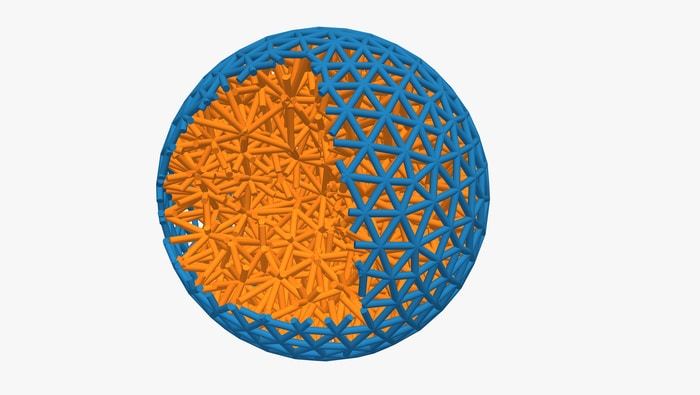
The authors of the study believe their breakthrough modeling on ‘active matter’ could mark a turning point in the design of robots. With further development of the concept, it may be possible to determine the shape, movement, and behavior of a soft solid not by its natural elasticity but by human-controlled activity on its surface.

The surface of an ordinary soft material always shrinks into a sphere. Think of the way water beads into droplets: the beading occurs because the surface of liquids and other soft material naturally contracts into the smallest surface area possible – i.e. a sphere. But active matter can be designed to work against this tendency. An example of this in action would be a rubber ball that’s wrapped in a layer of nano-robots, where the robots are programmed to work in unison to distort the ball into a new, pre-determined shape (say, a star).

{media id=278,layout=solo}

It is hoped that active matter will lead to a new generation of machines whose function will come from the bottom up. So, instead of being governed by a central controller (the way today’s robotic arms are controlled in factories), these new machines would be made from many individual active units that cooperate to determine the machine’s movement and function. This is akin to the workings of our own biological tissues, such as the fibers in heart muscle.

Using this idea, scientists could design soft machines with arms made of flexible materials powered by robots embedded in their surfaces. They could also tailor the size and shape of drug delivery capsules, by coating the surface of nanoparticles in a responsive, active material. This in turn could have a dramatic effect on how a drug interacts with cells in the body.

Work on active matter challenges the assumption that the energetic cost of the surface of a liquid or soft solid must always be positive because a certain amount of energy is always necessary to create a surface.

Dr. Jack Binysh, study first author, said: “Active matter makes us look at the familiar rules of nature – rules like the fact that surface tension has to be positive – in a new light. Seeing what happens if we break these rules, and how we can harness the results, is an exciting place to be doing research.”

Corresponding author Dr. Anton Souslov added: “This study is an important proof of concept and has many useful implications. For instance, future technology could produce soft robots that are far squishier and better at picking up and manipulating delicate materials.”

For the study, the researchers developed theory and simulations that described a 3D soft solid whose surface experiences active stresses. They found that these active stresses expand the surface of the material, pulling the solid underneath along with it, and causing a global shape change. The researchers found that the precise shape adopted by the solid could then be tailored by altering the elastic properties of the material.

In the next phase of this work – which has already begun – the researchers will apply this general principle to design specific robots, such as soft arms or self-swimming materials. They will also look at collective behavior – for example, what happens when you have many active solids, all packed together.

Italian built ML model forecasts if you'll leave your partner

Tyler O'Neal, Staff Editor GOVERNMENT March 10, 2022, 7:00 am

A Bocconi University, Milan, Italy study on couple dissolution shows that an ML approach can advance demographic research, detecting complex patterns in relatively small datasets

The life satisfaction of both partners and the woman’s percentage of housework turned out to be the most important predictors of union dissolution, when scholars affiliated to Bocconi’s Dondena Centre for Research on Social Dynamics and Public Policy used a machine learning (ML) technique to analyze data on 2,038 married or cohabiting couples who participated in the German Socio-Economic Panel Survey. Letizia Mencarini, Bocconi University, Milan, and co-authors used a Machine Learning technique to predict couple dissolution in a study published in Demography.  CREDIT Weiwei Chen
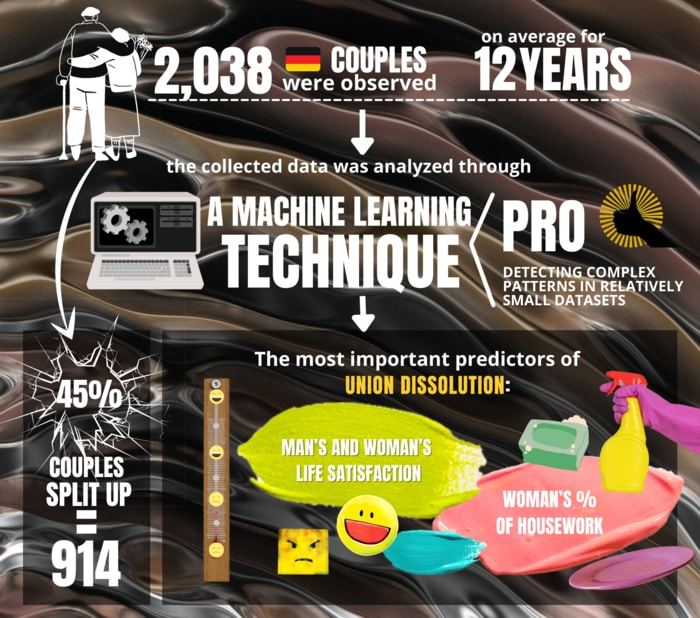
 
The couples were observed, on average, for 12 years, leading to a total of 18,613 observations. During the observation period, 914 couples (45%) split up.

In their article, newly published online on Demography, Bruno Arpino (University of Florence), Marco Le Moglie (Catholic University, Milan), and Letizia Mencarini (Bocconi), used an ML technique called Random Survival Forests (RSF) to overcome the difficulty to manage a large number of independent variables in conventional models.
 
“A clear-cut example of the potential difficulties of considering all variables and their possible interactions concerns the ‘big five personality traits,” Professor Mencarini said. “To account for both partners’ traits (10 variables) and all their two-way interactions (25 variables), one would need to include 35 independent variables, which would be very problematic in a regression model.” ML tools are, on the contrary, capable of detecting complex patterns in relatively small datasets.
 
Another advantage of ML is supposed to be its superior predictive power compared to conventional models, more attuned to explaining how certain mechanisms work than to predict the future behavior of the variables. When the authors divided their sample into two parts and used the results of the first half to predict the outcomes of the second half, they found that the predictive accuracy of RSF was considerably superior to that of conventional models. Nonetheless, the predictive accuracy of RSF was limited despite the use, as input variables, of all the most important predictors of union dissolution identified in the literature.

Among the variables with the greatest predictive ability, the authors found the life satisfaction of both partners, woman’s percentage of housework, marital status (i.e., married vs. cohabiting), woman’s working hours, woman’s level of openness, and man’s level of extraversion.
 
The analysis also found that many variables interact in complex ways. For instance, when a man’s life satisfaction was high, a higher woman’s life satisfaction constantly increased the union’s chances of surviving. But when man’s life satisfaction was low, the association between woman’s life satisfaction and union survival was negative after a given threshold.
 
The authors, though, did not detect any interaction effect when considering personal traits: a woman’s openness and a man’s extraversion make union dissolution more likely, irrespective of their partner’s personality.

  1. Using super-advanced computations, Northeastern researchers' breakthrough in quantum sensing provides new material to make qubits
  2. Quantum Brilliance wins commercialization partner in $17.5M German quantum supercomputing research project

Page 40 of 85

  • 35
  • 36
  • 37
  • 38
  • 39
  • 40
  • 41
  • 42
  • 43
  • 44
POPULAR RIGHT NOW
  • AI supercharges the hunt for stronger magnets: Iowa State researchers launch a new era of intelligent materials discovery
    AI supercharges the hunt for stronger magnets: Iowa State researchers launch a new era of intelligent materials discovery
  • IBM's Historic stock collapse raises questions for the future of enterprise supercomputing
    IBM's Historic stock collapse raises questions for the future of enterprise supercomputing
  • Could a novel dark matter theory simultaneously resolve multiple cosmic enigmas? Supercomputer simulations provide a compelling, albeit currently unverified, potential solution
    Could a novel dark matter theory simultaneously resolve multiple cosmic enigmas? Supercomputer simulations provide a compelling, albeit currently unverified, potential solution
  • Melting icebergs may be reshaping Earth’s greatest ocean current
    Melting icebergs may be reshaping Earth’s greatest ocean current
  • Supercomputers replace ‘bathtub’ flood maps with physics-based digital twins of Britain’s coastline
    Supercomputers replace ‘bathtub’ flood maps with physics-based digital twins of Britain’s coastline
  • Supercomputers push neural quantum simulation beyond previous limits
    Supercomputers push neural quantum simulation beyond previous limits
  • Intel’s AI supercomputing revival: Q2 financial surge signals new era for CPU-powered HPC infrastructure
    Intel’s AI supercomputing revival: Q2 financial surge signals new era for CPU-powered HPC infrastructure
  • AI infrastructure financing fears shake semiconductor sector
    AI infrastructure financing fears shake semiconductor sector
  • AWS supercomputing investment reaches historic scale as Amazon’s AI strategy powers record financial results
    AWS supercomputing investment reaches historic scale as Amazon’s AI strategy powers record financial results
  • Catching the wave of the future: Supercomputers unlock the hidden dynamics of Venus
    Catching the wave of the future: Supercomputers unlock the hidden dynamics of Venus
THIS YEAR'S MOST READ
  • Wall Street wants to trade supercomputing power like oil
    Wall Street wants to trade supercomputing power like oil
  • Beamforming the future: BeammWave's 6G push signals the rise of orbital-terrestrial wireless networks
    Joakim Axmon
    Joakim Axmon
  • Cosmic ambition at scale: UK’s supercomputer unlocks a 2.5 petabytes universe
    Cosmic ambition at scale: UK’s supercomputer unlocks a 2.5 petabytes universe
  • Hidden order, revealed at scale: Supercomputing, electron ptychography uncover the inner workings of relaxor ferroelectrics
    Hidden order, revealed at scale: Supercomputing, electron ptychography uncover the inner workings of relaxor ferroelectrics
  • Intel's Q1 results signal supercomputing surge driving Xeon momentum
    Intel's Q1 results signal supercomputing surge driving Xeon momentum
  • When stars fall apart: Supercomputing reveals the hidden physics of black holes
    When stars fall apart: Supercomputing reveals the hidden physics of black holes
  • Multi-layer simulations reveal the hidden supply chain of solar prominences
    Multi-layer simulations reveal the hidden supply chain of solar prominences
  • Japanese scientists decode dolphin speed with supercomputing: Turbulence, vortices, and the hidden physics of propulsion
    Japanese scientists decode dolphin speed with supercomputing: Turbulence, vortices, and the hidden physics of propulsion
  • Cosmic feedback at scale: Supercomputing reveals how quasars regulate the early Universe
    Cosmic feedback at scale: Supercomputing reveals how quasars regulate the early Universe
  • Modeling life at the microscopic scale: A computational breakthrough in oxygen transport
    Modeling life at the microscopic scale: A computational breakthrough in oxygen transport
MOST READ OF ALL-TIME
  • Largest Computational Biology Simulation Mimics The Ribosome
    Details
    112129
    The amino acid (green) slithers into the chemical reaction center, moving through an evolutionarily ancient corridor of the ribosome (purple). The amino acid is delivered to the reaction core by the transfer RNA molecule (yellow).
    The amino acid (green) slithers into the chemical reaction center, moving through an evolutionarily ancient corridor of the ribosome (purple). The amino acid is delivered to the reaction core by the transfer RNA molecule (yellow).
  • Silicon 'neurons' may add a new dimension to chips
    Details
    81042
    Silicon 'neurons' may add a new dimension to chips
  • Linux Networx Accelerators Expected to Drive up to 4x Price/Performance
    Details
    75564
  • Complex Concepts That Really Add Up
    Details
    73695
    Complex Concepts That Really Add Up
  • Blue Sky Studios Donates Animation SuperComputer to Wesleyan
    Details
    68167
    Each rack holds 52 Angstrom Microsystem-brand “blades,” with a memory footprint of 12 or 24 gigabytes each. (Photos by Olivia Bartlett Drake)
    Each rack holds 52 Angstrom Microsystem-brand “blades,” with a memory footprint of 12 or 24 gigabytes each. (Photos by Olivia Bartlett Drake)
  • Humanities, HPC connect at NERSC
    Details
    57974
  • TeraGrid ’09 'Call for Participation'
    Details
    54977
  • Turbulence responsible for black holes' balancing act
    Details
    52341
  • Cray Wins $52 Million SuperComputer Contract
    Details
    50163
  • SDSC Researchers Accurately Predict Protein Docking
    Details
    46116
  • FRONTPAGE
  • LATEST
  • POPULAR
  • REGISTER
  • SOCIAL
  • VIDEO
  • SUBSCRIPTION
  • RSS
  • GUIDELINES
  • PRIVACY
  • TOS
  • ABOUT
  • +1 (816) 799-4488
  • editorial@supercomputingonline.com
© 2001 - 2026 SuperComputingOnline.com, LLC. All rights reserved. This material may not be published, broadcast, rewritten or redistributed without permission.
Sign In
  • FRONT PAGE
  • LATEST
    • MEDIA KIT
    • MOST READ
    • RSS FEED
    • ACADEMIA
    • AEROSPACE
    • APPLICATIONS
    • ASTRONOMY
    • AUTOMOTIVE
    • BIG DATA
    • BIOLOGY
    • CHEMISTRY
    • CLIENTS
    • CLOUD
    • DEFENSE
    • DEVELOPER TOOLS
    • EARTH SCIENCES
    • ECONOMICS
    • ENGINEERING
    • ENTERTAINMENT
    • HEALTH
    • INDUSTRY
    • INTERCONNECTS
    • GAMING
    • GOVERNMENT
    • MANUFACTURING
    • MIDDLEWARE
    • MOVIES
    • NETWORKS
    • OIL & GAS
    • PHYSICS
    • PROCESSORS
    • RETAIL
    • SCIENCE
    • STORAGE
    • SYSTEMS
    • VISUALIZATION
  • VIDEOS
    • ADD YOUR VIDEOS
    • MANAGE VIDEOS
  • COMMUNITY
    • TRADE SHOWS
    • SOCIAL NETWORK VIDEOS
    • SURVEYS
    • APPLICATIONS BROWSER
    • CONVERSATION INBOX
    • SOCIAL ADVERTISER
    • GROUPS
    • MARKETPLACE LISTINGS
    • PAGES
    • LEADERBOARD
    • POINTS LISTING
      • BADGES
    • PRIVACY CONFIRM REQUEST
    • PRIVACY CREATE REQUEST

Hey there! We noticed you’re using an ad blocker.