SUPERCOMPUTING NEWS SUPERCOMPUTING NEWS
    • MEDIA KIT
    • MOST READ
    • RSS FEED
    • ACADEMIA
    • AEROSPACE
    • APPLICATIONS
    • ASTRONOMY
    • AUTOMOTIVE
    • BIG DATA
    • BIOLOGY
    • CHEMISTRY
    • CLIENTS
    • CLOUD
    • DEFENSE
    • DEVELOPER TOOLS
    • EARTH SCIENCES
    • ECONOMICS
    • ENGINEERING
    • ENTERTAINMENT
    • GAMING
    • GOVERNMENT
    • HEALTH
    • OIL & GAS
    • INDUSTRY
    • INTERCONNECTS
    • MANUFACTURING
    • MIDDLEWARE
    • MOVIES
    • NETWORKS
    • PHYSICS
    • PROCESSORS
    • RETAIL
    • SCIENCE
    • STORAGE
    • SYSTEMS
    • VISUALIZATION
    • AcyMailing subscription form

    • ADD YOUR VIDEOS
    • MANAGE VIDEOS
    • CONVERSATION INBOX
    • SOCIAL ADVERTISER
    • SOCIAL NETWORK VIDEOS
    • SURVEYS
    • GROUPS
    • PAGES
    • MARKETPLACE LISTINGS
    • APPLICATIONS BROWSER
    • PRIVACY CONFIRM REQUEST
    • PRIVACY CREATE REQUEST
    • LEADERBOARD
    • POINTS LISTING
      • BADGES
    • TRADE SHOWS
Sign In
Tyler O'Neal, Staff Editor GOVERNMENT May 18, 2021, 6:00 pm

German astrophysicists succeed in gaining new insight into the origin of the elements

Europium is the key for understanding the formation of the heavy elements by the fast neutron capture process, the so-called r-process. This is crucial both for the formation of half of the elements heavier than iron and for the total abundance of thorium and uranium in the universe. The EUROPIUM group has combined theoretical astrophysical simulations with observations of the oldest stars in our Galaxy and in dwarf galaxies. The latter are small, dark-matter-dominated galaxies orbiting our Galaxy. Dwarf galaxies are excellent test objects for studying the r-process, as some of the oldest metal-poor stars, those that have existed for 10 to 13 billion years, have exhibited an overabundance of r-process elements. Studies have even postulated that only a single neutron-rich event could be responsible for this enrichment in the smallest dwarf galaxies. The EUROPIUM group has combined theoretical astrophysical simulations with observations of the oldest stars in our galaxy and in dwarf galaxies.
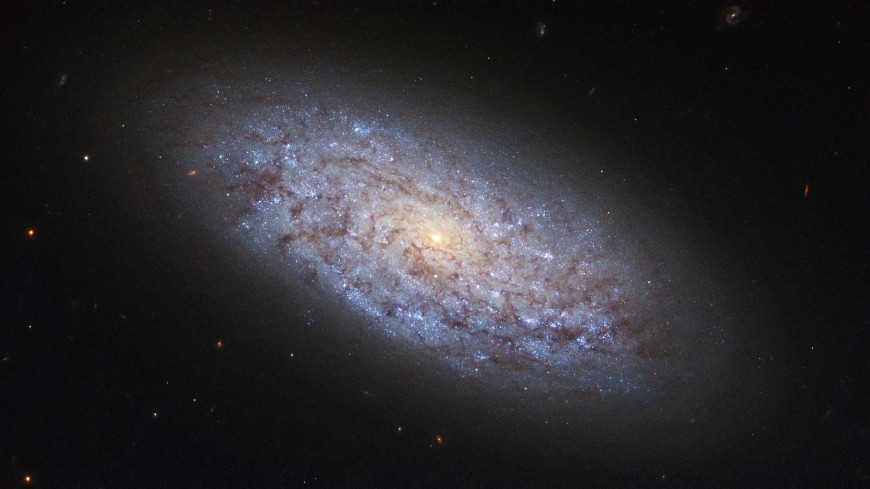
With their discovery, the researchers in Darmstadt and Heidelberg have succeeded in determining the highest europium content ever observed – and they have created a new name for these stars: "europium stars". These stars belong to the dwarf galaxy Fornax – a dwarf spheroidal galaxy with high stellar content. In their publication, the group also reports the first-ever observation of lutetium in a dwarf galaxy and the largest sample of observed zirconium.

The "europium stars" in Fornax were born shortly after an explosive production of heavy elements. Based on the high stellar metal abundance, the extreme r-process event must have occurred as recently as four to five billion years ago. This is a very rare finding, as most europium-rich stars are much older. Therefore, europium stars provide insight into the origin of elements in the universe at a very specific and late time.

Heavy elements are formed by the r-process in the merger of two neutron stars or in the explosive end of massive stars with strong magnetic fields. The EUROPIUM group has analyzed these two high-energy events and performed detailed studies of element production in these environments. However, due to the still large uncertainties in the nuclear physics data, it is not possible to unambiguously assign the heavy elements in the "europium stars" to one of these astrophysical environments. Future experiments in the new accelerator center FAIR at the GSI Helmholtzzentrum für Schwerionenforschung in Darmstadt will significantly reduce these uncertainties.

In addition, the new Hessian cluster project ELEMENTS, in which Professor Arcones is a principal investigator, will uniquely combine supercomputer simulations of neutron star fusion, nucleosynthesis calculations with the latest experimental information and observations to investigate the long-standing question: Where and how are heavy elements produced in the universe?

Chinese researchers achieve quantum information masking experimentally

Tyler O'Neal, Staff Editor GOVERNMENT May 18, 2021, 6:00 pm

The research team, led by Academician GUO Guangcan from the University of Science and Technology of China (USTC) of the Chinese Academy of Sciences, collaborating with LI Bo from Shangrao Normal University and CHEN Jingling from Nankai University, achieved the masking of optical quantum information. The researchers concealed quantum information into non-local quantum entangled states. The study was published in the journal Physical Review Letters.

Quantum information masking as one of the new information processing protocols transfers quantum information from a single quantum carrier to the quantum entangled state between multiple carriers avoiding the information decode from a single quantum carrier. Not all the kind of quantum states can achieve masking, but the variety of that helps people to select.

Quantum information masking can be used in a wide situation, not only in actual quantum information tasks such as quantum secret sharing but also in the further understanding of the conservation of quantum information.

In this research, the team realized quantum information masking for the first time based on the linear optics research platform.

Compared with the theoretical value, the fidelity of the entangled state can be 97.7%, meaning that the secure transmission of simple images can be complete for the three-party quantum secret sharing based on quantum information masking.

This study has great significance for theoretical research and the practical application of secure quantum communication. Based on it, the feasibility of quantum information masking as a brand-new quantum information processing protocol is improved.


Groningen physicists use new material for spintronics

Tyler O'Neal, Staff Editor GOVERNMENT May 18, 2021, 9:00 am

Classic computers use binary values (0/1) to perform. By contrast, our brain cells can use more values to operate, making them more energy-efficient than computers. This is why scientists are interested in neuromorphic (brain-like) computing. Physicists from the University of Groningen in the Netherlands have used a complex oxide to create elements comparable to the neurons and synapses in the brain using spins, a magnetic property of electrons. Their results were published on 18 May in the journal Frontiers in Nanotechnology. 

Although computers can do straightforward calculations much faster than humans, our brains outperform silicon machines in tasks like object recognition. Furthermore, our brain uses less energy than computers. Part of this can be explained by the way our brain operates: whereas a computer uses a binary system (with values 0 or 1), brain cells can provide more analog signals with a range of values.

Thin filmsThis is Anouk Goossens, first author of the Frontiers in Nanotechnology paper.

The operation of our brains can be simulated in supercomputers, but the basic architecture still relies on a binary system. That is why scientists look for ways to expand this, creating hardware that is more brain-like but will also interface with normal computers. "One idea is to create magnetic bits that can have intermediate states," says Tamalika Banerjee, Professor of Spintronics of Functional Materials at the Zernike Institute for Advanced Materials, University of Groningen. She works on spintronics, which uses a magnetic property of electrons called 'spin' to transport, manipulate and store information.

In this study, her Ph.D. student Anouk Goossens, first author of the paper, created thin films of a ferromagnetic metal (strontium-ruthenate oxide, SRO) grown on a substrate of strontium titanate oxide. The resulting thin film contained magnetic domains that were perpendicular to the plane of the film. "These can be switched more efficiently than in-plane magnetic domains', explains Goossens. By adapting the growth conditions, it is possible to control the crystal orientation in the SRO. Previously, out-of-plane magnetic domains have been made using other techniques, but these typically require complex layer structures. 

Magnetic anisotropy This is Mina Leiviskä, second author of the Frontiers in Nanotechnology paper.

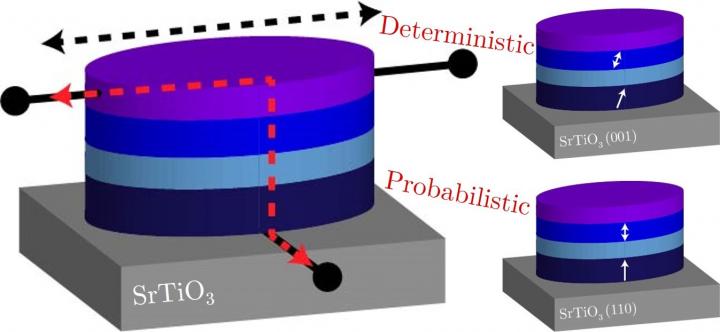
The magnetic domains can be switched using a current through a platinum electrode on top of the SRO. Goossens: "When the magnetic domains are oriented perfectly perpendicular to the film, this switching is deterministic: the entire domain will switch." However, when the magnetic domains are slightly tilted, the response is probabilistic: not all the domains are the same, and intermediate values occur when only part of the crystals in the domain have switched.

By choosing variants of the substrate on which the SRO is grown, scientists can control its magnetic anisotropy. This allows them to produce two different spintronic devices. 'This magnetic anisotropy is exactly what we wanted', says Goossens. "Probabilistic switching compares to how neurons function, while the deterministic switching is more like a synapse." Schematic of the proposed device structure for neuromorphic spintronic memristors. The write path is between the terminals through the top layer (black dotted line), the read path goes through the device stack (red dotted line). The right side of the figure indicates how the choice of substrate dictates whether the device will show deterministic or probabilistic behaviour.  CREDIT Banerjee group, University of Groningen

The scientists expect that in the future, brain-like computer hardware can be created by combining these different domains in a spintronic device that can be connected to standard silicon-based circuits. Furthermore, probabilistic switching would also allow for stochastic computing, a promising technology that represents continuous values by streams of random bits. Banerjee: "We have found a way to control intermediate states, not just for memory but also for computing."

  1. China shows how errors in large-scale, convective tropical precipitation simulations using current global models may impact climate feedback
  2. Future sparkles for diamond-based quantum technology

Page 53 of 85

  • 48
  • 49
  • 50
  • 51
  • 52
  • 53
  • 54
  • 55
  • 56
  • 57
POPULAR RIGHT NOW
  • AI supercharges the hunt for stronger magnets: Iowa State researchers launch a new era of intelligent materials discovery
    AI supercharges the hunt for stronger magnets: Iowa State researchers launch a new era of intelligent materials discovery
  • IBM's Historic stock collapse raises questions for the future of enterprise supercomputing
    IBM's Historic stock collapse raises questions for the future of enterprise supercomputing
  • Could a novel dark matter theory simultaneously resolve multiple cosmic enigmas? Supercomputer simulations provide a compelling, albeit currently unverified, potential solution
    Could a novel dark matter theory simultaneously resolve multiple cosmic enigmas? Supercomputer simulations provide a compelling, albeit currently unverified, potential solution
  • Melting icebergs may be reshaping Earth’s greatest ocean current
    Melting icebergs may be reshaping Earth’s greatest ocean current
  • Supercomputers replace ‘bathtub’ flood maps with physics-based digital twins of Britain’s coastline
    Supercomputers replace ‘bathtub’ flood maps with physics-based digital twins of Britain’s coastline
  • Supercomputers push neural quantum simulation beyond previous limits
    Supercomputers push neural quantum simulation beyond previous limits
  • Intel’s AI supercomputing revival: Q2 financial surge signals new era for CPU-powered HPC infrastructure
    Intel’s AI supercomputing revival: Q2 financial surge signals new era for CPU-powered HPC infrastructure
  • AI infrastructure financing fears shake semiconductor sector
    AI infrastructure financing fears shake semiconductor sector
  • AWS supercomputing investment reaches historic scale as Amazon’s AI strategy powers record financial results
    AWS supercomputing investment reaches historic scale as Amazon’s AI strategy powers record financial results
  • Catching the wave of the future: Supercomputers unlock the hidden dynamics of Venus
    Catching the wave of the future: Supercomputers unlock the hidden dynamics of Venus
THIS YEAR'S MOST READ
  • Wall Street wants to trade supercomputing power like oil
    Wall Street wants to trade supercomputing power like oil
  • Beamforming the future: BeammWave's 6G push signals the rise of orbital-terrestrial wireless networks
    Joakim Axmon
    Joakim Axmon
  • Cosmic ambition at scale: UK’s supercomputer unlocks a 2.5 petabytes universe
    Cosmic ambition at scale: UK’s supercomputer unlocks a 2.5 petabytes universe
  • Hidden order, revealed at scale: Supercomputing, electron ptychography uncover the inner workings of relaxor ferroelectrics
    Hidden order, revealed at scale: Supercomputing, electron ptychography uncover the inner workings of relaxor ferroelectrics
  • Intel's Q1 results signal supercomputing surge driving Xeon momentum
    Intel's Q1 results signal supercomputing surge driving Xeon momentum
  • When stars fall apart: Supercomputing reveals the hidden physics of black holes
    When stars fall apart: Supercomputing reveals the hidden physics of black holes
  • Multi-layer simulations reveal the hidden supply chain of solar prominences
    Multi-layer simulations reveal the hidden supply chain of solar prominences
  • Japanese scientists decode dolphin speed with supercomputing: Turbulence, vortices, and the hidden physics of propulsion
    Japanese scientists decode dolphin speed with supercomputing: Turbulence, vortices, and the hidden physics of propulsion
  • Cosmic feedback at scale: Supercomputing reveals how quasars regulate the early Universe
    Cosmic feedback at scale: Supercomputing reveals how quasars regulate the early Universe
  • Modeling life at the microscopic scale: A computational breakthrough in oxygen transport
    Modeling life at the microscopic scale: A computational breakthrough in oxygen transport
MOST READ OF ALL-TIME
  • Largest Computational Biology Simulation Mimics The Ribosome
    Details
    112129
    The amino acid (green) slithers into the chemical reaction center, moving through an evolutionarily ancient corridor of the ribosome (purple). The amino acid is delivered to the reaction core by the transfer RNA molecule (yellow).
    The amino acid (green) slithers into the chemical reaction center, moving through an evolutionarily ancient corridor of the ribosome (purple). The amino acid is delivered to the reaction core by the transfer RNA molecule (yellow).
  • Silicon 'neurons' may add a new dimension to chips
    Details
    81042
    Silicon 'neurons' may add a new dimension to chips
  • Linux Networx Accelerators Expected to Drive up to 4x Price/Performance
    Details
    75564
  • Complex Concepts That Really Add Up
    Details
    73695
    Complex Concepts That Really Add Up
  • Blue Sky Studios Donates Animation SuperComputer to Wesleyan
    Details
    68167
    Each rack holds 52 Angstrom Microsystem-brand “blades,” with a memory footprint of 12 or 24 gigabytes each. (Photos by Olivia Bartlett Drake)
    Each rack holds 52 Angstrom Microsystem-brand “blades,” with a memory footprint of 12 or 24 gigabytes each. (Photos by Olivia Bartlett Drake)
  • Humanities, HPC connect at NERSC
    Details
    57974
  • TeraGrid ’09 'Call for Participation'
    Details
    54977
  • Turbulence responsible for black holes' balancing act
    Details
    52341
  • Cray Wins $52 Million SuperComputer Contract
    Details
    50163
  • SDSC Researchers Accurately Predict Protein Docking
    Details
    46116
  • FRONTPAGE
  • LATEST
  • POPULAR
  • REGISTER
  • SOCIAL
  • VIDEO
  • SUBSCRIPTION
  • RSS
  • GUIDELINES
  • PRIVACY
  • TOS
  • ABOUT
  • +1 (816) 799-4488
  • editorial@supercomputingonline.com
© 2001 - 2026 SuperComputingOnline.com, LLC. All rights reserved. This material may not be published, broadcast, rewritten or redistributed without permission.
Sign In
  • FRONT PAGE
  • LATEST
    • MEDIA KIT
    • MOST READ
    • RSS FEED
    • ACADEMIA
    • AEROSPACE
    • APPLICATIONS
    • ASTRONOMY
    • AUTOMOTIVE
    • BIG DATA
    • BIOLOGY
    • CHEMISTRY
    • CLIENTS
    • CLOUD
    • DEFENSE
    • DEVELOPER TOOLS
    • EARTH SCIENCES
    • ECONOMICS
    • ENGINEERING
    • ENTERTAINMENT
    • HEALTH
    • INDUSTRY
    • INTERCONNECTS
    • GAMING
    • GOVERNMENT
    • MANUFACTURING
    • MIDDLEWARE
    • MOVIES
    • NETWORKS
    • OIL & GAS
    • PHYSICS
    • PROCESSORS
    • RETAIL
    • SCIENCE
    • STORAGE
    • SYSTEMS
    • VISUALIZATION
  • VIDEOS
    • ADD YOUR VIDEOS
    • MANAGE VIDEOS
  • COMMUNITY
    • TRADE SHOWS
    • SOCIAL NETWORK VIDEOS
    • SURVEYS
    • APPLICATIONS BROWSER
    • CONVERSATION INBOX
    • SOCIAL ADVERTISER
    • GROUPS
    • MARKETPLACE LISTINGS
    • PAGES
    • LEADERBOARD
    • POINTS LISTING
      • BADGES
    • PRIVACY CONFIRM REQUEST
    • PRIVACY CREATE REQUEST

Hey there! We noticed you’re using an ad blocker.