

SUPERCOMPUTING NEWS SUPERCOMPUTING NEWS
    • MEDIA KIT
    • MOST READ
    • RSS FEED
    • ACADEMIA
    • AEROSPACE
    • APPLICATIONS
    • ASTRONOMY
    • AUTOMOTIVE
    • BIG DATA
    • BIOLOGY
    • CHEMISTRY
    • CLIENTS
    • CLOUD
    • DEFENSE
    • DEVELOPER TOOLS
    • EARTH SCIENCES
    • ECONOMICS
    • ENGINEERING
    • ENTERTAINMENT
    • GAMING
    • GOVERNMENT
    • HEALTH
    • OIL & GAS
    • INDUSTRY
    • INTERCONNECTS
    • MANUFACTURING
    • MIDDLEWARE
    • MOVIES
    • NETWORKS
    • PHYSICS
    • PROCESSORS
    • RETAIL
    • SCIENCE
    • STORAGE
    • SYSTEMS
    • VISUALIZATION
    • AcyMailing subscription form

    • ADD YOUR VIDEOS
    • MANAGE VIDEOS
    • CONVERSATION INBOX
    • SOCIAL ADVERTISER
    • SOCIAL NETWORK VIDEOS
    • SURVEYS
    • GROUPS
    • PAGES
    • MARKETPLACE LISTINGS
    • APPLICATIONS BROWSER
    • PRIVACY CONFIRM REQUEST
    • PRIVACY CREATE REQUEST
    • LEADERBOARD
    • POINTS LISTING
      • BADGES
    • TRADE SHOWS
Sign In
Tyler O'Neal, Staff Editor INDUSTRY November 25, 2021, 8:40 am

A new artificial material mimics quantum entangled rare earth compounds

Viliam Vaňo and his colleagues created a new ultra-thin two-layer material with quantum properties that normally require rare earth compounds.This material could improve quantum supercomputers and advance research into superconductivity and quantum criticality.In this interview, Vaňo tells the story of how this discovery was made.
...

Read more https://www.supercomputingonline.com/categories-media/mediaitem/264-a-new-artificial-material-mimics-quantum-entangled-rare-earth-compounds?category_id=61

Data from ESA's Gaia mission is re-writing the history of our galaxy

Tyler O'Neal, Staff Editor INDUSTRY November 25, 2021, 7:00 am

A dwarf galaxy is a collection of between thousand and several billion stars. For decades it has been widely believed that the dwarf galaxies that surround the Milky Way are satellites, meaning that they are caught in orbit around our galaxy, and have been our constant companions for many billions of years. Now the motions of these dwarf galaxies have been super computed with unprecedented precision thanks to data from Gaia’s early third data release and the results are surprising.

François Hammer, Observatoire de Paris - Université Paris Sciences et Lettres, France, and colleagues from across Europe and China, used the Gaia data to calculate the movements of 40 dwarf galaxies around the Milky Way. They did this by supercomputing a set of quantities known as the three-dimensional velocities for each galaxy, and then using those to calculate the galaxy’s orbital energy and the angular (rotational) momentum. Dwarf galaxies around the Milky Way
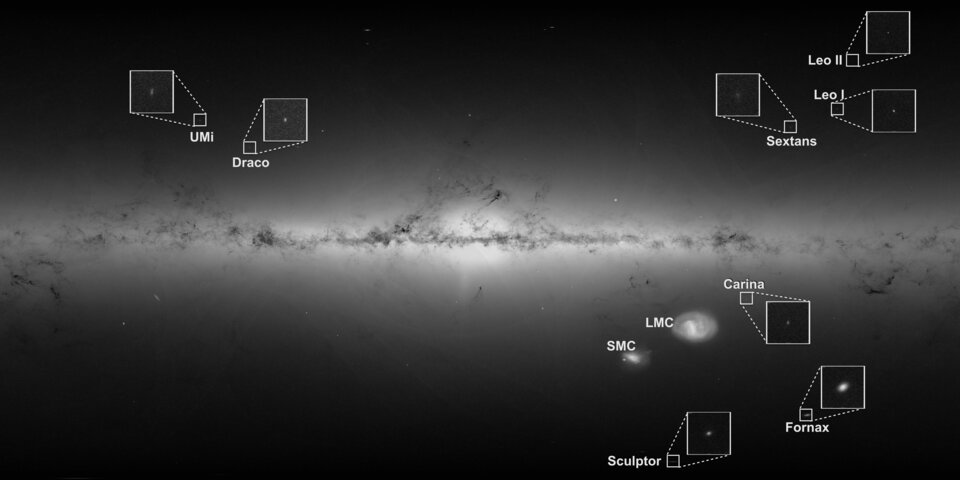
They found that these galaxies are moving much faster than the giant stars and star clusters that are known to be orbiting the Milky Way. So fast, that they couldn’t be in orbit yet around the Milky Way, where interactions with our galaxy and its contents would have sapped their orbital energy and angular momentum.

Our galaxy has cannibalized many dwarf galaxies in its past. For example, 8-10 billion years ago, a dwarf galaxy called Gaia-Enceladus was absorbed by the Milky Way. Its stars can be identified in Gaia data because of the eccentric orbits and range of energies they possess.

More recently, 4-5 billion years ago, the Sagittarius dwarf galaxy was captured by the Milky Way and is currently in the process of being pulled to pieces and assimilated. The energy of its stars is higher than those of Gaia-Enceladus, indicating the shorter time that they have been subject to the Milky Way’s influence.

In the case of the dwarf galaxies in the new study, which represents the majority of the dwarf galaxies around the Milky Way, their energies are higher still. This strongly suggests that they have only arrived in our vicinity in the last few billion years.

The discovery mirrors one made about the Large Magellanic Cloud (LMC), a larger dwarf galaxy so close to the Milky Way that it is visible as a smudge of light in the night sky from the southern hemisphere. The LMC was also thought to be a satellite galaxy of the Milky Way until the 2000s when astronomers measured its velocity and found that it was traveling too fast to be gravitationally bound. Instead of a companion, LMC is visiting for the first time. Now we know that the same is true for most dwarf galaxies too.

So will these newcomers settle into orbit or simply pass us by? “Some of them will be captured by the Milky Way and will become satellites,” says François.

But saying exactly which ones is difficult because it depends on the exact mass of the Milky Way, and that is a quantity that is difficult for astronomers to calculate with any real accuracy. Estimates vary by a factor of two.

The discovery of the dwarf galaxy energies is significant because it forces us to re-evaluate the nature of the dwarf galaxies themselves.

As a dwarf galaxy orbits, the Milky Way’s gravitational pull will try to wrench it apart. In physics, this is known as a tidal force. “The Milky Way is a big galaxy, so its tidal force is simply gigantic and it's very easy to destroy a dwarf galaxy after maybe one or two passages,” says François.

In other words, becoming a companion to the Milky Way is a death sentence for dwarf galaxies. The only thing that could resist our galaxy’s destructive grip is if the dwarf had a significant quantity of dark matter. Dark matter is the mysterious substance that astronomers think exists in the universe to provide the extra gravity to hold individual galaxies together.

And so, in the traditional view that the Milky Way’s dwarfs were satellite galaxies that had been in orbit for many billions of years, it was assumed that they must be dominated by dark matter to balance the Milky Way’s tidal force and keep them intact. The fact that Gaia has revealed that most of the dwarf galaxies are circling the Milky Way for the first time means that they do not necessarily need to include any dark matter at all, and we must re-assess whether these systems are in balance or rather in the process of destruction.

“Thanks in large part to Gaia, it is now obvious that the history of the Milky Way is far more storied than astronomers had previously understood. By investigating these tantalizing clues, we hope to further tease out the fascinating chapters in our galaxy’s past,” says Timo Prusti, Gaia Project Scientist, ESA.

Mirabilis Design System-Level AI Modeler reduces latency, power by 2-6X

Tyler O'Neal, Staff Editor INDUSTRY November 25, 2021, 6:00 am

Mirabilis Design has released VisualSim AI Processor Designer. VisualSim AI accelerates time-to-market of new AI technology, configures high-performance computing systems, eliminates under and over-design, and provides an interactive reference design for end-users to create new applications. 

VisualSim can be used for the architecture evaluation of AI processor hardware, partition AI algorithms on a System-on-Chip (SoC), test the AI/ML implementation, and measure power and performance of an AI processor in automotive, medical, and data center applications. The Intellectual Property available in the VisualSim AI brings together processor cores, neural networks, accelerators, GPU, and DSP. At the system level, VisualSim AI can be integrated with a network model and FPGA boards for full system verification.

“The best processor configuration depends on the application, price point, and the expected performance. Trying to predict the feasibility before building the first prototype requires modeling IP, which is never readily available. The intense competition in the marketplace makes the delay in detecting performance limitation, a major detriment to a successful new product introduction”, says Deepak Shankar, Vice President – Technology, Mirabilis Design Inc. “The complex model requires configurable IPs and an integrated simulation environment.”

The AI Designer enables an architect to rapidly construct a graphical model using parameterized IP and integrating around an interconnect such as a Network-on-Chip, Quantum Nodes, or in-Memory elements. The user can accurately simulate AI workloads and real-life interface traffic. The model can vary task allocation between cores, neural networks, and accelerators; size the system parameters; create an equilibrium between response time and power consumption, and select the scheduler and buffer strategy. The combination of the large model capacity, fast model construction, an extremely fast simulator, and a programmable analytics engine, enables users to rapidly arrive at the most suitable architecture. 

Users can run software on the VisualSim AI architecture to measure response times, power, network throughput, cache hit-ratio, and memory bandwidth. VisualSim AI enables companies to optimize and validate the SoC system specification, and system companies to select the right SoC for the target application. A number of beta customers have utilized this platform to design AI SoC for the data center and automotive applications. Other applications that can use this platform are autonomous driving, radars’ processing, defense systems, flight avionics, medical instruments, high-performance computing, and infotainment systems.

Availability

VisualSim AI designers have tested the accuracy of the IP blocks for task latency and power consumption across multiple projects. The platform works on VisualSim version 2140b. OS supported includes Windows, Linux, and Mac OS. To learn more, register for a private session in Booth 2441 at Design Automation Conference 2021 in San Francisco by registering at https://calendly.com/mirabilisdesign/dac or contact Mirabilis Design at info@mirabilisdesign.com. 

  1. Using MD simulations, MIT chemists show how molecular clusters in the nucleus interact with chromosomes
  2. University of Copenhagen's Lorenzen implements new algo on Computerome 2 to predict COVID-related ICU resource use, saves lives

Page 32 of 39

  • 27
  • 28
  • 29
  • 30
  • 31
  • 32
  • 33
  • 34
  • 35
  • 36
POPULAR RIGHT NOW
  • Supercomputers replace ‘bathtub’ flood maps with physics-based digital twins of Britain’s coastline
    Supercomputers replace ‘bathtub’ flood maps with physics-based digital twins of Britain’s coastline
  • Supercomputers push neural quantum simulation beyond previous limits
    Supercomputers push neural quantum simulation beyond previous limits
  • Intel’s AI supercomputing revival: Q2 financial surge signals new era for CPU-powered HPC infrastructure
    Intel’s AI supercomputing revival: Q2 financial surge signals new era for CPU-powered HPC infrastructure
  • AI infrastructure financing fears shake semiconductor sector
    AI infrastructure financing fears shake semiconductor sector
  • AWS supercomputing investment reaches historic scale as Amazon’s AI strategy powers record financial results
    AWS supercomputing investment reaches historic scale as Amazon’s AI strategy powers record financial results
  • Catching the wave of the future: Supercomputers unlock the hidden dynamics of Venus
    Catching the wave of the future: Supercomputers unlock the hidden dynamics of Venus
  • NCAR supercomputers run planet scale climate experiments impossible in the real world
    NCAR supercomputers run planet scale climate experiments impossible in the real world
  • AI hunts the cosmos: Machine learning helps astronomers discover the first ‘Wandering’ supermassive black hole caught destroying a star
    AI hunts the cosmos: Machine learning helps astronomers discover the first ‘Wandering’ supermassive black hole caught destroying a star
  • Supercomputing for the masses: Meta's vision of a personal superintelligence for everyone
    Supercomputing for the masses: Meta's vision of a personal superintelligence for everyone
  • NVIDIA helps turn AI compute into a new asset class as Wall Street mobilizes $500 billion
    NVIDIA helps turn AI compute into a new asset class as Wall Street mobilizes $500 billion
THIS YEAR'S MOST READ
  • Wall Street wants to trade supercomputing power like oil
    Wall Street wants to trade supercomputing power like oil
  • Beamforming the future: BeammWave's 6G push signals the rise of orbital-terrestrial wireless networks
    Joakim Axmon
    Joakim Axmon
  • Cosmic ambition at scale: UK’s supercomputer unlocks a 2.5 petabytes universe
    Cosmic ambition at scale: UK’s supercomputer unlocks a 2.5 petabytes universe
  • Hidden order, revealed at scale: Supercomputing, electron ptychography uncover the inner workings of relaxor ferroelectrics
    Hidden order, revealed at scale: Supercomputing, electron ptychography uncover the inner workings of relaxor ferroelectrics
  • Intel's Q1 results signal supercomputing surge driving Xeon momentum
    Intel's Q1 results signal supercomputing surge driving Xeon momentum
  • When stars fall apart: Supercomputing reveals the hidden physics of black holes
    When stars fall apart: Supercomputing reveals the hidden physics of black holes
  • MIT develops computational framework to probe dark matter via gravitational waves
    MIT develops computational framework to probe dark matter via gravitational waves
  • Explainable AI moves into the watershed: FAMU-FSU engineers build predictive framework for real-time E. coli forecasting
    FAMU-FSU College of Engineering Assistant Professor Nasrin Alamdari. (Scott Holstein/FAMU-FSU College of Engineering)
    FAMU-FSU College of Engineering Assistant Professor Nasrin Alamdari. (Scott Holstein/FAMU-FSU College of Engineering)
  • Multi-layer simulations reveal the hidden supply chain of solar prominences
    Multi-layer simulations reveal the hidden supply chain of solar prominences
  • Japanese scientists decode dolphin speed with supercomputing: Turbulence, vortices, and the hidden physics of propulsion
    Japanese scientists decode dolphin speed with supercomputing: Turbulence, vortices, and the hidden physics of propulsion
  • FRONTPAGE
  • LATEST
  • POPULAR
  • REGISTER
  • SOCIAL
  • VIDEO
  • SUBSCRIPTION
  • RSS
  • GUIDELINES
  • PRIVACY
  • TOS
  • ABOUT
  • +1 (816) 799-4488
  • editorial@supercomputingonline.com
© 2001 - 2026 SuperComputingOnline.com, LLC. All rights reserved. This material may not be published, broadcast, rewritten or redistributed without permission.
Sign In
  • FRONT PAGE
  • LATEST
    • MEDIA KIT
    • MOST READ
    • RSS FEED
    • ACADEMIA
    • AEROSPACE
    • APPLICATIONS
    • ASTRONOMY
    • AUTOMOTIVE
    • BIG DATA
    • BIOLOGY
    • CHEMISTRY
    • CLIENTS
    • CLOUD
    • DEFENSE
    • DEVELOPER TOOLS
    • EARTH SCIENCES
    • ECONOMICS
    • ENGINEERING
    • ENTERTAINMENT
    • HEALTH
    • INDUSTRY
    • INTERCONNECTS
    • GAMING
    • GOVERNMENT
    • MANUFACTURING
    • MIDDLEWARE
    • MOVIES
    • NETWORKS
    • OIL & GAS
    • PHYSICS
    • PROCESSORS
    • RETAIL
    • SCIENCE
    • STORAGE
    • SYSTEMS
    • VISUALIZATION
  • VIDEOS
    • ADD YOUR VIDEOS
    • MANAGE VIDEOS
  • COMMUNITY
    • TRADE SHOWS
    • SOCIAL NETWORK VIDEOS
    • SURVEYS
    • APPLICATIONS BROWSER
    • CONVERSATION INBOX
    • SOCIAL ADVERTISER
    • GROUPS
    • MARKETPLACE LISTINGS
    • PAGES
    • LEADERBOARD
    • POINTS LISTING
      • BADGES
    • PRIVACY CONFIRM REQUEST
    • PRIVACY CREATE REQUEST

Hey there! We noticed you’re using an ad blocker.