

SUPERCOMPUTING NEWS SUPERCOMPUTING NEWS
    • MEDIA KIT
    • MOST READ
    • RSS FEED
    • ACADEMIA
    • AEROSPACE
    • APPLICATIONS
    • ASTRONOMY
    • AUTOMOTIVE
    • BIG DATA
    • BIOLOGY
    • CHEMISTRY
    • CLIENTS
    • CLOUD
    • DEFENSE
    • DEVELOPER TOOLS
    • EARTH SCIENCES
    • ECONOMICS
    • ENGINEERING
    • ENTERTAINMENT
    • GAMING
    • GOVERNMENT
    • HEALTH
    • OIL & GAS
    • INDUSTRY
    • INTERCONNECTS
    • MANUFACTURING
    • MIDDLEWARE
    • MOVIES
    • NETWORKS
    • PHYSICS
    • PROCESSORS
    • RETAIL
    • SCIENCE
    • STORAGE
    • SYSTEMS
    • VISUALIZATION
    • AcyMailing subscription form

    • ADD YOUR VIDEOS
    • MANAGE VIDEOS
    • CONVERSATION INBOX
    • SOCIAL ADVERTISER
    • SOCIAL NETWORK VIDEOS
    • SURVEYS
    • GROUPS
    • PAGES
    • MARKETPLACE LISTINGS
    • APPLICATIONS BROWSER
    • PRIVACY CONFIRM REQUEST
    • PRIVACY CREATE REQUEST
    • LEADERBOARD
    • POINTS LISTING
      • BADGES
    • TRADE SHOWS
Sign In
Tyler O'Neal, Staff Editor MANUFACTURING September 17, 2021, 8:00 am

Osaka University researchers train a deep learning algorithm to find features of movement disorders shared across species which may assist in understanding Parkinson’s disease

Scientists from the Graduate School of Information Science and Technology at Osaka University used animal location tracking along with artificial intelligence to automatically detect walking behaviors of movement disorders that are shared across species. By automatically removing species-specific features from walking data, the resulting data can be used to better understand neurological disorders that affect movement.

Machine learning algorithms, especially deep learning approaches that use multiple layers of artificial neurons, are well suited for distinguishing between different sources of data. For example, they can determine the species according to the characteristics of its tracks left behind in the snow. However, there are times scientists care more about what is the same, rather than what is different, in various datasets. This may be the case when trying to aggregate readings from different types of animals. Differences in body scale among the different species. Locomotion trajectories of different animals (worm, beetle, and mouse) differ in spatial scale.  CREDIT © 2021 T. Maekawa et al., Nature Communications
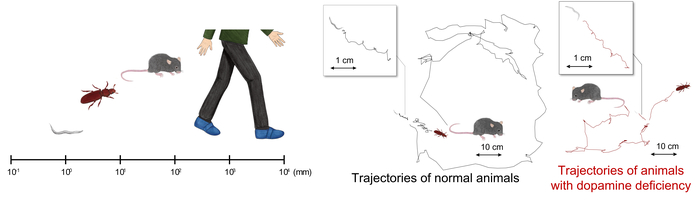
Now, a team of scientists led by Osaka University has used machine learning to obtain patterns from locomotion data created by a worm, beetle, mouse, and human subjects that were independent of the species. “A central goal of comparative behavioral analysis is to identify human-like behavioral repertoires in animals,” first author Takuya Maekawa explains. This method can help scientists studying human neurological conditions that cause motor dysfunctions, including those resulting from low dopamine levels. Animal motion data would generate much more information; however, the spatial and temporal scales of animal locomotion vary widely among species. This means that the data cannot be directly compared with human behavior. To overcome this, the team designed a neural network with a gradient reversal layer that predicts a) whether or not input locomotion data came from a diseased animal and b) from which species the input data came. From there, the network was trained so that it would fail to predict the species from which the input data was gathered, which resulted in the creation of a network that was incapable of distinguishing between species but capable of identifying specific diseases. This enabled the network to extract locomotion features inherent to the disease.

Their experiments revealed cross-species locomotion features shared by dopamine-deficient worms, mice, and humans. Despite their evolutionary differences, all of these organisms are unable to move while maintaining high speeds. Also, the speed of these animals was found to be unstable when accelerating. Interestingly, these animals exhibit similar movement disorders in the case of dopamine deficiency even though they have different body scales and locomotion methods. While previous studies had shown that dopamine deficiency was associated with movement disorders in all of these species, this research was the first to identify the shared locomotion features caused by this deficiency.

“Our project shows that deep learning can be a powerful tool for extracting knowledge from datasets that appear too different to be compared by human researchers,” author Takahiro Hara says. The team anticipates that this work will be used to find other common features for disorders that impact evolutionarily distant species.

Penn, CMU researchers develop new algorithmic approach that predicts strong leaders

Tyler O'Neal, Staff Editor MANUFACTURING September 15, 2021, 6:00 pm

Liberators and explorers were seen as the best leaders, media celebrities as the worst

Research on leadership has long recognized the importance of understanding how leaders are perceived, and past studies have used a variety of techniques to examine different aspects of leadership. In a new study, researchers developed a computational method to predict and identify the correlates of leadership perceptions. The researchers used the method to predict leadership perceptions for more than 6,600 well-known historical and contemporary figures and to uncover the traits, concepts, attributes people associate most strongly with effective leaders.

The study, by researchers at Carnegie Mellon University (CMU) and the University of Pennsylvania (Penn), is published in The Leadership Quarterly. Christopher Olivola, Associate Professor of Marketing

“Classic methodological approaches to studying leadership are costly and slow, and they can only be applied to relatively few leaders and dimensions of evaluation,” explains Christopher Olivola, Associate Professor of Marketing at CMU’s Tepper School of Business, who co-authored the study. “We developed a new methodological approach that can analyze and predict perceptions of leadership in an automated way on a very large scale to estimate how people judge the leadership ability of individuals mentioned in books, news, and social media.”

The researchers started with the idea that people have a shared understanding of the traits associated with effective leadership, and that they intuitively form judgments concerning a given individual’s potential to be an effective leader. Key to their approach is that well-known individuals—discussed in historical texts and the media—who share similar characteristics tend to be frequently mentioned together and that the traits most associated with these individuals—including traits used to guide leadership perceptions—are usually mentioned alongside them. Therefore, by analyzing the frequencies with which famous individuals were mentioned together and said to have certain traits, the researchers uncovered semantic representations of these people and predicted how they are perceived in terms of leadership ability.

Using machine learning techniques, data from a large body of news articles, and a modest sample of survey ratings, they built a model that estimates which individuals and groups of individuals are more or less likely to be perceived as effective leaders. They then applied their model to more than 6,600 famous individuals—including historical figures and contemporary celebrities—to see which ones were widely seen as effective leaders.

Many of the individuals the model predicted would be seen as the most effective leaders were liberators—such as Jomo Kenyatta and Abraham Lincoln—who worked to free countries and peoples, as well explorers—such as Francis Drake and Kalpana Chawla. By contrast, the model predicted that media celebrities—especially artists and reality show stars who appear on the cover of gossip magazines—would be seen as most lacking in leadership qualities.

To test the validity of their method, the researchers examined how well it predicted 210 survey participants’ ratings of leadership effectiveness for nearly 300 famous individuals. The new method predicted participants’ ratings extremely well, maintaining a high accuracy rate even when the researchers separated participants by gender, ethnicity, and political affiliation.

“Our method does more than simply predict people’s judgments of leadership effectiveness,” says Sudeep Bhatia, Assistant Professor of Psychology at Penn, who led the study “The conceptual map we generated can also help uncover the particular traits and concepts that underlie those judgments.”

“Scholars of leadership can use this approach to advance and accelerate their research, while practitioners–including people who advise leaders—can use it to better monitor how leaders are perceived, for example during an election campaign or following a scandal.”

Among the study’s limitations, the authors note that their method is constrained by the body of text used to build their model, as it can only make predictions about individuals mentioned in that text. In addition, the authors stress that their approach is designed to understand people’s subjective impressions of leaders, not their actual qualities.

Twisting light that switches direction at room temperature shows promise for quantum supercomputing

Tyler O'Neal, Staff Editor MANUFACTURING September 14, 2021, 9:02 pm

Japanese scientists have generated circularly polarized light and controlled its direction without using clunky magnets or very low temperatures. The findings, by Nagoya University researchers and colleagues in Japan, and published in the journal Advanced Materials, show promise for the development of materials and device methods that can be used in optical quantum information processing.

Light particles called photons have interesting properties that can be exploited for storing and transporting data and show tremendous promise for use in quantum supercomputing.

For this to happen, information is first stored in electrons that then interact with matter to generate data-carrying photons. Information can be encoded in the direction of an electron's spin, just as it is stored in the form of 0 and 1 in the 'bits' of computers. Data can also be stored when electrons occupy 'valleys' found in the energy bands they move between while they orbit an atom. When these electrons interact with specific light-emitting materials, they generate twisting 'chiral' 'valley-polarized light', which shows potential for storing large amounts of data.

So far, however, scientists have only managed to generate this type of circularly polarized light using magnets and very cold temperatures, making the technique impractical for widespread use.

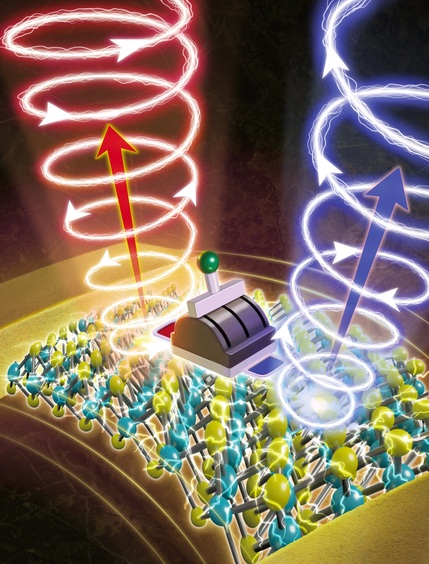
Nagoya University applied physicists Taishi Takenobu and Jiang Pu led a team of scientists to develop a room-temperature, electrically controlled approach for generating this chiral valley-polarized light. The team developed a room-temperature, electrically tunable  chiral light-emitting diode based on strained monolayer semiconductors   (Credit: Nagoya Univ. Takenobu Lab.)

First, they grew a monolayer of semiconducting tungsten disulfide on a sapphire substrate and covered it with an ion-gel film. Electrodes were placed on either end of the device and a small voltage was applied. This generated an electric field and ultimately produced light. The team found that chiral light was observed between -193°C and room temperature from the portions of the device where the sapphire substrate was naturally strained as a result of the synthetic process. It could only be generated from the strain-free areas, however, at much colder temperatures. The scientists concluded that strain played a crucial role in generating room temperature valley-polarized light.

They then manufactured a bending stage on which they placed a tungsten disulfide device on a plastic substrate. They used the bending stage to apply strain to their material, driving an electric current in the same direction of the strain and generating valley-polarized light at room temperature. Applying an electric field to the material switched the chiral light from moving in one direction to moving in the other.

"Our use of strained monolayer semiconductors is the first demonstration of a light-emitting device that can electrically generate and switch right- and left-handed circularly polarized light at room temperature," says Takenobu.

The team will next further optimize their device with the aim of developing practical chiral light sources.

  1. Scientists synthesized a yellow fever drug suggested by artificial intelligence
  2. Korean university builds a programmable DNA-based chip that solves complex math problems

Page 3 of 22

  • 1
  • 2
  • 3
  • 4
  • 5
  • 6
  • 7
  • 8
  • 9
  • 10
POPULAR RIGHT NOW
  • Supercomputers uncover a new class of cosmic explosions hidden in plain sight
    Supercomputers uncover a new class of cosmic explosions hidden in plain sight
  • AI supercharges the hunt for stronger magnets: Iowa State researchers launch a new era of intelligent materials discovery
    AI supercharges the hunt for stronger magnets: Iowa State researchers launch a new era of intelligent materials discovery
  • IBM's Historic stock collapse raises questions for the future of enterprise supercomputing
    IBM's Historic stock collapse raises questions for the future of enterprise supercomputing
  • Could a novel dark matter theory simultaneously resolve multiple cosmic enigmas? Supercomputer simulations provide a compelling, albeit currently unverified, potential solution
    Could a novel dark matter theory simultaneously resolve multiple cosmic enigmas? Supercomputer simulations provide a compelling, albeit currently unverified, potential solution
  • Melting icebergs may be reshaping Earth’s greatest ocean current
    Melting icebergs may be reshaping Earth’s greatest ocean current
  • Supercomputers replace ‘bathtub’ flood maps with physics-based digital twins of Britain’s coastline
    Supercomputers replace ‘bathtub’ flood maps with physics-based digital twins of Britain’s coastline
  • Supercomputers push neural quantum simulation beyond previous limits
    Supercomputers push neural quantum simulation beyond previous limits
  • Intel’s AI supercomputing revival: Q2 financial surge signals new era for CPU-powered HPC infrastructure
    Intel’s AI supercomputing revival: Q2 financial surge signals new era for CPU-powered HPC infrastructure
  • AI infrastructure financing fears shake semiconductor sector
    AI infrastructure financing fears shake semiconductor sector
  • AWS supercomputing investment reaches historic scale as Amazon’s AI strategy powers record financial results
    AWS supercomputing investment reaches historic scale as Amazon’s AI strategy powers record financial results
THIS YEAR'S MOST READ
  • Wall Street wants to trade supercomputing power like oil
    Wall Street wants to trade supercomputing power like oil
  • Cosmic ambition at scale: UK’s supercomputer unlocks a 2.5 petabytes universe
    Cosmic ambition at scale: UK’s supercomputer unlocks a 2.5 petabytes universe
  • Hidden order, revealed at scale: Supercomputing, electron ptychography uncover the inner workings of relaxor ferroelectrics
    Hidden order, revealed at scale: Supercomputing, electron ptychography uncover the inner workings of relaxor ferroelectrics
  • Beamforming the future: BeammWave's 6G push signals the rise of orbital-terrestrial wireless networks
    Joakim Axmon
    Joakim Axmon
  • Intel's Q1 results signal supercomputing surge driving Xeon momentum
    Intel's Q1 results signal supercomputing surge driving Xeon momentum
  • When stars fall apart: Supercomputing reveals the hidden physics of black holes
    When stars fall apart: Supercomputing reveals the hidden physics of black holes
  • Multi-layer simulations reveal the hidden supply chain of solar prominences
    Multi-layer simulations reveal the hidden supply chain of solar prominences
  • Japanese scientists decode dolphin speed with supercomputing: Turbulence, vortices, and the hidden physics of propulsion
    Japanese scientists decode dolphin speed with supercomputing: Turbulence, vortices, and the hidden physics of propulsion
  • Cosmic feedback at scale: Supercomputing reveals how quasars regulate the early Universe
    Cosmic feedback at scale: Supercomputing reveals how quasars regulate the early Universe
  • Modeling life at the microscopic scale: A computational breakthrough in oxygen transport
    Modeling life at the microscopic scale: A computational breakthrough in oxygen transport
MOST READ OF ALL-TIME
  • Largest Computational Biology Simulation Mimics The Ribosome
    Details
    112107
    The amino acid (green) slithers into the chemical reaction center, moving through an evolutionarily ancient corridor of the ribosome (purple). The amino acid is delivered to the reaction core by the transfer RNA molecule (yellow).
    The amino acid (green) slithers into the chemical reaction center, moving through an evolutionarily ancient corridor of the ribosome (purple). The amino acid is delivered to the reaction core by the transfer RNA molecule (yellow).
  • Silicon 'neurons' may add a new dimension to chips
    Details
    80990
    Silicon 'neurons' may add a new dimension to chips
  • Linux Networx Accelerators Expected to Drive up to 4x Price/Performance
    Details
    75537
  • Complex Concepts That Really Add Up
    Details
    73635
    Complex Concepts That Really Add Up
  • Blue Sky Studios Donates Animation SuperComputer to Wesleyan
    Details
    68140
    Each rack holds 52 Angstrom Microsystem-brand “blades,” with a memory footprint of 12 or 24 gigabytes each. (Photos by Olivia Bartlett Drake)
    Each rack holds 52 Angstrom Microsystem-brand “blades,” with a memory footprint of 12 or 24 gigabytes each. (Photos by Olivia Bartlett Drake)
  • Humanities, HPC connect at NERSC
    Details
    57945
  • TeraGrid ’09 'Call for Participation'
    Details
    54951
  • Turbulence responsible for black holes' balancing act
    Details
    52310
  • Cray Wins $52 Million SuperComputer Contract
    Details
    50139
  • SDSC Researchers Accurately Predict Protein Docking
    Details
    46078
  • FRONTPAGE
  • LATEST
  • POPULAR
  • REGISTER
  • SOCIAL
  • VIDEO
  • SUBSCRIPTION
  • RSS
  • GUIDELINES
  • PRIVACY
  • TOS
  • ABOUT
  • +1 (816) 799-4488
  • editorial@supercomputingonline.com
© 2001 - 2026 SuperComputingOnline.com, LLC. All rights reserved. This material may not be published, broadcast, rewritten or redistributed without permission.
Sign In
  • FRONT PAGE
  • LATEST
    • MEDIA KIT
    • MOST READ
    • RSS FEED
    • ACADEMIA
    • AEROSPACE
    • APPLICATIONS
    • ASTRONOMY
    • AUTOMOTIVE
    • BIG DATA
    • BIOLOGY
    • CHEMISTRY
    • CLIENTS
    • CLOUD
    • DEFENSE
    • DEVELOPER TOOLS
    • EARTH SCIENCES
    • ECONOMICS
    • ENGINEERING
    • ENTERTAINMENT
    • HEALTH
    • INDUSTRY
    • INTERCONNECTS
    • GAMING
    • GOVERNMENT
    • MANUFACTURING
    • MIDDLEWARE
    • MOVIES
    • NETWORKS
    • OIL & GAS
    • PHYSICS
    • PROCESSORS
    • RETAIL
    • SCIENCE
    • STORAGE
    • SYSTEMS
    • VISUALIZATION
  • VIDEOS
    • ADD YOUR VIDEOS
    • MANAGE VIDEOS
  • COMMUNITY
    • TRADE SHOWS
    • SOCIAL NETWORK VIDEOS
    • SURVEYS
    • APPLICATIONS BROWSER
    • CONVERSATION INBOX
    • SOCIAL ADVERTISER
    • GROUPS
    • MARKETPLACE LISTINGS
    • PAGES
    • LEADERBOARD
    • POINTS LISTING
      • BADGES
    • PRIVACY CONFIRM REQUEST
    • PRIVACY CREATE REQUEST

Hey there! We noticed you’re using an ad blocker.