SUPERCOMPUTING NEWS SUPERCOMPUTING NEWS
    • MEDIA KIT
    • MOST READ
    • RSS FEED
    • ACADEMIA
    • AEROSPACE
    • APPLICATIONS
    • ASTRONOMY
    • AUTOMOTIVE
    • BIG DATA
    • BIOLOGY
    • CHEMISTRY
    • CLIENTS
    • CLOUD
    • DEFENSE
    • DEVELOPER TOOLS
    • EARTH SCIENCES
    • ECONOMICS
    • ENGINEERING
    • ENTERTAINMENT
    • GAMING
    • GOVERNMENT
    • HEALTH
    • OIL & GAS
    • INDUSTRY
    • INTERCONNECTS
    • MANUFACTURING
    • MIDDLEWARE
    • MOVIES
    • NETWORKS
    • PHYSICS
    • PROCESSORS
    • RETAIL
    • SCIENCE
    • STORAGE
    • SYSTEMS
    • VISUALIZATION
    • AcyMailing subscription form

    • ADD YOUR VIDEOS
    • MANAGE VIDEOS
    • CONVERSATION INBOX
    • SOCIAL ADVERTISER
    • SOCIAL NETWORK VIDEOS
    • SURVEYS
    • GROUPS
    • PAGES
    • MARKETPLACE LISTINGS
    • APPLICATIONS BROWSER
    • PRIVACY CONFIRM REQUEST
    • PRIVACY CREATE REQUEST
    • LEADERBOARD
    • POINTS LISTING
      • BADGES
    • TRADE SHOWS
Sign In
German researchers demo solution for spintronics, storage
Tyler O'Neal, Staff Editor STORAGE October 30, 2023, 12:00 pm

German researchers demo solution for spintronics, storage

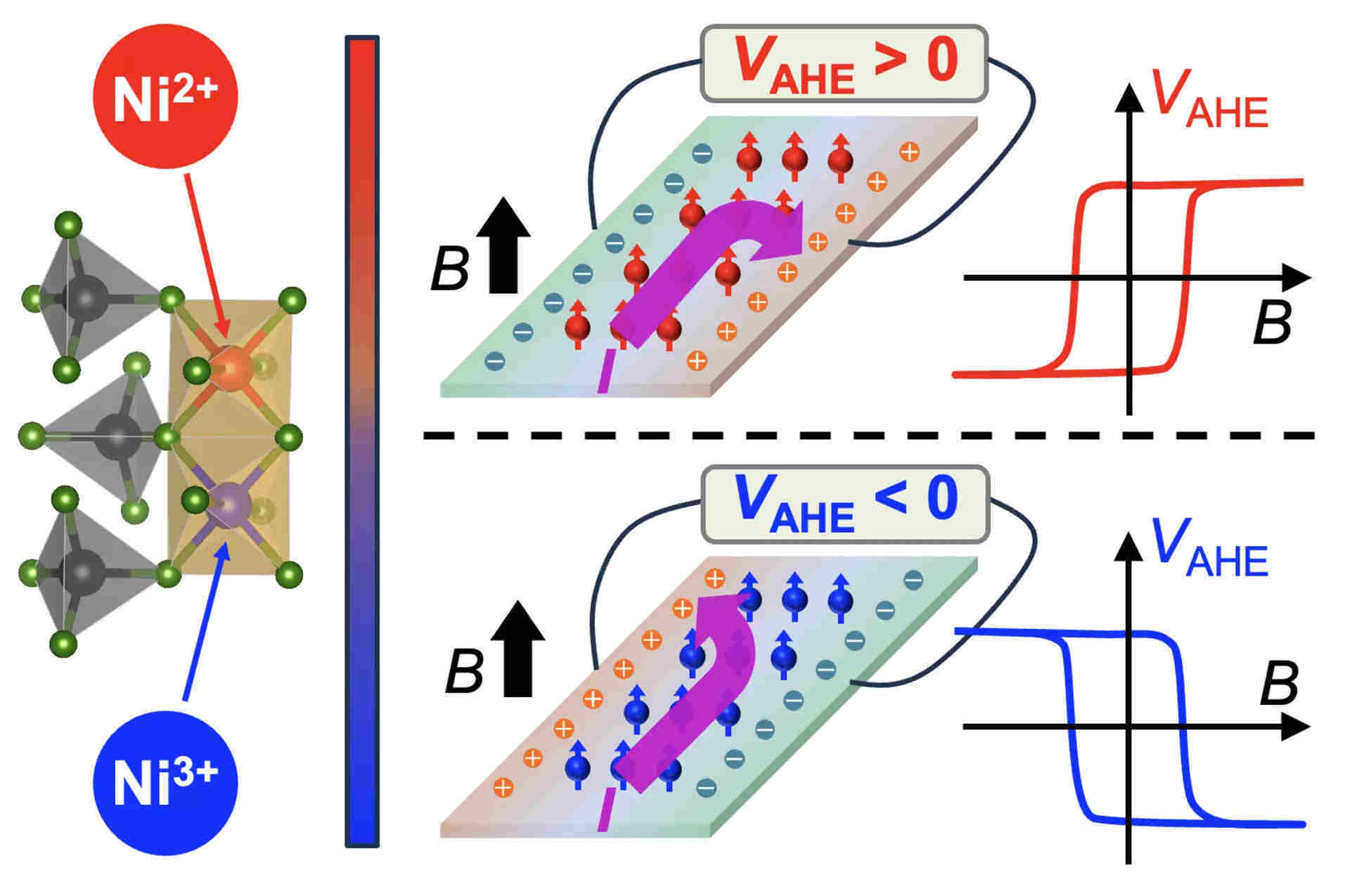
A team of researchers from the Paul Drude Institute in Berlin, Germany, and Xiamen University in China, has recently published a paper about a potential solution to a long-standing challenge in developing magnetic materials. They demonstrated how ferrimagnetic NiCo2O4 (NCO) could offer a robust out-of-plane magnetism, with a range of magnetic and electrical characteristics that could be tailored to suit different requirements.

The team explained that developing magnetic materials with a robust perpendicular magnetic anisotropy (PMA) is essential, as high-density memory superlattice structures rely on thin individual layers to realize PMA. The findings suggest that having materials with robust PMA in relatively thick films is a more cost-effective and practical method of device fabrication. NiCo2O4 showed these capabilities and offered flexibility in terms of tunability, making it an ideal candidate for a range of potential spintronic applications to enhance high-density memories beyond currently used antiferromagnetic materials.

The insights gained into magnetotransport phenomena and tunable magnetic properties offer much potential for future research, leading to the design of novel spintronic applications and advancements in the industrial development of high-density memories. The findings of Hua Lv, Xiao Chun Huang, Kelvin H. L. Zhang, Oliver Bierwagen, and Manfred Ramsteiner have broad, highly relevant implications for scientific research, and industrial, and societal applications. It is hoped that more research will be conducted to build on what has already been discovered.

DKFZ deploys StorageMAP to manage 27 petabytes of unstructured data

Tyler O'Neal, Staff Editor STORAGE July 12, 2023, 10:00 am
The German Cancer Research Institute (DKFZ)'s Working Group Leader for Central Servers, Tobias Reber, highlights the value of Datadobi's software, StorageMAP, in addressing their data management challenges. Reber highlights the ease of deployment and the platform's capabilities in providing a comprehensive view of their data landscape.
 
{media id=313,layout=solo}

Read more https://www.supercomputingonline.com/gallery/category/news/dkfz-deploys-storagemap-to-manage-27-petabytes-of-unstructured-data

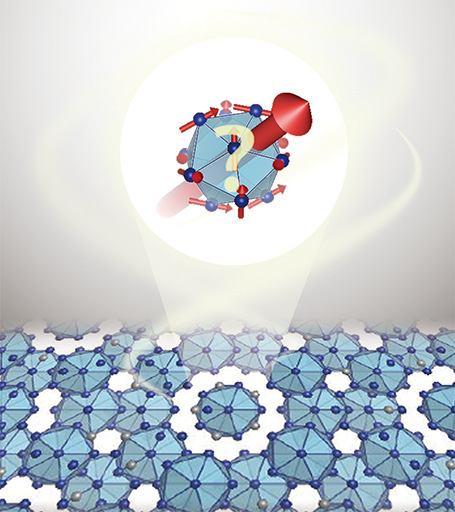
Icosahedral quasicrystals (i QCs)―which are solids possessing a special geometric structure and long-range order with crystallographically forbidden symmetries, but no periodicity―show interesting physical and magnetic properties

Japanese prof Tamura discovers a tunable ferromagnetic quasicrystal with high-phase purity for storage

Tyler O'Neal, Staff Editor STORAGE April 27, 2023, 5:00 am

Researchers provide direct evidence that the magnetic properties of the novel icosahedral quasicrystals depend on the electrons-per-atom ratio

Quasicrystals (QCs) exhibit long-range order with crystallographically forbidden symmetries in their atomic structures. Among the discovered QCs, icosahedral QCs (i QCs) with unique geometry demonstrate interesting physical and magnetic properties. Previously synthesized i QCs with long-range magnetic order were unsuitable for further study due to the inclusion of an approximant crystal phase. Now, researchers at the Tokyo University of Science have successfully synthesized gold-gallium-dysprosium i QC with high phase purity and tunable magnetic properties.

Quasicrystals (QCs) have peculiar structures with interesting atomic arrangements. Although they are similar to crystals from the exterior, at the atomic scale, they lack periodicity despite being ordered. Such structural arrangements confer quasicrystals with symmetries and other special properties that are missing in crystals. In particular, icosahedral QCs (i QCs), which have a special geometric structure, show interesting magnetic properties. In a recent breakthrough, a research team led by Professor Ryuji Tamura from the Tokyo University of Science (TUS) in Japan has discovered ferromagnetic order in gold-gallium-gadolinium and gold-gallium-terbium i QCs. However, these i QCs have not been suitable for the further study of ferromagnetism in i QCs because they have also contained a large fraction of the approximant crystal (AC) phase. ACs have a similar structure to QCs, but as they are also magnetic, this interferes with studies on the magnetism of the QC phase alone. (a) Powder X-ray diffraction patterns of the Au68-xGa17+xDy15 i QCs. In all the patterns, the peaks are indexed as those of primitive i QCs indicating the formation of highly pure i QCs (b) Selected area electron diffraction patterns of the Au65Ga20Dy15 i QC along the five-fold axis
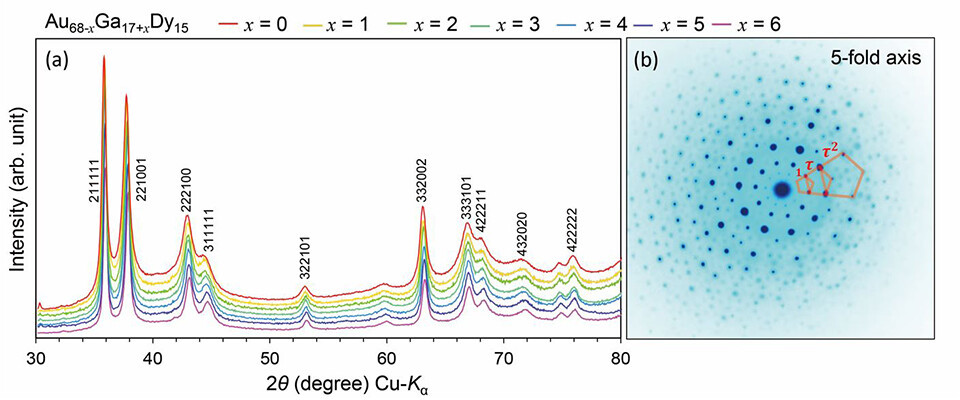
To bridge this gap, Professor Tamura's team has now synthesized a novel gold-gallium-dysprosium (Au-Ga-Dy) i QC. According to Professor Tamura, "The Au-Ga-Dy i QC is ferromagnetic, highly tunable, and has high phase purity". The research team, which included Mr. Ryo Takeuchi and Dr. Farid Labib from TUS, has published their findings in Physical Review Letters. This paper has been selected as Editor's Suggestion.

The new i QCs were prepared using mother alloys containing 15% Dy, 62-68% Au, and 23-17% Ga. The mother alloys were synthesized via arc-melting followed by rapid quenching. The resultant i QCs were studied using powder X-ray diffraction, electron microscopy, electron diffraction, and magnetic susceptibility measurements.

The researchers found that the synthesized i QC was polycrystalline with a highly pure ferromagnetic phase. They were further able to describe the mean-field-like nature of the ferromagnetic transition.

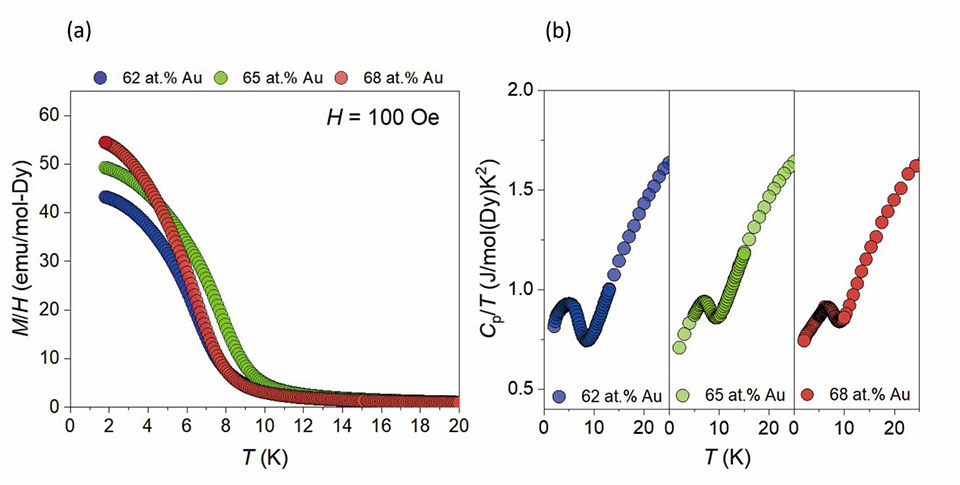
The researchers also discovered that the new i QCs exhibit a maximum Weiss temperature, a significant parameter in ferromagnetic transition, at an electrons-per-atom (e/a) ratio of 1.70, which aligns with previous findings for ACs. This discovery demonstrates that the magnetic properties of i QCs can be well-tuned using the Weiss temperature and e/a ratio (a parameter that indicates the variations in the Fermi energy of the i QC). Furthermore, these findings reveal that the balance of ferromagnetic and antiferromagnetic interactions, as well as the presence of exotic magnetic orders, can be tuned in i QCs by shifting the Fermi energy or adjusting the e/a ratio.

"The discovery of pure tunable ferromagnetic quasicrystals has the potential to revolutionize and expand the academic system based on crystals. Applying our findings to current theoretical work in the field, for example, in the realm of non-coplanar spin configurations such as hedgehog and whirling configurations, can lead to various nontrivial physical properties in i QCs, including anomalous and topological Hall effects," concludes Prof. Tamura.

These findings pave the way toward new frontiers of magnetic materials and advance the development of technologies such as magnetic data storage, spintronics, and magnetic sensors. (a) Temperature dependence of the field cooled magnetic susceptibility (M/H) of the Au68-xGa17+xDy15 i QCs (b) The specific heat of the samples as a function of temperature T in a range of 0-25 K
  1. UK physicists unravel ‘Hall effect’ mystery in search for next gen storage
  2. Illinois researchers propose the future of data storage is double-helical

Page 2 of 9

  • 1
  • 2
  • 3
  • 4
  • 5
  • 6
  • 7
  • 8
  • 9
POPULAR RIGHT NOW
  • Meta’s next frontier may not be social media; it may be supercomputing
    Meta’s next frontier may not be social media; it may be supercomputing
  • The future of cancer research runs on supercomputers
    Jill Mesirov, PhD
    Jill Mesirov, PhD
  • Rebuilding a lost continent: Supercomputers reveal Antarctica before the ice
    Antarctic ice meets the rocky coastline. Researchers traced landscape features from the two-kilometre-high coastal escarpment of Dronning Maud Land to the subglacial Gamburtsev Mountains, buried beneath 1–3 km of ice  Credit Matt Palmer
    Antarctic ice meets the rocky coastline. Researchers traced landscape features from the two-kilometre-high coastal escarpment of Dronning Maud Land to the subglacial Gamburtsev Mountains, buried beneath 1–3 km of ice Credit Matt Palmer
  • Supercomputers uncover a new class of cosmic explosions hidden in plain sight
    Supercomputers uncover a new class of cosmic explosions hidden in plain sight
  • AI supercharges the hunt for stronger magnets: Iowa State researchers launch a new era of intelligent materials discovery
    AI supercharges the hunt for stronger magnets: Iowa State researchers launch a new era of intelligent materials discovery
  • IBM's Historic stock collapse raises questions for the future of enterprise supercomputing
    IBM's Historic stock collapse raises questions for the future of enterprise supercomputing
  • Could a novel dark matter theory simultaneously resolve multiple cosmic enigmas? Supercomputer simulations provide a compelling, albeit currently unverified, potential solution
    Could a novel dark matter theory simultaneously resolve multiple cosmic enigmas? Supercomputer simulations provide a compelling, albeit currently unverified, potential solution
  • Melting icebergs may be reshaping Earth’s greatest ocean current
    Melting icebergs may be reshaping Earth’s greatest ocean current
  • Supercomputers replace ‘bathtub’ flood maps with physics-based digital twins of Britain’s coastline
    Supercomputers replace ‘bathtub’ flood maps with physics-based digital twins of Britain’s coastline
  • Supercomputers push neural quantum simulation beyond previous limits
    Supercomputers push neural quantum simulation beyond previous limits
THIS YEAR'S MOST READ
  • Cosmic ambition at scale: UK’s supercomputer unlocks a 2.5 petabytes universe
    Cosmic ambition at scale: UK’s supercomputer unlocks a 2.5 petabytes universe
  • Hidden order, revealed at scale: Supercomputing, electron ptychography uncover the inner workings of relaxor ferroelectrics
    Hidden order, revealed at scale: Supercomputing, electron ptychography uncover the inner workings of relaxor ferroelectrics
  • Intel's Q1 results signal supercomputing surge driving Xeon momentum
    Intel's Q1 results signal supercomputing surge driving Xeon momentum
  • When stars fall apart: Supercomputing reveals the hidden physics of black holes
    When stars fall apart: Supercomputing reveals the hidden physics of black holes
  • Wall Street wants to trade supercomputing power like oil
    Wall Street wants to trade supercomputing power like oil
  • Multi-layer simulations reveal the hidden supply chain of solar prominences
    Multi-layer simulations reveal the hidden supply chain of solar prominences
  • Japanese scientists decode dolphin speed with supercomputing: Turbulence, vortices, and the hidden physics of propulsion
    Japanese scientists decode dolphin speed with supercomputing: Turbulence, vortices, and the hidden physics of propulsion
  • Beamforming the future: BeammWave's 6G push signals the rise of orbital-terrestrial wireless networks
    Joakim Axmon
    Joakim Axmon
  • Modeling life at the microscopic scale: A computational breakthrough in oxygen transport
    Modeling life at the microscopic scale: A computational breakthrough in oxygen transport
  • Riding invisible waves: How open-source code transforms space weather science
    Riding invisible waves: How open-source code transforms space weather science
  • FRONTPAGE
  • LATEST
  • POPULAR
  • REGISTER
  • SOCIAL
  • VIDEO
  • SUBSCRIPTION
  • RSS
  • GUIDELINES
  • PRIVACY
  • TOS
  • ABOUT
  • +1 (816) 799-4488
  • editorial@supercomputingonline.com
© 2001 - 2026 SuperComputingOnline.com, LLC. All rights reserved. This material may not be published, broadcast, rewritten or redistributed without permission.
Sign In
  • FRONT PAGE
  • LATEST
    • MEDIA KIT
    • MOST READ
    • RSS FEED
    • ACADEMIA
    • AEROSPACE
    • APPLICATIONS
    • ASTRONOMY
    • AUTOMOTIVE
    • BIG DATA
    • BIOLOGY
    • CHEMISTRY
    • CLIENTS
    • CLOUD
    • DEFENSE
    • DEVELOPER TOOLS
    • EARTH SCIENCES
    • ECONOMICS
    • ENGINEERING
    • ENTERTAINMENT
    • HEALTH
    • INDUSTRY
    • INTERCONNECTS
    • GAMING
    • GOVERNMENT
    • MANUFACTURING
    • MIDDLEWARE
    • MOVIES
    • NETWORKS
    • OIL & GAS
    • PHYSICS
    • PROCESSORS
    • RETAIL
    • SCIENCE
    • STORAGE
    • SYSTEMS
    • VISUALIZATION
  • VIDEOS
    • ADD YOUR VIDEOS
    • MANAGE VIDEOS
  • COMMUNITY
    • TRADE SHOWS
    • SOCIAL NETWORK VIDEOS
    • SURVEYS
    • APPLICATIONS BROWSER
    • CONVERSATION INBOX
    • SOCIAL ADVERTISER
    • GROUPS
    • MARKETPLACE LISTINGS
    • PAGES
    • LEADERBOARD
    • POINTS LISTING
      • BADGES
    • PRIVACY CONFIRM REQUEST
    • PRIVACY CREATE REQUEST

Hey there! We noticed you’re using an ad blocker.