

SUPERCOMPUTING NEWS SUPERCOMPUTING NEWS
    • MEDIA KIT
    • MOST READ
    • RSS FEED
    • ACADEMIA
    • AEROSPACE
    • APPLICATIONS
    • ASTRONOMY
    • AUTOMOTIVE
    • BIG DATA
    • BIOLOGY
    • CHEMISTRY
    • CLIENTS
    • CLOUD
    • DEFENSE
    • DEVELOPER TOOLS
    • EARTH SCIENCES
    • ECONOMICS
    • ENGINEERING
    • ENTERTAINMENT
    • GAMING
    • GOVERNMENT
    • HEALTH
    • OIL & GAS
    • INDUSTRY
    • INTERCONNECTS
    • MANUFACTURING
    • MIDDLEWARE
    • MOVIES
    • NETWORKS
    • PHYSICS
    • PROCESSORS
    • RETAIL
    • SCIENCE
    • STORAGE
    • SYSTEMS
    • VISUALIZATION
    • AcyMailing subscription form

    • ADD YOUR VIDEOS
    • MANAGE VIDEOS
    • CONVERSATION INBOX
    • SOCIAL ADVERTISER
    • SOCIAL NETWORK VIDEOS
    • SURVEYS
    • GROUPS
    • PAGES
    • MARKETPLACE LISTINGS
    • APPLICATIONS BROWSER
    • PRIVACY CONFIRM REQUEST
    • PRIVACY CREATE REQUEST
    • LEADERBOARD
    • POINTS LISTING
      • BADGES
    • TRADE SHOWS
Sign In
Tyler O'Neal, Staff Editor SYSTEMS June 8, 2021, 7:00 am

Sportradar's super picks underdogs Czech Republic crowned as European soccer champions

GET ready for soccer’s biggest ever shock at Euro 2020; that’s the verdict of a SuperComputer that has analyzed all the teams and their results over the last 20 years.

The startling prediction sees massive underdogs Czech Republic crowned as champions after beating another of the outsiders, Denmark, 3-2 in a thrilling final.

Soccer experts at Sportradar, the world’s leading sports data provider, “played out” the whole of the tournament through their innovative Simulated Reality solution using Artificial Intelligence algorithms.

Sadly, for pre-tournament favorites England, it was another semi-final defeat as they crashed out to the beaten finalists with once again their luck deserting them in a major competition.
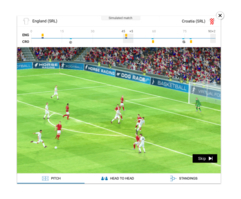
Simulated Reality screenshot of England v Croatia simulation Euro 2020

But even though the Euros is renowned for its unpredictability, the Czech Republic’s forecast success would be right up there with Greece’s sensational victory against all the odds in 2004.

And remember, the Euros is the place for seismic shocks with England suffering humiliating defeats by minnows Republic of Ireland in 1988, Sweden in 1992, and Iceland in 2016.

Also, the Czech Republic and Denmark, this year’s finalists according to Sportradar, have “form” when it comes to Euro shocks themselves.

Denmark didn’t even qualify in 1992 and was drafted in only two weeks before the competition began when Yugoslavia was forced to withdraw. They ended up going all the way, beating the mighty Germany 2-0 in the final to complete an improbable journey.

And how about the Czech Republic in 1996? They were beaten in their opening game by Germany but turned things round to beat Italy 2-1 in their next game and ended up getting to the final although there was no fairy tale ending this time as Germany beat them for a second time to take the Euro crown for the third time.

England, under Gareth Southgate, is predicted to continue in their role of “nearly men” as they reach the last four before losing 3-2 to Denmark. 

So, the Three Lions are projected to remain the perennial “bridesmaids”, not having won a major international tournament since the 1966 World Cup, which was held in England.

In the Euro 2020 Group stages, England qualified for the knockout stages after two wins and a loss. They beat Croatia 5-2 in their first game but had to battle hard to beat the ‘Auld Enemy’ Scotland 1-0 before going on to down eventual winners, the Czech Republic, 2-1.

In the Round of 16, England progressed by beating France 3-1, going on to beat Poland 3-2 in the quarter-finals before they succumbed to Denmark in the semis.

Despite their loss against England in the Group stage, the Czech Republic also beat Spain and Germany in the knockout stages to set up a semi-final against Portugal, which the Czechs won 1-0.

Werner Becher, Sportradar’s regional chief executive officer for Europe, the Middle East, Africa, and Latin America, said: “After such a long delay there’s a real sense of excitement about this tournament amongst fans. We’ve tapped into the breadth of our technical capabilities to simulate the tournament, processing millions of data points from the last 20 years in order to identify the winning team. 

“Football is unpredictable, it’s one of the things we love most about the game, but few fans would have put the Czech Republic and Denmark in the final.”

Mason's Mishin wins NSF grant to study thermodynamics of interfaces

Tyler O'Neal, Staff Editor SYSTEMS June 7, 2021, 1:00 pm

Yuri Mishin, Professor, Physics, and Astronomy, is working to advance the fundamental understanding of interface thermodynamics and kinetics using atomistic supercomputer modeling.

Mishin has several goals for this project.

First, he aims to understand the fundamental mechanisms of grain boundary (GB) segregation and GB diffusion in alloy systems.

Second, he aims to investigate the 2D thermodynamics of GB phase transformations in alloys.

Third, he intends to uncover relationships between the thermodynamic (segregation) and kinetic (diffusion) GB properties.

Next, he aims to investigate the solute drag effect by moving GBs and establishing relationships between maximum drag force, alloy thermodynamics, and GB type.

Finally, he aims to investigate phase transformations in moving GBs by direct molecular dynamics modeling.

To accomplish these tasks, Mishin will use molecular dynamics and Monte Carlo simulations in various statistical ensembles, along with other techniques, including kinetic Monte Carlo and jump correlation analysis.

Mishin received $232,190 from the National Science Foundation for this project. Funding began in June 2021 and will end in late May 2024.

University of Technology Sydney models what happens when we inhale coronavirus aerosols

Tyler O'Neal, Staff Editor SYSTEMS June 7, 2021, 11:00 am

When we inhale isolated coronavirus particles, more than 65% reach the deepest region of our lungs where damage to cells can lead to low blood oxygen levels, new research has discovered, and more of these aerosols reach the right lung than the left.

The lead author of the study Dr. Saidul Islam, from the University of Technology Sydney, said while previous research has revealed how virus aerosols travel through the upper airways including the nose, mouth, and throat - this study was the first to examine how they flow through the lower lungs.

"Our lungs resemble tree branches that divide up to 23 times into smaller and smaller branches. Due to the complexity of this geometry, it is difficult to develop a computer simulation, however, we were able to model what happens in the first 17 generations, or branches, of the airways," said Dr. Islam.

"Depending on our breathing rate, between 32% and 35% of viral particles are deposited in these first 17 branches. This means around 65% of virus particles escape to the deepest regions of our lungs, which includes the alveoli or air sacs," he said. A new study models what happens when we inhale coronavirus aerosols.  CREDIT Image: Mohamed Hassan / Pixabay cc

The alveolar system is critical to our ability to absorb oxygen, so significant amounts of virus in this region, along with inflammation caused by our body's immune response, can cause severe damage, reducing the amount of oxygen in the blood and increasing the risk of death.

The study also revealed that more virus particles are deposited in the right lung, especially the right upper lobe and the right lower lobe, than in the left lung. This is due to the highly asymmetrical anatomical structure of the lungs and the way air flows through the different lobes.

The research is backed up by a recent study of chest CT scans of COVID-19 patients showing greater infection and disease in the regions predicted by the model.

The researchers modeled three different flow rates - 7.5, 15, and 30 liters per minute. The model showed greater virus deposition at lower flow rates.

As well as improving our understanding of coronavirus transmission, the findings have implications for the development of targeted drug delivery devices that can deliver medicine to the areas of the respiratory system most affected by the virus.

"Normally when we inhale drugs from a drug delivery device most of it is deposited in the upper airways, and only a minimum amount of drugs can reach the targeted position of the lower airways. However, with diseases like COVID-19 we need to target the areas most affected," said Dr. Islam.

"We are working to develop devices that can target specific regions, and we also hope to build age and patient-specific whole lung models to increase understanding of how SARS CoV-2 aerosols affect individual patients," said co-author and group leader of the UTS Computer Simulations and Modelling group, Dr. Suvash Saha.

The World Health Organisation recently updated its advice about the importance of aerosol transmission, warning that because aerosols can remain suspended in the air, crowded indoor settings and areas with poor ventilation pose a significant risk for transmission of Covid-19.

"When we use an aerosol deodorant, the smallest particles of that liquid fall on us under extreme pressure in the form of gas. Similarly, when an infected person speaks, sings, sneezes, or coughs, the virus is spread through the air and can infect those nearby," said Dr. Saha.

The study has further applications, with researchers using portable devices to examine air quality - including PM2.5 and PM10 concentration and gasses such as carbon dioxide, formaldehyde, and sulfur dioxide - in spaces such as train carriages. The researchers can then use this data to model the impact on our lungs.

The study, SARS CoV-2 aerosol: How far it can travel to the lower airways, was recently published in the journal Physics of Fluids.

  1. Rice wins NIH grant that boosts computational search for cancer drugs
  2. Marvell launches 1.6T Ethernet PHY with 100G PAM4 I/Os in 5nm for cloud data centers

Page 7 of 31

  • 2
  • 3
  • 4
  • 5
  • 6
  • 7
  • 8
  • 9
  • 10
  • 11
POPULAR RIGHT NOW
  • Meta’s next frontier may not be social media; it may be supercomputing
    Meta’s next frontier may not be social media; it may be supercomputing
  • The future of cancer research runs on supercomputers
    Jill Mesirov, PhD
    Jill Mesirov, PhD
  • Rebuilding a lost continent: Supercomputers reveal Antarctica before the ice
    Antarctic ice meets the rocky coastline. Researchers traced landscape features from the two-kilometre-high coastal escarpment of Dronning Maud Land to the subglacial Gamburtsev Mountains, buried beneath 1–3 km of ice  Credit Matt Palmer
    Antarctic ice meets the rocky coastline. Researchers traced landscape features from the two-kilometre-high coastal escarpment of Dronning Maud Land to the subglacial Gamburtsev Mountains, buried beneath 1–3 km of ice Credit Matt Palmer
  • Supercomputers uncover a new class of cosmic explosions hidden in plain sight
    Supercomputers uncover a new class of cosmic explosions hidden in plain sight
  • AI supercharges the hunt for stronger magnets: Iowa State researchers launch a new era of intelligent materials discovery
    AI supercharges the hunt for stronger magnets: Iowa State researchers launch a new era of intelligent materials discovery
  • IBM's Historic stock collapse raises questions for the future of enterprise supercomputing
    IBM's Historic stock collapse raises questions for the future of enterprise supercomputing
  • Could a novel dark matter theory simultaneously resolve multiple cosmic enigmas? Supercomputer simulations provide a compelling, albeit currently unverified, potential solution
    Could a novel dark matter theory simultaneously resolve multiple cosmic enigmas? Supercomputer simulations provide a compelling, albeit currently unverified, potential solution
  • Melting icebergs may be reshaping Earth’s greatest ocean current
    Melting icebergs may be reshaping Earth’s greatest ocean current
  • Supercomputers replace ‘bathtub’ flood maps with physics-based digital twins of Britain’s coastline
    Supercomputers replace ‘bathtub’ flood maps with physics-based digital twins of Britain’s coastline
  • Supercomputers push neural quantum simulation beyond previous limits
    Supercomputers push neural quantum simulation beyond previous limits
MOST READ THIS YEAR
  • Cosmic ambition at scale: UK’s supercomputer unlocks a 2.5 petabytes universe
    Cosmic ambition at scale: UK’s supercomputer unlocks a 2.5 petabytes universe
  • Intel's Q1 results signal supercomputing surge driving Xeon momentum
    Intel's Q1 results signal supercomputing surge driving Xeon momentum
  • When stars fall apart: Supercomputing reveals the hidden physics of black holes
    When stars fall apart: Supercomputing reveals the hidden physics of black holes
  • FRONTPAGE
  • LATEST
  • POPULAR
  • REGISTER
  • SOCIAL
  • VIDEO
  • SUBSCRIPTION
  • RSS
  • GUIDELINES
  • PRIVACY
  • TOS
  • ABOUT
  • +1 (816) 799-4488
  • editorial@supercomputingonline.com
© 2001 - 2026 SuperComputingOnline.com, LLC. All rights reserved. This material may not be published, broadcast, rewritten or redistributed without permission.
Sign In
  • FRONT PAGE
  • LATEST
    • MEDIA KIT
    • MOST READ
    • RSS FEED
    • ACADEMIA
    • AEROSPACE
    • APPLICATIONS
    • ASTRONOMY
    • AUTOMOTIVE
    • BIG DATA
    • BIOLOGY
    • CHEMISTRY
    • CLIENTS
    • CLOUD
    • DEFENSE
    • DEVELOPER TOOLS
    • EARTH SCIENCES
    • ECONOMICS
    • ENGINEERING
    • ENTERTAINMENT
    • HEALTH
    • INDUSTRY
    • INTERCONNECTS
    • GAMING
    • GOVERNMENT
    • MANUFACTURING
    • MIDDLEWARE
    • MOVIES
    • NETWORKS
    • OIL & GAS
    • PHYSICS
    • PROCESSORS
    • RETAIL
    • SCIENCE
    • STORAGE
    • SYSTEMS
    • VISUALIZATION
  • VIDEOS
    • ADD YOUR VIDEOS
    • MANAGE VIDEOS
  • COMMUNITY
    • TRADE SHOWS
    • SOCIAL NETWORK VIDEOS
    • SURVEYS
    • APPLICATIONS BROWSER
    • CONVERSATION INBOX
    • SOCIAL ADVERTISER
    • GROUPS
    • MARKETPLACE LISTINGS
    • PAGES
    • LEADERBOARD
    • POINTS LISTING
      • BADGES
    • PRIVACY CONFIRM REQUEST
    • PRIVACY CREATE REQUEST

Hey there! We noticed you’re using an ad blocker.