SUPERCOMPUTING NEWS SUPERCOMPUTING NEWS
    • MEDIA KIT
    • MOST READ
    • RSS FEED
    • ACADEMIA
    • AEROSPACE
    • APPLICATIONS
    • ASTRONOMY
    • AUTOMOTIVE
    • BIG DATA
    • BIOLOGY
    • CHEMISTRY
    • CLIENTS
    • CLOUD
    • DEFENSE
    • DEVELOPER TOOLS
    • EARTH SCIENCES
    • ECONOMICS
    • ENGINEERING
    • ENTERTAINMENT
    • GAMING
    • GOVERNMENT
    • HEALTH
    • OIL & GAS
    • INDUSTRY
    • INTERCONNECTS
    • MANUFACTURING
    • MIDDLEWARE
    • MOVIES
    • NETWORKS
    • PHYSICS
    • PROCESSORS
    • RETAIL
    • SCIENCE
    • STORAGE
    • SYSTEMS
    • VISUALIZATION
    • AcyMailing subscription form

    • ADD YOUR VIDEOS
    • MANAGE VIDEOS
    • CONVERSATION INBOX
    • SOCIAL ADVERTISER
    • SOCIAL NETWORK VIDEOS
    • SURVEYS
    • GROUPS
    • PAGES
    • MARKETPLACE LISTINGS
    • APPLICATIONS BROWSER
    • PRIVACY CONFIRM REQUEST
    • PRIVACY CREATE REQUEST
    • LEADERBOARD
    • POINTS LISTING
      • BADGES
    • TRADE SHOWS
Sign In
Tyler O'Neal, Staff Editor VISUALIZATION May 10, 2021, 12:00 pm

Researchers in Sweden develop light emitters for quantum circuits

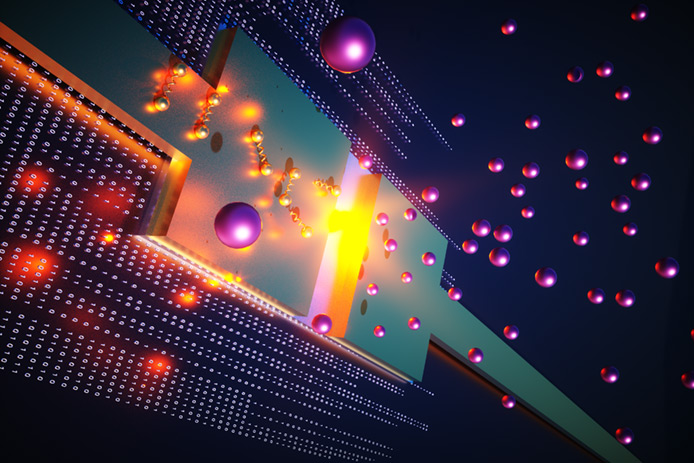
The promise of a quantum internet depends on the complexities of harnessing light to transmit quantum information over fiber optic networks. A potential step forward was reported today by researchers in Sweden who developed integrated chips that can generate light particles on demand and without the need for extreme refrigeration.

Quantum supercomputing today relies on states of matter, that is, electrons that carry qubits of information to perform multiple calculations simultaneously, in a fraction of the time it takes with classical supercomputing.

The co-author of the research, Val Zwiller, Professor at KTH Royal Institute of Technology, says that to integrate quantum supercomputing seamlessly with fiber-optic networks--which are used by the internet today--a more promising approach would be to harness optical photons.

"The photonic approach offers a natural link between communication and computation," he says. "That's important since the end goal is to transmit the processed quantum information using light."

But for photons to deliver qubits on-demand in quantum systems, they need to be emitted in a deterministic, rather than probabilistic, fashion. This can be accomplished at extremely low temperatures in artificial atoms, but today the research group at KTH reported a way to make it work in optical integrated circuits--at room temperature. A closer look at the single photon emitter designed by researchers in Sweden.  CREDIT Ali Elshaair
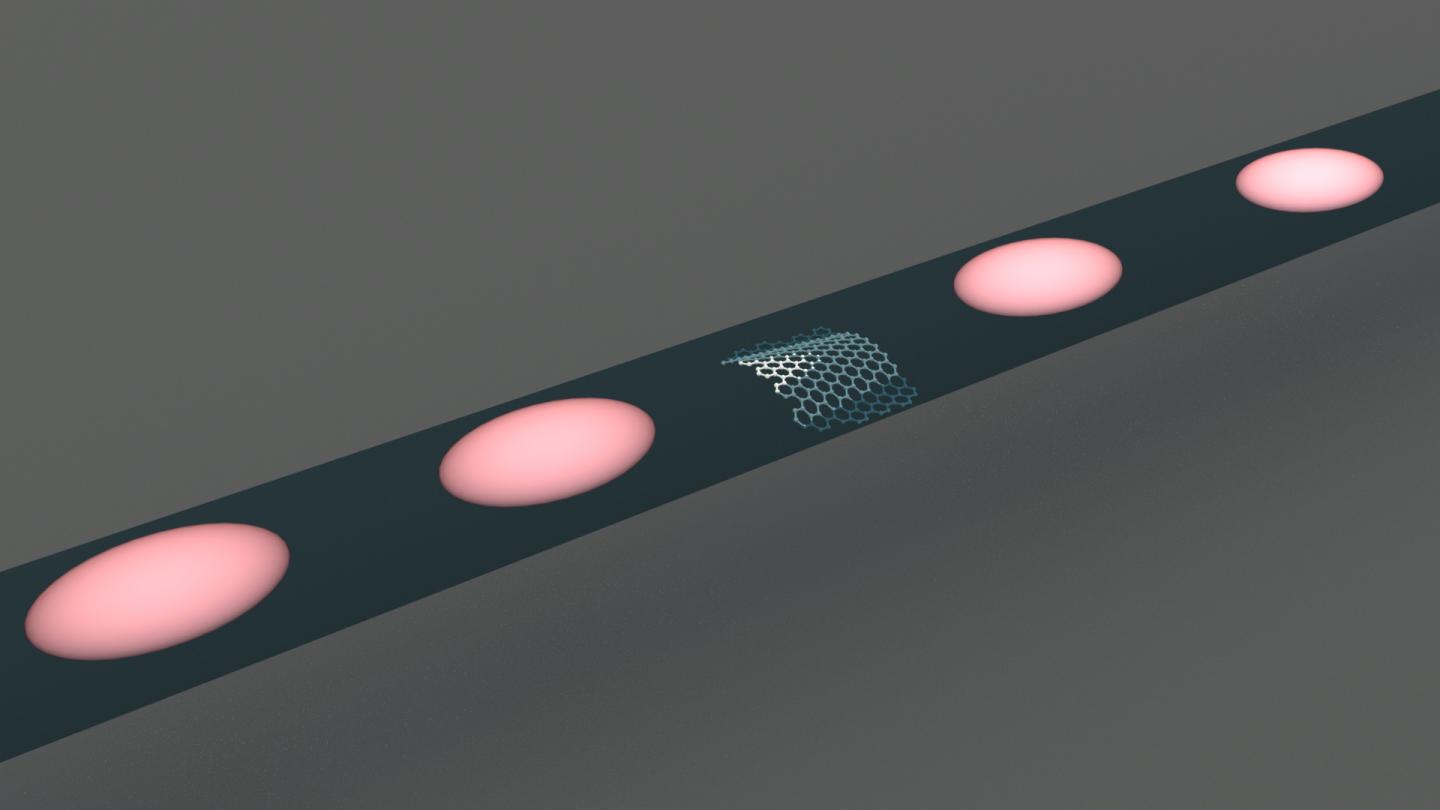
The new method enables photon emitters to be precisely positioned in integrated optical circuits that resemble copper wires for electricity, except that they carry light instead, says co-author of the research, Ali Elshaari, Associate Professor at KTH Royal Institute of Technology.

The researchers harnessed the single-photon-emitting properties of hexagonal boron nitride (hBN), a layered material. hBN is a compound commonly used is used ceramics, alloys, resins, plastics, and rubbers to give them self-lubricating properties. They integrated the material with silicon nitride waveguides to direct the emitted photons.

Quantum circuits with light are either operated at cryogenic temperatures--plus 4 Kelvin above absolute zero--using atom-like single-photon sources, or at room temperature using random single-photon sources, Elshaari says. By contrast, the technique developed at KTH enables optical circuits with on-demand emission of light particles at room temperature.

"In existing optical circuits operating at room temperature, you never know when the single photon is generated unless you do a heralding measurement," Elshaari says. "We realized a deterministic process that precisely positions light-particles emitters operating at room temperature in an integrated photonic circuit."

The researchers reported coupling of hBN single-photon emitter to silicon nitride waveguides, and they developed a method to image the quantum emitters. Then in a hybrid approach, the team built the photonic circuits for the quantum sources locations using a series of steps involving electron beam lithography and etching, while still preserving the high-quality nature of the quantum light.

The achievement opens a path to hybrid integration, that is, incorporating atom-like single-photon emitters into photonic platforms that cannot emit light efficiently on demand.
NOAA scientists unravel positional, structural errors in numerical weather forecast models

Tyler O'Neal, Staff Editor VISUALIZATION May 10, 2021, 9:00 am

Due to the chaotic nature of the atmosphere, weather forecasts, even with ever-improving numerical weather prediction models, eventually lose all skill. Meteorologists have a strong desire to better understand this process as they try to trace forecast error back to observational gaps and to provide a means for improvement.

Root mean square error (rms, or its square, the variance distance) is often used to measure differences between simulated and observed fields. In this case, scientists measured the distance between a model forecast field within its grid and the verifying analysis field that represents all real-world observations. However, one must consider that atmospheric features, like fronts and pressure systems, are three-dimensional weather features in space that supercomputer models displace and also structurally distort as the numerical forecast moves away from initiation. Variance or rms error metrics do not quantify the displacement and distortion of weather systems.

In a recently published paper in Advances in Atmospheric Sciences, a team of scientists with the National Oceanic and Atmospheric Administration (NOAA), the Massachusetts Institute of Technology (MIT), and the University of Connecticut set out to find a general approach to assess the positional and structural components of the total difference between two fields. Essentially, meteorologists want to assess the accuracy of many different weather features within a model forecast compared to a verifying analysis based on real-world observations.

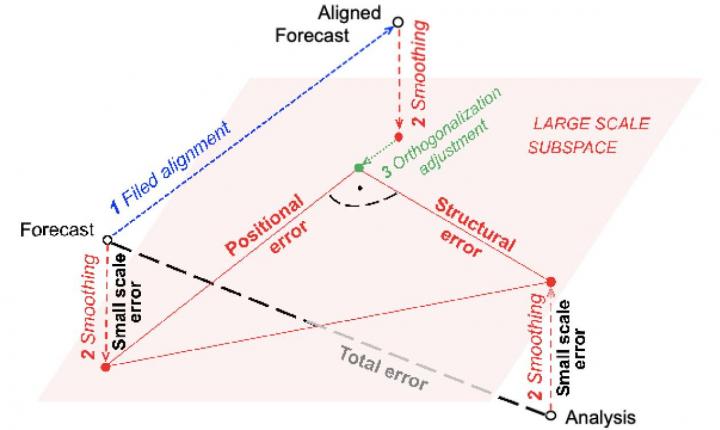
Sai Ravela from MIT, a co-author of this study, previously developed a Field Alignment method. In this case, his approach aligns the model forecast field with the observationally-based analysis in a smooth fashion so their difference is minimized (Step 1 in the schematic diagram, see also example map). Next, small-scale errors from uncertain origins are removed from all three fields (the original and aligned forecast as well as the verifying analysis, or proxy for observations) through a process called spatial filtering or smoothing (Step 2). The total variance distance, or difference, is then partitioned into three unique components (Step 3). Positional error, which is the variance distance between the smoothed original model forecast and smoothed aligned forecast fields, and structural error that is the variance distance between the smoothed aligned forecast and the smoothed verifying analysis fields, are two sides of the right-angle triangle in Fig. 1, and fine-scale noise, which are the uncertain small-scale errors removed from the original model forecast and verifying analysis, or observation fields (see smoothing arrows orthogonal to the triangle in Fig. 1). Fig. 1. Schematic for total forecast error reduction: (1) Spatially align a forecast with the verifying analysis field; (2) Smooth original and aligned forecast and analysis to remove unpredictable scales; (3) Decompose total error into orthogonal (right angle) components of (i) large scale positional error, (ii) large scale structural error, and (iii) small scale noise.  CREDIT Isidora Jankov

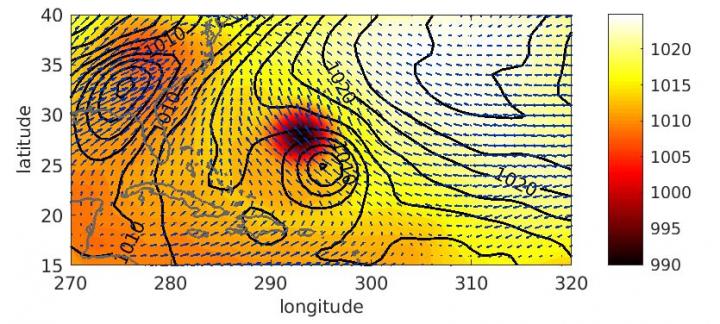
This method outputs the three orthogonal error components as scalar fields, as well as a vector field (Fig. 2) indicating the large-scale displacement of the forecast compared to the observational analysis field. Interestingly, throughout all regions and lead times that the team studied, more than half of the total error variance is associated with the misplacement of weather features. Therefore, displacement is more pronounced than distortion in forecast fields: only about 25% error variance is associated with structural inaccuracies of the partially predictable features, such as fronts and low-pressure systems. The rest of the error variance remains unexplained or unpredictable variability or noise. Fig. 2. 3.5-day forecast (black contour) and verifying analysis (shades of color) of mean sea level pressure for Hurricane Katia, valid at 12 UTC 6 September 2011. Moving the forecast along with the blue arrows aligns it with the observational analysis.  CREDIT Isidora Jankov

"How noise grows in error variance as a function of forecast lead time, and whether a positional-structural-noise decomposition of the spread among an ensemble of perturbed forecasts captures forecast error components is the subject of ongoing studies," said Dr. Jankov from NOAA, the lead author of the study.

Raytheon BBN Technologies harnesses quantum’s ‘noise problem’

Tyler O'Neal, Staff Editor VISUALIZATION May 7, 2021, 12:00 pm

Scientists at Raytheon BBN Technologies have developed a new way to detect a single photon, or particle of light, a development with big applications for sensors, communications, and exponentially more powerful quantum computer processors.

The team has published its work, which centers on the use of a component called a Josephson junction, in the academic journal Science. The discovery builds on the same team’s previous research into a microwave radiation detector 100,000 times more sensitive than existing systems.

“A Josephson junction in quantum computing is analogous to a transistor for modern electronics, so they are super important,” said Kin Chung Fong, a quantum information processing scientist at Raytheon BBN Technologies and a research associate at Harvard University. “Our new device enables this basic unit in quantum computing to communicate through as little as one photon. It will improve the speed in the communication and can make quantum networking and sensing possible.” This illustration depicts a newly developed component, known as a Josephson junction that can detect a single photon of light. The research, led by Raytheon Intelligence & Space, has potential applications for sensors, communications and quantum computers.

Researchers and labs around the world have started building larger quantum computers, seeking to unlock the promise of faster processing.

“In theory, quantum computers can take over where traditional computers would run out of processing power,” said Brad Tousley, president of Raytheon BBN Technologies. “Quantum computers are particularly good at solving critical optimization problems. One example would be for a computer-aided design of a large system like an aircraft. Quantum computing allows for a more finite analysis of something like a wing shape than ever before. Fundamental everyday processing optimization is the first problem we’d like to tackle with quantum computing.”

The technical limitation has been the background noise that causes qubits to lose memory, creating errors in the processing. While other researchers see the noise as a problem, Fong and his team see opportunity.

Their method works a little like a highway, where superconducting charges play the role of cars. In principle, they can move very fast without bumping into each other. Background noise is like a broken-down car in the center lane – it breaks the flow of traffic.

“The interruption could destroy the data in quantum computing applications,” Fong said. “However, we can utilize this same phenomenon to detect a single photon, allowing the traffic to continue to speed along.”

The discovery is part of a research effort at Raytheon BBN Technologies, a subsidiary of Raytheon Intelligence & Space. Raytheon BBN has been providing advanced technology research and development for more than 70 years, often serving as a crucial link between the military and researchers at universities. As an example, it was one of the first nodes in the ARPANET, the precursor of the internet funded by the Defense Advanced Research Projects Agency, or DARPA. Scientists at Raytheon BBN work in broad-reaching portfolios, while quantum engineering and supercomputing continue to show promise for next-generation capabilities.

“This discovery is going to open up quantum processors to be connected like never before,” Tousley said. “The next step is characterizing performance and scaling up to more than one device in parallel or linking multiple devices.”

The Raytheon BBN team believes they have the systems engineering expertise to take this basic research to more practical applications.

“We’ve filled a technological void with the first Josephson junction to detect a single photon,” said Fong. “It’s an enabling technology for networking, communication, and computation. We are really just scratching the surface.”


  1. Cambridge researchers shine a light on how federated learning evolves towards being environmentally friendly
  2. Russian physicists unveil the condensation of liquid light in a semiconductor one-atom-thick

Page 2 of 14

  • 1
  • 2
  • 3
  • 4
  • 5
  • 6
  • 7
  • 8
  • 9
  • 10
POPULAR RIGHT NOW
  • Supercomputers uncover a new class of cosmic explosions hidden in plain sight
    Supercomputers uncover a new class of cosmic explosions hidden in plain sight
  • AI supercharges the hunt for stronger magnets: Iowa State researchers launch a new era of intelligent materials discovery
    AI supercharges the hunt for stronger magnets: Iowa State researchers launch a new era of intelligent materials discovery
  • IBM's Historic stock collapse raises questions for the future of enterprise supercomputing
    IBM's Historic stock collapse raises questions for the future of enterprise supercomputing
  • Could a novel dark matter theory simultaneously resolve multiple cosmic enigmas? Supercomputer simulations provide a compelling, albeit currently unverified, potential solution
    Could a novel dark matter theory simultaneously resolve multiple cosmic enigmas? Supercomputer simulations provide a compelling, albeit currently unverified, potential solution
  • Melting icebergs may be reshaping Earth’s greatest ocean current
    Melting icebergs may be reshaping Earth’s greatest ocean current
  • Supercomputers replace ‘bathtub’ flood maps with physics-based digital twins of Britain’s coastline
    Supercomputers replace ‘bathtub’ flood maps with physics-based digital twins of Britain’s coastline
  • Supercomputers push neural quantum simulation beyond previous limits
    Supercomputers push neural quantum simulation beyond previous limits
  • Intel’s AI supercomputing revival: Q2 financial surge signals new era for CPU-powered HPC infrastructure
    Intel’s AI supercomputing revival: Q2 financial surge signals new era for CPU-powered HPC infrastructure
  • AI infrastructure financing fears shake semiconductor sector
    AI infrastructure financing fears shake semiconductor sector
  • AWS supercomputing investment reaches historic scale as Amazon’s AI strategy powers record financial results
    AWS supercomputing investment reaches historic scale as Amazon’s AI strategy powers record financial results
THIS YEAR'S MOST READ
  • Wall Street wants to trade supercomputing power like oil
    Wall Street wants to trade supercomputing power like oil
  • Cosmic ambition at scale: UK’s supercomputer unlocks a 2.5 petabytes universe
    Cosmic ambition at scale: UK’s supercomputer unlocks a 2.5 petabytes universe
  • Hidden order, revealed at scale: Supercomputing, electron ptychography uncover the inner workings of relaxor ferroelectrics
    Hidden order, revealed at scale: Supercomputing, electron ptychography uncover the inner workings of relaxor ferroelectrics
  • Beamforming the future: BeammWave's 6G push signals the rise of orbital-terrestrial wireless networks
    Joakim Axmon
    Joakim Axmon
  • Intel's Q1 results signal supercomputing surge driving Xeon momentum
    Intel's Q1 results signal supercomputing surge driving Xeon momentum
  • When stars fall apart: Supercomputing reveals the hidden physics of black holes
    When stars fall apart: Supercomputing reveals the hidden physics of black holes
  • Multi-layer simulations reveal the hidden supply chain of solar prominences
    Multi-layer simulations reveal the hidden supply chain of solar prominences
  • Japanese scientists decode dolphin speed with supercomputing: Turbulence, vortices, and the hidden physics of propulsion
    Japanese scientists decode dolphin speed with supercomputing: Turbulence, vortices, and the hidden physics of propulsion
  • Cosmic feedback at scale: Supercomputing reveals how quasars regulate the early Universe
    Cosmic feedback at scale: Supercomputing reveals how quasars regulate the early Universe
  • Modeling life at the microscopic scale: A computational breakthrough in oxygen transport
    Modeling life at the microscopic scale: A computational breakthrough in oxygen transport
MOST READ OF ALL-TIME
  • Largest Computational Biology Simulation Mimics The Ribosome
    Details
    112107
    The amino acid (green) slithers into the chemical reaction center, moving through an evolutionarily ancient corridor of the ribosome (purple). The amino acid is delivered to the reaction core by the transfer RNA molecule (yellow).
    The amino acid (green) slithers into the chemical reaction center, moving through an evolutionarily ancient corridor of the ribosome (purple). The amino acid is delivered to the reaction core by the transfer RNA molecule (yellow).
  • Silicon 'neurons' may add a new dimension to chips
    Details
    80990
    Silicon 'neurons' may add a new dimension to chips
  • Linux Networx Accelerators Expected to Drive up to 4x Price/Performance
    Details
    75537
  • Complex Concepts That Really Add Up
    Details
    73635
    Complex Concepts That Really Add Up
  • Blue Sky Studios Donates Animation SuperComputer to Wesleyan
    Details
    68140
    Each rack holds 52 Angstrom Microsystem-brand “blades,” with a memory footprint of 12 or 24 gigabytes each. (Photos by Olivia Bartlett Drake)
    Each rack holds 52 Angstrom Microsystem-brand “blades,” with a memory footprint of 12 or 24 gigabytes each. (Photos by Olivia Bartlett Drake)
  • Humanities, HPC connect at NERSC
    Details
    57945
  • TeraGrid ’09 'Call for Participation'
    Details
    54951
  • Turbulence responsible for black holes' balancing act
    Details
    52310
  • Cray Wins $52 Million SuperComputer Contract
    Details
    50139
  • SDSC Researchers Accurately Predict Protein Docking
    Details
    46078
  • FRONTPAGE
  • LATEST
  • POPULAR
  • REGISTER
  • SOCIAL
  • VIDEO
  • SUBSCRIPTION
  • RSS
  • GUIDELINES
  • PRIVACY
  • TOS
  • ABOUT
  • +1 (816) 799-4488
  • editorial@supercomputingonline.com
© 2001 - 2026 SuperComputingOnline.com, LLC. All rights reserved. This material may not be published, broadcast, rewritten or redistributed without permission.
Sign In
  • FRONT PAGE
  • LATEST
    • MEDIA KIT
    • MOST READ
    • RSS FEED
    • ACADEMIA
    • AEROSPACE
    • APPLICATIONS
    • ASTRONOMY
    • AUTOMOTIVE
    • BIG DATA
    • BIOLOGY
    • CHEMISTRY
    • CLIENTS
    • CLOUD
    • DEFENSE
    • DEVELOPER TOOLS
    • EARTH SCIENCES
    • ECONOMICS
    • ENGINEERING
    • ENTERTAINMENT
    • HEALTH
    • INDUSTRY
    • INTERCONNECTS
    • GAMING
    • GOVERNMENT
    • MANUFACTURING
    • MIDDLEWARE
    • MOVIES
    • NETWORKS
    • OIL & GAS
    • PHYSICS
    • PROCESSORS
    • RETAIL
    • SCIENCE
    • STORAGE
    • SYSTEMS
    • VISUALIZATION
  • VIDEOS
    • ADD YOUR VIDEOS
    • MANAGE VIDEOS
  • COMMUNITY
    • TRADE SHOWS
    • SOCIAL NETWORK VIDEOS
    • SURVEYS
    • APPLICATIONS BROWSER
    • CONVERSATION INBOX
    • SOCIAL ADVERTISER
    • GROUPS
    • MARKETPLACE LISTINGS
    • PAGES
    • LEADERBOARD
    • POINTS LISTING
      • BADGES
    • PRIVACY CONFIRM REQUEST
    • PRIVACY CREATE REQUEST

Hey there! We noticed you’re using an ad blocker.