
This artist's concept offers a new view of the Milky Way, featuring two major arms extending from a thick central bar, with two less prominent minor arms located in between.

USC's COZMIC Milky-Way simulation: Powerful supercomputer, or just hype?

 In bold news, the University of Southern California claimed its new “COZMIC” simulation, dubbed “Milky-Way twins,” leverages a powerful supercomputer to uncover hidden truths about dark matter. The announcement paints a picture of groundbreaking progress but how much of this is genuine scientific advance, and how much is hype?

The PR spin

COZMIC stands for Cosmological Zoom-in Simulations with Initial Conditions beyond Cold Dark Matter. The USC-led team, led by cosmologist Vera Gluscevic and co-researchers Ethan Nadler and Andrew Benson, celebrate the system’s ability to model galaxies with novel physics and test various dark-matter behaviors.

Yet the coverage is heavy with speculation. The project has run through three dark-matter scenarios—billiard-ball interactions, mixed-sector, and self-interacting models—and then compared them to real telescopic views. The team hopes that matching their “twin” galaxies to what we observe will narrow down what dark matter actually is. However, critics argue that the leap from simulation to cosmological truth remains vast and perhaps unbridgeable.

Which supercomputer?

Despite promotional material crediting "supercomputers" in the plural, the USC story leaves key details conspicuously vague. What is the specific machine running COZMIC, and how powerful is it? There are no hardware specifications, operating speeds, or funding sources—just vague assertions of computational prowess. 

This mystery stands in sharp contrast to other astrophysics simulations. For example, the Eris simulation—the first detailed virtual Milky Way—was run over eight months on NASA’s Pleiades supercomputer, totaling nearly 1.4 million processor hours. Other projects used Titan, Summit, or even Frontier, explicitly naming their machines and citing performance data. The recently launched Frontier is the world’s fastest, capable of an 10^18 FLOPS throughput.

By omitting similar details, USC may be aiming to conceal any comparative weakness in its setup. The claims sound plausible—but without specifying whether COZMIC runs on a Pleiades-class, Summit-class, or some lesser-known cluster, there’s no basis to evaluate the simulation’s actual might. 

The cautionary tale

High-profile simulations have stumbled on this. In 2014, Swiss and US teams used Piz Daint and Titan to simulate a 51-billion-particle Milky Way, achieving 24.8 petaflops on GPUs—but they were transparent about hardware, performance, and time-to-solution. The USC coverage lacks such metrics.

Absent numbers, the claim "programmed a supercomputer to create very detailed cosmological simulations" begs the question—how detailed, and how quickly? The milestone sounds impressive, but at what cost in time, compute hours, or raw scale?

Final analysis

COZMIC certainly represents an intriguing approach, it’s rare to see dark matter–normal matter collisions simulated at this level. That much is novel. Still, branding alone doesn’t make a simulation revolutionary. If USC cannot substantiate how its "supercomputer" compares with the titans of the field (Frontier, Summit, Pleiades), its claims risk being little more than buzz‑bait.

Until researchers provide details such as FLOPS, runtime, memory footprints, or node count, their "twins" remain shadow puppets, dancing in the dark. And claims of new light on dark matter may just be smoke, without the hardware to burn it away.
AI joins the fight to save the Amazon: Leicester scientists pioneer tech-driven conservation

In a groundbreaking development that blends tradition with technology, scientists at the University of Leicester are harnessing artificial intelligence to help safeguard one of the most critical ecosystems on Earth: the Amazon rainforest.

A new study from Leicester’s School of Geography, Geology, and the Environment is making global headlines for its innovative use of AI models to understand and address the alarming biodiversity crisis in the Amazon. Collaborating with Indigenous communities and local knowledge holders, the Leicester team has developed AI systems capable of rapidly analyzing satellite imagery, mapping biodiversity hotspots, and predicting areas at risk of deforestation or ecological collapse.

Dr. Mark G. Thomas, the project's lead researcher, emphasized the importance of combining traditional ecological wisdom with cutting-edge AI tools: “We’re not replacing Indigenous knowledge—we’re amplifying it. By training AI models on the rich observational data collected by local communities, we’re empowering those who know the forest best to protect it even more effectively.”

The AI system, called BioSentinel, uses deep learning to detect subtle environmental changes that often precede larger ecological disruptions. Whether it’s the soundscape of endangered species or shifts in the canopy's color gradient, BioSentinel can recognize patterns that are invisible to the human eye and alert conservationists before it’s too late.

What sets Leicester’s approach apart is not just the use of artificial intelligence, but also its ethical and inclusive design. Rather than imposing a top-down system, BioSentinel is being co-developed with Indigenous groups, ensuring that data sovereignty, cultural insights, and on-the-ground expertise shape every stage of deployment.

“The AI doesn’t just tell us what’s changing — it helps us ask why,” said Dr. Carolina Alves, an ecologist on the team. “By integrating local storytelling and forest lore into the training data, we’re making AI more human — more attuned to the rhythms of nature.”

Early results have been encouraging. In just the first few months of testing, BioSentinel identified over 25 high-risk zones for illegal logging that had previously gone undetected by traditional satellite monitoring. Conservation groups have already begun coordinating with authorities to intervene, preventing what could have been irreversible damage.

Looking ahead, the University of Leicester hopes to expand the technology beyond the Amazon basin, with applications in Southeast Asia, Africa, and even closer to home in the UK’s own protected lands.

Amid the challenges facing our planet, this is a story of hope — one where AI doesn’t stand apart from nature but becomes a vital tool in its defense. It’s a vision of harmony between science, technology, and ancient wisdom, proving that when humanity listens — and innovates — nature responds.

The future of conservation may be digital, but its heart remains deeply human.

Supercomputers illuminate the North Atlantic's climate enigma

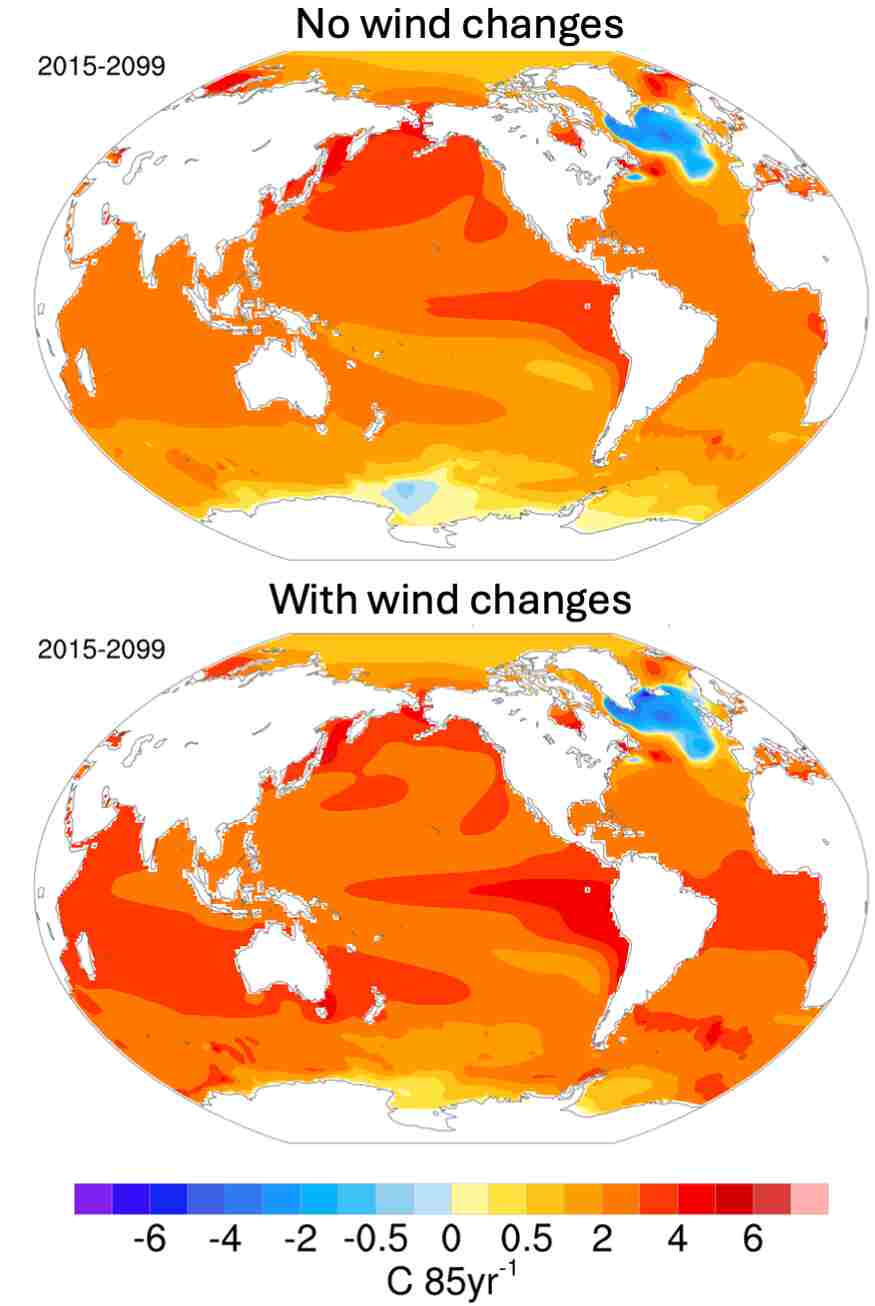
In the vast expanse between Greenland and Ireland lies a curious climatic anomaly: the North Atlantic warming hole. Contrary to its name, this region is experiencing a relative cooling trend amidst global warming. Recent research from the University of Alaska Fairbanks (UAF) explores this phenomenon, utilizing advanced supercomputer models to unravel its mysteries.

Decoding the Cooling

While the planet's oceans are generally warming due to climate change, this particular area in the North Atlantic remains an exception. Scientists have long observed this cooling patch but lacked a comprehensive understanding of its underlying mechanisms. The new study suggests that shifting wind patterns, influenced by climate change, play a pivotal role in this anomaly. Specifically, these winds affect ocean circulation, leading to reduced mixing of warm subsurface waters to the surface, thereby amplifying the cooling effect.

Harnessing Computational Power

To investigate this further, researchers employed sophisticated computer models to simulate two scenarios: one in which changing winds impact ocean circulation and another in which they don't. The models, based on moderate to high greenhouse gas emission projections, indicate that by around 2040, wind-driven changes will begin to enhance cooling in the North Atlantic. This cooling is expected to persist for several decades, potentially influencing precipitation patterns and temperatures across the broader region.

Implications for the Future

Understanding the dynamics of the North Atlantic warming hole is crucial, as it holds significant implications for regional and global climates. Accurate models are essential for predicting future climate scenarios and informing policy decisions. The insights gained from this study underscore the importance of integrating atmospheric and oceanic data to capture the complex interplay of factors driving climate anomalies.

As we continue to refine our models and expand our understanding, the enigmatic cooling of the North Atlantic serves as a reminder of the intricate and interconnected nature of Earth's climate system.