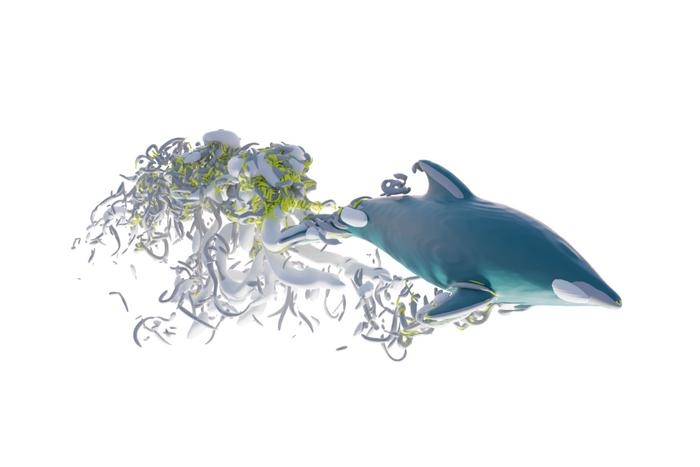
Japanese scientists decode dolphin speed with supercomputing: Turbulence, vortices, and the hidden physics of propulsion

 
The exceptional swimming speed and efficiency of dolphins has long intrigued researchers. Recent advances in computational science have now enabled a novel approach to this question, utilizing high-performance supercomputing rather than relying solely on empirical observation.
 
Researchers at the University of Osaka employed large-scale numerical simulations to investigate the turbulent fluid dynamics associated with dolphin locomotion. Their analysis uncovers a hierarchical organization of vortices within the flow, structures that serve as the primary drivers of propulsion, thereby advancing the scientific understanding of efficient fluid motion.

Turbulence as a computational frontier

Fluid dynamics remains one of the most computationally demanding domains in physics. Governed by the nonlinear Navier–Stokes equations, turbulent flows exhibit multiscale behavior, where energy cascades from large coherent structures down to smaller, chaotic eddies.
 
Capturing this hierarchy requires direct numerical simulation (DNS) or similarly high-resolution computational approaches, techniques that are infeasible without supercomputing infrastructure. In this study, researchers used a supercomputer to resolve the full spatiotemporal evolution of flow fields generated by oscillating dolphin tails, enabling them to:
  • Decompose turbulent flow into scale-dependent vortex structures.
  • Track energy transfer across scales (the “energy cascade”).
  • Quantify thrust contributions from different flow components.
  • Perform parameter sweeps across multiple swimming regimes.
This computational framework effectively turns the supercomputer into a “fluid microscope,” revealing details inaccessible to experimental measurement alone.

The hierarchy of vortices

The simulations demonstrate that dolphin propulsion is dominated not by the total turbulence generated, but by a hierarchical structure of vortices.
 
At the top of this hierarchy are large-scale vortex rings, generated by the oscillatory motion of the dolphin’s tail. These structures:
  • Carry the majority of the momentum transfer.
  • Push water backward efficiently.
  • Generate the bulk of forward thrust.
As these large vortices evolve, they break down into progressively smaller vortices through nonlinear interactions, a hallmark of turbulence known as the energy cascade. However, the simulations show that:
  • Small-scale vortices contribute minimally to propulsion.
  • Their role is largely dissipative, redistributing energy rather than generating thrust.
This distinction is critical. While classical turbulence theory emphasizes the complexity of small-scale structures, the Osaka team’s results indicate that biological propulsion exploits the largest coherent structures, effectively filtering useful motion from chaotic flow.
 
“Our goal is to understand which parts of the turbulent flow help dolphins swim so quickly,” noted lead researcher Yutaro Motoori, emphasizing the importance of isolating dominant flow components through computation.

Supercomputing enables flow decomposition

A key innovation in the study is the ability to computationally decompose turbulence into scale-specific contributions, a task nearly impossible in laboratory settings. By simulating the full velocity and vorticity fields, researchers could isolate:
  • Coherent vortex rings (large-scale structures).
  • Intermediate eddies contribute to energy transfer.
  • Fine-scale turbulent dissipation.
This decomposition allows for a quantitative mapping between flow structure and propulsion efficiency. The results remained robust across varying swimming speeds, suggesting a universal mechanism underlying dolphin locomotion.
 
Such insights depend critically on high-resolution simulation grids and parallel computation, where millions, or more degrees of freedom, must be solved simultaneously over time.

From biological insight to engineering design

Beyond biology, the implications of this work extend into engineering and applied physics. Understanding how dolphins harness turbulence efficiently could inform:
  • Next-generation underwater vehicles, optimized for thrust efficiency
  • Bio-inspired propulsion systems, mimicking oscillatory tail dynamics
  • Flow control strategies, reducing drag or enhancing lift in turbulent regimes
The study highlights a broader paradigm shift: rather than avoiding turbulence, advanced systems may learn to exploit its structure, guided by insights derived from supercomputing.

A curious glimpse into nature’s algorithms

Perhaps most intriguing is what this research suggests about nature itself. Dolphins, through evolution, appear to have “solved” a complex fluid dynamics problem, one that scientists are only now unraveling using some of the most powerful computational tools available.
 
By revealing that propulsion depends primarily on large-scale vortex organization rather than the full turbulent spectrum, the study offers a simpler, more elegant picture of motion in fluids.
 
It is a reminder that, in the age of supercomputing, curiosity driven science can uncover not only the mechanics of the natural world but the underlying principles that make it efficient.
 
And in this case, the answer to a deceptively simple question, why dolphins swim so fast, turns out to be written in the language of vortices, decoded by machines powerful enough to simulate the sea itself.
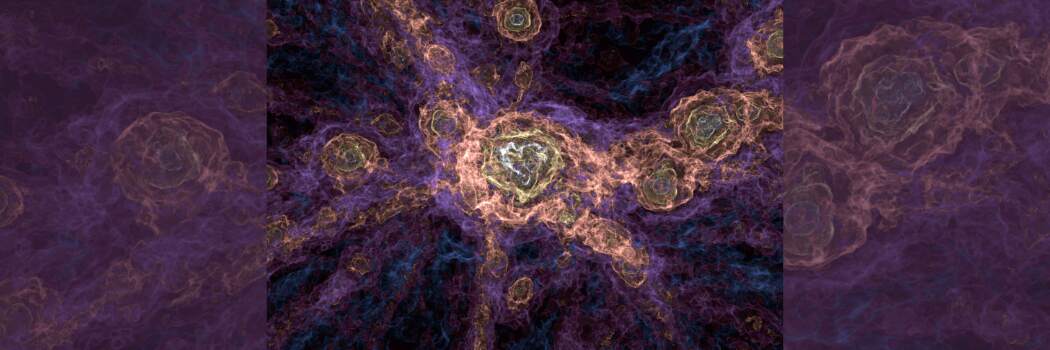

Cosmic ambition at scale: UK’s supercomputer unlocks a 2.5 petabytes universe

 
Marking a significant advancement in computational astrophysics, researchers at Durham University have released one of the most extensive cosmological simulation datasets to date. This comprehensive digital reconstruction of the Universe, enabled by high-performance supercomputing, demonstrates the unprecedented scale at which modern astrophysical phenomena can be modeled and analyzed.
 
Central to this achievement is the FLAMINGO project, an international collaborative effort aimed at simulating the evolution of matter across cosmological timescales. The resulting dataset, exceeding 2.5 petabytes, a volume comparable to approximately half a million high-definition films, provides the global scientific community with access to highly detailed virtual universes that trace the formation and evolution of cosmic structures from the post-Big Bang epoch to the present era.

Supercomputing as the engine of discovery

The simulations were executed on the COSMA-8 supercomputer, part of the UK’s DiRAC national high-performance computing infrastructure. This system, purpose-built for data-intensive cosmological workloads, enabled the integration of vast spatial scales with sophisticated physical modeling.
 
Unlike earlier generations of cosmological simulations, which often forced a trade-off between resolution and scale, FLAMINGO bridges both extremes. It simultaneously models:
  • Gigaparsec-scale cosmic volumes, spanning billions of light-years
  • Galaxy formation physics, including gas dynamics, star formation, and feedback processes
  • Dark matter and dark energy evolution, the dominant drivers of cosmic structure
  • Large-scale clustering, producing the filamentary “cosmic web” observed in galaxy surveys
This dual capability reflects a fundamental shift enabled by supercomputing: the convergence of astrophysical detail with cosmological precision.

The computational architecture of a universe

From a technical standpoint, the FLAMINGO simulations represent a triumph of parallel computing and algorithmic design. The underlying software stack, built around advanced cosmological simulation codes such as SWIFT, leverages:
  • Massively parallel processing, distributing billions of computational elements across thousands of cores
  • Hybrid gravity–hydrodynamics solvers, capturing both collisionless dark matter and baryonic physics
  • Time-resolved evolution, tracking the growth of structure across cosmic epochs
  • Petascale I/O pipelines, capable of writing, storing, and indexing multi-petabyte outputs
These simulations follow matter as it collapses under gravity, forming halos, galaxies, and clusters, while simultaneously modeling the energetic feedback from stars and black holes that regulates galaxy growth. The result is a statistically robust, physically grounded synthetic universe.
 
Crucially, the dataset’s size and complexity required not only raw compute power but also innovations in data accessibility. The team developed a web-based platform that allows researchers to query and extract subsets of the data without downloading entire petabyte-scale files, effectively democratizing access to supercomputer-scale science.

A global resource for precision cosmology

The scientific potential of the dataset is vast. Cosmological simulations are essential tools for interpreting observational data from next-generation telescopes and surveys. By comparing simulated universes with real observations, researchers can test competing models of:
  • Dark matter particle properties
  • Dark energy and cosmic acceleration
  • Galaxy formation and evolution
  • Large-scale structure statistics
FLAMINGO’s scale enables percent-level precision cosmology, allowing subtle deviations between theory and observation to be identified and explored.
 
Moreover, the ability to simulate rare, large-scale structures, such as massive galaxy clusters, provides insights that smaller simulations cannot capture. These structures serve as sensitive probes of cosmological parameters and fundamental physics.

Inspiring the next era of computational science

The release of this dataset is more than a technical achievement; it is a statement about the future of science. By making one of the largest supercomputer-generated datasets openly available, the team is lowering the barrier to entry for researchers, students, and institutions worldwide.
 
As noted by project leaders, access to facilities like COSMA-8 is typically limited. By distributing the results of these simulations globally, the project transforms a localized supercomputing capability into a shared scientific resource.
 
This approach reflects a broader trend: supercomputing is no longer just a tool; it is an infrastructure for collaboration and discovery.

Toward an exaflops cosmos

Looking ahead, projects like FLAMINGO foreshadow the coming era of exaflops computing, where simulations will achieve even higher resolution, incorporate additional physical processes, and integrate real-time observational data.
 
For now, Durham’s 2.5 petabytes universe stands as a powerful demonstration of what is possible when computational ambition meets scientific vision. It is a reminder that, in the age of supercomputing, humanity is no longer limited to observing the cosmos; we are beginning to recreate it.

Intel's Q1 results signal supercomputing surge driving Xeon momentum

In a strong start to 2026, Intel has reported first-quarter financial results that underscore a growing reality across the high-performance computing (HPC) landscape: demand for supercomputing and AI-scale infrastructure is accelerating, and with it, the need for powerful server processors.
 
The company posted revenue of approximately $13.6 billion, exceeding expectations and marking a notable 7% year-over-year increase. Earnings also surpassed forecasts, reflecting renewed strength in Intel’s core data center business.
 
Shares of the U.S. chipmaker jumped 15% in after-hours trading.

Supercomputing demand lifts Xeon sales

At the center of this growth is Intel’s Xeon processor line, long a cornerstone of supercomputing systems and hyperscale data centers. As global investment in AI, simulation, and large-scale modeling intensifies, Xeon-based platforms are seeing renewed demand.
 
Intel’s data center segment delivered particularly strong performance, generating over $5 billion in revenue for the quarter and outperforming analyst expectations. This surge is closely tied to expanding workloads in AI training, scientific simulation, and cloud-scale analytics, domains traditionally dominated by supercomputing infrastructure.
 
Xeon processors remain deeply embedded in HPC ecosystems. Historically, they have powered a majority of the world’s top supercomputers, thanks to their high core counts, memory bandwidth, and compatibility with parallel workloads. As modern systems evolve toward hybrid CPU-GPU architectures, CPUs like Xeon continue to orchestrate workloads, manage data movement, and execute complex simulations.

AI and HPC converge

A key driver behind this momentum is the convergence of AI and traditional supercomputing. Workloads once confined to national labs, climate modeling, molecular dynamics, and astrophysics are now intersecting with enterprise AI applications such as large language models and digital twins.
 
Intel executives emphasized that CPUs remain essential even in GPU-heavy environments. Server processors are critical for feeding data to accelerators, running inference workloads, and maintaining system-level efficiency.
 
This architectural balance is fueling demand not just for accelerators, but for robust general-purpose compute, an area where Xeon continues to play a pivotal role.

Market tailwinds favor HPC growth

Broader industry trends reinforce Intel’s position. The global x86 server market remains dominant, accounting for the vast majority of server shipments and benefiting from the rapid expansion of hyperscale data centers.
 
At the same time, AI infrastructure investments are reaching unprecedented levels, with enterprises and governments alike racing to deploy supercomputing-class systems. These deployments increasingly require dense, scalable CPU architectures capable of handling both traditional HPC and emerging AI workloads.
 
Intel’s continued investment in next-generation Xeon platforms, including upcoming architectures designed for higher core counts and improved memory throughput, positions the company to capitalize on this shift.

Looking ahead: A supercomputing renaissance

While challenges remain, including competition and prior supply constraints, Intel’s latest results suggest a turning point. The company is benefiting from a broader resurgence in compute demand, driven by the same forces that are redefining supercomputing itself.
 
From national laboratories to cloud providers, the appetite for high-performance infrastructure is expanding rapidly. And as that demand grows, so too does the importance of the processors at its foundation.
 
For Intel, the message from Q1 2026 is clear: the supercomputing era is not just alive, it is accelerating, and Xeon is riding the wave.