Tiny whirlpools, massive potential: How skyrmions could reshape supercomputing memory

What if the future of supercomputing didn’t depend on building bigger machines, but on discovering smaller, stranger building blocks?
 
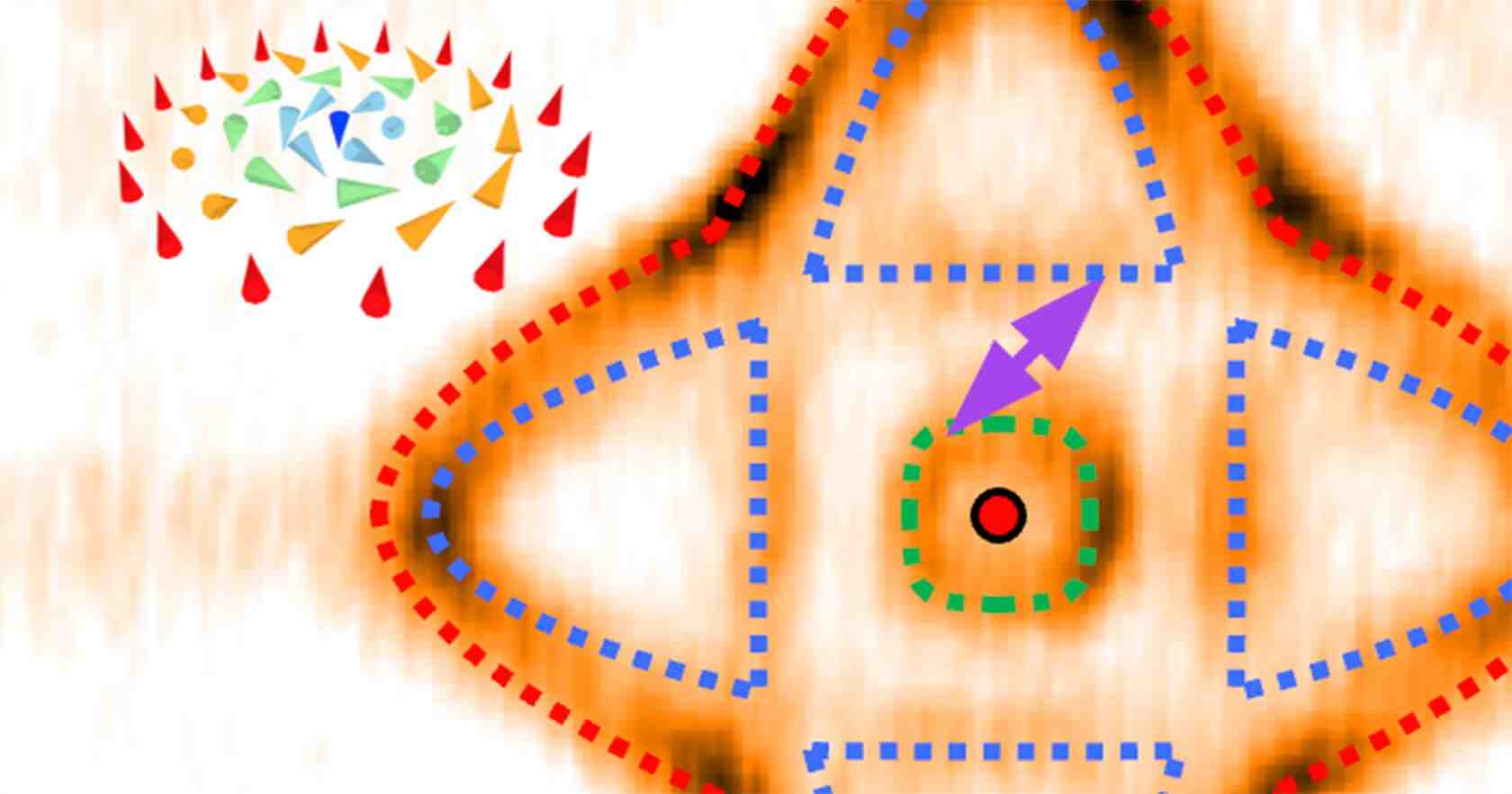
Deep inside exotic materials, researchers have uncovered something that looks almost imaginary: tiny magnetic whirlpools just 2 nanometers wide, thousands of times smaller than a human hair.
 
These structures, known as skyrmions, were once purely theoretical.
 
Now, they may hold the key to the next revolution in computing.

A particle that isn’t a particle

Skyrmions are not particles in the traditional sense. They are swirling patterns of magnetism, vortex-like arrangements of atomic spins that behave as if they are stable, self-contained objects.
 
For years, scientists suspected they could exist. But understanding how they form and how to control them remained elusive.
 
That is beginning to change.
 
Researchers at Tohoku University in Japan have now identified critical mechanisms behind skyrmion formation, revealing that these structures can exist in materials previously thought impossible.
 
Even more surprisingly, their behavior appears to follow a kind of hidden blueprint encoded in the material’s electronic structure.

The Blueprint Beneath the Surface

At the heart of the discovery is a phenomenon called a Lifshitz transition, a sudden shift in a material’s electronic state.
 
When this shift occurs, it reshapes the material’s “Fermi surface,” creating overlapping patterns that act like a structural template for skyrmions.
 
Researchers describe this as a kind of design rule: a way to predict not just whether skyrmions will form, but their size, arrangement, and behavior.
 
Even the force that stabilizes them turned out to be unexpected.
 
For years, scientists believed skyrmions were governed by one type of magnetic interaction. Instead, the new study shows they are driven by the RKKY interaction, a subtle effect mediated by electrons moving through the material.
 
It is a reminder that in physics, even well-established assumptions can quietly unravel.

Why supercomputing cares

At first glance, these nanoscale whirlpools might seem far removed from the world of high-performance computing.
 
But they address one of its biggest challenges: memory.
 
Modern supercomputers, and especially AI-driven data centers, are increasingly limited not by processing power, but by how fast and efficiently they can store and move data. Energy consumption has become a defining constraint.
 
This is where skyrmions become intriguing.
 
They are:
  • Extremely stable (resistant to disruption)
  • Tiny (enabling ultra-high-density storage)
  • Energy-efficient (movable with minimal electrical current)
In practical terms, this means future memory devices could store vastly more data while consuming far less power, a combination that could redefine the architecture of supercomputing systems.

Memory that moves like a fluid

One of the most curious aspects of skyrmions is how they behave.
 
Unlike traditional bits stored in fixed locations, skyrmions can move, gliding through materials like microscopic beads on a track. This opens the door to entirely new types of memory, where data is not just stored, but dynamically transported.
 
It’s a concept that feels almost biological, less like rigid hardware, more like a flowing system.
 
And it raises new questions:
  • Could memory become something that evolves in real time?
  • Could computing architectures shift from static layouts to dynamic ones?
  • Could supercomputers become not just faster, but fundamentally different?

From theory to technology

There is still a long road ahead.
 
One major challenge is temperature: many skyrmion systems currently require conditions that are impractical for everyday devices. Researchers are now working to design materials that function reliably at higher, more accessible temperatures.
 
But the path forward is clearer than before.
 
By linking electronic structure to magnetic behavior, scientists are moving from trial-and-error experimentation to intentional design, engineering materials with properties tailored for computation.

A curious future, computed at the nanoscale

What makes this discovery so compelling is not just its potential, but its strangeness.
 
A swirling pattern of spins, once a mathematical curiosity, now sits at the center of a possible technological shift.
 
And like many breakthroughs in modern science, it exists at the intersection of disciplines:
  • quantum physics
  • materials science
  • nanotechnology
  • and, increasingly, supercomputing
Understanding, simulating, and ultimately harnessing skyrmions requires immense computational power. Their behavior emerges from complex interactions that only advanced modeling and high-performance computing can fully capture.

The smallest frontier

In the race toward more powerful supercomputers, it’s tempting to think in terms of scale, more cores, more data, more energy.
 
But skyrmions suggest a different path.
 
One where progress comes not from building bigger systems, but from discovering smaller, smarter ones.
 
Where the future of computation may hinge on structures so small they were once invisible to science, and so elegant they almost feel like nature’s own code.
 
And where curiosity, once again, leads the way.
When stars fall apart: Supercomputing reveals the hidden physics of black holes

Amid the infinite darkness of space, a silent catastrophe unfolds.
 
A star wanders perilously close to a supermassive black hole. Gravitational forces stretch and tear it apart, transforming the star into a radiant stream of stellar debris that spirals into oblivion. For a fleeting instant, the cosmos ignites, producing a phenomenon known as a tidal disruption event (TDE).
 
These violent encounters are among the most powerful probes of black holes. But until now, scientists may have been misunderstanding what actually happens in those crucial first moments after destruction.
 
It took supercomputing at an unprecedented scale to see the truth.

Simulating a cosmic catastrophe

In a new study published in The Astrophysical Journal Letters, researchers have used cutting-edge simulations to recreate the fate of a Sun-like star destroyed by a black hole one million times more massive than our Sun.
 
But this was no ordinary simulation.
 
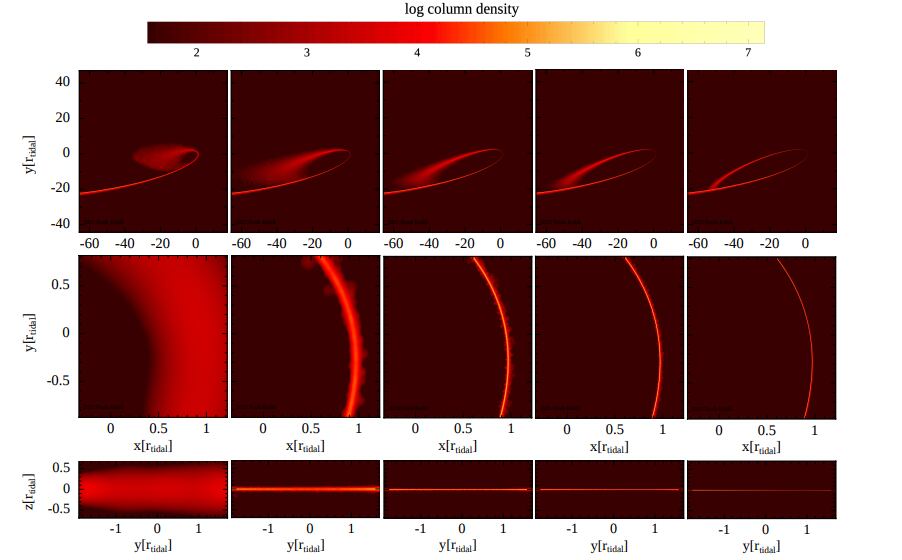
Using a GPU-powered code known as SPH-EXA and running on the ALPS supercomputer, the team modeled the event with up to 10 billion particles, orders of magnitude beyond previous efforts.
 
This level of detail matters. In TDEs, the physics spans extremes: from the size of a star to orbits stretching tens of thousands of stellar radii, and from minutes-long stellar collapse to debris returning weeks later.
 
Capturing all of it requires immense computational precision.
 
Supercomputers, in this case, are not just tools; they are the only way to observe the unobservable.

A long-standing theory falls apart

For years, scientists believed that as the shredded stellar material swings back toward the black hole, it undergoes intense compression near its closest approach, creating powerful “nozzle shocks” that rapidly heat and spread the debris.
 
This process was thought to play a key role in forming the bright, glowing disk of material that ultimately feeds the black hole.
 
But the new simulations tell a different story.
 
As the resolution increased, a key finding emerged: the dramatic spreading of the debris disappeared, and at the highest resolution, the returning stream stayed narrow and largely undisturbed.
 
Even more striking, the simulations showed that the amount of energy lost to shocks dropped to almost nothing, just one hundred-thousandth of the material’s kinetic energy. This finding directly challenges previous ideas about how the debris behavior was understood.
 
What once appeared to be a fundamental physical process now looks, in part, like a numerical illusion.

The power, responsibility of supercomputing

This revelation underscores a deeper truth about modern science: resolution is not just a technical detail. It can fundamentally change our understanding of reality.
 
Lower-resolution simulations had suggested a universe where stellar debris violently disperses near the black hole. Higher-resolution, supercomputer-driven models reveal a more delicate picture, one where the debris remains coherent, awaiting a different mechanism to evolve.
 
That mechanism, the study suggests, is likely stream to stream collision: where incoming and outgoing flows of stellar material intersect and dissipate energy more gradually.
 
It is a subtle shift, but one with major implications for how we interpret cosmic observations.

Reading the light of shredded stars

These insights arrive at a critical moment.
 
Astronomers are increasingly using tidal disruption events as tools to study otherwise invisible black holes. Each flare carries information about the black hole’s mass, spin, and environment.
 
But decoding those signals depends on understanding the physics behind them.
 
If the early stages of these events are governed not by violent shocks but by more structured, collision-driven processes, then the light we observe may tell a more nuanced story, one shaped by geometry, orbital dynamics, and relativistic effects.
 
In other words, every shredded star becomes a kind of message.
 
And supercomputing helps us learn how to read it.

Toward a new era of precision astrophysics

What makes this work inspiring is not just its findings, but its method.
 
By pushing simulations to billions of particles and leveraging advanced GPU architectures, researchers are entering a new regime of precision astrophysics, where numerical artifacts give way to physical truth.
 
It is a reminder that the universe does not yield its secrets easily. Sometimes, the difference between misconception and discovery is measured not in theory, but in computational power.

A universe reconstructed in code

We may never witness a star being torn apart up close.
 
But through supercomputing, we can reconstruct the event in astonishing detail, following every fragment, every orbit, every interaction as gravity does its work.
 
And in doing so, we move closer to answering one of the most profound questions in astrophysics:
 
What really happens when matter meets the edge of a black hole?
 
Thanks to the growing power of supercomputing, the answer is no longer beyond our reach.

Intel, Google's latest AI pact: A boost for supercomputing, or a strategic rebrand?

 
In today’s announcement, which has already bolstered investor confidence, Intel and Google unveiled a deeper collaboration aimed at advancing artificial intelligence infrastructure. On the surface, the partnership appears to be a natural evolution of two long-time collaborators aligning around the next phase of AI. But for the supercomputing community, the implications are more complex and perhaps less revolutionary than advertised.
 
At the core of the agreement is a renewed emphasis on general-purpose compute, specifically Intel’s Xeon CPUs, and the co-development of custom infrastructure processing units (IPUs). These components are intended to handle the growing demands of AI inference workloads, which are rapidly overtaking training as the dominant computational burden in production systems.

The return of the CPU, or a narrative adjustment?

For years, the supercomputing narrative has been dominated by accelerators: GPUs, TPUs, and specialized AI silicon. This partnership, however, attempts to reposition the CPU as indispensable to modern AI systems. Intel’s leadership has stressed that “balanced systems” combining CPUs and domain-specific processors are essential for scaling AI workloads.
 
That argument is not without merit. Large-scale simulations, hybrid HPC-AI workflows, and data preprocessing pipelines still rely heavily on CPUs. In supercomputing environments, orchestration, memory management, and I/O remain CPU-bound challenges.
 
Yet skepticism is warranted. The renewed focus on CPUs may reflect less a technological breakthrough and more a strategic necessity. Intel ceded significant ground during the early AI boom, where GPU-centric architectures, particularly from rivals, became the backbone of both hyperscale AI and leadership-class supercomputers. Reframing CPUs as “central” to AI could be as much about reclaiming relevance as it is about architectural truth.

IPUs: Innovation or incrementalism?

The collaboration’s second pillar, custom IPUs, promises efficiency gains by offloading specific workloads from CPUs. In theory, this aligns well with trends in heterogeneous supercomputing, where specialized units handle tightly scoped tasks.
 
However, the concept is hardly novel. The supercomputing ecosystem has long embraced heterogeneous architectures, from GPU-accelerated nodes to FPGA-enhanced systems. The introduction of yet another processing unit raises questions about software fragmentation and interoperability, persistent pain points in HPC environments.
 
Without robust, open, and portable programming models, IPUs risk becoming yet another siloed technology that complicates already intricate supercomputing stacks.

Supercomputing impact: Real, but indirect

Where this partnership does matter is at the infrastructure level. Hyperscale cloud providers like Google increasingly serve as de facto supercomputing platforms, particularly for AI-driven scientific workloads. The continued deployment of Intel Xeon processors in these environments ensures that a significant portion of global compute capacity remains CPU-centric.
For researchers and HPC practitioners, this translates into:
  • Greater availability of CPU-optimized AI inference platforms
  • Potential cost efficiencies for mixed workloads
  • Incremental improvements in system balance and flexibility
But these are evolutionary gains, not transformative leaps. The partnership does not introduce a new computing paradigm, nor does it fundamentally alter the trajectory of exaflops or post-exaflops systems.

Market signals vs. technical substance

The immediate market reaction, Intel’s stock surge, and renewed investor enthusiasm suggest the announcement carries more financial than technical weight.
 
This raises a broader question: are such partnerships driving innovation in supercomputing, or simply repackaging existing strategies for a market eager for AI narratives?

A measured outlook

For the supercomputing community, the Intel-Google collaboration is best viewed as a reaffirmation of existing trends rather than a disruptive milestone. It underscores the enduring importance of CPUs in heterogeneous systems while acknowledging the growing complexity of AI infrastructure.
But it stops short of addressing the deeper challenges facing HPC:
  • Software portability across heterogeneous architectures
  • Energy efficiency at exascale and beyond
  • Data movement bottlenecks in AI-driven simulations
Until those issues are meaningfully tackled, announcements like this, however headline-grabbing, will remain incremental steps dressed in transformative language.
 
In the end, the partnership may strengthen Intel’s position and optimize Google’s infrastructure. Whether it meaningfully advances supercomputing is a more open and far more debatable question.