
AI for financial stability, or systemic risk? A look at the ‘Faustian bargain’

As supercomputing systems take on a increasing role in powering financial modeling, a new working paper from Stanford Graduate School of Business poses a challenging question: Should regulators rely on AI models that can forecast crises, yet fail to provide clear explanations for their predictions?
 
In “Financial Regulation and AI: A Faustian Bargain?”, the authors examine how advanced machine learning models, trained on detailed financial holdings, might transform macroprudential policy. For high-performance computing (HPC) professionals, the real issue is not finance per se, but the computational tradeoff: What are the risks when the ability to predict outstrips our ability to understand why?

From HPC Models to Financial Policy Engines

Modern financial systems generate enormous datasets: transaction flows, portfolio holdings, derivatives exposure, and cross-institutional dependencies. Processing these datasets requires supercomputing-scale infrastructure, where graph-based deep learning models can ingest and analyze relational data across millions of nodes and edges.
 
The Stanford study introduces a graph-based deep learning architecture designed specifically for this task. By learning embeddings for both assets and investors, the model captures the network structure of financial markets and achieves strong out-of-sample predictive performance in identifying stress points, such as forced liquidations or fire-sale cascades.
 
From an HPC standpoint, this is a familiar pattern:
  • Massive graph datasets
  • Distributed training across accelerators
  • Nonlinear models extracting latent structure from high-dimensional inputs
In other words, financial regulation is beginning to resemble large-scale simulation and inference workflows already common in climate science or genomics.

The Core Tradeoff: Prediction vs. Causality

The paper’s central argument is deceptively simple: AI models can predict where financial stress will occur, but may provide little insight into how policy interventions will change those outcomes.
 
This creates what the authors describe as a “Faustian bargain.” Regulators gain predictive accuracy, but risk losing interpretability and causal grounding.
 
Technically, the issue stems from the nature of modern ML systems:
  • Models are highly nonlinear and reduced-form.
  • Predictions are derived from correlations in historical data.
  • The underlying causal mechanisms remain opaque.
As the paper notes, there is “no guarantee” that these models capture structural relationships that remain stable when policy itself changes.
 
For HPC practitioners, this is analogous to running a highly accurate simulation that fails under perturbation, a model that fits the data, but not the system.

A Feedback Loop Hidden in the Compute

The study goes further by modeling how financial institutions might respond to AI-driven regulation.
 
If regulators use predictive models to anticipate crises and intervene earlier, market participants will adapt. Portfolios may shift toward assets perceived as “protected” or more likely to benefit from intervention.
 
This creates a feedback loop:
  1. AI predicts fragile assets.
  2. Regulators intervene.
  3. Markets adjust behavior based on expected intervention.
  4. The underlying system changes.
The result is a moving target, one where the model’s predictions may become less reliable precisely because they are being used.
 
From a supercomputing perspective, this resembles adaptive systems with endogenous responses, where the act of measurement or intervention alters the system being modeled.

When More Compute Doesn’t Mean More Certainty

The natural instinct in HPC is to scale:
  • More data
  • Larger models
  • Higher-resolution predictions
But the Stanford paper suggests that scaling alone does not resolve the core issue.
 
Even a perfectly trained model, running on the most advanced GPU clusters, cannot guarantee useful policy guidance if it lacks causal interpretability. Predictive precision only improves outcomes when it aligns with areas where regulators already understand how interventions work.
 
In practical terms:
  • Accuracy ≠ policy effectiveness
  • Resolution ≠ robustness
  • Compute ≠ understanding
This is a subtle but critical limitation for HPC-driven AI systems deployed in real-world decision-making environments.

Implications for Supercomputing Users

For the supercomputing community, the implications extend beyond finance.
 
The paper highlights a broader pattern emerging across domains:
  • AI models trained on massive datasets outperform traditional methods.
  • These models are deployed in decision loops, not just analysis pipelines.
  • The systems they model begin to react to the models themselves.
In such settings, HPC becomes part of a closed-loop system, where computation influences behavior, and behavior feeds back into computation.
 
This raises uncomfortable questions:
  • How do we validate models in systems that change in response to them?
  • What does “ground truth” mean when interventions alter outcomes?
  • Can we scale our way out of fundamentally epistemic uncertainty?

A Skeptical Outlook

The Stanford paper doesn’t suggest abandoning AI for financial regulation. Rather, it demonstrates that predictive models can enhance outcomes in specific scenarios.
 
However, the study pushes back against a prevailing belief in the HPC and AI worlds: the idea that increasing model power inevitably leads to better decisions.
 
Instead, it argues for caution. No matter how advanced, predictive systems are only as effective as their alignment with causal reasoning and policy limitations.
 
For supercomputing users, this may be the real takeaway.
 
The next frontier of HPC is not just scaling models, but understanding when those models should, and should not, be trusted.

Reducing the data bottleneck: A curious look at compression for supercomputing workflows

As high-performance computing (HPC) systems advance toward exascale and beyond, a familiar challenge endures across scientific domains: data movement. In fields such as climate modeling, genomics, and large-scale AI training, the expense of moving, storing, and accessing massive datasets now often matches, or even surpasses, the cost of computation itself.
 
A recently announced compression technology, highlighted in today’s press release from Xinnor, and a recent deployment at GWDG, the HPC center supporting research at the University of Göttingen.
 
In short: GWDG replaced their legacy storage with an all-NVMe Lustre system built by MEGWARE using Xinnor's xiRAID software, achieving more than 4x performance improvement across the board. It seeks to address this imbalance by targeting one of HPC’s most stubborn inefficiencies: the rapid growth of intermediate and output data produced by contemporary workloads.
 
At first glance, compression might seem like a solved problem. But for supercomputing users, the reality is more nuanced. Traditional compression techniques often trade off compression ratio, speed, and fidelity in ways that are not well aligned with the requirements of HPC. The question, then, is whether a new generation of compression tools can meaningfully integrate into performance-critical pipelines without introducing unacceptable overhead.

Compression in the Age of Exascale

Modern HPC systems generate data at extraordinary rates. Simulation codes can produce terabytes per run, while AI workloads routinely generate massive checkpoint files and intermediate tensors. In many workflows, I/O bandwidth and storage capacity have become limiting factors.
 
The product described in the press release is designed to operate within these constraints by offering:
  • High-throughput compression and decompression optimized for parallel environments
  • Integration with HPC storage layers, including parallel file systems
  • Support for large, structured scientific datasets
From an architectural perspective, the focus appears to be on minimizing the traditional penalties of compression, particularly latency and CPU overhead, while maximizing compatibility with distributed workflows.
 
For HPC engineers, this raises an immediate point of curiosity: Can compression be applied in-line with computation, rather than as a post-processing step?

Inline Compression and Workflow Integration

One of the more intriguing aspects of the product is its positioning as a pipeline-integrated component rather than a standalone utility.
 
In typical HPC workflows, data is written to disk in raw or lightly processed form, then compressed later for storage or transfer. This approach introduces additional I/O cycles, increasing pressure on storage systems.
 
An inline model suggests a different paradigm:
  • Data is compressed as it is generated.
  • Reduced data volume lowers pressure on interconnects and storage.
  • Downstream processes operate on smaller datasets, improving throughput.
If implemented effectively, this could shift compression from a peripheral optimization to a first-class component of HPC workflows.
 
However, this also introduces technical challenges familiar to HPC practitioners:
  • Maintaining deterministic performance under parallel workloads.
  • Avoiding contention between compute and compression threads.
  • Preserving numerical fidelity where required.

Implications for AI and Simulation Workloads

The relevance of compression is particularly pronounced in two dominant HPC domains: scientific simulation and machine learning.
 
In simulation environments, large multidimensional arrays, often representing physical fields, can be compressed using domain-aware techniques that exploit spatial and temporal coherence. This reduces storage requirements while maintaining acceptable error bounds.
 
In machine learning, especially in distributed training, checkpointing and data movement represent significant overhead. Compression applied to model states or gradients could reduce communication costs across nodes, particularly in large GPU clusters.
 
For supercomputing users, the key question is not whether compression works, but whether it can be deployed without disrupting tightly optimized pipelines.

A Shift in How HPC Thinks About Data

What makes this development noteworthy is not just the product itself, but the broader shift it represents.
 
Historically, HPC optimization has focused on compute performance, faster processors, better interconnects, and more efficient algorithms. Increasingly, attention is turning toward data efficiency:
  • Reducing data movement
  • Minimizing storage overhead
  • Optimizing I/O pathways
Compression sits at the intersection of all three.
 
If solutions like the one described can deliver on their promise, combining high throughput, scalability, and integration, they may help rebalance HPC architectures where data has become the dominant cost.

A Curious Future for HPC Data Pipelines

For the supercomputing community, this raises an open and intriguing possibility:
What if the next major gains in HPC performance do not come from faster computation, but from smarter data handling?
 
Compression, once treated as an afterthought, may become a central design consideration in future HPC systems. Not merely as a storage optimization, but as a core component of the computational pipeline itself.
 
And as datasets continue to grow, that shift may prove just as transformative as any advance in hardware.

Cratered clues: How supercomputers are reconstructing the violent history of asteroid Psyche

In the distant reaches of the asteroid belt between Mars and Jupiter, a metallic world named 16 Psyche preserves vital clues to planetary formation. Once thought to be the exposed core of an incomplete planet, Psyche is now at the center of groundbreaking research led by scientists from the University of Arizona. Using supercomputer simulations, they are re-examining the asteroid’s surface to unravel secrets about the early solar system.
 
Central to this research are the vast impact craters that pockmark Psyche’s exterior. These craters are not mere remnants of collisions; they hold essential information about the asteroid’s internal makeup, composition, and origins. Unlocking these secrets requires more than careful observation, it demands large-scale computational reconstruction.

From Telescope Data to Computational Models

Asteroid Psyche, roughly 220 kilometers in diameter, is one of the most massive metal-rich bodies in the asteroid belt.
 
Yet its composition remains debated. While once believed to be a solid iron-nickel core, more recent evidence suggests a mixed metal–silicate structure, complicating assumptions about its formation.
 
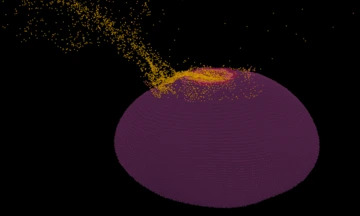
To resolve this uncertainty, researchers are turning to large-scale numerical impact simulations, using supercomputers to model how craters form under different material conditions. By comparing simulated crater morphologies with observational data, scientists can infer what lies beneath Psyche’s surface.
 
This approach effectively transforms crater analysis into an inverse problem, one where the observed geometry must be matched to a forward model of high-energy impacts governed by nonlinear physics.

HPC at the Core of Planetary Reconstruction

The study, published in Journal of Geophysical Research: Planets, leverages hydrocode simulations, a class of numerical methods used to model shock physics, material deformation, and high-velocity impacts. These simulations solve coupled partial differential equations describing:
  • Momentum conservation under extreme pressures
  • Energy transfer during hypervelocity collisions
  • Phase transitions in metal and silicate materials
  • Fragmentation and ejecta dynamics
Such models are computationally intensive. Each simulation must resolve fine spatial and temporal scales while exploring a large parameter space, including:
  • Impactor size and velocity
  • Target composition (metal-rich vs. mixed material)
  • Porosity and internal layering
  • Gravity regime of the asteroid
Running these scenarios across multiple configurations requires massively parallel HPC systems, often executing thousands of simulations to converge on statistically robust interpretations.

Craters as Probes of Internal Structure

One of the key insights from the study is that crater size alone is not sufficient to infer surface composition. Instead, the shape, depth, and ejecta distribution of craters vary significantly depending on whether the target material behaves like solid metal, fractured rock, or a porous composite.
 
Supercomputer simulations revealed that some of Psyche’s largest craters are more consistent with impacts into a lower-density or heterogeneous, rather than purely metallic, body. This finding aligns with recent observational and spectral data suggesting Psyche is not a simple exposed core, but a more complex, differentiated object.
 
In practical terms, this suggests the asteroid’s history likely includes a sequence of complex processes: partial differentiation followed by structural disruption, subsequent re-accumulation of mixed materials, and repeated high-energy impact events.
 
Each of these scenarios leaves distinct signatures in crater morphology, signatures that only become interpretable through computational modeling.

A Digital Twin Ahead of NASA’s Arrival

The timing of this work is particularly significant. NASA’s Psyche mission, launched in 2023, is expected to arrive at the asteroid in 2029.
 
By the time the spacecraft begins transmitting high-resolution imagery and gravity data, researchers aim to have a computational framework already in place, a kind of digital twin of Psyche that can rapidly assimilate new observations.
 
For HPC users, this represents a familiar paradigm:
  • Build large ensembles of forward simulations.
  • Precompute parameter sensitivities.
  • Utilize observational data to constrain model space in real-time.
In planetary science, this workflow is becoming increasingly central as datasets grow and missions demand faster scientific interpretation.
 
"Large impact basins or craters excavate deep into the asteroid, which gives clues about what its interior is made of," said Namya Baijal, a doctoral candidate at the LPL and first author of the paper. "By simulating the formation of one of its largest craters, we were able to make testable predictions for Psyche's overall composition when the spacecraft arrives."

Inspiration for the Supercomputing Community

For supercomputing engineers, Psyche offers a compelling example of how HPC extends beyond traditional domains into planetary-scale inference problems.
 
The work illustrates a broader shift: modern space science is no longer limited by data collection, but by our ability to simulate, compare, and interpret complex physical systems.
 
Craters, once viewed as static geological features, are now dynamic datasets, decoded through parallel computation and advanced modeling.
 
And in those impact scars, billions of years old, supercomputers are helping scientists read a story that was once thought unreachable: the formation of worlds, written in metal and stone, reconstructed in code.