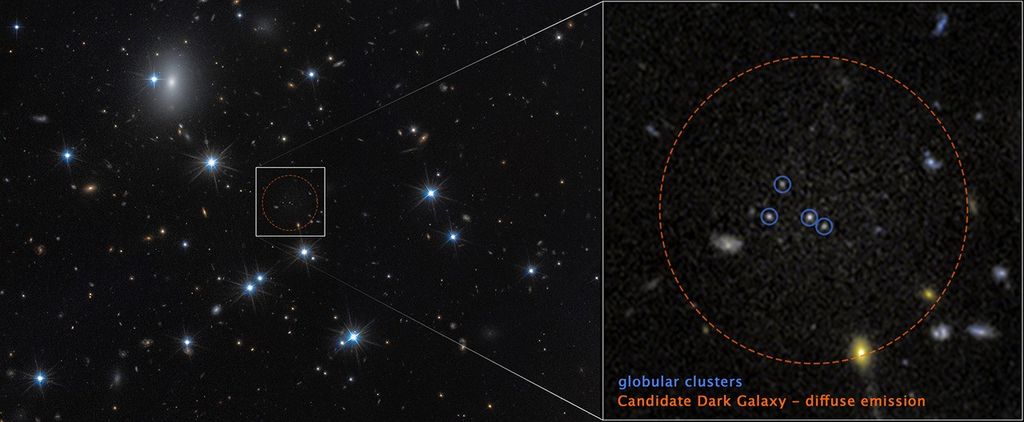
The low-surface-brightness galaxy CDG-2, within the dashed red circle at right, is dominated by dark matter and contains only a sparse scattering of stars. The full image from NASA’s Hubble Space Telescope is at left. NASA, ESA, Dayi Li (UToronto); Image Processing: Joseph DePasquale (STScI)

Peering into cosmic darkness: Supercomputers illuminate one of the faintest galaxies ever seen

Astronomers have made a discovery that redefines how we think of galaxies, which are often pictured as shining collections of stars. By leveraging cutting-edge space telescopes and state-of-the-art data analysis, scientists have pinpointed one of the dimmest galaxies ever observed, a nearly invisible structure where just a few scattered stars hint at a vast, hidden mass. This achievement, made possible by advanced computational methods, demonstrates how supercomputing and data science are pushing the boundaries of our ability to detect the universe’s faintest and most mysterious objects.
 
Named Candidate Dark Galaxy-2 (CDG-2), this galaxy lies about 300 million light-years from Earth in the Perseus cluster. Instead of shining with billions of stars like most galaxies, CDG-2 emits barely any light, with a visible brightness equivalent to just six million suns. Even more astonishing, over 99 percent of its mass seems to be made of dark matter, the enigmatic, unseen substance that dominates the universe’s mass but does not emit or absorb light.
 
What makes this discovery especially groundbreaking is how the galaxy was found. Rather than detecting the galaxy directly by its stars, researchers used globular clusters, densely packed, gravitationally bound spheres of old stars, as cosmic beacons. These compact clusters were identified as unusually tight groupings in survey data, hinting that they might be orbiting an unseen underlying galaxy. Follow-up imaging with NASA’s Hubble Space Telescope confirmed the clusters’ presence, while data from ESA’s Euclid mission and the Subaru Telescope in Hawaii revealed an ultra-faint diffuse glow around them, the first direct evidence of the dark galaxy itself. 

This detection would have been impossible without high-performance computing and sophisticated statistical models, which are capable of sifting through vast datasets and isolating subtle signals. Modern astrophysical research increasingly relies on supercomputer-assisted analyses to combine multi-telescope observations, model faint features buried in noise, and test competing interpretations of the observed data. In essence, HPC enables astronomers to digitally construct cosmic systems too faint or distant to examine through direct observation alone.
 
CDG-2 stands apart from most known systems not just for its dimness, but for what it may reveal about the role of dark matter in galaxy formation and evolution. The prevailing view in cosmology holds that dark matter provides the gravitational scaffolding around which normal matter, gas, and stars accumulate to form galaxies. Yet the extreme case of CDG-2 suggests scenarios in which star formation was suppressed or stripped away, leaving behind a halo rich in dark matter but poor in visible stars. Such galaxies are thought to be exceedingly rare, making this one a crucial testbed for theories of cosmic structure formation.
 
The supercomputing community should take particular pride in this discovery, as the identification and analysis of CDG-2 depended on algorithms and models developed to handle petabyte-scale datasets from ongoing and upcoming sky surveys. As observatories like the Vera C. Rubin Observatory and the Nancy Grace Roman Space Telescope begin mapping the sky with unprecedented depth and breadth, the role of HPC will only grow, not just in storing and processing data, but in helping astronomers ask new questions about the dark universe and find answers hidden within noise.
 
Moreover, the methods used to detect CDG-2, effectively letting computational exploration precede direct detection, open a new frontier in observational astronomy. In future surveys, machine learning and other supercomputer-powered techniques may routinely uncover objects too faint or too exotic to be seen by the naked eye of a telescope, blurring the line between observation and inference.
 
While CDG-2 may be one of the darkest galaxies yet discovered, its detection casts an inspiring light on the future of astrophysics. It reminds us that the universe still holds countless hidden wonders and that with the synergy of powerful telescopes and supercomputing, we are just beginning to uncover them.
Supercomputers tackle a stellar puzzle, but have we really solved it?

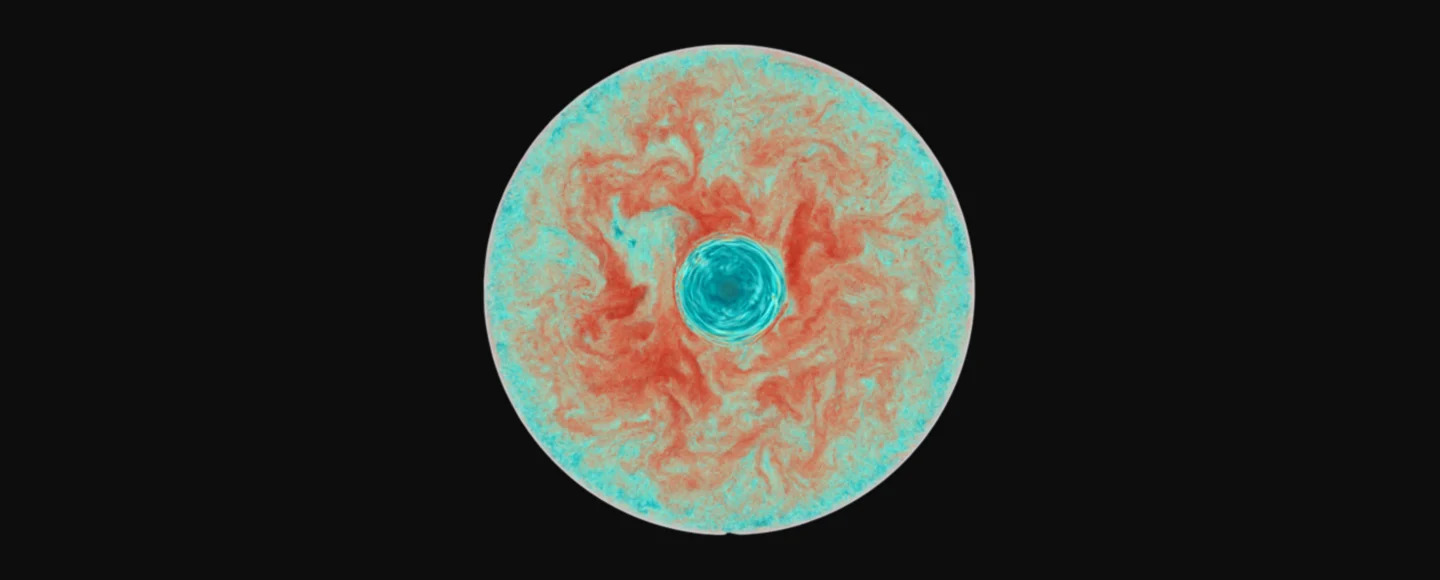
Astrophysicists have long puzzled over a key mystery in the life cycle of red giant stars, the swollen, aging stars that will eventually include our own Sun. For more than fifty years, scientists have documented changes in the surface chemistry of these stars as they evolve; however, the process responsible for these changes has remained unclear. Now, researchers at the University of Victoria’s Astronomy Research Centre report that advanced supercomputer simulations have finally cracked the case: stellar rotation intensifies internal mixing, carrying elements from deep inside red giants up to their surfaces.
 
These results are grounded in sophisticated three-dimensional hydrodynamical simulations. Such simulations are feasible only thanks to the immense computational power of modern high-performance computing facilities, including the Texas Advanced Computing Center and the Trillium supercomputer at SciNet in Canada.
 
According to lead researcher Simon Blouin, rotation dramatically increases the efficiency with which internal waves move material through the stable barrier layer between the core and the outer convection zone. In practical terms, this means that elements like carbon and nitrogen can be transported outward in ways that align with what telescopes have observed for decades, particularly changes in isotopic ratios like carbon-12 to carbon-13 that had until now lacked a convincing cause.
 
But before declaring this celestial riddle fully solved, especially for a scientifically literate audience like that of SC Online, it’s worth digging into what this “solution” really entails, and where skepticism might still be warranted.

Simulation Success, But What About Reality?

The crux of the new work lies in computational hydrodynamics: solving the fluid motion of stellar interiors under the influence of rotation, gravity, turbulence, and thermal gradients. These simulations are not simple; even with hundreds of processors working in parallel, individual runs can consume millions of CPU hours. Their scope and resolution reflect the kind of computational scale once reserved for meteorology and climate models, “big science” simulations where raw computational power often dictates what questions can be asked as much as what answers are found.
 
While the results reproduce observed surface anomalies under specific rotation regimes, there are critical caveats inherent to any model of such complexity:
  • Parameter Dependence: The simulations assume particular rotation rates and internal structural profiles. Whether those parameters accurately represent all red giants, especially those with different masses or histories, is not firmly established.
  • Resolution Limits: Even top-tier HPC clusters must balance between resolution and computational cost. Fine details of mixing processes can be sensitive to grid size and physics approximations, meaning that what appears as a “solution” at one scale might shift at higher fidelity.
  • Model Uncertainties: Stellar interiors host a vast array of poorly constrained physical processes,  from magnetism to subtle wave interactions, some of which may not be fully captured in current models.
In other words, while the simulations are impressive and represent a significant step forward in computational astrophysics, there remains ample room for cautious interpretation.

The Computational Science Perspective

For the supercomputing community, the UVic work is a testament to both the power and limitations of HPC. Without large-scale simulations, computations spread across hundreds or thousands of processors, exploring how rotating convection and internal gravity waves interact inside a star would remain purely theoretical. Supercomputers act here as numerical laboratories, where hypotheses about internal stellar dynamics can be tested in silico, complementing observations from telescopes with otherwise unreachable insights.
 
At the same time, this breakthrough highlights that solving a scientific problem rarely equates to closure. Computational results often raise as many questions as they answer: How universal is the rotational mixing mechanism across the diversity of red giant stars? Could different physical processes dominate in other evolutionary phases? And how might uncertainties in initial conditions or physics assumptions influence model outcomes?
 
These are issues that only further HPC-driven research, informed by both observation and theoretical refinement, can address. In that sense, the latest simulations are less a final answer and more a checkpoint in a long, iterative process of scientific inquiry.

A Future Written in Code

As supercomputing power continues to grow and astrophysical models become ever more detailed, simulations like these will increasingly serve as essential tools and indispensable partners in unraveling cosmic mysteries. Whether it’s mixing winds in red giants or simulating galaxy formation at cosmological scales, HPC remains at the frontier of our capacity to think computationally about the universe.
 
Still, caution is warranted. Matching known observations with a model marks significant progress, but it does not equate to a final answer. In astronomy and other computational sciences, findings are only as robust as the underlying assumptions, and verifying those assumptions across the universe’s full complexity is a task that extends far beyond any individual study.
 
At present, supercomputer-generated star models present a compelling narrative for how rotation affects red giant surfaces. Whether this narrative endures further examination, evolves with new data, or is ultimately rewritten remains to be seen.

Can Scientific AI truly solve quantum chemistry’s hardest problems?

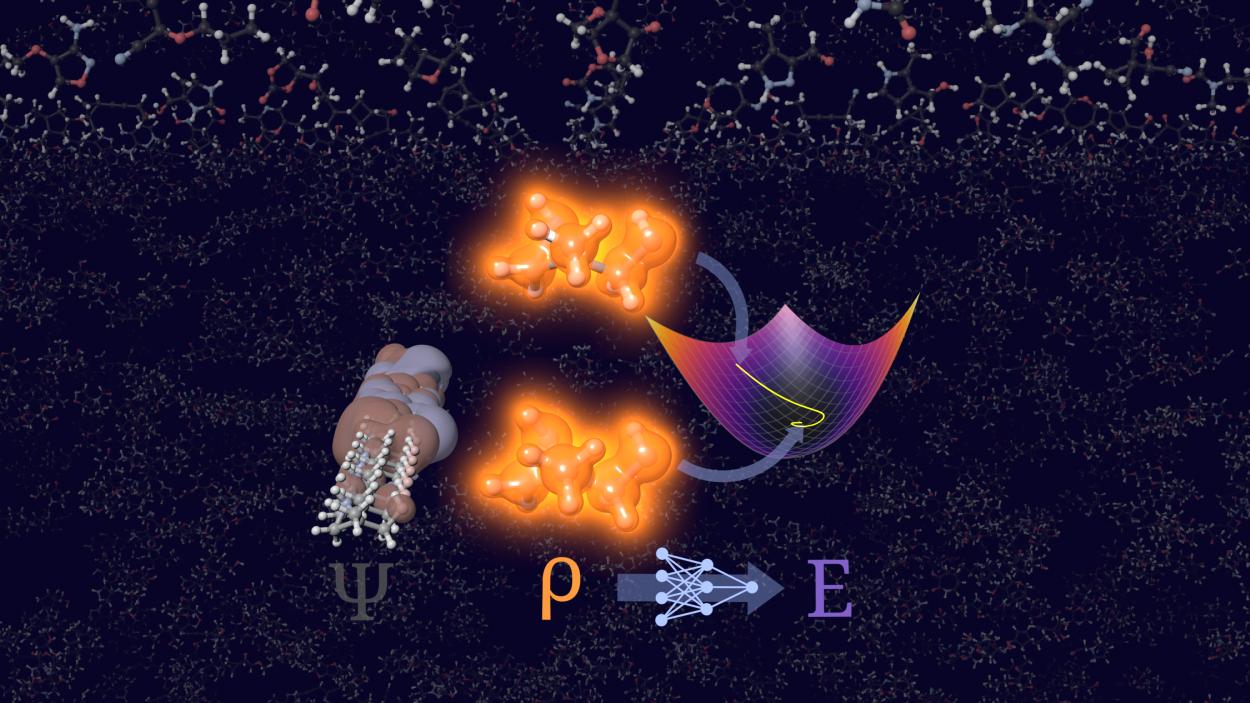
Today's press release from Heidelberg University in Germany highlights a notable advance in quantum chemistry: researchers have leveraged “scientific artificial intelligence” to address a longstanding challenge, calculating molecular energies and electron densities without relying on orbitals. This approach, called orbital-free density functional theory (OF-DFT), has often been dismissed as impractical because even small errors in electron density can lead to non-physical outcomes. The university’s new AI-driven model, STRUCTURES25, reportedly overcomes these hurdles by stabilizing the calculations and producing physically meaningful results, even for more complex molecules.
 
The main appeal of this orbital-free method is efficiency: by bypassing the explicit calculation of quantum mechanical wave functions (orbitals), which become computationally expensive as system size grows, chemists could significantly cut computational costs and enable simulations of much larger molecules, a persistent barrier in materials design, drug discovery, and energy research.
 
At its core, the new method trains a neural network to map electron density directly to energy and other quantum properties, using training data from conventional, more expensive quantum chemical calculations. The researchers emphasize that their model was trained not just on optimal solutions, but also on perturbed data around the correct answer, a strategy they argue helps the system avoid getting “lost” in unphysical results during prediction. The result? According to the team, STRUCTURES25 achieves a level of accuracy competitive with established reference methods while scaling more efficiently with molecular size.
 
The press materials present these findings as a major triumph for scientific artificial intelligence, implicitly suggesting that AI has matured enough to solve central problems of quantum chemistry. Yet a closer look reveals reasons for cautious interpretation, especially for SC Online’s technically informed readership.

Promise vs. Practicality

The underlying scientific goal, constructing a reliable density functional that predicts energy from electron density alone, is grounded in the Hohenberg-Kohn theorems, which mathematically guarantee that such a functional exists. But the theorems do not tell us how to find it, and decades of theoretical work have shown that constructing an exact, universally accurate functional remains elusive.
 
Most practical quantum chemistry remains anchored in Kohn-Sham density functional theory (KS-DFT), which introduces orbitals to approximate the true many-electron problem with usable accuracy while still facing steep computational cost. OF-DFT, in contrast, has always struggled with accuracy because the electron kinetic energy, a dominant contributor to total molecular energy, is not known exactly in terms of density alone. Supervised machine learning can fit complex mappings, but it does not change the fact that the underlying physics is approximated rather than derived from first principles.
 
Even the most recent advances in the field acknowledge that machine learning can narrow the gap between theory and practice, but they stop short of claiming a definitive solution. For example, a recent paper in the Journal of the American Chemical Society demonstrates that ML-enhanced orbital-free DFT can achieve chemical accuracy for a benchmark dataset when trained with high-quality reference data, a noteworthy achievement on its own, yet it depends on that reference data and its applicability outside trained molecular classes is still an open question.

The AI Hype Trap

This distinction matters: while AI-driven models like STRUCTURES25 can accelerate and scale certain calculations, they do not replace the fundamental approximations and assumptions of the underlying physics. The model’s success on organic molecules drawn from benchmark sets is a necessary proof of concept, but it is not yet evidence that AI has unlocked a universal remedy for the computational complexity of quantum chemistry. Indeed, even classical machine learning approaches applied to OF-DFT have shown promise in limited domains but struggle with generalization beyond trained chemical spaces.
 
For researchers in computational science and supercomputing, the real takeaway should be this: AI can be a powerful tool when combined with robust physical models and vast computational resources, but it is not a silver bullet that magically solves NP-hard problems in quantum mechanics. Supercomputers remain indispensable for generating the high-quality reference calculations needed to train and validate these models, and HPC continues to be the arena where theory, data, and computation intersect.

Where Future Challenges Remain

Key questions include:
* How well do AI-trained orbital-free models generalize to systems outside their training data?
* Can such models maintain physical consistency in extreme chemical environments, such as transition metal complexes or excited states?
* Do the computational savings of orbital-free approaches outweigh the costs of generating training data on large supercomputing installations?
 
Until such questions are rigorously addressed, claims of “solving” central problems with AI should be viewed with an appropriately critical lens, not to dismiss progress, but to contextualize it.
 
In summary, the Heidelberg work represents an interesting computational advance built on the interplay between machine learning and quantum chemistry. But rather than signifying a definitive breakthrough, it fits into a broader pattern: AI augments existing methods and enriches the toolkit of computational chemistry, yet still depends on supercomputing and fundamental physics to realize its potential.