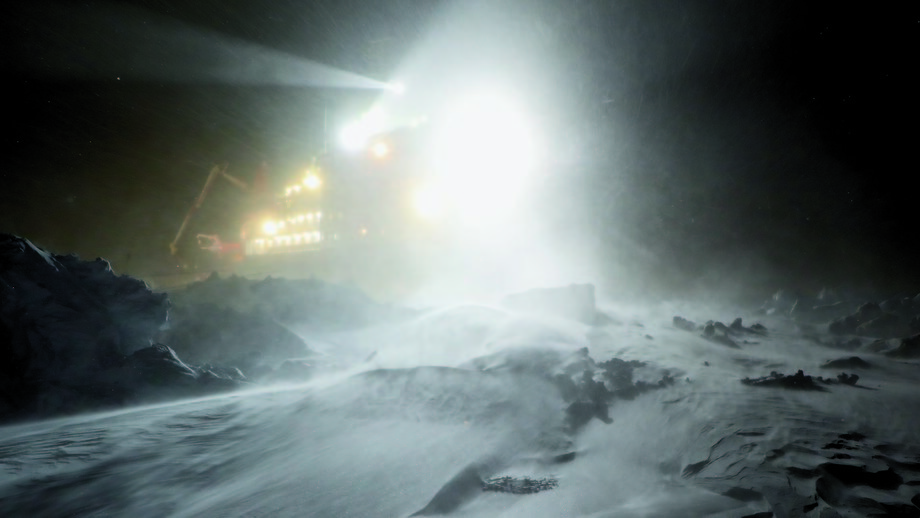
Oliktok Point research facility in Alaska, where the DAS experiment was headquartered. | Sandia National Laboratories

What are the advantages of using telecommunications cable to track sea ice extent in the Arctic?

A telecommunications fiber optic cable deployed offshore of Oliktok Point, Alaska recorded ambient seismic noise that can be used to finely track the formation and retreat of sea ice in the area, researchers report in The Seismic RecordMap of Oliktok Point and layout of the submarine fiber optic cable (gray line). Distributed Acoustic Sensing (DAS) recorded data for the first 37.4 km of the cable. Black diamonds and gray circles represent intervals of 5 km and 1 km, respectively, along the cable. Inset shows the location of Oliktok (red square) with respect to Alaska (United States).

Andres Felipe Peña Castro of the University of New Mexico and colleagues used distributed acoustic sensing, or DAS, to identify seismic signals related to the motion of waves on open water and the sea ice that suppresses that wave action. The technique offers a way to track sea ice with increasing spatial and temporal resolution—on the scale of hours and kilometers–compared to satellite images that are updated daily and may cover tens to hundreds of kilometers.

Swiftly monitoring sea ice changes is important to commercial shipping as well as Native communities and could become another useful tool in tracking Arctic climate change, the research team noted.

In the TSR study, the scientists were able to observe abrupt changes in sea ice extent up to 10 kilometers that occurred in less than a day.

“It was definitely surprising that the sea ice can change so much in a few hours,” said Peña Castro. “A few colleagues have mentioned that these rapid changes may be common but the temporal resolution of satellites makes it rare to observe such rapid changes in sea ice.”

DAS uses the tiny internal flaws in a long optical fiber as thousands of seismic sensors. An instrument called an interrogator at one end of the fiber sends laser pulses down the cable that are reflected off the fiber flaws and bounced back to the instrument. Researchers can examine changes in the timing of the reflected pulses to learn more about the resulting seismic waves.

Peña Castro and colleagues used a 37.4-kilometer-long section of seafloor fiber optic cable, part of a network owned by Quintillion Global and not actively carrying telecom data, in their DAS experiment. The DAS data were recorded between 9-15 July 2021 and 10-16 November 2021, times that were specifically targeted to capture periods of transitional sea ice coverage.

The original idea, said Peña Castro, was to classify different signals emerging from the interaction of ocean, earth, and atmosphere, such as potential local sea state and storm surges, shoaling, and sea ice fracturing. “We wanted to objectively identify the major types of signals in the data without assuming how many signals or which signals would be dominant,” he said. “We did not expect to observe changes in sea ice cover with such fine spatiotemporal detail.”

The researchers turned to machine learning algorithms to sort through the massive fiber optic data set. “In general, DAS generates large amounts of data that are impossible to process manually and that’s why we opted to use a machine learning approach that can identify possible patterns in the data,” Peña Castro explained. “Once a signal or pattern has been identified then we can consider how to track that signal most efficiently.”

The researchers were able to observe the formation of sea ice along the length of the cable, but not how far the ice spread perpendicular to the cable. They did not measure sea ice thickness in the TSR study, but Peña Castro said “In theory, it is possible to determine ice thickness using DAS. One difficulty is that ground truth measurements of ice thickness are necessary to validate proposed methods.”

The combination of machine learning and DAS techniques is already being used in the oil and gas industry, said Peña Castro. “In general, clustering techniques such as those used in this study may help identify lots of different types of change in environmental or anthropogenic signals that create ground vibrations.”

The results of this study demonstrate that telecommunications cable can be used to track sea ice extent in the Arctic with accuracy and precision. This technology can be used to monitor sea ice extent in real time, providing valuable information to those studying climate change and its effects on the Arctic region. Additionally, this technology can be used to help inform decisions related to Arctic shipping routes and other activities in the region.

Webb’s NIRCam (Near-Infrared Camera) instrument reveals the star, nicknamed Earendel, to be a massive B-type star more than twice as hot as our Sun, and about a million times more luminous. Credits: Image: NASA, ESA, CSA, D. Coe (STScI/AURA for ESA; Johns Hopkins University), B. Welch (NASA’s Goddard Space Flight Center; University of Maryland, College Park). Image processing: Z. Levay.

Webb discovers colors of Earendel, the most distant star ever detected

The night sky has been a source of wonder and mystery since the dawn of time, and now astronomers have made a remarkable discovery that takes us further into the unknown. A team of astronomers has detected the colors of Earendel, the most distant star ever seen. This discovery is a testament to the power of human curiosity and exploration. 

NASA’s James Webb Space Telescope has followed up on observations by the Hubble Space Telescope of the farthest star ever detected in the very distant universe, within the first billion years after the big bang. Webb’s NIRCam (Near-Infrared Camera) instrument reveals the star to be a massive B-type star more than twice as hot as our Sun, and about a million times more luminous. This image from NASA’s James Webb Space Telescope of a massive galaxy cluster called WHL0137-08 contains the most strongly magnified galaxy known in the universe’s first billion years: the Sunrise Arc, and within that galaxy, the most distant star ever detected. In this image, the Sunrise Arc appears as a red streak just below the diffraction spike at the 5 o’clock position. Credits: Image: NASA, ESA, CSA, D. Coe (STScI/AURA for ESA; Johns Hopkins University), B. Welch (NASA’s Goddard Space Flight Center; University of Maryland, College Park). Image processing: Z. Levay.

The star, which the research team has dubbed Earendel, is located in the Sunrise Arc galaxy and is detectable only due to the combined power of human technology and nature via an effect called gravitational lensing. Both Hubble and Webb were able to detect Earendel due to its lucky alignment behind a wrinkle in space-time created by the massive galaxy cluster WHL0137-08. The galaxy cluster, located between us and Earendel, is so massive that it warps the fabric of space itself, which produces a magnifying effect, allowing astronomers to look through the cluster like a magnifying glass. 

While other features in the galaxy appear multiple times due to gravitational lensing, Earendel only appears as a single point of light even in Webb’s high-resolution infrared imaging. Based on this, astronomers determine the object is magnified by a factor of at least 4,000, and thus is extremely small – the most distant star ever detected, observed 1 billion years after the big bang. The previous record-holder for the most distant star was detected by Hubble and observed around 4 billion years after the big bang. Another research team using Webb recently identified a gravitationally lensed star they nicknamed Quyllur, a red giant star observed 3 billion years after the big bang.

Stars as massive as Earendel often have companions. Astronomers did not expect Webb to reveal any companions of Earendel since they would be so close together and indistinguishable from the sky. However, based solely on the colors of Earendel, astronomers think they see hints of a cooler, redder companion star. This light has been stretched by the universe's expansion to wavelengths longer than Hubble’s instruments can detect, and so was only detectable with Webb.

Webb’s NIRCam also shows other notable details in the Sunrise Arc, which is the most highly magnified galaxy yet detected in the universe’s first billion years. Features include both young star-forming regions and older established star clusters as small as 10 light-years across. On either side of the wrinkle of maximum magnification, which runs right through Earendel, these features are mirrored by the distortion of the gravitational lens. The region forming stars appears elongated and is estimated to be less than 5 million years old. Smaller dots on either side of Earendel are two images of one older, more established star cluster, estimated to be at least 10 million years old. Astronomers determined this star cluster is gravitationally bound and likely to persist until the present day. This shows us how the globular clusters in our own Milky Way might have looked when they formed 13 billion years ago.

Astronomers are currently analyzing data from Webb’s NIRSpec (Near-Infrared Spectrograph) instrument observations of the Sunrise Arc galaxy and Earendel, which will provide precise composition and distance measurements for the galaxy.

Since Hubble discovered Earendel, Webb has detected other very distant stars using this technique, though none quite as far as Earendel. The discoveries have opened a new realm of the universe to stellar physics, and new subject matter to scientists studying the early universe, where once galaxies were the most miniature detectable cosmic objects. The research team has cautious hope that this could be a step toward the eventual detection of one of the very first generation of stars, composed only of the raw ingredients of the universe created in the big bang – hydrogen and helium. 

Webb's discovery of the colors of Earendel, the most distant star ever detected, is a testament to the power of human curiosity and exploration. This discovery has pushed the boundaries of our knowledge and understanding of the universe and has inspired us to reach ever further into the unknown.

Gravitational waves may reveal nature of dark matter

Observations of gravitational waves from merging black holes may reveal new insights about dark matter, suggests a new study from a UCL-led international team.

The study, presented at the 2023 National Astronomy Meeting in Cardiff and now published in the journal Physical Review D, used supercomputer simulations to study the production of gravitational wave signals in simulated universes with different kinds of dark matter.

Their findings show that counting the number of black-hole merging events detected by the next generation of observatories could tell us whether or not dark matter interacts with other particles and therefore help pin down what it is made of.

Cosmologists generally regard dark matter as one of the biggest missing pieces in our understanding of the cosmos. Despite strong evidence that dark matter makes up 85% of all the matter in the Universe, there is currently no consensus on its underlying nature. This includes questions such as whether dark matter particles can collide with other particles such as atoms or neutrinos, or whether they pass straight through them unaffected.

A way to test this is by looking at how galaxies form in dense clouds of dark matter called haloes. If dark matter collides with neutrinos, the dark matter structure becomes dispersed, resulting in fewer galaxies being formed.

The problem with this method is that any galaxies that go missing are very small and very distant from us, so it’s hard to see whether they are there or not, even with the best telescopes available.

Rather than targeting the missing galaxies directly, the authors of this study propose using gravitational waves as an indirect measure of their abundance. Their simulations show that in models where dark matter does collide with other particles, there are significantly fewer black-hole mergers in the distant universe.

While this effect is too small to be seen by current gravitational wave experiments, it will be a prime target for the next generation of observatories that are currently being planned.

The authors hope their methods will help stimulate new ideas for using gravitational wave data to explore the large-scale structure of the Universe, and shine a new light on the mysterious nature of dark matter.

Dr Alex Jenkins (UCL Physics & Astronomy), one of the lead authors of the study, said: “Gravitational waves are a powerful new tool for observing the distant Universe. The next generation of observatories will detect hundreds of thousands of black-hole mergers every year, giving us unprecedented insights into the structure and evolution of the cosmos.”

Co-author Dr Sownak Bose of Durham University said: “Dark matter remains one of the enduring mysteries in our understanding of the Universe. This means it is especially important to continue identifying new ways to explore models of dark matter, combining both existing and new probes to test model predictions to the fullest. Gravitational-wave astronomy offers a pathway to better understand not just dark matter, but the formation and evolution of galaxies more generally.”

Using machine learning, researchers at MIT and Dana-Farber Cancer Institute created a computational model that can analyze the sequence of about 400 genes and use that information to predict where a given tumor originated in the body. Credits :Image: iStock, MIT News

MIT builds AI model that can help determine where a patient's cancer arose

Predictions from the OncoNPC model could enable doctors to choose targeted treatments for difficult-to-treat tumors.

For a small percentage of cancer patients, doctors are unable to determine where their cancer originated. This makes it much more difficult to choose a treatment for those patients, because many cancer drugs are typically developed for specific cancer types.

A new approach developed by researchers at MIT and Dana-Farber Cancer Institute may make it easier to identify the sites of origin for those enigmatic cancers. Using machine learning, the researchers created a computational model that can analyze the sequence of about 400 genes and use that information to predict where a given tumor originated in the body.

Using this model, the researchers showed that they could accurately classify at least 40 percent of tumors of unknown origin with high confidence, in a dataset of about 900 patients. This approach enabled a 2.2-fold increase in the number of patients who could have been eligible for a genomically guided, targeted treatment, based on where their cancer originated.

“That was the most important finding in our paper, that this model could be potentially used to aid treatment decisions, guiding doctors toward personalized treatments for patients with cancers of unknown primary origin,” says Intae Moon, an MIT graduate student in electrical engineering and computer science who is the lead author of the new study.

Alexander Gusev, an associate professor of medicine at Harvard Medical School and Dana-Farber Cancer Institute, is the senior author of the paper.

Mysterious origins

In 3 to 5 percent of cancer patients, particularly in cases where tumors have metastasized throughout the body, oncologists don’t have an easy way to determine where the cancer originated. These tumors are classified as cancers of unknown primary (CUP).

This lack of knowledge often prevents doctors from being able to give patients “precision” drugs, which are typically approved for specific cancer types where they are known to work. These targeted treatments tend to be more effective and have fewer side effects than treatments that are used for a broad spectrum of cancers, which are commonly prescribed to CUP patients.

“A sizeable number of individuals develop these cancers of unknown primary every year, and because most therapies are approved in a site-specific way, where you have to know the primary site to deploy them, they have very limited treatment options,” Gusev says.

Moon, an affiliate of the Computer Science and Artificial Intelligence Laboratory who is co-advised by Gusev, decided to analyze genetic data that is routinely collected at Dana-Farber to see if it could be used to predict cancer type. The data consist of genetic sequences for about 400 genes that are often mutated in cancer. The researchers trained a machine-learning model on data from nearly 30,000 patients who had been diagnosed with one of 22 known cancer types. That set of data included patients from Memorial Sloan Kettering Cancer Center and Vanderbilt-Ingram Cancer Center, as well as Dana-Farber.

The researchers then tested the resulting model on about 7,000 tumors that it hadn’t seen before, but whose site of origin was known. The model, which the researchers named OncoNPC, was able to predict their origins with about 80 percent accuracy. For tumors with high-confidence predictions, which constituted about 65 percent of the total, its accuracy rose to roughly 95 percent.

After those encouraging results, the researchers used the model to analyze a set of about 900 tumors from patients with CUP, which were all from Dana-Farber. They found that for 40 percent of these tumors, the model was able to make high-confidence predictions.

The researchers then compared the model’s predictions with an analysis of the germline, or inherited, mutations in a subset of tumors with available data, which can reveal whether the patients have a genetic predisposition to develop a particular type of cancer. The researchers found that the model’s predictions were much more likely to match the type of cancer most strongly predicted by the germline mutations than any other type of cancer.

Guiding drug decisions

To further validate the model’s predictions, the researchers compared data on the CUP patients’ survival time with the typical prognosis for the type of cancer that the model predicted. They found that CUP patients who were predicted to have cancer with a poor prognosis, such as pancreatic cancer, showed correspondingly shorter survival times. Meanwhile, CUP patients who were predicted to have cancers that typically have better prognoses, such as neuroendocrine tumors, had longer survival times.

Another indication that the model’s predictions could be useful came from looking at the types of treatments that CUP patients analyzed in the study had received. About 10 percent of these patients had received a targeted treatment, based on their oncologists’ best guess about where their cancer had originated. Among those patients, those who received a treatment consistent with the type of cancer that the model predicted for them fared better than patients who received a treatment typically given for a different type of cancer than what the model predicted for them.

Using this model, the researchers also identified an additional 15 percent of patients (2.2-fold increase) who could have received an existing targeted treatment, if their cancer type had been known. Instead, those patients ended up receiving more general chemotherapy drugs.

“That potentially makes these findings more clinically actionable because we’re not requiring a new drug to be approved. What we’re saying is that this population can now be eligible for precision treatments that already exist,” Gusev says.

The researchers now hope to expand their model to include other types of data, such as pathology images and radiology images, to provide a more comprehensive prediction using multiple data modalities. This would also provide the model with a comprehensive perspective of tumors, enabling it to predict not just the type of tumor and patient outcome, but potentially even the optimal treatment.

The research was funded by the National Institutes of Health, the Louis B. Mayer Foundation, the Doris Duke Charitable Foundation, the Phi Beta Psi Sorority, and the Emerson Collective.

Gas distribution around the trinary protostars IRAS 04239+2436, (left) ALMA observations of SO emissions, and (right) as reproduced by the numerical simulation on the supercomputer ATERUI. In the left panel, protostars A and B, shown in blue, indicate the radio waves from the dust around the protostars. Within protostar A, two unresolved protostars are thought to exist. In the right panel, the locations of the three protostars are shown by the blue crosses. (Credit: ALMA (ESO/NAOJ/NRAO), J.-E. Lee et al.)

Japanese-built supercomputers discover gas streamers feed triple-baby stars

Recent observations and supercomputer simulations of three gas spiral arms feeding three protostars in a trinary system have helped to clarify the formation of multi-star systems. 

Most stars with a mass similar to the Sun form in multi-star systems together with other stars. So an understanding of multi-star system formation is important to an overall theory of star formation. However, the complexity and lack of high-resolution, high-sensitivity data left astronomers uncertain about the formation scenario. In particular, recent observations of protostars often reported structures called "streamers" of gas flows toward the protostars, but it has been unclear how these streamers form. 

An international team led by Jeong-Eun Lee, a professor at Seoul National University, used the Atacama Large Millimeter/submillimeter Array (ALMA) to observe the trinary protostar system IRAS 04239+2436 located 460 light-years away in the constellation Taurus. The team found that emissions from sulfur monoxide (SO) molecules trace three spiral arms around the three protostars forming in the system. Video: {joomvideos id=327}

Comparison with simulations led by Tomoaki Matsumoto, a professor at Hosei University using the supercomputers “ATERUI” and “ATERUI II” in the Center for Computational Astrophysics at the National Astronomical Observatory of Japan (NAOJ) indicate that the three spiral arms are streamers feeding material to the three protostars. The combination of observations and simulations revealed, for the first time, how the streamers are created and contribute to the growth of the protostars at the center.

The discovery of three baby stars being fed by a single gas streamer is a remarkable feat of astronomy. It is a testament to the power of modern supercomputing technology and the dedication of the research team that such a complex and intricate system was able to be observed and documented. This discovery provides a unique insight into the formation of stars and the evolution of galaxies and could lead to further breakthroughs in our understanding of the universe. It is a reminder that the universe is full of wonders and that with enough dedication and hard work, we can uncover its secrets.