HMCI, Rapt.ai deploy NVIDIA GB10 systems to power Rancho Cordova’s new AI & Robotics Ecosystem

A first-of-its-kind municipal AI initiative is taking shape in Rancho Cordova, CA, where the Human Machine Collaboration Institute (HMCI) and Rapt.ai have announced the deployment of NVIDIA GB10 systems to anchor a new regional AI & Robotics Ecosystem. The public–private partnership aims to make advanced computing accessible to students, startups, educators, and civic innovators across the Greater Sacramento region.
 
The announcement, made at SC25 in St. Louis, marks a significant municipal investment in applied AI. Backed by $5 million from the City of Rancho Cordova, the ecosystem will serve as a shared development space where local talent can access the same class of high-performance infrastructure used by commercial AI labs and university research centers.
 
At the center of the build-out is NVIDIA’s new GB10 Grace Blackwell Superchip, deployed in GB10 systems to support both high-throughput training workloads and real-time robotics simulation. The ecosystem blends this on-premises performance with cloud elasticity through Rapt.ai’s workload-aware GPU orchestration and seamless scalability into NeoCloud (FarmGPU), a GPU cloud designed for distributed training, inference, and data-intensive science.
 
“This initiative is about unlocking opportunity through accessibility,” said Sadie St. Lawrence, CEO of HMCI. “By bringing NVIDIA-powered infrastructure to the Sacramento region and combining it with Rapt’s orchestration and NeoCloud’s scalability, we’re giving students, startups, and civic teams the power to innovate locally and impact globally.”
 
Rapt.ai CEO Charlie Leeming underscored the affordability gap the partnership aims to close. “NVIDIA GB10 systems deliver world-class AI performance at a fraction of traditional cloud cost,” he said. “Together with HMCI and FarmGPU, we’re proving that cities can lead the next wave of applied AI by providing practical, scalable, affordable infrastructure.”
 
FarmGPU CEO JM Hands added that the collaboration builds on existing momentum within Rancho Cordova’s tech corridor. “FarmGPU is proud to extend HMCI’s local AI capacity with our NeoCloud platform, strengthened by our partnership with Solidigm’s AI Central Lab in Rancho Cordova.”
 
Set to launch in early 2026, the AI & Robotics Ecosystem will offer both on-site and remote access for model evaluation, fine-tuning, multimodal experimentation, robotics simulation, and large-scale data science. The organizers aim to lower the barrier to AI innovation and create a civic hub where academia, industry, and government can develop applied AI solutions together.
 
This initiative positions Rancho Cordova as a regional leader in democratized AI infrastructure, an emerging trend at SC25, where cities, universities, and startups are increasingly exploring hybrid public–private models to support local innovation.
 
As the deployment moves forward, HMCI and Rapt.ai will release more details on curriculum programs, startup accelerator partnerships, and public-access options ahead of the 2026 rollout.

At SC25, Phison pushes AI storage to Gen5 speeds, brings AI agents to everyday laptops

SuperComputing 2025 (SC25) delivered no shortage of big swings this week, but Phison presented a rare, cohesive vision that extends from the densest enterprise racks to the laptops in classrooms and corporate offices. At booth 4532, the storage leader debuted two new PCIe Gen5 enterprise SSDs, Pascari X201 and Pascari D201, and a live demo showcasing AI agents running on an integrated-GPU laptop using its aiDAPTIV+ technology. The message was clear: AI acceleration shouldn't be restricted to high-end GPUs or data center budgets.

PCIe Gen5 Muscle for AI and Cloud

Phison’s new Pascari X201 and D201 drives push Gen5 performance to the edge of the envelope:
  • Up to 14.5 GB/s read, 12 GB/s write
  • Up to 3.3M / 1.05M random read/write IOPS
  • Configurations up to 30.72 TB (X201) and 15.36 TB (D201)
The X201 targets high-intensity applications, including AI training nodes, analytics engines, financial modeling, and HPC workloads. The D201 is designed for hyperscalers and cloud builders who need high density with predictable QoS, particularly for object storage and large-scale database clusters. Both represent the steady march toward AI-first storage design: low latency, deterministic operations, and the throughput needed to saturate GPU clusters.

AI Agents on iGPUs, 25× Faster Than Before

The unexpected star of Phison’s booth was a consumer-class laptop demo. With aiDAPTIV+, the system turned an integrated GPU, normally the weak link in AI workflows, into a surprisingly capable AI agent platform.
 
Phison says the tech delivers:
  • Up to 25× faster AI agent performance
  • A drop in latency from 73 seconds to ~4 seconds in one real-world demo, GenAI inference on YouTube video content.
This is significant beyond mere convenience. Universities, IT departments, and early-stage businesses can now conduct meaningful AI experiments using their existing hardware. For students and corporate employees, this indicates a move toward AI agents becoming as commonplace as web browsers or office software.

Scaling Toward Extreme Capacity

Phison reminded SC25 attendees that the capacity race is not slowing. The company's Pascari D205V, a 122.88TB E3.L behemoth already shipping to selected OEMs, continues to set the ceiling for PCIe Gen5. Phison confirmed a roadmap path to 245TB, a number that would have sounded like science fiction just a few cycles ago.

Industry Voices at SC25

Michael Wu, GM and President of Phison US, framed the announcement in the larger arc of AI adoption: “Every sector is somewhere on the AI journey… Storage is vital at every stage.”

Why SC25 Cares

SC25 is increasingly the place where the AI stack, compute, networking, storage, and software gets pressure-tested. Phison’s lineup shows a company positioning itself not just as a NAND supplier but as a critical backbone for AI at every tier:
  • Client: AI agents on iGPUs
  • Enterprise: X201 for training and HPC
  • Cloud/hyperscale: D201 and the ultra-dense D205V series
With shipments of the X201 and D201 headed to enterprise customers by year-end and iGPU systems with aiDAPTIV+ coming in early 2026, the company is clearly betting on a future where AI workloads blur across devices and form factors.

Availability

  • Pascari X201 / D201: Shipping to select enterprise customers and OEMs by end of 2025
  • aiDAPTIV+ iGPU systems: OEM rollouts in early 2026
  • More details at phison.com
Phison didn't just bring new hardware to SC25; they presented a clear vision: AI infrastructure should be fast, scalable, power-efficient, and accessible to everyone, from hyperscale operators to students with a laptop. The future of AI won't be confined to one place, and Phison seems determined to connect it all.

MSI unveils next-gen AI, data center platforms at SC25

 
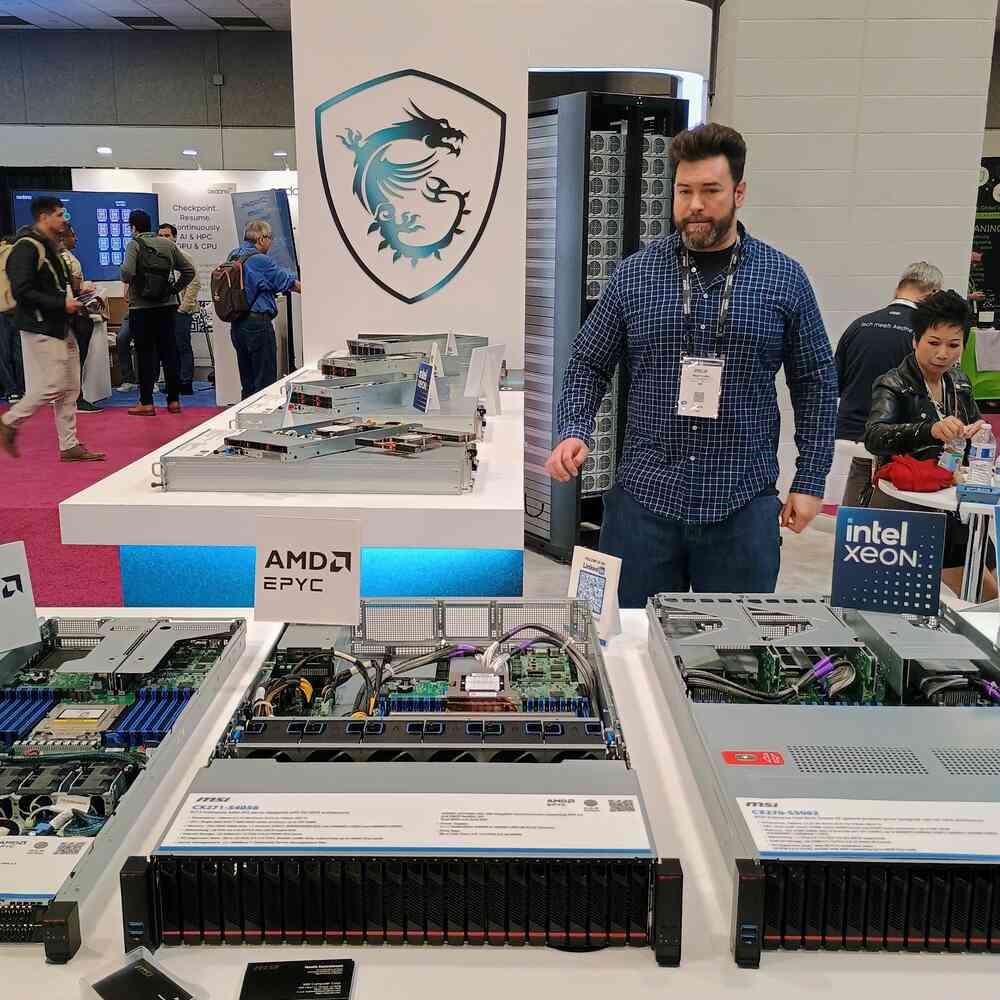
MSI stepped into the SuperComputing 2025 spotlight this week with a full slate of next-generation server and AI systems, signaling a major escalation in the company’s push into high-performance computing, hyperscale infrastructure, and enterprise AI.
 
At Booth #205, MSI debuted its ORv3 rack solution and a refreshed portfolio of DC-MHS–based compute platforms built in collaboration with AMD, Intel, and NVIDIA. The message was clear: the next era of data centers will be denser, more energy-efficient, and more modular, and MSI plans to be one of the vendors powering that shift.
 
Danny Hsu, General Manager of Enterprise Platform Solutions, framed it plainly: MSI wants to give operators scalable infrastructure that can move as fast as AI models evolve. “Our goal is to deliver scalable, energy-efficient infrastructure that empowers customers to accelerate AI development and next-generation computing with performance, reliability, and flexibility at scale,” Hsu said.

Rack-Scale Ambition: The ORv3 Platform

The star of MSI’s showcase was its ORv3 21-inch, 44OU rack, a fully validated, integrated design specifically designed for hyperscale cloud builders. Outfitted with sixteen CD281-S4051-X2 2OU DC-MHS servers, the rack features centralized 48V power, front-facing I/O, and a streamlined thermal design that maximizes CPU, memory, and storage density in every square inch.
 
Each node leverages AMD’s EPYC 9005 processors in a single-socket layout. Per-node, operators get 12 DDR5 DIMM slots and 12 E3.S PCIe 5.0 NVMe bays, providing ample capacity for AI pipelines, large-scale analytics, and bandwidth-intensive cloud workloads.
 
High-Density Compute for the Modern Data Center
MSI also expanded its DC-MHS Core Compute lineup, offering both AMD and Intel variants with TDP envelopes up to 500W. Available in 2U 4-node and 2U 2-node configurations, these systems target high-density environments where rack efficiency is king.
 
On the AMD EPYC side, MSI highlighted two platforms (CD270-S4051-X4 and X2), while Intel Xeon 6 versions (CD270-S3061-X4 and CD270-S3071-X2) bring expanded DDR5 memory and PCIe 5.0 storage options. All share a standardized modular architecture designed to simplify deployment, upgrades, and serviceability.
 
The enterprise-focused “CX” series broadened that theme with higher memory ceilings, extensive PCIe lanes, and configurations optimized for cloud, virtualization, and storage providers. Dual-socket Xeon 6 versions deliver up to 32 DIMM slots in 1U and 2U footprints, a density profile aimed at operators balancing compute with I/O-heavy workloads.

AI Systems Powered by NVIDIA Hopper and Blackwell

With AI dominating both the SC25 conversation and data center budgets, MSI backed up its hardware story with new NVIDIA-powered AI systems. These include MGX-based servers, DGX-class AI stations, and workstation-scale development nodes.
 
The flagship CG481-S6053 and CG480-S5063 4U servers support up to eight dual-width GPUs (up to 600W each), paired with either AMD EPYC 9005 CPUs or Intel Xeon 6 processors. These are built for heavyweight tasks: large language model training, deep learning acceleration, and NVIDIA Omniverse workloads.
 
A compact 2U option, the CG290-S3063, delivers four 600W GPUs in a single-socket Xeon 6 system, aimed at edge-inference clusters and smaller research deployments.
 
To bring AI development directly to the desktop, MSI introduced the AI Station CT60-S8060, a workstation built around NVIDIA’s GB300 Grace Blackwell Ultra Superchip, offering up to 784GB of unified memory. Its pitch: DGX-scale power without the data center footprint.

Why It Matters

SC25 is the annual pulse check for supercomputing, a place where vendors unveil real hardware, not vaporware. MSI’s move signals an intensifying competition among server manufacturers to meet surging AI demand while tackling the constraints everyone feels: power, heat, density, and time-to-deploy.
 
Their approach leans into modularity. DC-MHS standardization, ORv3 rack integration, and MGX compatibility allow operators to build AI-ready data centers faster and adapt them as GPUs evolve.
The broader takeaway is that data centers are shifting from “build once and upgrade later” to “assemble, scale, swap, repeat.” MSI’s portfolio pushes that philosophy from edge to hyperscale.
 
More details, demo videos, and supporting technical resources are available directly from MSI following the SC25 exhibition.