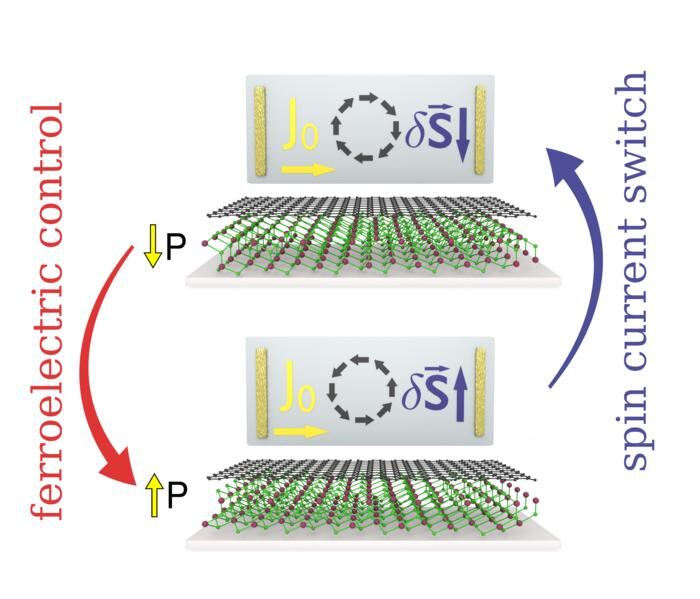
Characteristics of the graphene/In2Se3 heterostructure transport device that shows the spin chirality switch.  Credit Martin Gmitra from the Slovak Academy of Sciences and Marcin Kurpas from University of Silesia in Katowice.
Characteristics of the graphene/In2Se3 heterostructure transport device that shows the spin chirality switch. Credit Martin Gmitra from the Slovak Academy of Sciences and Marcin Kurpas from University of Silesia in Katowice.

Supercomputing sheds light on electrically controlling spin currents in graphene

In an European collaboration blending quantum materials science and high-performance computing, researchers have discovered how ferroelectric switching can modulate spin currents in a graphene-based heterostructure, a revelation made possible by supercomputers.

From Charge to Spin: A New Spintronics Platform

The study, "Ferroelectric switching control of spin current in graphene proximitized by In₂Se₃," published in Materials Futures, explores a heterostructure of graphene, a two-dimensional conductor, stacked atop a ferroelectric monolayer of In₂Se₃. The team found that switching the polarization of the In₂Se₃ layer reverses the sign of the charge-to-spin conversion coefficient in the graphene layer, effectively flipping the chirality (spin orientation pattern) of the generated spin current. In one configuration (17.5° twist angle between layers), an unconventional "radial Rashba field" emerged for one polarization direction, a rare phenomenon in planar heterostructures.

Supercomputing: The Hidden Engine

This project would have been impossible without extensive computing power. The researchers combined first-principles calculations (density-functional theory) with tight-binding modelling to capture electronic structure, spin-orbit coupling, ferroelectric polarization effects, and interface proximity influences.
 
Such simulations involve large Hamiltonian matrices, fine k-space sampling, spin-texture mapping, and multiple twist-angle geometries, tasks that scale poorly without parallel, high-performance systems. By leveraging supercomputing clusters, the team was able to:
  • Evaluate both polarization states of the ferroelectric layer.
  • Model two twist angles (0° and 17.5°) to identify emergent fields;
  • Extract charge-to-spin conversion coefficients and Rashba phase directly from computational data.
These capabilities underline how HPC is no longer just for weather and astrophysics; now it’s central to designing tomorrow’s spintronic devices.

Why It Matters

Modern electronics are approaching the limits of charge-based logic. Spintronics, using the electron’s spin rather than its charge, promises faster, lower-power, non-volatile devices. The challenge: controllably steering spin currents without bulky magnetic fields.
 
By showing that ferroelectric polarization can electrically flip spin current direction (and spin texture) in graphene, the study opens a pathway to magnet-free, ultra-efficient spin logic devices. In short, you apply a voltage, you flip a spin current, no magnetic coil needed.

A Timely Breakthrough for the HPC World

With the SC25 supercomputing conference opening next week in St. Louis, the research underscores a widening frontier: supercomputers aren’t just solving equations, they’re beginning to decode nature’s design language.
 
Although the study is not confirmed as an official SC25 presentation, its ideas are likely to circulate in hallway conversations, workshops, and poster sessions, where the fusion of physics, simulation, and computing continues to accelerate innovation.

Looking Ahead

While this work is theoretical (computational), the authors propose that the predicted effects "can be experimentally detected" under realistic conditions. The next step involves device fabrication, nanoscale spin current measurements, and benchmarking against conventional spintronic architectures.
 
The larger picture is HPC-driven material discovery. As supercomputers become more powerful and accessible, the timeline from concept to device may shorten, leading to a shift towards compute-to-create workflows, rather than the current synthesize-then-hope approach.
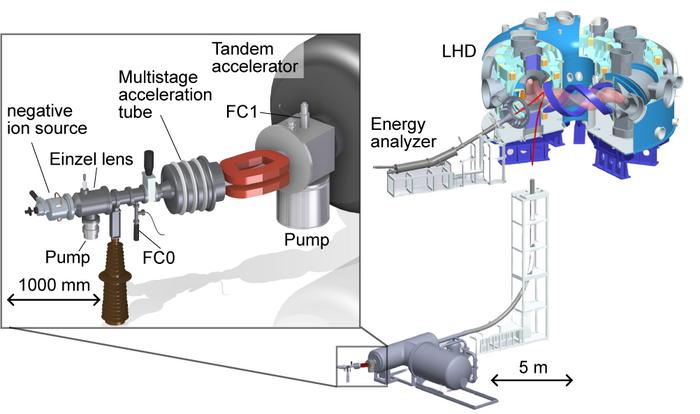
The Large Helical Device (LHD) and the heavy ion beam probe (HIBP) system.

Supercomputers help scientists decode turbulent plasma behaviors in fusion reactors

A new international study, published in Nuclear Fusion and announced through a press release, offers one of the most detailed looks yet at plasma behavior inside fusion reactors, thanks to modern supercomputers. The research highlights the central role of high-performance computing (HPC) in advancing fusion energy science.

A Breakthrough in Plasma Modeling

Japanese researchers led a team that used state-of-the-art numerical simulations to capture how micro-scale plasma turbulence interacts with large-scale flows inside tokamak confinement systems. These interactions have long puzzled physicists because they contribute to unexpected energy losses, undermining reactor performance.
 
The new simulations reveal coupling mechanisms that had not been directly observed before. By resolving turbulence, particle transport, and fast-ion behavior simultaneously, the researchers were able to build a more complete picture of how fusion plasmas evolve under reactor-relevant conditions.
 
According to the study, these insights may guide improvements in the design and operation of future fusion devices.

Powered by Supercomputers

The research leveraged massive computational resources, including GPU-accelerated clusters and petascale CPU hours, to capture plasma behavior across multiple spatial and temporal scales. Advanced techniques, such as domain decomposition, hybrid MPI/OpenMP parallelization, and fine-mesh refinement, enabled the simulation of sub-millimeter turbulence while still modeling the full evolution of a reactor-scale plasma.
 
The authors emphasize that without supercomputer-level performance, such multiscale modeling would be impossible. In essence, HPC is becoming a “virtual reactor,” allowing scientists to test physics theories and device configurations in silico before real-world experiments.

SC25 in St. Louis

The timing of this publication is noteworthy, as the global supercomputing community will convene next week in St. Louis for SC25, the premier HPC conference. While the study directly relates to high-performance computing and could be discussed informally at SC25, there's no confirmation that it will be officially presented. Nonetheless, the study's themes of extreme-scale computation, energy modeling, and plasma physics align with key SC25 tracks, making it an ideal meeting point for researchers and vendors.

A Step Toward Fusion’s Future

Fusion holds immense promise for clean, abundant energy, but understanding plasma behavior presents a significant hurdle. This research helps bridge the gap between theory and experiment by providing predictive tools that can improve reactor design and operational strategies.
 
With new supercomputing tech, researchers anticipate the ability to simulate entire fusion devices under reactor conditions, potentially expediting the path to practical fusion energy. 
 
For now, this work serves as a compelling illustration of how supercomputing is transforming one of the world’s most challenging scientific frontiers.
The Cocos Islands in the Indian Ocean between Australia and Sri Lanka.

Continents peeling from below: Supercomputers reveal the hidden hand shaping Earth’s oceans

When continents undergo separation, the effects are not limited to the surface. A gradual revolution is occurring beneath our feet, detectable only through the utilization of the world's most advanced supercomputers. Researchers from the UK's University of Southampton and Germany's GFZ Helmholtz Centre for Geosciences have discovered that the Earth's continents are undergoing a "peeling" process from below, thereby triggering volcanic activity across the ocean floor. Their recent study suggests that this deep churning of the planet's mantle may be responsible for many of the volcanic islands scattered across our oceans, including the Indian Ocean's Christmas Island seamounts and the Atlantic's Walvis Ridges.

Peeling Continents, Boiling Oceans

The team's simulations, powered by high-performance computing models, demonstrate that as continents stretch and fracture, their thick roots of ancient rock (the subcontinental lithospheric mantle) are eroded by organized "chains" of convective currents. These instabilities act like conveyor belts, transporting chemically enriched material from deep beneath the continents into the oceanic mantle, where it can later erupt as seafloor volcanoes.
 
Over tens of millions of years, this subterranean process moves vast amounts of continental material outward, enriching the mantle in patterns that match the timing and chemistry of known oceanic volcanic provinces. “It’s as if the continents shed their skin into the sea,” said lead author Dr. Tom Gernon of Southampton. “We’ve uncovered a missing piece of Earth’s deep recycling system.”

Supercomputing the Deep Earth

To capture this invisible movement, the researchers relied on ASPECT, a powerful geodynamic modeling tool that simulates rock behavior under extreme pressures and temperatures. These thermomechanical simulations, run on supercomputers in the UK and Germany, tracked the flow of molten rock and heat through the mantle over spans exceeding 100 million years.
 
Such calculations require enormous computational power, similar to that used in climate modeling or astrophysical simulations, because they solve complex equations of energy, mass, and momentum at microscopic scales within a planet-sized domain. The models revealed that continental "peeling" begins within a few million years of tectonic breakup and peaks approximately 50 million years later, a finding that aligns with isotope data from Indian Ocean volcanoes.
 
These insights wouldn’t have been possible without advances in high-performance computing (HPC). This area has been prominently showcased at recent supercomputing gatherings, such as the COP30-linked climate and Earth system sessions in Brazil. As global attention turns toward planetary resilience, HPC has become a bridge between climate science, energy modeling, and now, deep-Earth geodynamics, allowing researchers to model entire planetary systems in silico.

Rethinking Oceanic Volcanism

Traditionally, scientists attributed oceanic volcanism to deep mantle plumes, columns of hot rock rising from near the Earth’s core. But this new study proposes a more surface-linked mechanism: the long-term “convective erosion” of continental roots. It explains why enriched volcanic rocks often appear along continental margins and even billions of years after the continents split apart.
 
This finding also has implications for the global carbon cycle, as the peeling and melting of carbon-rich rocks could regulate the release of greenhouse gases from deep within the Earth. It hints at a feedback loop between the planet’s tectonic heartbeat and its atmospheric chemistry, a process both ancient and ongoing.

The New Frontier Beneath Us

The Southampton team's discovery adds a fascinating layer to our understanding of planetary evolution. Beneath the seemingly stable crust, continents are quietly dissolving from below, feeding a slow planetary respiration that shapes the chemistry of oceans, the formation of islands, and perhaps even the stability of climate over eons.
 
It’s a humbling reminder that the ground beneath us is not still, merely patient. And with the help of supercomputers, we’re finally starting to hear its pulse.