Hokkaido University develops a simple way to control swarming molecular machines

The swarming behavior of about 100 million molecular machines can be controlled by applying simple mechanical stimuli such as extension and contraction. This method could lead to the development of new swarming molecular machines and small energy-saving devices.

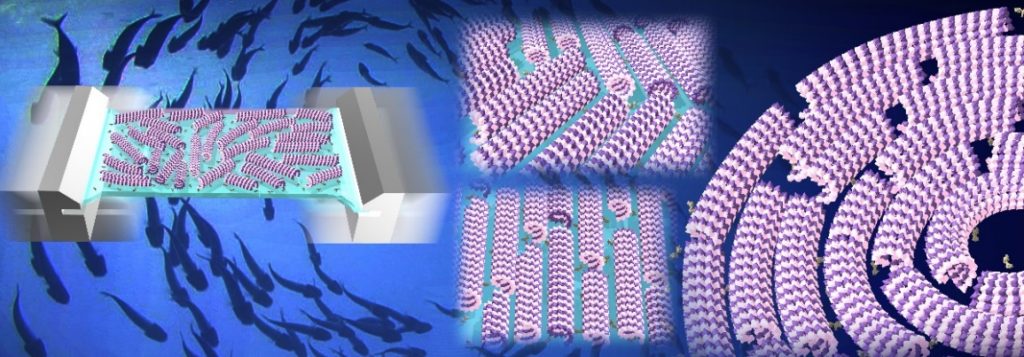
Conceptual drawing of the swarming molecular machines that change moving patterns upon mechanical stimuli.{module In-article} Conceptual drawing of the swarming molecular machines that change moving patterns upon mechanical stimuli.
The swarming molecules in motion aligned in one direction exhibited zigzag patterns or formed a vortex responding to varying mechanical stimuli. They could even self-repair the moving pattern after a disruption, according to a study led by Hokkaido University scientists.

In recent years, many scientists have made efforts to miniaturize machines found in the macroscopic world. The 2016 Nobel laureates in chemistry were awarded for their outstanding research on molecular machines and design and synthesis of nanomachines. 

In previous studies, the research team led by Associate Professor Akira Kakugo of Hokkaido University developed molecular machines consisting of motor proteins called kinesins and microtubules, which showed various swarming behaviors. “Swarming is a key concept in modern robotics. It gives molecular machines new properties such as robustness and flexibility that an individual machine cannot have,” says Akira Kakugo. “However, establishing a methodology for controlling swarming behaviors has been a challenge.”

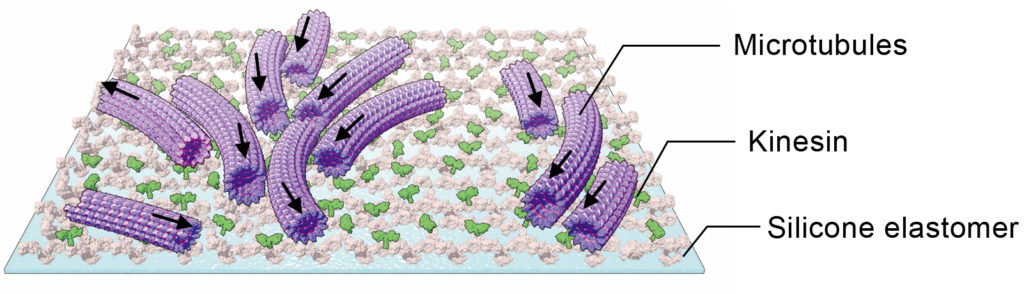
The molecular machines comprising microtubules and kinesins. Microtubules run on the kinesins attached on the surface of a silicone elastomer. (Daisuke I. et al., ACS Nano. October 4, 2019){module In-article}

The molecular machines comprising microtubules and kinesins. Microtubules run on the kinesins attached on the surface of a silicone elastomer. (Daisuke I. et al., ACS Nano. October 4, 2019)

In the current study published in ACS Nano, the team used the same system comprising motor protein kinesins and microtubules, both bioengineered. The kinesins are fixed on an elastomer substrate surface, and the microtubules are self-propelled on the kinesins, powered by the hydrolysis of adenosine triphosphate (ATP). 

“Since we know that applying mechanical stress can play a key role in pattern formation for active matters, we investigated how deformation of the elastomer substrate influences the swarming patterns of molecular machines,” says Akira Kakugo.

By extending and contracting the elastomer substrate, mechanical stimulation is applied to about 100 million microtubules that run on the substrate surface. The researchers first found that microtubules form wave patterns when no stress is applied. When the substrate is expanded and contracted 1.3 times or more one time, almost all of the 100 million microtubules perpendicularly aligned to the expansion and contraction axis, and when the substrate is expanded and contracted 1.3 times or less repeatably, it created zigzag patterns placed in diagonal directions.

The microtubules formed wave patterns when no stress is applied (left). When the elastomer substrate is expanded and contracted, they turned into an aligned pattern (middle) or a zigzag pattern (right). (Daisuke I. et al., ACS Nano. October 4, 2019)

The microtubules formed wave patterns when no stress is applied (left). When the elastomer substrate is expanded and contracted, they turned into an aligned pattern (middle) or a zigzag pattern (right). (Daisuke I. et al., ACS Nano. October 4, 2019)

Their supercomputer simulation suggested that the orientation angles of microtubules correspond to the direction to attain smooth movement without buckling, which is further amplified by the collective migration of the microtubules.

A large vortex was formed under radial strain on the substrate. (Daisuke I. et al., ACS Nano. October 4, 2019)

A large vortex was formed under radial strain on the substrate. (Daisuke I. et al., ACS Nano. October 4, 2019)

Another important finding was that the moving pattern of microtubules can be modulated by applying new mechanical stimuli and it can be self-repaired even if the microtubule arrangement is disturbed by scratching a part of it. 

“Our findings may contribute to the development of new molecular machines that perform collective motion and could also help advance technologies for energy-saving small devices,” Akira Kakugo commented.

This study was conducted in collaboration with scientists at the Tokyo Institute of Technology, Gifu University, and Columbia University.

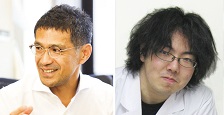
Akira Kakugo (Left) and Daisuke Inoue (Right) of research team at Hokkaido University.

Akira Kakugo (Left) and Daisuke Inoue (Right) of research team at Hokkaido University.

US DOD awards £1m to Queen Mary of London University for AI research on treating injured soldiers

The US Department of Defense has awarded the Centre for Trauma Sciences (C4TS) at Queen Mary a $1.2 million (£976.500) grant to develop AI tools that could help save the lives of badly injured soldiers.

It is aimed at developing and validating a suite of accurate prediction models and Clinical Decision Support (CDS) tools that clinicians can use to treat wounded soldiers on the battlefield, traveling to the hospital and in hospitals.

Study lead and honorary senior lecturer at Queen Mary, Colonel Nigel Tai, consultant trauma and vascular surgeon at Barts Health NHS Trust and UK Defence Medical Service, said: “War zones are obviously very fraught environments for clinical decision making, and we know military clinicians have to make difficult decisions under time pressure, far away from the kind of sophisticated diagnostic equipment or senior, experienced advisors that are found in the NHS. So, deciding whether to employ particular surgical techniques, or whether to attempt salvage of a mangled limb or to use precious stocks of blood is ripe for the kind of decision support aids that Artificial Intelligence might help with.”

C4TS, which is part of Queen Mary’s Blizard Institute, will work in collaboration with Queen Mary’s Risk and Information Management research group in the School of Electronic Engineering and Computer Science.

The grant builds on joint work between Queen Mary’s Computer Science team – led by Dr. William Marsh – and C4TS over more than five years. It has drawn on major advances in computational modeling to develop Bayesian Network (BN) statistical analysis CDS tools for clinicians treating patients in the Royal London Hospital Major Trauma Centre. The tools generate accurate risk assessments of whether a seriously injured patient is likely to experience a major blood clotting problem – Trauma-Induced Coagulopathy (TIC) - and whether amputation is necessary for a badly damaged limb. The right treatment can then be matched to individual patients.

The grant will enable the University’s teams to extend this vital research to develop CDS models that improve the effectiveness of damage control surgery and resuscitation, limb salvage and other critical medical interventions in conflict zones.


Colonel Tai concluded: “The grant is an acknowledgment of the world-leading trauma research being undertaken by the C4TS team. The new CDS tools will first be developed and validated using sophisticated statistical models in London and the US. If successful, these AI clinical innovations could potentially be adopted by major trauma centers around the world to save civilian lives.”

Russian university's mathematicians help improve efficiency of data centers using Markov chains

RUDN University, situated in southwestern Moscow, mathematicians have created a model of maximum efficiency of data centers. It is based on a nontrivial Markov chain. In addition to the obvious practical applications of the results for the organization of servers and data centers, the theoretical part will be useful for the theory of queues and queuing, as well as for working with big data and neural networks. The study is published in the journal MathematicsCREDIT RUDN University{module In-article}

A data center is a system of servers, and their task is to provide supercomputing resources and disk space at the request of users. The higher the load, the more equipment is heating up. Servers may temporarily stop working if they overheat. The temperature level that corresponds to the overheating point is called the first critical level. The second is the level to which the temperature of the server must fall for it to resume (at least partially) the work.

These levels are different. For example, if each user loads the server so that the temperature of its processor grows by 0.1 degrees, and the first critical level is 100 degrees, the second critical level should be set no higher than 99.9 degrees. If to put above, the first request of the user will overheat the server again. In this case, the two critical levels should be located close enough to each other - if their difference is big, the server capacity will not be used completely. It is necessary to configure these levels so that the servers of the data center do not shut down constantly due to overheating and at the same time work with a full load.

RUDN University mathematicians Olga Dudina and Alexander Dudin were able to find a solution to the optimization problem, which allows ensuring that the servers work at full capacity and do not overheat. Its condition looks like this: depending on a random process that simulates the flow of users, place two critical levels to prevent overheating, but the computation power would be used to the maximum. At the same time, partial inactivity is allowed, that is, if the second critical temperature level is exceeded, some requests from users are rejected.

RUDN University mathematicians solved probabilistic equations for different values of critical levels. As a random process that simulates the arrival of users, RUDN University mathematicians used the Markov chain. The simplest example of such a chain is a random walk of a point along a straight line. Every second, a coin is tossed: if heads come up, the point moves 1 cm forward, if tails - ¬one centimeter back. Time is discrete in this process, that is, changes occur once a second, and the position of the point in the future depends only on its current position and the result of the coin toss.

To test the effectiveness of their method, RUDN University mathematicians conducted a numerical experiment that simulated the behavior of the server. Its results were evaluated using indicator E, a quality criterion that determines losses for denial of service to the user and overheating of equipment per unit of time. It turned out that the new method allows more than ten times - from 0.31 to 0.03 - to reduce the loss of the simulated server and significantly increase the efficiency of the data center.

Also, the Markov chain, which originated in the work of mathematicians, has some interesting properties. In addition to its applications in IT, their model will be useful in Queueing theory. This theory is necessary for solving queuing problems, working with big data and neural networks.