

SUPERCOMPUTING NEWS SUPERCOMPUTING NEWS
    • MEDIA KIT
    • MOST READ
    • RSS FEED
    • ACADEMIA
    • AEROSPACE
    • APPLICATIONS
    • ASTRONOMY
    • AUTOMOTIVE
    • BIG DATA
    • BIOLOGY
    • CHEMISTRY
    • CLIENTS
    • CLOUD
    • DEFENSE
    • DEVELOPER TOOLS
    • EARTH SCIENCES
    • ECONOMICS
    • ENGINEERING
    • ENTERTAINMENT
    • GAMING
    • GOVERNMENT
    • HEALTH
    • OIL & GAS
    • INDUSTRY
    • INTERCONNECTS
    • MANUFACTURING
    • MIDDLEWARE
    • MOVIES
    • NETWORKS
    • PHYSICS
    • PROCESSORS
    • RETAIL
    • SCIENCE
    • STORAGE
    • SYSTEMS
    • VISUALIZATION
    • AcyMailing subscription form

    • ADD YOUR VIDEOS
    • MANAGE VIDEOS
    • CONVERSATION INBOX
    • SOCIAL ADVERTISER
    • SOCIAL NETWORK VIDEOS
    • SURVEYS
    • GROUPS
    • PAGES
    • MARKETPLACE LISTINGS
    • APPLICATIONS BROWSER
    • PRIVACY CONFIRM REQUEST
    • PRIVACY CREATE REQUEST
    • LEADERBOARD
    • POINTS LISTING
      • BADGES
    • TRADE SHOWS
Sign In
Tyler O'Neal, Staff Editor BIOLOGY October 14, 2020, 5:15 pm

Johns Hopkins' new website predicts likelihood of cyber attacks between nations

Cyber Attack Predictive Index ranks a dozen possible scenarios

Where in the world might the next cyberattack between nations take place?

A new online database developed by a team of Johns Hopkins University computer scientists and international studies students predicts that there is an "extremely high likelihood" of a Russian cyberattack on Ukraine.

The second most likely? The United States against Iran.

The Cyber Attack Predictive Index (CAPI) devised by computer science professor Anton Dahbura along with cybersecurity lecturer Terry Thompson and former undergraduate Divya Rangarajan provides a predictive analysis of nations most likely to engage in the surreptitious strategy waged with keyboards, code, and destructive malware rather than soldiers, tanks and airplanes. Johns Hopkins{module INSIDE STORY}
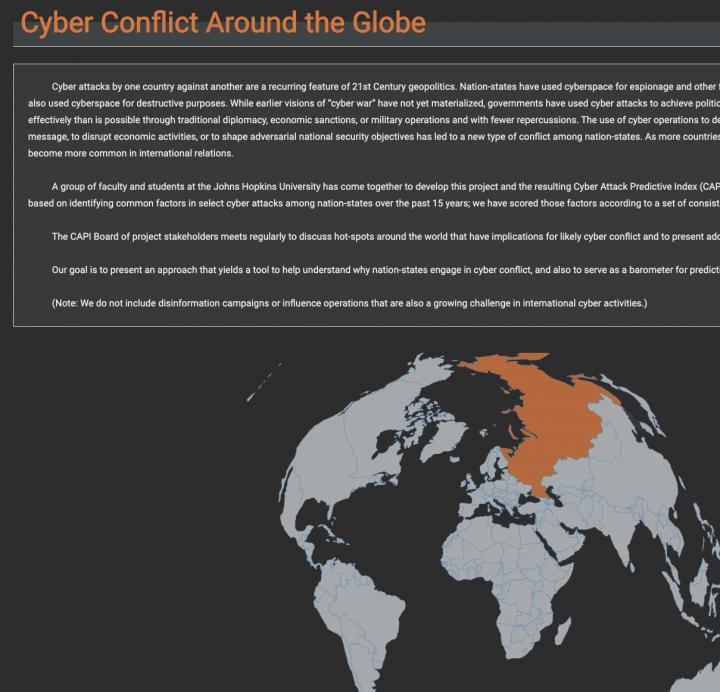
"The site attempts to anticipate and predict where the next major cyber conflict could break out based on existing data from past attacks," said Dahbura, executive director of the Johns Hopkins Information Security Institute and co-director of the new Johns Hopkins University Institute for Assured Autonomy. "It's a very good approximation of what's hot and what's not."

In 2019 as the rhetoric and record around deploying the malware menace grew more threatening, Dahbura began developing the site with Thompson when he was a lecturer in the Information Security Institute and Rangarajan before she graduated in May. Thompson worked for three decades at the National Security Agency and other federal agencies before moving to the private sector as a vice president at Booz Allen and teaches graduate courses in global cybersecurity, cyber policy, and cybersecurity risk management.

"This is going to be a much more common form of conflict in the future," Dahbura said.

The team devised a methodology for grading nations based on five common elements identified in all of the national cyberattacks over the past 15 years. Scored on a 1 to 5 scale, they are:

1. The strength and sophistication of the attacker's cyber force (from none to most advanced);

2. The severity of the grievance motivating the attacker against its target (from none to extremely aggrieved);

3. The attacker's lack of fear of serious repercussions (from extreme fear to none);

4. The consistency of an attack with the attacker's national security policy (from no policy to extremely consistent);

5. The degree of technological vulnerabilities within the target (from none to many).

The higher the total score the more likely a nation is to attack. The 12 nation-on-nation scenarios scored on the website range from the very low likelihood of India attacking China to four tied as the third most likely situations: China against the United States, Israel against Iran, Russia against the United States and the United States against Russia.

Dahbura and Thompson have formed a CAPI Advisory Board of project stakeholders that meets regularly to discuss hot-spots around the world that have implications for likely cyber conflict and to update the online CAPI Heat Index.

The website also provides several case studies used to devise the scoring system. The two highest-scoring incidents were the cyberattack Russia simultaneously launched with its 2008 invasion of neighboring Georgia, and the STUXNET malware the United States and Israel unleashed on an Iranian nuclear facility. The project website can be found at https://cyberheatmap.isi.jhu.edu/.
Supercomputer model uses virus 'appearance' to better predict winter flu strains

Tyler O'Neal, Staff Editor BIOLOGY October 13, 2020, 1:49 pm

New findings suggest combining experimental data about the appearance of the flu virus with its genetic code can improve the predictive power of supercomputer models to forecast future strains

Combining genetic and experimental data into models about the influenza virus can help predict more accurately which strains will be most common during the next winter, says a study published recently in eLife.

The models could make the design of flu vaccines more accurate, providing fuller protection against a virus that causes around half a million deaths each year globally.

Vaccines are the best protection we have against the flu. But the virus changes its appearance to our immune system every year, requiring researchers to update the vaccine to match. Since a new vaccine takes almost a year to make, flu researchers must predict which flu viruses look the most like the viruses of the future. {module INSIDE STORY}

The gold-standard ways of studying influenza involve laboratory experiments looking at a key molecule that coats the virus called haemagglutinin. But these methods are labor-intensive and take a long time. Researchers have focused instead on using computers to predict how the flu virus will evolve from the genetic sequence of haemagglutinin alone, but these data only give part of the picture.

"The influenza research community has long recognized the importance of taking into account physical characteristics of the flu virus, such as how haemagglutinin changes over time, as well as genetic information," explains lead author John Huddleston, a PhD student in the Bedford Lab at Fred Hutchinson Cancer Research Center and Molecular and Cell Biology Program at the University of Washington, Seattle, US. "We wanted to see whether combining genetic sequence-only models of influenza evolution with other high-quality experimental measurements could improve the forecasting of the new strains of flu that will emerge one year down the line."

Huddleston and the team looked at different components of virus 'fitness' - that is, how likely the virus is to thrive and continue to evolve. These included how similar the antigens of the virus are to previously circulating strains (antigens being the components of the virus that trigger an immune response). They also measured how many mutations the virus has accumulated and whether they are beneficial or harmful.

Using 25 years of historical flu data, the team made forecasts one year into the future from all available flu seasons. Each forecast predicted what the future virus population would look like using the virus' genetic code, the experimental data, or both. They compared the predicted and real future populations of flu to find out which data types were more helpful for predicting the virus' evolution.

They found that the forecasts that combined experimental measures of the virus' appearance with changes in its genetic code were more accurate than forecasts that used the genetic code alone. Models were most informative if they included experimental data on how flu antigens changed over time, the presence of likely harmful mutations, and how rapidly the flu population had grown in the past six months. "Genetic sequence alone could not accurately predict future flu strains - and therefore should not take the place of traditional experiments that measure the virus' appearance," Huddleston says.

"Our results highlight the importance of experimental measurements to quantify the effects of changes to virus' genetic code and provide a foundation for attempts to forecast evolutionary systems," concludes senior author Trevor Bedford, Principal Investigator at the Vaccine and Infectious Disease Division, Fred Hutchinson Cancer Research Center, Seattle, Washington. "We hope the open-source forecasting tools we have developed can immediately provide better forecasts of flu populations, leading to improved vaccines and ultimately fewer illnesses and deaths from flu."

Tetrahedra may explain water's uniqueness

Tyler O'Neal, Staff Editor BIOLOGY October 12, 2020, 9:56 pm

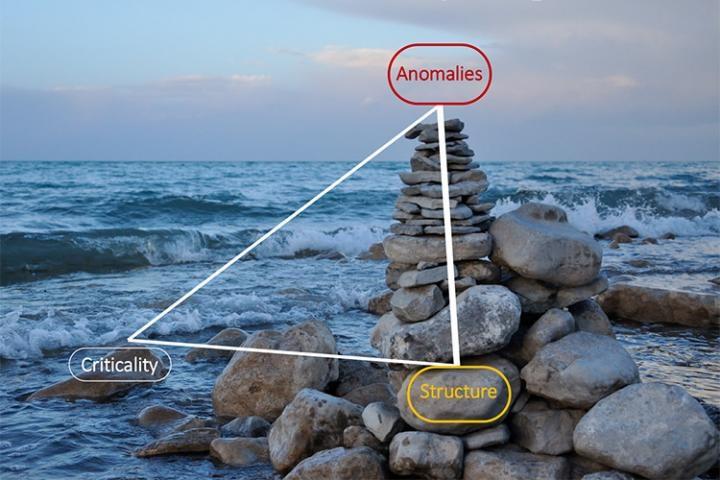
Researchers at the Institute of Industrial Science at The University of Tokyo sifted through experimental data to probe the possibility that supercooled water has a liquid-to-liquid phase transition between disordered and tetrahedrally structured forms. They found evidence of a critical point based on the cooperative formation of tetrahedra, and show its minor role in water's anomalies. This work shows that water's special qualities--which are essential for life--originate predominantly from the two-state feature.

Liquid water is indispensable for life as we know it, yet many of its properties do not conform with the way other fluids behave. Some of these anomalies, such as water's maximum density at 4°C and its large heat capacity, have important implications for living organisms. The origin of these features has sparked fierce debates in the scientific community since the time of Röntgen.

Now, researchers at The University of Tokyo have utilized a two-state model that posits the dynamical coexistence of two types of molecular structures in liquid water. These are the familiar disordered normal-liquid structure and a locally favored tetrahedral structure. As with many other phase transitions, there may be a "critical point" at which the correlation between tetrahedra takes on a power-law form, which means there will no longer be any "typical" length scale. Scientists at The University of Tokyo use a two-state model based on the formation of tetrahedral structures to explain water's anomalous properties and the surprising liquid-liquid transition of water {module INSIDE STORY}

Using supercomputer simulations of water molecules, along with a comprehensive analysis of experimental structural, thermodynamic, and dynamic data--including X-ray scattering, density, compressibility, and viscosity measurements--the researchers were able to narrow down where a critical point should be if it exists.

"If the formation of tetrahedral structures in liquid water is cooperative under these conditions, then a liquid-liquid phase transition with a critical point is possible," lead author Rui Shi says.

The team showed that this occurs around a temperature of -90°C and a pressure of about 1,700 atmospheres. Experiments in this range are exceedingly difficult: because the water is so far below its normal freezing, ice crystals can quickly form. However, samples can remain liquid in a metastable "supercooled" state at these very high pressures.

"We saw evidence that the critical point is real, but its effect is almost negligible in the experimentally accessible region of liquid water because it is too far from the critical point. This means that water's anomalies come from the two-state feature and not from criticality," senior author Hajime Tanaka says. The scientists anticipate that this project will lead to the convergence of the long debate on the origin of water's anomalies and more experimental research to access the second critical point of water.

  1. Hokkaido University discovers age does not contribute to COVID-19 susceptibility
  2. Dartmouth wins $12.5 million grant to establish Center for Quantitative Biology

Page 15 of 17

  • 8
  • 9
  • 10
  • 11
  • 12
  • 13
  • 14
  • 15
  • 16
  • 17
POPULAR RIGHT NOW
  • AI supercharges the hunt for stronger magnets: Iowa State researchers launch a new era of intelligent materials discovery
    AI supercharges the hunt for stronger magnets: Iowa State researchers launch a new era of intelligent materials discovery
  • IBM's Historic stock collapse raises questions for the future of enterprise supercomputing
    IBM's Historic stock collapse raises questions for the future of enterprise supercomputing
  • Could a novel dark matter theory simultaneously resolve multiple cosmic enigmas? Supercomputer simulations provide a compelling, albeit currently unverified, potential solution
    Could a novel dark matter theory simultaneously resolve multiple cosmic enigmas? Supercomputer simulations provide a compelling, albeit currently unverified, potential solution
  • Melting icebergs may be reshaping Earth’s greatest ocean current
    Melting icebergs may be reshaping Earth’s greatest ocean current
  • Supercomputers replace ‘bathtub’ flood maps with physics-based digital twins of Britain’s coastline
    Supercomputers replace ‘bathtub’ flood maps with physics-based digital twins of Britain’s coastline
  • Supercomputers push neural quantum simulation beyond previous limits
    Supercomputers push neural quantum simulation beyond previous limits
  • Intel’s AI supercomputing revival: Q2 financial surge signals new era for CPU-powered HPC infrastructure
    Intel’s AI supercomputing revival: Q2 financial surge signals new era for CPU-powered HPC infrastructure
  • AI infrastructure financing fears shake semiconductor sector
    AI infrastructure financing fears shake semiconductor sector
  • AWS supercomputing investment reaches historic scale as Amazon’s AI strategy powers record financial results
    AWS supercomputing investment reaches historic scale as Amazon’s AI strategy powers record financial results
  • Catching the wave of the future: Supercomputers unlock the hidden dynamics of Venus
    Catching the wave of the future: Supercomputers unlock the hidden dynamics of Venus
THIS YEAR'S MOST READ
  • Wall Street wants to trade supercomputing power like oil
    Wall Street wants to trade supercomputing power like oil
  • Beamforming the future: BeammWave's 6G push signals the rise of orbital-terrestrial wireless networks
    Joakim Axmon
    Joakim Axmon
  • Cosmic ambition at scale: UK’s supercomputer unlocks a 2.5 petabytes universe
    Cosmic ambition at scale: UK’s supercomputer unlocks a 2.5 petabytes universe
  • Hidden order, revealed at scale: Supercomputing, electron ptychography uncover the inner workings of relaxor ferroelectrics
    Hidden order, revealed at scale: Supercomputing, electron ptychography uncover the inner workings of relaxor ferroelectrics
  • Intel's Q1 results signal supercomputing surge driving Xeon momentum
    Intel's Q1 results signal supercomputing surge driving Xeon momentum
  • When stars fall apart: Supercomputing reveals the hidden physics of black holes
    When stars fall apart: Supercomputing reveals the hidden physics of black holes
  • Multi-layer simulations reveal the hidden supply chain of solar prominences
    Multi-layer simulations reveal the hidden supply chain of solar prominences
  • Japanese scientists decode dolphin speed with supercomputing: Turbulence, vortices, and the hidden physics of propulsion
    Japanese scientists decode dolphin speed with supercomputing: Turbulence, vortices, and the hidden physics of propulsion
  • Cosmic feedback at scale: Supercomputing reveals how quasars regulate the early Universe
    Cosmic feedback at scale: Supercomputing reveals how quasars regulate the early Universe
  • Modeling life at the microscopic scale: A computational breakthrough in oxygen transport
    Modeling life at the microscopic scale: A computational breakthrough in oxygen transport
MOST READ OF ALL-TIME
  • Largest Computational Biology Simulation Mimics The Ribosome
    Details
    112127
    The amino acid (green) slithers into the chemical reaction center, moving through an evolutionarily ancient corridor of the ribosome (purple). The amino acid is delivered to the reaction core by the transfer RNA molecule (yellow).
    The amino acid (green) slithers into the chemical reaction center, moving through an evolutionarily ancient corridor of the ribosome (purple). The amino acid is delivered to the reaction core by the transfer RNA molecule (yellow).
  • Silicon 'neurons' may add a new dimension to chips
    Details
    81040
    Silicon 'neurons' may add a new dimension to chips
  • Linux Networx Accelerators Expected to Drive up to 4x Price/Performance
    Details
    75563
  • Complex Concepts That Really Add Up
    Details
    73693
    Complex Concepts That Really Add Up
  • Blue Sky Studios Donates Animation SuperComputer to Wesleyan
    Details
    68166
    Each rack holds 52 Angstrom Microsystem-brand “blades,” with a memory footprint of 12 or 24 gigabytes each. (Photos by Olivia Bartlett Drake)
    Each rack holds 52 Angstrom Microsystem-brand “blades,” with a memory footprint of 12 or 24 gigabytes each. (Photos by Olivia Bartlett Drake)
  • Humanities, HPC connect at NERSC
    Details
    57973
  • TeraGrid ’09 'Call for Participation'
    Details
    54976
  • Turbulence responsible for black holes' balancing act
    Details
    52339
  • Cray Wins $52 Million SuperComputer Contract
    Details
    50162
  • SDSC Researchers Accurately Predict Protein Docking
    Details
    46115
  • FRONTPAGE
  • LATEST
  • POPULAR
  • REGISTER
  • SOCIAL
  • VIDEO
  • SUBSCRIPTION
  • RSS
  • GUIDELINES
  • PRIVACY
  • TOS
  • ABOUT
  • +1 (816) 799-4488
  • editorial@supercomputingonline.com
© 2001 - 2026 SuperComputingOnline.com, LLC. All rights reserved. This material may not be published, broadcast, rewritten or redistributed without permission.
Sign In
  • FRONT PAGE
  • LATEST
    • MEDIA KIT
    • MOST READ
    • RSS FEED
    • ACADEMIA
    • AEROSPACE
    • APPLICATIONS
    • ASTRONOMY
    • AUTOMOTIVE
    • BIG DATA
    • BIOLOGY
    • CHEMISTRY
    • CLIENTS
    • CLOUD
    • DEFENSE
    • DEVELOPER TOOLS
    • EARTH SCIENCES
    • ECONOMICS
    • ENGINEERING
    • ENTERTAINMENT
    • HEALTH
    • INDUSTRY
    • INTERCONNECTS
    • GAMING
    • GOVERNMENT
    • MANUFACTURING
    • MIDDLEWARE
    • MOVIES
    • NETWORKS
    • OIL & GAS
    • PHYSICS
    • PROCESSORS
    • RETAIL
    • SCIENCE
    • STORAGE
    • SYSTEMS
    • VISUALIZATION
  • VIDEOS
    • ADD YOUR VIDEOS
    • MANAGE VIDEOS
  • COMMUNITY
    • TRADE SHOWS
    • SOCIAL NETWORK VIDEOS
    • SURVEYS
    • APPLICATIONS BROWSER
    • CONVERSATION INBOX
    • SOCIAL ADVERTISER
    • GROUPS
    • MARKETPLACE LISTINGS
    • PAGES
    • LEADERBOARD
    • POINTS LISTING
      • BADGES
    • PRIVACY CONFIRM REQUEST
    • PRIVACY CREATE REQUEST

Hey there! We noticed you’re using an ad blocker.