

SUPERCOMPUTING NEWS SUPERCOMPUTING NEWS
    • MEDIA KIT
    • MOST READ
    • RSS FEED
    • ACADEMIA
    • AEROSPACE
    • APPLICATIONS
    • ASTRONOMY
    • AUTOMOTIVE
    • BIG DATA
    • BIOLOGY
    • CHEMISTRY
    • CLIENTS
    • CLOUD
    • DEFENSE
    • DEVELOPER TOOLS
    • EARTH SCIENCES
    • ECONOMICS
    • ENGINEERING
    • ENTERTAINMENT
    • GAMING
    • GOVERNMENT
    • HEALTH
    • OIL & GAS
    • INDUSTRY
    • INTERCONNECTS
    • MANUFACTURING
    • MIDDLEWARE
    • MOVIES
    • NETWORKS
    • PHYSICS
    • PROCESSORS
    • RETAIL
    • SCIENCE
    • STORAGE
    • SYSTEMS
    • VISUALIZATION
    • AcyMailing subscription form

    • ADD YOUR VIDEOS
    • MANAGE VIDEOS
    • CONVERSATION INBOX
    • SOCIAL ADVERTISER
    • SOCIAL NETWORK VIDEOS
    • SURVEYS
    • GROUPS
    • PAGES
    • MARKETPLACE LISTINGS
    • APPLICATIONS BROWSER
    • PRIVACY CONFIRM REQUEST
    • PRIVACY CREATE REQUEST
    • LEADERBOARD
    • POINTS LISTING
      • BADGES
    • TRADE SHOWS
Sign In
Tyler O'Neal, Staff Editor June 14, 2021, 5:00 pm

Italian researchers perform molecular dynamics simulations to study biomolecules

The structure of a biomolecule can reveal much about its functioning and interaction with the surrounding environment. The double-helical structure of DNA and its implications for the processes of transmission of genetic information form an obvious example. In a new study by SISSA - Scuola Internazionale Superiore di Studi Avanzati, experimental data were combined with supercomputer simulations of molecular dynamics to examine the conformation of an RNA fragment involved in protein synthesis and its dependence on the salts present in the solution. The research has led to a new method for a high-resolution definition of the structures of biomolecules in their physiological environments. Webp.net resizeimage 29 52270
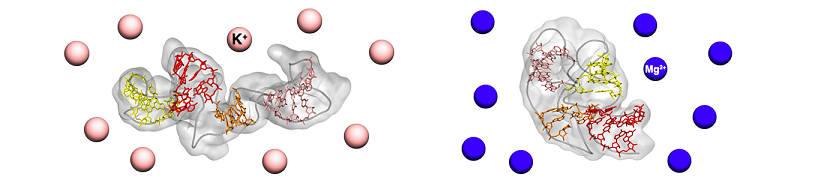
"X-ray crystallography, as used to discover the double-helical conformation of DNA, remains one of the most common techniques for studying biomolecule structures", explains SISSA physicist Giovanni Bussi. "This technique allows us to reconstruct the image of the molecule in solid-state crystalline form. However, this yields a static view of the structure that may not correspond to that assumed in the aqueous natural environment in which biomolecules are normally found."

This is why researchers began to use the small-angle X-ray scattering (SAXS) technique in the last decade to study RNA molecules, which can have highly dynamic structures. This method can be used directly in aqueous solutions that reproduce the physiological environment. Furthermore, the composition of the solutions can be modified to study how the molecules adapt to different conditions. Unfortunately, however, SAXS has limited resolution, in the order of a nanometer. Giovanni Bussi and Mattia Bernetti, a research fellow at SISSA, therefore decided to enhance SAXS via a 'computational microscope', combining it with molecular dynamics simulations that allow computerized reconstruction of molecular structures at the atomic level.

"We studied a fragment of ribosomal RNA involved in protein synthesis," explains the researchers. "We used SAXS data, derived from aqueous solutions containing different mixtures of salts, that was provided by Kathleen B. Hall of the Washington University School of Medicine in St Louis and combined them with molecular dynamics simulations. By this means we discovered the existence of two distinct conformations: one more compact and functional to the protein synthesis process, the other more extended, confirming the dynamic nature of RNA. In particular, we noticed how the prevalence of one structure over the other varies with the salts dissolved in solution, further underlining the importance of studying these molecules in an environment as similar as possible to that of the cell."

Bernetti and Bussi conclude that the results of the study, published in Nucleic Acids Research, have significance beyond the specific case and indicate an innovative method offering two advantages: "In this work, we combined molecular dynamics simulations and SAXS experimental data to obtain high-resolution structures of RNA biomolecules. This is a useful approach in two senses: on one hand, it allows detail to be added to SAXS experimental data, which in fact give a very approximate view; on the other hand, it allows results of molecular dynamics to be corrected if the models used in the simulations are insufficiently accurate."
Minnesota researchers discover a key cause of energy loss in spintronic materials

Tyler O'Neal, Staff Editor June 14, 2021, 11:00 am

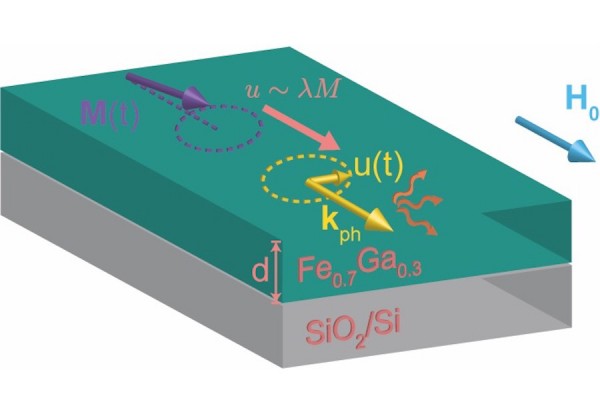
A study led by University of Minnesota Twin Cities researchers uncovered a property of magnetic materials that will allow engineers to develop more efficient spintronic devices in the future. Spintronics focuses on using the magnetic “spin” property of electrons instead of their charge, which improves the speed and efficiency of devices used for supercomputing and data storage. University of Minnesota-led research discovered that the interaction between magnetism and sound particles in spintronic devices can lead to damping, or the loss of energy, a process depicted in the figure above. The finding will ultimately allow engineers to develop more efficient spintronic devices in the future.

The research is published in Physical Review B, a peer-reviewed scientific journal published by the American Physical Society.

One of the major roadblocks in developing better spintronic devices is an effect called “damping,” in which the magnetic energy essentially leaks out of the materials, causing them to be less efficient. Traditionally, scientists have blamed this property on the interaction between the spin of the electron and its motion. However, the University of Minnesota-led team has proven that there is another factor—magnetoelastic coupling, which is the interaction between electron spin, or magnetism, and sound particles.

“Our work doesn’t say that [the original theory] is wrong, it just says that that's only part of the story,” explained Bill Peria, lead author of the study and a Ph.D. student in the University of Minnesota’s School of Physics and Astronomy. “We were able to show that in these magnetic materials, we do see that behavior, but it's actually only a relatively minor fraction of the entire damping. There’s also this other mechanism by which the magnetism can be damped that is not usually considered.”

The researchers used a technique called ferromagnetic resonance, which measures how much magnetic energy is released or leaked. In order to understand the phenomenon, they had to perform this technique at multiple temperatures, ranging from room temperature to 5 Kelvin, just five degrees above absolute zero and the equivalent of about -450 degrees Fahrenheit. 

The study’s findings provide a more holistic picture of what causes damping. This will allow engineers to develop magnetic materials with “ultralow” damping that are more energy efficient, ultimately leading to higher quality supercomputers of the future.

“We care about low damping because we, along with our collaborators, are trying to make devices in which magnetic excitations can propagate over long distances,” said Paul Crowell, senior author of the paper and a professor in the University’s School of Physics and Astronomy. “We are trying to build the ‘wires’ in which magnetic signals can propagate across a chip without losing their strength.”

In addition to Peria and Crowell, the research team included University of Maryland researchers Ichiro Takeuchi (professor), Xinjun Wang (postdoctoral researcher), and Heshan Yu (Ph.D. student); and Seunghun Lee, a professor of physics at Pukyong National University in Busan, South Korea. 

The research was supported by the University of Minnesota’s Spintronic Materials for Advanced Information Technologies (SMART) center, which is funded by nCORE, a Semiconductor Research Corporation program sponsored by the National Institute of Standards and Technology.

Read the full paper entitled “Magnetoelastic Gilbert damping in magnetostrictive Fe0.7Ga0.3 thin films” on the Physical Review B website.

Rensselaer's materials combo provides progress toward quantum supercomputing

Tyler O'Neal, Staff Editor June 14, 2021, 10:00 am

The future of quantum supercomputing may depend on the further development and understanding of semiconductor materials known as transition metal dichalcogenides (TMDCs). These atomically thin materials develop unique and useful electrical, mechanical, and optical properties when they are manipulated by pressure, light, or temperature. 

Engineers from Rensselaer Polytechnic Institute demonstrated how, when the TMDC materials they make are stacked in a particular geometry, the interaction that occurs between particles gives researchers more control over the devices’ properties. Specifically, the interaction between electrons becomes so strong that they form a new structure known as a correlated insulating state. This is an important step, researchers said, toward developing quantum emitters needed for future quantum simulation and supercomputing. 

“There is something exciting going on,” said Sufei Shi, an assistant professor of chemical and biological engineering at Rensselaer, who led this work. “One of the quantum degrees of freedom that we hope to use in quantum computing is enhanced when this correlated state exists.” 

Much of Shi’s research has focused on gaining a better understanding of the potential of the exciton, which is formed when an electron, excited by light, bonds with a hole — a positively charged version of the electron. Shi and his team have demonstrated this phenomenon in TMDC devices made of layers of Tungsten disulfide (WS2) and Tungsten diselenide (WSe2). Recently, the team also observed the creation of an interlayer exciton, which is formed when an electron and hole exist in two different layers of material. The benefit of this type of exciton, Shi said, is that it holds a longer lifetime and responds more significantly to an electric field — giving researchers greater ability to manipulate its properties. 

In their latest research, Shi and his team showed how, by stacking TMDCs in a particular manner, they can develop a lattice known as a moiré superlattice. Picture two sheets of paper stacked on top of one another, each with the same pattern of hexagons cut out of them. If you were to shift the angle of one of the pieces of paper, the hexagons would no longer perfectly match up. The new formation is similar to that of a moiré superlattice. 

The benefit of such a geometry, Shi said, is that it encourages electrons and interlayer excitons to bond together, further increasing the amount of control researchers have over the excitons themselves. This discovery, Shi said, is an important step toward developing quantum emitters that will be needed for future quantum simulation and quantum supercomputing. 

“It has essentially opened the door to a new world. We see a lot of things already, just by peeking through the door, but we have no idea what is going to happen if we open the door and get inside,” Shi said. “That is what we want to do, we want to open the door and get inside.”    

Shi said his team’s collaboration with the Center for Materials, Devices, and Integrated Systems at Rensselaer has enabled the development of the TMDC devices needed to study these atomically small interactions. This serves as an example of the interdisciplinary model that drives education and research at Rensselaer. 

  1. Japanese researchers uncover a key clue as to whether hurricanes will decay or re-intensify after hitting land
  2. German researchers discover the largest rotation in the universe

Page 7 of 15

  • 2
  • 3
  • 4
  • 5
  • 6
  • 7
  • 8
  • 9
  • 10
  • 11
POPULAR RIGHT NOW
  • Supercomputers uncover a new class of cosmic explosions hidden in plain sight
    Supercomputers uncover a new class of cosmic explosions hidden in plain sight
  • AI supercharges the hunt for stronger magnets: Iowa State researchers launch a new era of intelligent materials discovery
    AI supercharges the hunt for stronger magnets: Iowa State researchers launch a new era of intelligent materials discovery
  • IBM's Historic stock collapse raises questions for the future of enterprise supercomputing
    IBM's Historic stock collapse raises questions for the future of enterprise supercomputing
  • Could a novel dark matter theory simultaneously resolve multiple cosmic enigmas? Supercomputer simulations provide a compelling, albeit currently unverified, potential solution
    Could a novel dark matter theory simultaneously resolve multiple cosmic enigmas? Supercomputer simulations provide a compelling, albeit currently unverified, potential solution
  • Melting icebergs may be reshaping Earth’s greatest ocean current
    Melting icebergs may be reshaping Earth’s greatest ocean current
  • Supercomputers replace ‘bathtub’ flood maps with physics-based digital twins of Britain’s coastline
    Supercomputers replace ‘bathtub’ flood maps with physics-based digital twins of Britain’s coastline
  • Supercomputers push neural quantum simulation beyond previous limits
    Supercomputers push neural quantum simulation beyond previous limits
  • Intel’s AI supercomputing revival: Q2 financial surge signals new era for CPU-powered HPC infrastructure
    Intel’s AI supercomputing revival: Q2 financial surge signals new era for CPU-powered HPC infrastructure
  • AI infrastructure financing fears shake semiconductor sector
    AI infrastructure financing fears shake semiconductor sector
  • AWS supercomputing investment reaches historic scale as Amazon’s AI strategy powers record financial results
    AWS supercomputing investment reaches historic scale as Amazon’s AI strategy powers record financial results
THIS YEAR'S MOST READ
  • Wall Street wants to trade supercomputing power like oil
    Wall Street wants to trade supercomputing power like oil
  • Cosmic ambition at scale: UK’s supercomputer unlocks a 2.5 petabytes universe
    Cosmic ambition at scale: UK’s supercomputer unlocks a 2.5 petabytes universe
  • Hidden order, revealed at scale: Supercomputing, electron ptychography uncover the inner workings of relaxor ferroelectrics
    Hidden order, revealed at scale: Supercomputing, electron ptychography uncover the inner workings of relaxor ferroelectrics
  • Beamforming the future: BeammWave's 6G push signals the rise of orbital-terrestrial wireless networks
    Joakim Axmon
    Joakim Axmon
  • Intel's Q1 results signal supercomputing surge driving Xeon momentum
    Intel's Q1 results signal supercomputing surge driving Xeon momentum
  • When stars fall apart: Supercomputing reveals the hidden physics of black holes
    When stars fall apart: Supercomputing reveals the hidden physics of black holes
  • Multi-layer simulations reveal the hidden supply chain of solar prominences
    Multi-layer simulations reveal the hidden supply chain of solar prominences
  • Japanese scientists decode dolphin speed with supercomputing: Turbulence, vortices, and the hidden physics of propulsion
    Japanese scientists decode dolphin speed with supercomputing: Turbulence, vortices, and the hidden physics of propulsion
  • Cosmic feedback at scale: Supercomputing reveals how quasars regulate the early Universe
    Cosmic feedback at scale: Supercomputing reveals how quasars regulate the early Universe
  • Modeling life at the microscopic scale: A computational breakthrough in oxygen transport
    Modeling life at the microscopic scale: A computational breakthrough in oxygen transport
MOST READ OF ALL-TIME
  • Largest Computational Biology Simulation Mimics The Ribosome
    Details
    112107
    The amino acid (green) slithers into the chemical reaction center, moving through an evolutionarily ancient corridor of the ribosome (purple). The amino acid is delivered to the reaction core by the transfer RNA molecule (yellow).
    The amino acid (green) slithers into the chemical reaction center, moving through an evolutionarily ancient corridor of the ribosome (purple). The amino acid is delivered to the reaction core by the transfer RNA molecule (yellow).
  • Silicon 'neurons' may add a new dimension to chips
    Details
    80990
    Silicon 'neurons' may add a new dimension to chips
  • Linux Networx Accelerators Expected to Drive up to 4x Price/Performance
    Details
    75537
  • Complex Concepts That Really Add Up
    Details
    73635
    Complex Concepts That Really Add Up
  • Blue Sky Studios Donates Animation SuperComputer to Wesleyan
    Details
    68140
    Each rack holds 52 Angstrom Microsystem-brand “blades,” with a memory footprint of 12 or 24 gigabytes each. (Photos by Olivia Bartlett Drake)
    Each rack holds 52 Angstrom Microsystem-brand “blades,” with a memory footprint of 12 or 24 gigabytes each. (Photos by Olivia Bartlett Drake)
  • Humanities, HPC connect at NERSC
    Details
    57945
  • TeraGrid ’09 'Call for Participation'
    Details
    54951
  • Turbulence responsible for black holes' balancing act
    Details
    52310
  • Cray Wins $52 Million SuperComputer Contract
    Details
    50139
  • SDSC Researchers Accurately Predict Protein Docking
    Details
    46078
  • FRONTPAGE
  • LATEST
  • POPULAR
  • REGISTER
  • SOCIAL
  • VIDEO
  • SUBSCRIPTION
  • RSS
  • GUIDELINES
  • PRIVACY
  • TOS
  • ABOUT
  • +1 (816) 799-4488
  • editorial@supercomputingonline.com
© 2001 - 2026 SuperComputingOnline.com, LLC. All rights reserved. This material may not be published, broadcast, rewritten or redistributed without permission.
Sign In
  • FRONT PAGE
  • LATEST
    • MEDIA KIT
    • MOST READ
    • RSS FEED
    • ACADEMIA
    • AEROSPACE
    • APPLICATIONS
    • ASTRONOMY
    • AUTOMOTIVE
    • BIG DATA
    • BIOLOGY
    • CHEMISTRY
    • CLIENTS
    • CLOUD
    • DEFENSE
    • DEVELOPER TOOLS
    • EARTH SCIENCES
    • ECONOMICS
    • ENGINEERING
    • ENTERTAINMENT
    • HEALTH
    • INDUSTRY
    • INTERCONNECTS
    • GAMING
    • GOVERNMENT
    • MANUFACTURING
    • MIDDLEWARE
    • MOVIES
    • NETWORKS
    • OIL & GAS
    • PHYSICS
    • PROCESSORS
    • RETAIL
    • SCIENCE
    • STORAGE
    • SYSTEMS
    • VISUALIZATION
  • VIDEOS
    • ADD YOUR VIDEOS
    • MANAGE VIDEOS
  • COMMUNITY
    • TRADE SHOWS
    • SOCIAL NETWORK VIDEOS
    • SURVEYS
    • APPLICATIONS BROWSER
    • CONVERSATION INBOX
    • SOCIAL ADVERTISER
    • GROUPS
    • MARKETPLACE LISTINGS
    • PAGES
    • LEADERBOARD
    • POINTS LISTING
      • BADGES
    • PRIVACY CONFIRM REQUEST
    • PRIVACY CREATE REQUEST

Hey there! We noticed you’re using an ad blocker.