

SUPERCOMPUTING NEWS SUPERCOMPUTING NEWS
    • MEDIA KIT
    • MOST READ
    • RSS FEED
    • ACADEMIA
    • AEROSPACE
    • APPLICATIONS
    • ASTRONOMY
    • AUTOMOTIVE
    • BIG DATA
    • BIOLOGY
    • CHEMISTRY
    • CLIENTS
    • CLOUD
    • DEFENSE
    • DEVELOPER TOOLS
    • EARTH SCIENCES
    • ECONOMICS
    • ENGINEERING
    • ENTERTAINMENT
    • GAMING
    • GOVERNMENT
    • HEALTH
    • OIL & GAS
    • INDUSTRY
    • INTERCONNECTS
    • MANUFACTURING
    • MIDDLEWARE
    • MOVIES
    • NETWORKS
    • PHYSICS
    • PROCESSORS
    • RETAIL
    • SCIENCE
    • STORAGE
    • SYSTEMS
    • VISUALIZATION
    • AcyMailing subscription form

    • ADD YOUR VIDEOS
    • MANAGE VIDEOS
    • CONVERSATION INBOX
    • SOCIAL ADVERTISER
    • SOCIAL NETWORK VIDEOS
    • SURVEYS
    • GROUPS
    • PAGES
    • MARKETPLACE LISTINGS
    • APPLICATIONS BROWSER
    • PRIVACY CONFIRM REQUEST
    • PRIVACY CREATE REQUEST
    • LEADERBOARD
    • POINTS LISTING
      • BADGES
    • TRADE SHOWS
Sign In
Tyler O'Neal, Staff Editor August 7, 2020, 4:01 am

CU produces new look at Mars' eerie, ultraviolet nighttime glow

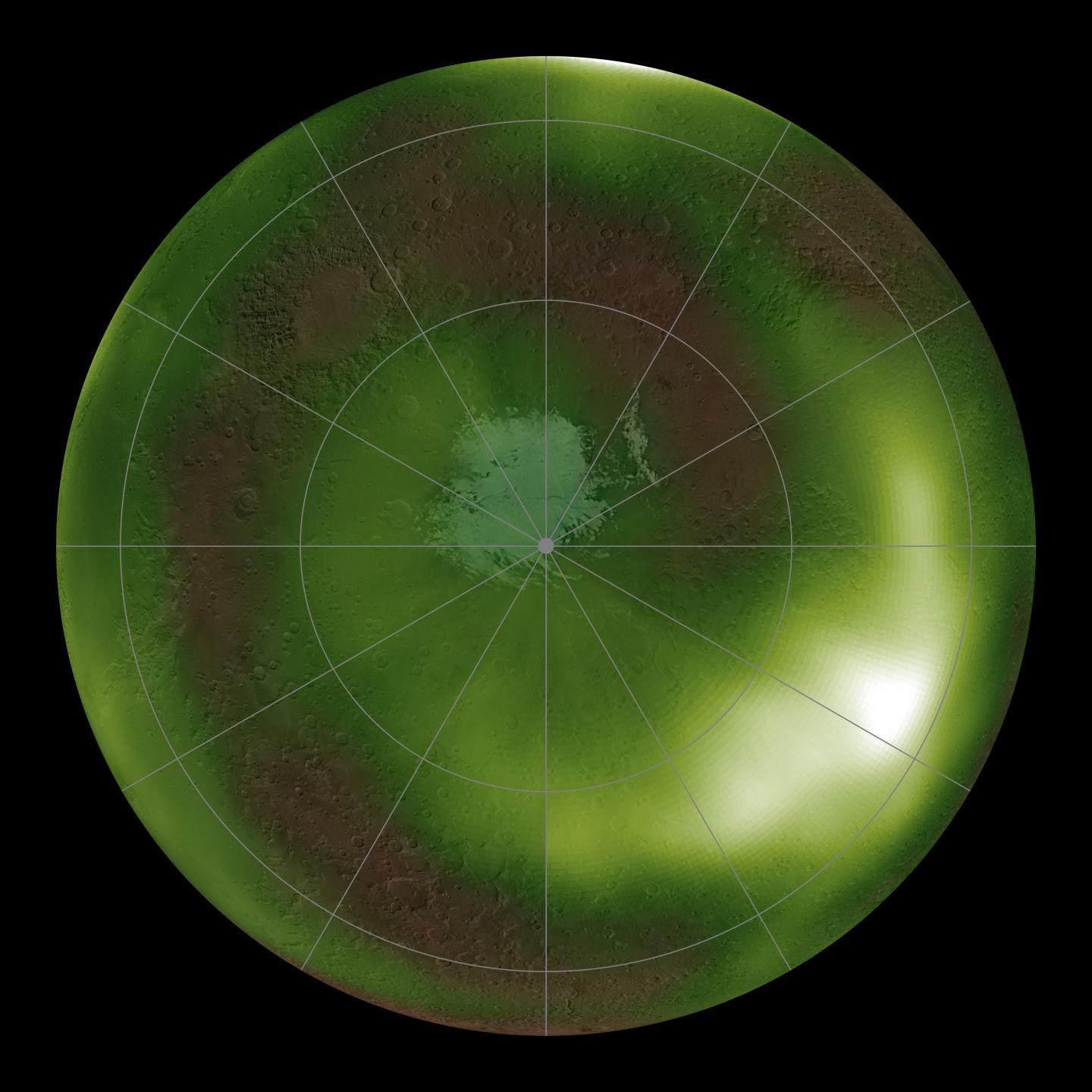
Every night on Mars, when the sun sets and temperatures fall to minus 80 degrees Fahrenheit and below, an eerie phenomenon spreads across much of the planet's sky: a soft glow created by chemical reactions occurring tens of miles above the surface.

An astronaut standing on Mars couldn't see this "nightglow"--it shows up only as ultraviolet light. But it may one day help scientists to better predict the churn of Mars' surprisingly complex atmosphere.

"If we're going to send people to Mars, we better understand what's going on in the atmosphere," said Zachariah Milby, a professional research assistant at the Laboratory for Atmospheric and Space Physics (LASP) at CU Boulder.

In a study published today in the Journal of Geophysical Research: Space Physics, Milby and his colleagues set their sights on understanding the phenomenon. They drew on data from NASA's Mars Atmosphere and Volatile Evolution (MAVEN) spacecraft to map the planet's nightglow in greater detail than ever before.

The team's findings show how this light display ebbs and flows over Mars' seasons. The group also discovered something unusual: an unexpectedly bright spot that appears in the planet's atmosphere just above its equator.

Mars, in other words, still has a few surprises in store for scientists, said LASP's Nick Schneider, lead author of the new study.

"The behavior of the Martian atmosphere is every bit as complicated and insightful as that of Earth's atmosphere," said Schneider, also a professor in the Department of Astrophysical and Planetary Sciences. Mars' nightglow as seen above the planet's polar ice cap.{module INSIDE STORY}
Full picture

MAVEN wasn't the first spacecraft to spot the nightglow on Mars, a phenomenon that resembles similar glows seen on Earth and Venus. That honor belongs to the European Space Agency's Mars Express Mission, which entered orbit around Mars in 2003.

But the mission was the first to capture the nightglow for what it is--a dynamic and constantly evolving phenomenon.

"It wasn't until MAVEN came along in 2014 that we could actually snap this full picture five times a day as the planet rotates," Schneider said.

In the new study, researchers used MAVEN's Imaging Ultraviolet Spectrograph (IUVS)--an instrument designed and built at LASP--to snap images of Mars from a distance of 3,700 miles. Those far-flung recordings allowed the team to trace the path of nightglow as it moved across the entire planet.

Milby led the data analysis for the research while he was still an undergraduate student at CU Boulder.

He explained that the eerie aura appears when air currents high in Mars' atmosphere plunge to about 40 miles above the planet's surface. When that happens, lone nitrogen and oxygen atoms in the atmosphere combine to form molecules of nitric oxide, giving off small bursts of ultraviolet light in the process.

Put differently, when its atmosphere drops, Mars shines.

"It's a great tracer for dynamics between the layers of the atmosphere," Milby said.

Bright spots

Milby added that, like on Earth, those dynamics can shift with the seasons. The MAVEN team found, for example, that Mars' nightglow seems to be brightest at the height of the planet's northern and southern winters when hotter currents rush away from the equator and toward Mars' poles.

Milby also found something he wasn't expecting in the data: an extra-bright blob of nightglow that appeared and disappeared from almost exactly above 0 degrees longitude and 0 degrees latitude on Mars.

"We spent weeks thinking there was a bug in our code somewhere," Milby said.

There wasn't a bug. The researchers still aren't sure why Mars is glowing so much at that unusual spot--it may have something to do with the shape of the terrain underneath. But Schneider said that observations like this can help scientists improve their computer models of how the planet's atmosphere works.

And that could lead to something that every astronaut might use: more accurate weather reports on Mars.

"We use supercomputers to predict weather on Earth so that you can plan for your vacation or growing crops," Schneider said. "The same computer models can be spun up for Mars and all the other planets."

U.S. Department of Defense Creating a Public Nuisance?

Jane Genova July 27, 2010, 6:57 am
By Jane Genova, We’re the government and we’re here to help.  When government first says that, it probably is true.  Take the U.S. Department of Defense (DOD).  

Decades ago, DOD became involved with research and development of high performance computers (HPC) as a must-do in national security.  Those HPC applications support aeronautics, cryptography, and nuclear weapons design and testing.  Then, in the mid 1980s, DOD leveraged that expertise for U.S. economic competitive strength, including stimulating productivity and innovation in the private sector, ranging from manufacturing to energy [http://www.stormingmedia.us/15/15559/A155994.html].   

That was then.  Today, HPC is a stand-alone industry.  It’s business-as-usual in the financial markets, biological sciences, geo-sciences, and engineering.  Last year, despite the downturn, the high end grew by 25% to $3.4 billion, according to WORLDWIDE HIGH-PERFORMANCE TECHNICAL SERVER.

Yet, an irony tragically typical of government, DOD seems to be the source of problems in the HPC industry.  Those problems are of two types.  Together they could be impairing or harming the common good in such a way as to be considered legally and in terms of public policy a “public nuisance.”  Since 2005, I have been covering how the traditional theory of public nuisance is being applied to product liability, the environment and energy.  Recently, in “North Carolina v. TVA,” the plaintiff used the concept of public nuisance and won.    

One of the two problems is the lack of disclosure, which could be masking a conflict of interest.  That is the situation in the DOD publication of InsideHPC.com.  That online site is headed by DOD full-time employee John E. West.  On the “About Us” page, West identifies himself as employed “in a computing strategy role in R&D in the public sector.” Why isn’t DOD explicitly identified? A source informs me that West “works with Lockheed Martin as the systems integrator at the U.S. Army site.”  John Leidel, also involved with InsideHPC.com, the same source tells me “works for Convey Computer.”

When I presented this information to Christopher M. O’Neal, Chief Executive Officer of SuperComputerOnline.com, he noted, “FTC Disclosure Policies are designed to allow online communicators to self-identify any affiliation that may influence the content of the blog and allow readers to make their own judgment regarding the influence on content.”  Variations of disclosure rules regarding online content are working their way through state and federal courts.  At stake in those rulings is the credibility of digital as a medium as well as its commercial future.

Some might shrug “InsideHPC is only one of those dry government publications.”  But, Inside HPC.com is hardly that.  Actually it is slickly commercial.  In fact, it gushes on its website, “We aren’t just another ‘me too’ HPC news site, and we aren’t interested in letting ‘me too’ HPC companies reach our readers.”  Yet, this no me-too is paid for with tax-payer money.  West’s trips to HPC conferences are funded by tax-payers.  

Simultaneously, there are now private-sector HPC publications, ranging from SuperComputerOnline.com to HPCWire.com, which play in that same sandbox.    Only to play, all their expenses, including for trips to conferences, must come from their own pocket.  Those costs represent a minus from revenue.

That leads right in to the second argument supporting that DOD might be creating or contributing to a public nuisance in permitting InsideHPC.com to exist in its present form.  That second issue is: Why is this unfair competition with the private sector being permitted?  

Anyone who understands perception knows this: The DOD publication, being issued by the government, implies a type of official imprimatur.  In media we call that the “halo effect.”  That could position it, among private-sector publications, as unique in its authority and credibility.  Clearly, that is an unfair advantage it has over other HPC publications that should not exist.  

That brings up the core issue: Why would any government agency set itself up as a competitor with business?  Doesn’t that bring up the very question of what is the mission and function of government?

When government intrudes in this way, at best this creates redundancy.  At worst it is taking on private enterprise – and with built-in cost and influence advantages.  At the top of the list in not having to factor in many kinds of expenses which enterprises have to.  

There’s more.  InsideHPC now has a dedicated marketing and sales arm, including Mike Bernhardt, to sell ads.  Right now most of advertising is a zero-sum game.  What space InsideHPC sells, the private sector likely doesn’t.  Yet, most publications depend on advertising for profits.  

The Business Coalition for Fair Competition provides a white paper on what’s very dangerous with both these best and worst case scenarios [http:governmentcompetition.org/howgovtcompetes.html].  Isn’t this the other side of the coin of government agencies being too cozy with businesses? Unfortunately, this side too often remains invisible, due to lack of transparency.

U.S. government can be most helpful when it discerns its mission has been accomplished and it surrenders that function.   If it refuses to do just that, then it can be viewed in the legal and public policy light of creating a public nuisance.

Jane Genova blogged the Rhode Island lead paint public nuisance trial and its aftermath, beginning on syndicated site http://janegenova.com under “legal” and continuing on syndicated site http://lawandmore.typepad.com.  Then she expanded analysis of public nuisance to environmental and energy matters.  She has been interviewed on legal and policy issues by THE NEW YORK TIMES, CRAIN’S BUSINESS and PLAIN DEALER. Her posts are regularly linked to by THE WALL STREET JOURNAL, LEGAL TECHNOLOGY, PUBLIC NUISANCE, and NEW YORK Magazine.

Page 15 of 15

  • 6
  • 7
  • 8
  • 9
  • 10
  • 11
  • 12
  • 13
  • 14
  • 15
POPULAR RIGHT NOW
  • Supercomputers uncover a new class of cosmic explosions hidden in plain sight
    Supercomputers uncover a new class of cosmic explosions hidden in plain sight
  • AI supercharges the hunt for stronger magnets: Iowa State researchers launch a new era of intelligent materials discovery
    AI supercharges the hunt for stronger magnets: Iowa State researchers launch a new era of intelligent materials discovery
  • IBM's Historic stock collapse raises questions for the future of enterprise supercomputing
    IBM's Historic stock collapse raises questions for the future of enterprise supercomputing
  • Could a novel dark matter theory simultaneously resolve multiple cosmic enigmas? Supercomputer simulations provide a compelling, albeit currently unverified, potential solution
    Could a novel dark matter theory simultaneously resolve multiple cosmic enigmas? Supercomputer simulations provide a compelling, albeit currently unverified, potential solution
  • Melting icebergs may be reshaping Earth’s greatest ocean current
    Melting icebergs may be reshaping Earth’s greatest ocean current
  • Supercomputers replace ‘bathtub’ flood maps with physics-based digital twins of Britain’s coastline
    Supercomputers replace ‘bathtub’ flood maps with physics-based digital twins of Britain’s coastline
  • Supercomputers push neural quantum simulation beyond previous limits
    Supercomputers push neural quantum simulation beyond previous limits
  • Intel’s AI supercomputing revival: Q2 financial surge signals new era for CPU-powered HPC infrastructure
    Intel’s AI supercomputing revival: Q2 financial surge signals new era for CPU-powered HPC infrastructure
  • AI infrastructure financing fears shake semiconductor sector
    AI infrastructure financing fears shake semiconductor sector
  • AWS supercomputing investment reaches historic scale as Amazon’s AI strategy powers record financial results
    AWS supercomputing investment reaches historic scale as Amazon’s AI strategy powers record financial results
THIS YEAR'S MOST READ
  • Wall Street wants to trade supercomputing power like oil
    Wall Street wants to trade supercomputing power like oil
  • Cosmic ambition at scale: UK’s supercomputer unlocks a 2.5 petabytes universe
    Cosmic ambition at scale: UK’s supercomputer unlocks a 2.5 petabytes universe
  • Hidden order, revealed at scale: Supercomputing, electron ptychography uncover the inner workings of relaxor ferroelectrics
    Hidden order, revealed at scale: Supercomputing, electron ptychography uncover the inner workings of relaxor ferroelectrics
  • Beamforming the future: BeammWave's 6G push signals the rise of orbital-terrestrial wireless networks
    Joakim Axmon
    Joakim Axmon
  • Intel's Q1 results signal supercomputing surge driving Xeon momentum
    Intel's Q1 results signal supercomputing surge driving Xeon momentum
  • When stars fall apart: Supercomputing reveals the hidden physics of black holes
    When stars fall apart: Supercomputing reveals the hidden physics of black holes
  • Multi-layer simulations reveal the hidden supply chain of solar prominences
    Multi-layer simulations reveal the hidden supply chain of solar prominences
  • Japanese scientists decode dolphin speed with supercomputing: Turbulence, vortices, and the hidden physics of propulsion
    Japanese scientists decode dolphin speed with supercomputing: Turbulence, vortices, and the hidden physics of propulsion
  • Cosmic feedback at scale: Supercomputing reveals how quasars regulate the early Universe
    Cosmic feedback at scale: Supercomputing reveals how quasars regulate the early Universe
  • Modeling life at the microscopic scale: A computational breakthrough in oxygen transport
    Modeling life at the microscopic scale: A computational breakthrough in oxygen transport
MOST READ OF ALL-TIME
  • Largest Computational Biology Simulation Mimics The Ribosome
    Details
    112107
    The amino acid (green) slithers into the chemical reaction center, moving through an evolutionarily ancient corridor of the ribosome (purple). The amino acid is delivered to the reaction core by the transfer RNA molecule (yellow).
    The amino acid (green) slithers into the chemical reaction center, moving through an evolutionarily ancient corridor of the ribosome (purple). The amino acid is delivered to the reaction core by the transfer RNA molecule (yellow).
  • Silicon 'neurons' may add a new dimension to chips
    Details
    80990
    Silicon 'neurons' may add a new dimension to chips
  • Linux Networx Accelerators Expected to Drive up to 4x Price/Performance
    Details
    75537
  • Complex Concepts That Really Add Up
    Details
    73635
    Complex Concepts That Really Add Up
  • Blue Sky Studios Donates Animation SuperComputer to Wesleyan
    Details
    68140
    Each rack holds 52 Angstrom Microsystem-brand “blades,” with a memory footprint of 12 or 24 gigabytes each. (Photos by Olivia Bartlett Drake)
    Each rack holds 52 Angstrom Microsystem-brand “blades,” with a memory footprint of 12 or 24 gigabytes each. (Photos by Olivia Bartlett Drake)
  • Humanities, HPC connect at NERSC
    Details
    57945
  • TeraGrid ’09 'Call for Participation'
    Details
    54951
  • Turbulence responsible for black holes' balancing act
    Details
    52310
  • Cray Wins $52 Million SuperComputer Contract
    Details
    50139
  • SDSC Researchers Accurately Predict Protein Docking
    Details
    46078
  • FRONTPAGE
  • LATEST
  • POPULAR
  • REGISTER
  • SOCIAL
  • VIDEO
  • SUBSCRIPTION
  • RSS
  • GUIDELINES
  • PRIVACY
  • TOS
  • ABOUT
  • +1 (816) 799-4488
  • editorial@supercomputingonline.com
© 2001 - 2026 SuperComputingOnline.com, LLC. All rights reserved. This material may not be published, broadcast, rewritten or redistributed without permission.
Sign In
  • FRONT PAGE
  • LATEST
    • MEDIA KIT
    • MOST READ
    • RSS FEED
    • ACADEMIA
    • AEROSPACE
    • APPLICATIONS
    • ASTRONOMY
    • AUTOMOTIVE
    • BIG DATA
    • BIOLOGY
    • CHEMISTRY
    • CLIENTS
    • CLOUD
    • DEFENSE
    • DEVELOPER TOOLS
    • EARTH SCIENCES
    • ECONOMICS
    • ENGINEERING
    • ENTERTAINMENT
    • HEALTH
    • INDUSTRY
    • INTERCONNECTS
    • GAMING
    • GOVERNMENT
    • MANUFACTURING
    • MIDDLEWARE
    • MOVIES
    • NETWORKS
    • OIL & GAS
    • PHYSICS
    • PROCESSORS
    • RETAIL
    • SCIENCE
    • STORAGE
    • SYSTEMS
    • VISUALIZATION
  • VIDEOS
    • ADD YOUR VIDEOS
    • MANAGE VIDEOS
  • COMMUNITY
    • TRADE SHOWS
    • SOCIAL NETWORK VIDEOS
    • SURVEYS
    • APPLICATIONS BROWSER
    • CONVERSATION INBOX
    • SOCIAL ADVERTISER
    • GROUPS
    • MARKETPLACE LISTINGS
    • PAGES
    • LEADERBOARD
    • POINTS LISTING
      • BADGES
    • PRIVACY CONFIRM REQUEST
    • PRIVACY CREATE REQUEST

Hey there! We noticed you’re using an ad blocker.