

SUPERCOMPUTING NEWS SUPERCOMPUTING NEWS
    • MEDIA KIT
    • MOST READ
    • RSS FEED
    • ACADEMIA
    • AEROSPACE
    • APPLICATIONS
    • ASTRONOMY
    • AUTOMOTIVE
    • BIG DATA
    • BIOLOGY
    • CHEMISTRY
    • CLIENTS
    • CLOUD
    • DEFENSE
    • DEVELOPER TOOLS
    • EARTH SCIENCES
    • ECONOMICS
    • ENGINEERING
    • ENTERTAINMENT
    • GAMING
    • GOVERNMENT
    • HEALTH
    • OIL & GAS
    • INDUSTRY
    • INTERCONNECTS
    • MANUFACTURING
    • MIDDLEWARE
    • MOVIES
    • NETWORKS
    • PHYSICS
    • PROCESSORS
    • RETAIL
    • SCIENCE
    • STORAGE
    • SYSTEMS
    • VISUALIZATION
    • AcyMailing subscription form

    • ADD YOUR VIDEOS
    • MANAGE VIDEOS
    • CONVERSATION INBOX
    • SOCIAL ADVERTISER
    • SOCIAL NETWORK VIDEOS
    • SURVEYS
    • GROUPS
    • PAGES
    • MARKETPLACE LISTINGS
    • APPLICATIONS BROWSER
    • PRIVACY CONFIRM REQUEST
    • PRIVACY CREATE REQUEST
    • LEADERBOARD
    • POINTS LISTING
      • BADGES
    • TRADE SHOWS
Sign In
Tyler O'Neal, Staff Editor EARTH SCIENCES October 28, 2020, 6:21 pm

American disease transmission models help forecast election outcome

According to a new model, if the U.S. presidential election were to take place today, former Vice President Joe Biden would have an 88.3% percent chance of winning. That’s the finding of a group of U.S. university researchers based on new research published in SIAM Review today. 

This finding assumes that Americans vote the way that they say they will in publicly available polling data and that voters not accounted for in existing polling data will turn out equally for both candidates. 

How did the researchers — from Northwestern University, UCLA, Augusta University, and The Ohio State University — arrive at their conclusion? By applying a modeling framework like one's experts use to forecast the spread of infectious diseases (such as COVID-19) to the high-stakes challenge of forecasting election outcomes.

“What we assume is that similar to how an infected person can cause — or influence — a susceptible person to become infected with a virus, a Republican or Democratic voter can influence an undecided voter,” said lead researcher Alexandria Volkening, an NSF–Simons Fellow at Northwestern University, who co-authored the study with UCLA Mathematics professor Mason Porter, Augusta University Biostatistics and Data Science professor Daniel Linder, and Ohio State University Biostatistics and Mathematics professor Grzegorz Rempala. Their 2020 forecasts are also done in collaboration with Volkening’s students Samuel Chian, William He, and Christopher Lee.

“I think we were all initially surprised that a disease-transmission model could produce meaningful forecasts of elections, but one of the benefits of mathematical modeling is that you can apply similar methods to shed light on many different problems,” she added.

The group’s election forecasting model — which is based on “compartmental modeling” — was shown to have a similar success rate to popular forecasters FiveThirtyEight and Sabato’s Crystal Ball. 

Researchers treated Democratic and Republican voting inclinations as two possible kinds of ‘infections’ that can spread between states. Undecided, independent, or minor-party voters were considered ‘susceptible’ individuals, and infection was interpreted as adopting Democratic or Republican opinions. ‘Recovery’ represented the turnover of committed voters to undecided ones.

Unlike election forecasts that combine polling data with other data, such as historical voting, the economy, and approval ratings, the researchers’ model uses only publicly available polling data and treats all polls on equal footing. Transmission is interpreted as opinion persuasion, influenced by campaigning, media coverage and debates, and opinions spread both within and between states. Despite its simplicity, the model performs surprisingly well, Volkening explained. For example, it was as effective as popular analysts were at predicting (known as “calling”) the 2012 and 2016 races for governors, senators, and presidents in the U.S. using historical polling data, she said.
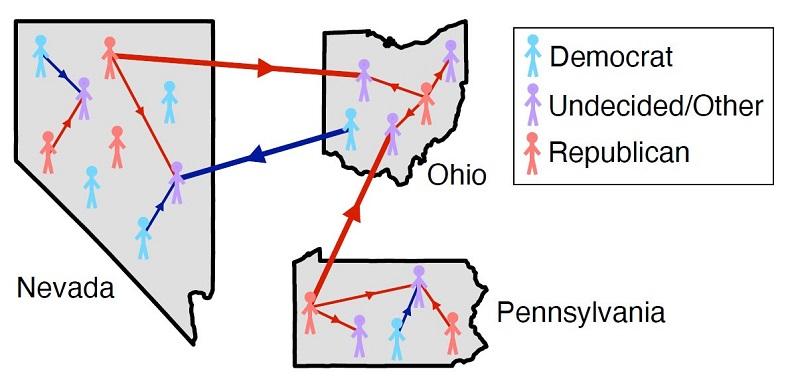
Figure 1: Voters can interact both within and between states, influencing each other’s political opinions. Figure courtesy of Alexandria Volkening, Daniel F. Linder, Mason A. Porter, and Grzegorz A. Rempala.

Figure 1: Voters can interact both within and between states, influencing each other’s political opinions. Figure courtesy of Alexandria Volkening, Daniel F. Linder, Mason A. Porter, and Grzegorz A. Rempala. {module INSIDE STORY}

"One important limitation is that we assume all undecided individuals who are left at the end of our simulated elections vote for minor-party candidates or turn out equally for the Democratic and Republican candidates,” Volkening said. “If undecided voters all vote in one direction or voter turnout is heavily partisan, it is very possible for a trailing candidate to win.”

Though the paper is being published in the midst of a global pandemic, UCLA’s Porter is quick to point out that the idea to use a disease transmission model was made long before the COVID-19 pandemic surfaced.

“When we first discussed using this approach, it was on the heels of the 2016 election when pollsters were predicting a Clinton win and of course that’s not what happened,” said Porter, noting that the researchers speculated that something was wrong with the forecasting models that were being applied, the polling data itself, or the interpretations of forecast uncertainty. 

“There are many tools already available for compartmental modeling because people have studied infectious diseases for quite some time with great success, so it made sense to try a similar approach to study election forecasting,” he said.

The group’s model and U.S. election forecasts are publicly available at https://modelingelectiondynamics.gitlab.io/2020-forecasts/index.html and the researchers strongly encourage readers to try out their modeling framework and build on it further.

To read the entire study, visit SIAM Review.

Russian scientists develop ML algo to find binding sites in drug targets

Tyler O'Neal, Staff Editor EARTH SCIENCES October 27, 2020, 7:06 pm

Scientists from the iMolecule group at Skoltech Center for Computational and Data-Intensive Science and Engineering (CDISE) developed BiteNet, a machine learning (ML) algorithm that helps find drug binding sites, i.e. potential drug targets, in proteins. BiteNet can analyze 1,000 protein structures in 1.5 minutes and find optimal spots for drug molecules to attach. The research was published in the Communications Biology journal.

Proteins, the molecules that control most biological processes, are typically the common targets for drugs. To produce a therapeutic effect, drugs should attach to proteins at specific sites called binding sites. The protein's ability to bind to a drug is determined by the site's amino acid sequence and spatial structure. Binding sites are real "hot spots" in pharmacology. The more binding sites are known, the more opportunities there are for creating more effective and safer drugs.

Skoltech CDISE assistant professor Petr Popov and PhD student Igor Kozlovskii developed a new computational approach for spatio-temporal detection of binding sites in proteins by applying deep learning algorithms and computer vision to protein structures treated as 3D images. With this new technology, one can detect even elusive sites: for instance, scientists managed to detect binding sites concealed in experimental atomic structures or formed by several protein molecules for the ion channel, G protein-coupled receptor, and the epithelial growth factor, one of the most important drug targets. {module INSIDE STORY}

Petr Popov, the study lead and assistant professor at Skoltech, comments: "The human genome consists of nearly 20,000 proteins, and very few among them get associated with a pharmacological target. Our approach allows searching the protein for binding sites for drug-like compounds, thus expanding the array of possible pharmacological targets. Besides, initial structure-based drug discovery strongly depends on the choice of the protein's atomic structure. Working on a structure with the binding site barred for the drug or missing altogether can fail. Our method enables analyzing a large number of structures in a protein and finding the most suitable one for a specific stage."

According to Igor Kozlovskii, the first author of the paper, BiteNet outperforms its counterparts both in speed and accuracy: "BiteNet is based on the computer vision, we treat protein structures as images, and binding sites as objects to detect on this images. It takes about 0.1 seconds to analyze one spatial structure and 1.5 minutes to evaluate 1,000 protein structures of about 2,000 atoms."

MIT's Brown wins SfN's Swartz Prize for Theoretical and Computational Neuroscience

Tyler O'Neal, Staff Editor EARTH SCIENCES October 26, 2020, 3:49 pm

The Society for Neuroscience announced today that it has awarded the Swartz Prize for Theoretical and Computational Neuroscience to Emery N. Brown, Edward Hood Taplin Professor of Medical Engineering and Computational Neuroscience at MIT.

Brown, a member of The Picower Institute for Learning and Memory and the Institute for Medical Engineering and Science as well as the Warren M. Zapol Professor at Harvard Medical School, is a neuroscientist, a statistician, and a practicing anesthesiologist at Massachusetts General Hospital. His research has produced principled and efficient new methods for decoding patterns of neural and brain network activity and has an advanced neuroscientific understanding of how anesthetics affect the brain, which can improve patient care. CAPTION Emery N. Brown speaks at the Society for Neuroscience Annual Meeting in 2019.  CREDIT MIT Picower Institute for Learning and Memory{module INSIDE STORY}

"Dr. Brown's seminal scientific contributions to neural signal processing and the theory of anesthetic mechanisms, together with his service as an educator and a physician, make him highly deserving of the 2020 Swartz Prize," SfN President Barry Everitt said in a press release announcing the award. "Dr. Brown has demonstrated an unusually broad knowledge of neuroscience, a deep understanding of theoretical and computational tools, and an uncanny ability to find explanatory simplicity lurking beneath complicated observational phenomena."

In its announcement, the world's largest neuroscience organization elaborated on the breadth and depth of Brown's influence in many lines of research.

"Brown's insights and approaches have been critical to the development of some of the first models estimating functional connectivity among a group of simultaneously recorded neurons," SfN's announcement stated. "He has contributed statistical methods to analyze recordings of circadian rhythms and signal processing methods to analyze neuronal spike trains, local field potentials, and EEG recordings."

With regard to anesthesiology, the statement continued: "Brown has proposed that the altered arousal states produced by the principal classes of anesthetics can be characterized by analyzing the locations of their molecular targets, along with the anatomy and physiology of the circuits that connect these locations. Overall, his systems neuroscience paradigm, supported by mechanistic modeling and cutting-edge statistical evaluation of evidence, is transforming anesthesiology from an empirical, clinical practice into a principled neuroscience-based discipline.

Brown said the recognition made him thankful for the chances his research, teaching, and medical practice have given him to work with colleagues and students.

"Receiving the Swartz Prize is a great honor," he said. "The Prize recognizes my group's work to characterize more accurately the properties of neural systems by developing and applying statistical methods and signal processing algorithms that capture their dynamical features. It further recognizes our efforts to uncover the neurophysiological mechanisms of how anesthetics work and to translate those insights into new practices for managing patients receiving anesthesia care.

"Finally," he added, "Receipt of the Swartz Prize makes me eternally grateful for the outstanding colleagues, graduate students, post-doc, undergraduates, research assistants, and staff with whom I have had the good fortune to work."

The prize, which includes $30,000, is being awarded during SfN's Awards Announcement Week Oct. 26-29.

  1. Scripps chemists develop framework to enable efficient synthesis of 'information-dense' molecules
  2. Johns Hopkins researchers discover 'spooky' similarity in how brains, computers see

Page 19 of 23

  • 14
  • 15
  • 16
  • 17
  • 18
  • 19
  • 20
  • 21
  • 22
  • 23
POPULAR RIGHT NOW
  • AI supercharges the hunt for stronger magnets: Iowa State researchers launch a new era of intelligent materials discovery
    AI supercharges the hunt for stronger magnets: Iowa State researchers launch a new era of intelligent materials discovery
  • IBM's Historic stock collapse raises questions for the future of enterprise supercomputing
    IBM's Historic stock collapse raises questions for the future of enterprise supercomputing
  • Could a novel dark matter theory simultaneously resolve multiple cosmic enigmas? Supercomputer simulations provide a compelling, albeit currently unverified, potential solution
    Could a novel dark matter theory simultaneously resolve multiple cosmic enigmas? Supercomputer simulations provide a compelling, albeit currently unverified, potential solution
  • Melting icebergs may be reshaping Earth’s greatest ocean current
    Melting icebergs may be reshaping Earth’s greatest ocean current
  • Supercomputers replace ‘bathtub’ flood maps with physics-based digital twins of Britain’s coastline
    Supercomputers replace ‘bathtub’ flood maps with physics-based digital twins of Britain’s coastline
  • Supercomputers push neural quantum simulation beyond previous limits
    Supercomputers push neural quantum simulation beyond previous limits
  • Intel’s AI supercomputing revival: Q2 financial surge signals new era for CPU-powered HPC infrastructure
    Intel’s AI supercomputing revival: Q2 financial surge signals new era for CPU-powered HPC infrastructure
  • AI infrastructure financing fears shake semiconductor sector
    AI infrastructure financing fears shake semiconductor sector
  • AWS supercomputing investment reaches historic scale as Amazon’s AI strategy powers record financial results
    AWS supercomputing investment reaches historic scale as Amazon’s AI strategy powers record financial results
  • Catching the wave of the future: Supercomputers unlock the hidden dynamics of Venus
    Catching the wave of the future: Supercomputers unlock the hidden dynamics of Venus
THIS YEAR'S MOST READ
  • Wall Street wants to trade supercomputing power like oil
    Wall Street wants to trade supercomputing power like oil
  • Beamforming the future: BeammWave's 6G push signals the rise of orbital-terrestrial wireless networks
    Joakim Axmon
    Joakim Axmon
  • Cosmic ambition at scale: UK’s supercomputer unlocks a 2.5 petabytes universe
    Cosmic ambition at scale: UK’s supercomputer unlocks a 2.5 petabytes universe
  • Hidden order, revealed at scale: Supercomputing, electron ptychography uncover the inner workings of relaxor ferroelectrics
    Hidden order, revealed at scale: Supercomputing, electron ptychography uncover the inner workings of relaxor ferroelectrics
  • Intel's Q1 results signal supercomputing surge driving Xeon momentum
    Intel's Q1 results signal supercomputing surge driving Xeon momentum
  • When stars fall apart: Supercomputing reveals the hidden physics of black holes
    When stars fall apart: Supercomputing reveals the hidden physics of black holes
  • Multi-layer simulations reveal the hidden supply chain of solar prominences
    Multi-layer simulations reveal the hidden supply chain of solar prominences
  • Japanese scientists decode dolphin speed with supercomputing: Turbulence, vortices, and the hidden physics of propulsion
    Japanese scientists decode dolphin speed with supercomputing: Turbulence, vortices, and the hidden physics of propulsion
  • Cosmic feedback at scale: Supercomputing reveals how quasars regulate the early Universe
    Cosmic feedback at scale: Supercomputing reveals how quasars regulate the early Universe
  • Modeling life at the microscopic scale: A computational breakthrough in oxygen transport
    Modeling life at the microscopic scale: A computational breakthrough in oxygen transport
MOST READ OF ALL-TIME
  • Largest Computational Biology Simulation Mimics The Ribosome
    Details
    112127
    The amino acid (green) slithers into the chemical reaction center, moving through an evolutionarily ancient corridor of the ribosome (purple). The amino acid is delivered to the reaction core by the transfer RNA molecule (yellow).
    The amino acid (green) slithers into the chemical reaction center, moving through an evolutionarily ancient corridor of the ribosome (purple). The amino acid is delivered to the reaction core by the transfer RNA molecule (yellow).
  • Silicon 'neurons' may add a new dimension to chips
    Details
    81040
    Silicon 'neurons' may add a new dimension to chips
  • Linux Networx Accelerators Expected to Drive up to 4x Price/Performance
    Details
    75563
  • Complex Concepts That Really Add Up
    Details
    73693
    Complex Concepts That Really Add Up
  • Blue Sky Studios Donates Animation SuperComputer to Wesleyan
    Details
    68166
    Each rack holds 52 Angstrom Microsystem-brand “blades,” with a memory footprint of 12 or 24 gigabytes each. (Photos by Olivia Bartlett Drake)
    Each rack holds 52 Angstrom Microsystem-brand “blades,” with a memory footprint of 12 or 24 gigabytes each. (Photos by Olivia Bartlett Drake)
  • Humanities, HPC connect at NERSC
    Details
    57973
  • TeraGrid ’09 'Call for Participation'
    Details
    54976
  • Turbulence responsible for black holes' balancing act
    Details
    52339
  • Cray Wins $52 Million SuperComputer Contract
    Details
    50162
  • SDSC Researchers Accurately Predict Protein Docking
    Details
    46115
  • FRONTPAGE
  • LATEST
  • POPULAR
  • REGISTER
  • SOCIAL
  • VIDEO
  • SUBSCRIPTION
  • RSS
  • GUIDELINES
  • PRIVACY
  • TOS
  • ABOUT
  • +1 (816) 799-4488
  • editorial@supercomputingonline.com
© 2001 - 2026 SuperComputingOnline.com, LLC. All rights reserved. This material may not be published, broadcast, rewritten or redistributed without permission.
Sign In
  • FRONT PAGE
  • LATEST
    • MEDIA KIT
    • MOST READ
    • RSS FEED
    • ACADEMIA
    • AEROSPACE
    • APPLICATIONS
    • ASTRONOMY
    • AUTOMOTIVE
    • BIG DATA
    • BIOLOGY
    • CHEMISTRY
    • CLIENTS
    • CLOUD
    • DEFENSE
    • DEVELOPER TOOLS
    • EARTH SCIENCES
    • ECONOMICS
    • ENGINEERING
    • ENTERTAINMENT
    • HEALTH
    • INDUSTRY
    • INTERCONNECTS
    • GAMING
    • GOVERNMENT
    • MANUFACTURING
    • MIDDLEWARE
    • MOVIES
    • NETWORKS
    • OIL & GAS
    • PHYSICS
    • PROCESSORS
    • RETAIL
    • SCIENCE
    • STORAGE
    • SYSTEMS
    • VISUALIZATION
  • VIDEOS
    • ADD YOUR VIDEOS
    • MANAGE VIDEOS
  • COMMUNITY
    • TRADE SHOWS
    • SOCIAL NETWORK VIDEOS
    • SURVEYS
    • APPLICATIONS BROWSER
    • CONVERSATION INBOX
    • SOCIAL ADVERTISER
    • GROUPS
    • MARKETPLACE LISTINGS
    • PAGES
    • LEADERBOARD
    • POINTS LISTING
      • BADGES
    • PRIVACY CONFIRM REQUEST
    • PRIVACY CREATE REQUEST

Hey there! We noticed you’re using an ad blocker.