

SUPERCOMPUTING NEWS SUPERCOMPUTING NEWS
    • MEDIA KIT
    • MOST READ
    • RSS FEED
    • ACADEMIA
    • AEROSPACE
    • APPLICATIONS
    • ASTRONOMY
    • AUTOMOTIVE
    • BIG DATA
    • BIOLOGY
    • CHEMISTRY
    • CLIENTS
    • CLOUD
    • DEFENSE
    • DEVELOPER TOOLS
    • EARTH SCIENCES
    • ECONOMICS
    • ENGINEERING
    • ENTERTAINMENT
    • GAMING
    • GOVERNMENT
    • HEALTH
    • OIL & GAS
    • INDUSTRY
    • INTERCONNECTS
    • MANUFACTURING
    • MIDDLEWARE
    • MOVIES
    • NETWORKS
    • PHYSICS
    • PROCESSORS
    • RETAIL
    • SCIENCE
    • STORAGE
    • SYSTEMS
    • VISUALIZATION
    • AcyMailing subscription form

    • ADD YOUR VIDEOS
    • MANAGE VIDEOS
    • CONVERSATION INBOX
    • SOCIAL ADVERTISER
    • SOCIAL NETWORK VIDEOS
    • SURVEYS
    • GROUPS
    • PAGES
    • MARKETPLACE LISTINGS
    • APPLICATIONS BROWSER
    • PRIVACY CONFIRM REQUEST
    • PRIVACY CREATE REQUEST
    • LEADERBOARD
    • POINTS LISTING
      • BADGES
    • TRADE SHOWS
Sign In
Tyler O'Neal, Staff Editor EARTH SCIENCES March 15, 2020, 1:29 pm

Earth's mantle, not its core, may have generated planet's Early magnetic field


Scripps Oceanography researcher's assertion bolstered by series of new studies

New research lends credence to an unorthodox retelling of the story of early Earth first proposed by a geophysicist at Scripps Institution of Oceanography at UC San Diego.

In a study appearing March 15 in the journal Earth and Planetary Science Letters, Scripps Oceanography researchers Dave Stegman, Leah Ziegler, and Nicolas Blanc provide new estimates for the thermodynamics of magnetic field generation within the liquid portion of the early Earth's mantle and show how long that field was available.

The paper provides a "door-opening opportunity" to resolve inconsistencies in the narrative of the planet's early days. Significantly, it coincides with two new studies from UCLA and Arizona State University geophysicists that expand on Stegman's concept and apply it in new ways. {module INSIDE STORY}

"Currently we have no grand unifying theory for how Earth has evolved thermally," Stegman said. "We don't have this conceptual framework for understanding the planet's evolution. This is one viable hypothesis."

The trio of studies are the latest developments in a paradigm shift that could change how Earth history is understood.

It has been a bedrock tenet of geophysics that Earth's liquid outer core has always been the source of the dynamo that generates its magnetic field. Magnetic fields form on Earth and other planets that have liquid, metallic cores, rotate rapidly, and experience conditions that make the convection of heat possible.

In 2007, researchers in France proposed a radical departure from the long-held assumption that the Earth's mantle has remained entirely solid since the very beginnings of the planet. They argued that during the first half of the planet's 4.5-billion-year history, the bottom third of Earth's mantle would have had to have been molten, which they call "the basal magma ocean." Six years later, Stegman and Ziegler expanded upon that idea, publishing the first work showing how this once-liquid portion of the lower mantle, rather than the core, could have exceeded the thresholds needed to create Earth's magnetic field during that time.

The Earth's mantle is made of silicate material that is normally a very poor electrical conductor. Therefore, even if the lowermost mantle were liquid for billions of years, rapid fluid motions inside it wouldn't produce large electrical currents needed for magnetic field generation, similar to how Earth's dynamo currently works in the core. Stegman's team asserted the liquid silicate might actually be more electrically conductive than what was generally believed.

"Ziegler and Stegman first proposed the idea of a silicate dynamo for the early Earth," said UCLA geophysicist Lars Stixrude. The idea was met with skepticism because their early results "showed that a silicate dynamo was only possible if the electrical conductivity of silicate liquid was remarkably high, much higher than had been measured in silicate liquids at low pressure and temperature."

A team led by Stixrude used quantum-mechanical supercomputations to predict the conductivity of silicate liquid at basal magma ocean conditions for the first time.

According to Stixrude, "we found very large values of the electrical conductivity, large enough to sustain a silicate dynamo." The UCLA study appeared in an academic journal. 

In another paper, Arizona State geophysicist Joseph O'Rourke applied Stegman's concept to consider whether it's possible that Venus might have at one point generated a magnetic field within a molten mantle.

These new studies are signs that the premise is starting to take hold, but is still far from being widely accepted.

"No one is going to believe it until they do it themselves and now two other highly esteemed scientists have done it themselves," said Stegman.

"The pioneering studies of Dave Stegman and his collaborators directly inspired my work on Venus," said O'Rourke. "Their recent paper helps answer a question that vexed scientists for many years: How has Earth's magnetic field survived for billions of years?"

If Stegman's premise is correct, it would mean the mantle could have provided the young planet's first magnetic shield against cosmic radiation. It could also underpin studies of how tectonics evolved on the planet later in history.

"If the magnetic field was generated in the molten lower mantle above the core, then Earth had protection from the very beginning and that might have made life on Earth possible sooner," Stegman said.

"Ultimately, our papers are complementary because they demonstrate that basal magma oceans are important to the evolution of terrestrial planets," said O'Rourke. "Earth's basal magma ocean has solidified but was key to the longevity of our magnetic field."
Japanese researchers perform quantum mechanical simulations of Earth's lower mantle minerals

Tyler O'Neal, Staff Editor EARTH SCIENCES March 2, 2020, 6:34 pm

At the Geodynamics Research Center, Ehime University, Matsuyama, Japan, recent progress in theoretical mineral physics based on the ab initio quantum mechanical computation method has been dramatic in conjunction with the rapid advancement of supercomputer technologies. It is now possible to predict stability, elasticity, and transport properties of complex minerals quantitatively with uncertainties that are comparable or even smaller than those attached in experimental data.

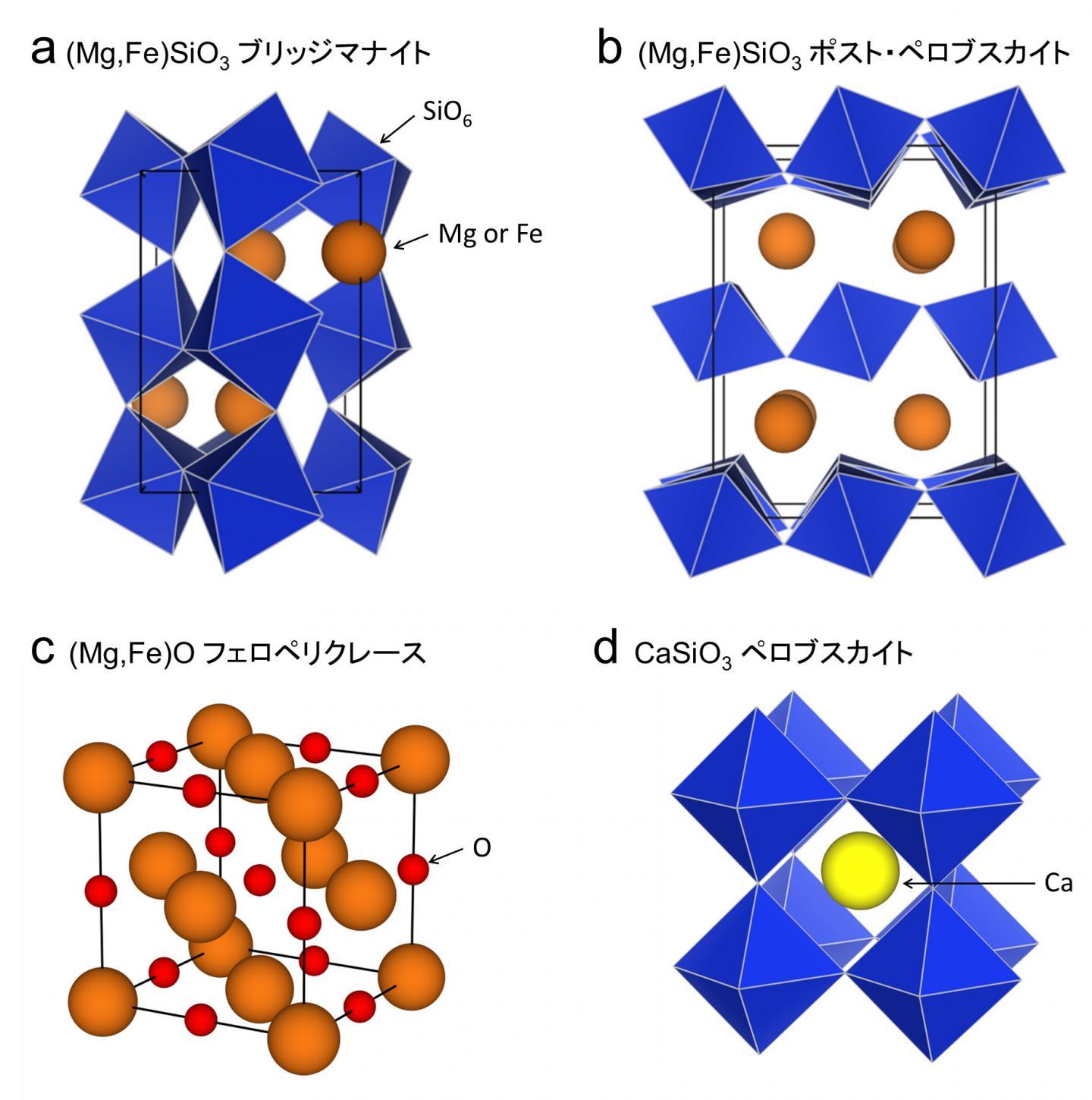
These calculations under in situ high-pressure (P) and high-temperature (T) conditions are of particular interest since they allow them to construct a priori mineralogical model of the deep Earth. In the present article, we briefly review our recent accomplishments in studying high-P phase relations, elasticity, thermal conductivity and rheological properties of major lower mantle silicate and oxide minerals including (Mg,Fe)SiO3 bridgmanite, its high-pressure form post-perovskite, CaSiO3 perovskite, (Mg,Fe)O ferropericlase, and some hydrous phases (AlOOH, MgSiO4H2, FeOOH). CAPTION Crystal structures of major mineral phases composing the Earth's deep mantle, (Mg,Fe)SiO3 bridgmanite (Brg), its high-pressure phase post-perovskite (PPv), CaSiO3 perovskite, and (Mg,Fe)O ferropericlase{module INSIDE STORY}

The analyses indicate that the pyrolitic composition can be used to describe the Earth's properties quite well in terms of all of the densities, and P and S wave velocity. Supercomputations also suggest some new hydrous compounds which could persist down to the deepest mantle and that the post-perovskite phase boundary is the boundary not only of the mineralogy but also of the thermal conductivity.

Russian scientist discovers why photons flying from other galaxies do not reach the Earth

Tyler O'Neal, Staff Editor EARTH SCIENCES December 4, 2019, 1:04 pm

An international group of scientists, including Andrey Savelyev, associate professor of the Institute of Physical and Mathematical Sciences and Information Technologies of the IKBFU, has improved a supercomputer program that helps simulate the behavior of photons when interacting with hydrogen spilled in intergalactic space. Work results were published in an educational journal.

"In the Universe, there are extragalactic objects such as blazars, which very intensively generate a powerful gamma-ray flux, part of photons from this stream reaches the Earth, as they say, directly, and part - are converted along the way into electrons, then again converted into photons and only then get to us. The problem here is that mathematical calculations say that a certain number of photons should reach the Earth, and in fact, it gets much less," said Savelyev.

Scientists, according to Savelyev, today have two versions of why this happens. The first is that a photon, after being converted into an electron (and this, as is known, in contrast to a neutral photon, a charged particle) falls into a magnetic field, deviates from its path and does not reach the Earth, even after being transformed again in the photon. {module INSIDE STORY}

The second version explains the behavior of particles flying to our planet not by their interaction with an electromagnetic field, but by contact with hydrogen "spilled" in the intergalactic space.

"Many people believe that space is completely empty and that there is nothing between the galaxies. In fact, there is a lot of hydrogen in a state of plasma, that is, in other words, very strongly heated hydrogen. And our report is about how particles interact with this plasma. There is a special [super]computer program that calculates models of particle behavior in intergalactic space. We can say that we improved this program by considering several possible options for the development of events in interaction with plasma".

Unfortunately, it is not yet possible to verify the calculations empirically, because people have not yet learned how to create extreme space conditions on Earth, but Savelyev is sure that someday this will become possible to some extent.

It is important to note that the results of the research, despite the fact that while they are what is called "pure science," can theoretically be applied in practice in the future.

Plasma, the fourth state of matter (in addition to gas, liquid and solid), is very difficult for research said Savelyev. At the same time, humanity has high hopes for it, as a source of cheap and very powerful energy. And our study is a small contribution to the collection of plasma knowledge. Perhaps they will be useful in developing effective nuclear fusion.

Page 23 of 23

  • 14
  • 15
  • 16
  • 17
  • 18
  • 19
  • 20
  • 21
  • 22
  • 23
POPULAR RIGHT NOW
  • AI supercharges the hunt for stronger magnets: Iowa State researchers launch a new era of intelligent materials discovery
    AI supercharges the hunt for stronger magnets: Iowa State researchers launch a new era of intelligent materials discovery
  • IBM's Historic stock collapse raises questions for the future of enterprise supercomputing
    IBM's Historic stock collapse raises questions for the future of enterprise supercomputing
  • Could a novel dark matter theory simultaneously resolve multiple cosmic enigmas? Supercomputer simulations provide a compelling, albeit currently unverified, potential solution
    Could a novel dark matter theory simultaneously resolve multiple cosmic enigmas? Supercomputer simulations provide a compelling, albeit currently unverified, potential solution
  • Melting icebergs may be reshaping Earth’s greatest ocean current
    Melting icebergs may be reshaping Earth’s greatest ocean current
  • Supercomputers replace ‘bathtub’ flood maps with physics-based digital twins of Britain’s coastline
    Supercomputers replace ‘bathtub’ flood maps with physics-based digital twins of Britain’s coastline
  • Supercomputers push neural quantum simulation beyond previous limits
    Supercomputers push neural quantum simulation beyond previous limits
  • Intel’s AI supercomputing revival: Q2 financial surge signals new era for CPU-powered HPC infrastructure
    Intel’s AI supercomputing revival: Q2 financial surge signals new era for CPU-powered HPC infrastructure
  • AI infrastructure financing fears shake semiconductor sector
    AI infrastructure financing fears shake semiconductor sector
  • AWS supercomputing investment reaches historic scale as Amazon’s AI strategy powers record financial results
    AWS supercomputing investment reaches historic scale as Amazon’s AI strategy powers record financial results
  • Catching the wave of the future: Supercomputers unlock the hidden dynamics of Venus
    Catching the wave of the future: Supercomputers unlock the hidden dynamics of Venus
THIS YEAR'S MOST READ
  • Wall Street wants to trade supercomputing power like oil
    Wall Street wants to trade supercomputing power like oil
  • Beamforming the future: BeammWave's 6G push signals the rise of orbital-terrestrial wireless networks
    Joakim Axmon
    Joakim Axmon
  • Cosmic ambition at scale: UK’s supercomputer unlocks a 2.5 petabytes universe
    Cosmic ambition at scale: UK’s supercomputer unlocks a 2.5 petabytes universe
  • Hidden order, revealed at scale: Supercomputing, electron ptychography uncover the inner workings of relaxor ferroelectrics
    Hidden order, revealed at scale: Supercomputing, electron ptychography uncover the inner workings of relaxor ferroelectrics
  • Intel's Q1 results signal supercomputing surge driving Xeon momentum
    Intel's Q1 results signal supercomputing surge driving Xeon momentum
  • When stars fall apart: Supercomputing reveals the hidden physics of black holes
    When stars fall apart: Supercomputing reveals the hidden physics of black holes
  • Multi-layer simulations reveal the hidden supply chain of solar prominences
    Multi-layer simulations reveal the hidden supply chain of solar prominences
  • Japanese scientists decode dolphin speed with supercomputing: Turbulence, vortices, and the hidden physics of propulsion
    Japanese scientists decode dolphin speed with supercomputing: Turbulence, vortices, and the hidden physics of propulsion
  • Cosmic feedback at scale: Supercomputing reveals how quasars regulate the early Universe
    Cosmic feedback at scale: Supercomputing reveals how quasars regulate the early Universe
  • Modeling life at the microscopic scale: A computational breakthrough in oxygen transport
    Modeling life at the microscopic scale: A computational breakthrough in oxygen transport
MOST READ OF ALL-TIME
  • Largest Computational Biology Simulation Mimics The Ribosome
    Details
    112127
    The amino acid (green) slithers into the chemical reaction center, moving through an evolutionarily ancient corridor of the ribosome (purple). The amino acid is delivered to the reaction core by the transfer RNA molecule (yellow).
    The amino acid (green) slithers into the chemical reaction center, moving through an evolutionarily ancient corridor of the ribosome (purple). The amino acid is delivered to the reaction core by the transfer RNA molecule (yellow).
  • Silicon 'neurons' may add a new dimension to chips
    Details
    81040
    Silicon 'neurons' may add a new dimension to chips
  • Linux Networx Accelerators Expected to Drive up to 4x Price/Performance
    Details
    75563
  • Complex Concepts That Really Add Up
    Details
    73693
    Complex Concepts That Really Add Up
  • Blue Sky Studios Donates Animation SuperComputer to Wesleyan
    Details
    68166
    Each rack holds 52 Angstrom Microsystem-brand “blades,” with a memory footprint of 12 or 24 gigabytes each. (Photos by Olivia Bartlett Drake)
    Each rack holds 52 Angstrom Microsystem-brand “blades,” with a memory footprint of 12 or 24 gigabytes each. (Photos by Olivia Bartlett Drake)
  • Humanities, HPC connect at NERSC
    Details
    57973
  • TeraGrid ’09 'Call for Participation'
    Details
    54976
  • Turbulence responsible for black holes' balancing act
    Details
    52339
  • Cray Wins $52 Million SuperComputer Contract
    Details
    50162
  • SDSC Researchers Accurately Predict Protein Docking
    Details
    46115
  • FRONTPAGE
  • LATEST
  • POPULAR
  • REGISTER
  • SOCIAL
  • VIDEO
  • SUBSCRIPTION
  • RSS
  • GUIDELINES
  • PRIVACY
  • TOS
  • ABOUT
  • +1 (816) 799-4488
  • editorial@supercomputingonline.com
© 2001 - 2026 SuperComputingOnline.com, LLC. All rights reserved. This material may not be published, broadcast, rewritten or redistributed without permission.
Sign In
  • FRONT PAGE
  • LATEST
    • MEDIA KIT
    • MOST READ
    • RSS FEED
    • ACADEMIA
    • AEROSPACE
    • APPLICATIONS
    • ASTRONOMY
    • AUTOMOTIVE
    • BIG DATA
    • BIOLOGY
    • CHEMISTRY
    • CLIENTS
    • CLOUD
    • DEFENSE
    • DEVELOPER TOOLS
    • EARTH SCIENCES
    • ECONOMICS
    • ENGINEERING
    • ENTERTAINMENT
    • HEALTH
    • INDUSTRY
    • INTERCONNECTS
    • GAMING
    • GOVERNMENT
    • MANUFACTURING
    • MIDDLEWARE
    • MOVIES
    • NETWORKS
    • OIL & GAS
    • PHYSICS
    • PROCESSORS
    • RETAIL
    • SCIENCE
    • STORAGE
    • SYSTEMS
    • VISUALIZATION
  • VIDEOS
    • ADD YOUR VIDEOS
    • MANAGE VIDEOS
  • COMMUNITY
    • TRADE SHOWS
    • SOCIAL NETWORK VIDEOS
    • SURVEYS
    • APPLICATIONS BROWSER
    • CONVERSATION INBOX
    • SOCIAL ADVERTISER
    • GROUPS
    • MARKETPLACE LISTINGS
    • PAGES
    • LEADERBOARD
    • POINTS LISTING
      • BADGES
    • PRIVACY CONFIRM REQUEST
    • PRIVACY CREATE REQUEST

Hey there! We noticed you’re using an ad blocker.