SUPERCOMPUTING NEWS SUPERCOMPUTING NEWS
    • MEDIA KIT
    • MOST READ
    • RSS FEED
    • ACADEMIA
    • AEROSPACE
    • APPLICATIONS
    • ASTRONOMY
    • AUTOMOTIVE
    • BIG DATA
    • BIOLOGY
    • CHEMISTRY
    • CLIENTS
    • CLOUD
    • DEFENSE
    • DEVELOPER TOOLS
    • EARTH SCIENCES
    • ECONOMICS
    • ENGINEERING
    • ENTERTAINMENT
    • GAMING
    • GOVERNMENT
    • HEALTH
    • OIL & GAS
    • INDUSTRY
    • INTERCONNECTS
    • MANUFACTURING
    • MIDDLEWARE
    • MOVIES
    • NETWORKS
    • PHYSICS
    • PROCESSORS
    • RETAIL
    • SCIENCE
    • STORAGE
    • SYSTEMS
    • VISUALIZATION
    • AcyMailing subscription form

    • ADD YOUR VIDEOS
    • MANAGE VIDEOS
    • CONVERSATION INBOX
    • SOCIAL ADVERTISER
    • SOCIAL NETWORK VIDEOS
    • SURVEYS
    • GROUPS
    • PAGES
    • MARKETPLACE LISTINGS
    • APPLICATIONS BROWSER
    • PRIVACY CONFIRM REQUEST
    • PRIVACY CREATE REQUEST
    • LEADERBOARD
    • POINTS LISTING
      • BADGES
    • TRADE SHOWS
Sign In
Tyler O'Neal, Staff Editor ECONOMICS June 29, 2021, 7:00 am

eROSITA magneticum simulations show how the matter highway in space makes galaxy clusters grow

Six months ago, astronomers at the University of Bonn reported the discovery of an extremely long intergalactic gas filament with the X-ray telescope eROSITA. A new study has now focused on an interesting structure in the filament, the northern clump. Their new observational data prove that this is a cluster of galaxies with a black hole at its center. Therefore, the gas filament is a galactic matter highway: The northern clump is moving along it towards two more giant galaxy clusters and will eventually merge with them. The paper will be published in the journal Astronomy & Astrophysics, along with other papers published on the occasion of the first eROSITA data release.

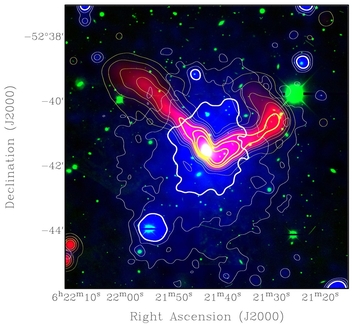
The universe resembles a Swiss cheese - but one with huge holes: Large areas in space are absolutely empty. In between, thousands of galaxies crowd in a comparatively small space. These clusters are connected by highways of thin matter gas, like the gossamer filaments of a spider's web. The northern clump - as it appears in X-rays (blue, XMM-Newton satellite), in visual light (green, DECam), and at radio wavelengths (red, ASKAP/EMU).
At least, this is what the standard model of cosmology predicts. Whether this is actually the case was hard to prove until recently. This is because the matter in the gas filaments is so diluted that it eluded the view of even the most sensitive measuring instruments: The filaments contain just ten particles per cubic meter, which is far fewer than are present in the best vacuum that humans can produce.

This is why a study led by the University of Bonn in Germany caused such a stir last winter. The researchers had discovered an intergalactic gas filament measuring at least 50 million light-years in length that emanates from two giant galaxy clusters. "There is another galaxy cluster in this filament, the northern clump," explains Prof. Dr. Thomas Reiprich of the Argelander Institute for Astronomy at the University of Bonn. "In the paper now submitted for publication, we have taken a closer look at this."

Bow shock and matter tail

To do this, the researchers combined images from several sources: the SRG/eROSITA, XMM-Newton, and Chandra satellites, as well as the EMU survey with the ASKAP radio telescope and DECam optical data. The resulting images have a richness of detail never seen before. "This allows us to identify a large galaxy at the center of the northern clump," says Reiprich's colleague and lead author of the study, Angie Veronica. "And at its center sits a supermassive black hole." Two so-called matter jets emanate from it, in which the particles move away from the black hole at close to the speed of light. This produces synchrotron radiation, which can be visualized in radio telescope images.

In addition, the northern clump contains very hot matter gas. "Because of its high temperature of 20 million degrees, it emits X-rays, which we see in the eROSITA images and have now been able to measure very precisely with the XMM-Newton satellite," says Veronica. Overall, the combination of data sources indicates that the northern clump is likely moving at high velocity. The jets of matter emanating from the black hole point backward like the braids of a running girl; in front of the clump, the gas additionally seems to form a kind of bow shock. "We also see a matter tail behind it," Reiprich explains. "We currently interpret this observation to mean that the northern clump is losing matter as it travels. However, it could also be the case that even smaller clumps of matter in the highway are falling towards the northern clump."

Overall, the observations confirm the view derived from theories that the gas filament is an intergalactic matter highway. The northern clump is moving along this road at high speed toward two other much larger clusters of galaxies called Abell 3391 and Abell 3395. "It falls on these piles, so to speak, and will continue to make them bigger - according to the principle: Whoever has will be given more," explains Reiprich, who is also a member of the transdisciplinary research area "Building Blocks of Matter" at the University of Bonn. "What we're seeing is a snapshot of this fall."

Observations consistent with theoretical predictions

The observations are remarkably consistent with the result of the Magneticum supercomputer simulations developed by researchers of the eROSITA consortium. Therefore, they can also be taken as an argument that the current assumptions about the origin and evolution of the universe are correct. This includes the thesis that a large part of the matter is invisible to our measuring instruments. 85 percent of the matter in our universe is said to consist of this "dark matter". One of its most important roles in the standard model of cosmology is as a condensation nucleus, which caused gaseous matter to condense into galaxies after the Big Bang.

RAMBO speeds searches on massive DNA databases

Tyler O'Neal, Staff Editor ECONOMICS June 28, 2021, 5:00 pm

Rice method cuts indexing times from weeks to hours, search times from hours to minutes

Rice University computer scientists are sending RAMBO to rescue genomic researchers who sometimes wait days or weeks for search results from enormous DNA databases.

DNA sequencing is so popular, genomic datasets are doubling in size every two years, and the tools to search the data haven't kept pace. Researchers who compare DNA across genomes or study the evolution of organisms like the virus that causes COVID-19 often wait weeks for software to index large, "metagenomic" databases, which get bigger every month and are now measured in petabytes.

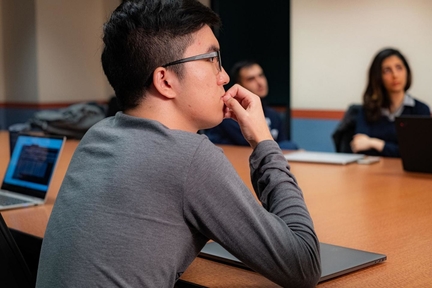
RAMBO, which is short for "repeated and merged bloom filter," is a new method that can cut indexing times for such databases from weeks to hours and search times from hours to seconds. Gaurav Gupta is a Ph.D. student in electrical and computer engineering at Rice University.

"Querying millions of DNA sequences against a large database with traditional approaches can take several hours on a large compute cluster and can take several weeks on a single server," said RAMBO co-creator Todd Treangen, a Rice computer scientist whose lab specializes in metagenomics. "Reducing database indexing times, in addition to query times, is crucially important as the size of genomic databases are continuing to grow at an incredible pace."

To solve the problem, Treangen teamed with Rice computer scientist Anshumali Shrivastava, who specializes in creating algorithms that make big data and machine learning faster and more scalable, and graduate students Gaurav Gupta and Minghao Yan, co-lead authors.

RAMBO uses a data structure that has a significantly faster query time than state-of-the-art genome indexing methods as well as other advantages like ease of parallelization, a zero false-negative rate, and a low false-positive rate.

"The search time of RAMBO is up to 35 times faster than existing methods," said Gupta, a doctoral student in electrical and computer engineering. In experiments using a 170-terabyte dataset of microbial genomes, Gupta said RAMBO reduced indexing times from "six weeks on a sophisticated, dedicated cluster to nine hours on a shared commodity cluster."

Yan, a master's student in computer science, said, "On this huge archive, RAMBO can search for a gene sequence in a couple of milliseconds, even sub-milliseconds using a standard server of 100 machines." Minghao Yan is a Ph.D. student in computer science at Rice University.

RAMBO improves on the performance of Bloom filters, a half-century-old search technique that has been applied to genomic sequence search in several previous studies. RAMBO improves on earlier Bloom filter methods for genomic search by employing a probabilistic data structure known as a count-min sketch that "leads to a better query time and memory trade-off" than earlier methods, and "beats the current baselines by achieving a very robust, low-memory and ultrafast indexing data structure," the authors wrote in the study.

Gupta and Yan said RAMBO has the potential to democratize genomic search by making it possible for almost any lab to quickly and inexpensively search huge genomic archives with off-the-shelf computers.

"RAMBO could decrease the wait time for tons of investigations in bioinformatics, such as searching for the presence of SARS-CoV-2 in wastewater metagenomes across the globe," Yan said. "RAMBO could become instrumental in the study of cancer genomics and bacterial genome evolution, for example."

UVA prof Zhigilei visits top public research university in Germany

Tyler O'Neal, Staff Editor ECONOMICS June 28, 2021, 8:00 am

His world is picoseconds, trillionths of seconds; too short for any atomically resolved experiments: Professor Leonid Zhigilei is a materials scientist at the University of Virginia (USA). He was awarded the Humboldt Research Award for his calculations on the production of nanoparticles and will be spending his associated research stay in Technical Chemistry I at the University of Duisburg-Essen (UDE) in Germany. The focus will be on materials for catalysis.

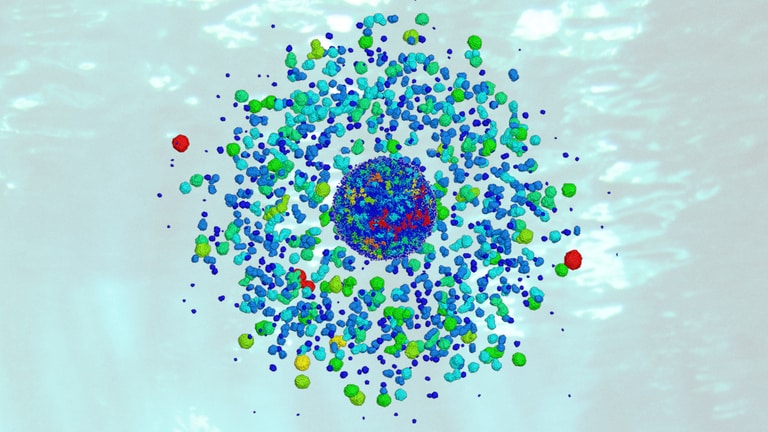
Catalysts make our high standard of living possible, and the "Energiewende" would be inconceivable without them: They are essential in fuel cells, enable the green production of hydrogen, and also its conversion into storable chemicals as an energy reservoir. For this purpose, catalysts have so-called "active sites": millions of tiny pores in the material into which precursors migrate. There, they convert into a product of interest – without a catalyst, this would happen more slowly, with more energy input, or simply not at all. Therefore, the active sites must be easily accessible and not blocked by foreign molecules. Graphical representation of a bursting gold nanoparticle excited by ultrafast laser. The colors reflect the sizes of the resulting fragments: approx. 3 nm (red), approx. 1 nm (blue). © Zhigilei

Such pure nanoparticles for catalyst materials can be produced by high-energy laser pulses, as the team of Technical Chemistry I at UDE does. To further understand these processes and improve them accordingly, it is necessary to study the individual steps – but that is not possible even with high-tech methods in experiments; they just happen too quickly.

Leonid Zhigilei, on the other hand, uses supercomputers to simulate these steps with atomic resolution and calculates the ultrashort time scales: "We design theory and experiment together. That way, my simulations can show both dead ends and promising changes in advance."

Zhigilei is already cooperating with the Technical Chemistry I team led by Professor Stephan Barcikowski. As soon as the situation will allow, he is going to spend a longer period of time as a guest in the working group. "We do research in different fields, and that's exactly why our collaboration is so fruitful," says Zhigilei, explaining his decision to come to UDE after receiving the Humboldt Research Award. "We ask each other questions that the other would not have thought of."

The Humboldt Research Award is granted to leading researchers from all disciplines outside Germany. It recognizes their accomplishments and enables them to spend several months researching an academic institution in Germany.

  1. American, Japanese team's folding simulations solve a puzzle to design larger proteins
  2. Physicist Jean Dalibard awarded the 2021 CNRS Gold Medal

Page 7 of 16

  • 2
  • 3
  • 4
  • 5
  • 6
  • 7
  • 8
  • 9
  • 10
  • 11
POPULAR RIGHT NOW
  • Supercomputers uncover a new class of cosmic explosions hidden in plain sight
    Supercomputers uncover a new class of cosmic explosions hidden in plain sight
  • AI supercharges the hunt for stronger magnets: Iowa State researchers launch a new era of intelligent materials discovery
    AI supercharges the hunt for stronger magnets: Iowa State researchers launch a new era of intelligent materials discovery
  • IBM's Historic stock collapse raises questions for the future of enterprise supercomputing
    IBM's Historic stock collapse raises questions for the future of enterprise supercomputing
  • Could a novel dark matter theory simultaneously resolve multiple cosmic enigmas? Supercomputer simulations provide a compelling, albeit currently unverified, potential solution
    Could a novel dark matter theory simultaneously resolve multiple cosmic enigmas? Supercomputer simulations provide a compelling, albeit currently unverified, potential solution
  • Melting icebergs may be reshaping Earth’s greatest ocean current
    Melting icebergs may be reshaping Earth’s greatest ocean current
  • Supercomputers replace ‘bathtub’ flood maps with physics-based digital twins of Britain’s coastline
    Supercomputers replace ‘bathtub’ flood maps with physics-based digital twins of Britain’s coastline
  • Supercomputers push neural quantum simulation beyond previous limits
    Supercomputers push neural quantum simulation beyond previous limits
  • Intel’s AI supercomputing revival: Q2 financial surge signals new era for CPU-powered HPC infrastructure
    Intel’s AI supercomputing revival: Q2 financial surge signals new era for CPU-powered HPC infrastructure
  • AI infrastructure financing fears shake semiconductor sector
    AI infrastructure financing fears shake semiconductor sector
  • AWS supercomputing investment reaches historic scale as Amazon’s AI strategy powers record financial results
    AWS supercomputing investment reaches historic scale as Amazon’s AI strategy powers record financial results
THIS YEAR'S MOST READ
  • Wall Street wants to trade supercomputing power like oil
    Wall Street wants to trade supercomputing power like oil
  • Cosmic ambition at scale: UK’s supercomputer unlocks a 2.5 petabytes universe
    Cosmic ambition at scale: UK’s supercomputer unlocks a 2.5 petabytes universe
  • Hidden order, revealed at scale: Supercomputing, electron ptychography uncover the inner workings of relaxor ferroelectrics
    Hidden order, revealed at scale: Supercomputing, electron ptychography uncover the inner workings of relaxor ferroelectrics
  • Beamforming the future: BeammWave's 6G push signals the rise of orbital-terrestrial wireless networks
    Joakim Axmon
    Joakim Axmon
  • Intel's Q1 results signal supercomputing surge driving Xeon momentum
    Intel's Q1 results signal supercomputing surge driving Xeon momentum
  • When stars fall apart: Supercomputing reveals the hidden physics of black holes
    When stars fall apart: Supercomputing reveals the hidden physics of black holes
  • Multi-layer simulations reveal the hidden supply chain of solar prominences
    Multi-layer simulations reveal the hidden supply chain of solar prominences
  • Japanese scientists decode dolphin speed with supercomputing: Turbulence, vortices, and the hidden physics of propulsion
    Japanese scientists decode dolphin speed with supercomputing: Turbulence, vortices, and the hidden physics of propulsion
  • Cosmic feedback at scale: Supercomputing reveals how quasars regulate the early Universe
    Cosmic feedback at scale: Supercomputing reveals how quasars regulate the early Universe
  • Modeling life at the microscopic scale: A computational breakthrough in oxygen transport
    Modeling life at the microscopic scale: A computational breakthrough in oxygen transport
MOST READ OF ALL-TIME
  • Largest Computational Biology Simulation Mimics The Ribosome
    Details
    112107
    The amino acid (green) slithers into the chemical reaction center, moving through an evolutionarily ancient corridor of the ribosome (purple). The amino acid is delivered to the reaction core by the transfer RNA molecule (yellow).
    The amino acid (green) slithers into the chemical reaction center, moving through an evolutionarily ancient corridor of the ribosome (purple). The amino acid is delivered to the reaction core by the transfer RNA molecule (yellow).
  • Silicon 'neurons' may add a new dimension to chips
    Details
    80990
    Silicon 'neurons' may add a new dimension to chips
  • Linux Networx Accelerators Expected to Drive up to 4x Price/Performance
    Details
    75537
  • Complex Concepts That Really Add Up
    Details
    73635
    Complex Concepts That Really Add Up
  • Blue Sky Studios Donates Animation SuperComputer to Wesleyan
    Details
    68140
    Each rack holds 52 Angstrom Microsystem-brand “blades,” with a memory footprint of 12 or 24 gigabytes each. (Photos by Olivia Bartlett Drake)
    Each rack holds 52 Angstrom Microsystem-brand “blades,” with a memory footprint of 12 or 24 gigabytes each. (Photos by Olivia Bartlett Drake)
  • Humanities, HPC connect at NERSC
    Details
    57945
  • TeraGrid ’09 'Call for Participation'
    Details
    54951
  • Turbulence responsible for black holes' balancing act
    Details
    52310
  • Cray Wins $52 Million SuperComputer Contract
    Details
    50139
  • SDSC Researchers Accurately Predict Protein Docking
    Details
    46078
  • FRONTPAGE
  • LATEST
  • POPULAR
  • REGISTER
  • SOCIAL
  • VIDEO
  • SUBSCRIPTION
  • RSS
  • GUIDELINES
  • PRIVACY
  • TOS
  • ABOUT
  • +1 (816) 799-4488
  • editorial@supercomputingonline.com
© 2001 - 2026 SuperComputingOnline.com, LLC. All rights reserved. This material may not be published, broadcast, rewritten or redistributed without permission.
Sign In
  • FRONT PAGE
  • LATEST
    • MEDIA KIT
    • MOST READ
    • RSS FEED
    • ACADEMIA
    • AEROSPACE
    • APPLICATIONS
    • ASTRONOMY
    • AUTOMOTIVE
    • BIG DATA
    • BIOLOGY
    • CHEMISTRY
    • CLIENTS
    • CLOUD
    • DEFENSE
    • DEVELOPER TOOLS
    • EARTH SCIENCES
    • ECONOMICS
    • ENGINEERING
    • ENTERTAINMENT
    • HEALTH
    • INDUSTRY
    • INTERCONNECTS
    • GAMING
    • GOVERNMENT
    • MANUFACTURING
    • MIDDLEWARE
    • MOVIES
    • NETWORKS
    • OIL & GAS
    • PHYSICS
    • PROCESSORS
    • RETAIL
    • SCIENCE
    • STORAGE
    • SYSTEMS
    • VISUALIZATION
  • VIDEOS
    • ADD YOUR VIDEOS
    • MANAGE VIDEOS
  • COMMUNITY
    • TRADE SHOWS
    • SOCIAL NETWORK VIDEOS
    • SURVEYS
    • APPLICATIONS BROWSER
    • CONVERSATION INBOX
    • SOCIAL ADVERTISER
    • GROUPS
    • MARKETPLACE LISTINGS
    • PAGES
    • LEADERBOARD
    • POINTS LISTING
      • BADGES
    • PRIVACY CONFIRM REQUEST
    • PRIVACY CREATE REQUEST

Hey there! We noticed you’re using an ad blocker.