

SUPERCOMPUTING NEWS SUPERCOMPUTING NEWS
    • MEDIA KIT
    • MOST READ
    • RSS FEED
    • ACADEMIA
    • AEROSPACE
    • APPLICATIONS
    • ASTRONOMY
    • AUTOMOTIVE
    • BIG DATA
    • BIOLOGY
    • CHEMISTRY
    • CLIENTS
    • CLOUD
    • DEFENSE
    • DEVELOPER TOOLS
    • EARTH SCIENCES
    • ECONOMICS
    • ENGINEERING
    • ENTERTAINMENT
    • GAMING
    • GOVERNMENT
    • HEALTH
    • OIL & GAS
    • INDUSTRY
    • INTERCONNECTS
    • MANUFACTURING
    • MIDDLEWARE
    • MOVIES
    • NETWORKS
    • PHYSICS
    • PROCESSORS
    • RETAIL
    • SCIENCE
    • STORAGE
    • SYSTEMS
    • VISUALIZATION
    • AcyMailing subscription form

    • ADD YOUR VIDEOS
    • MANAGE VIDEOS
    • CONVERSATION INBOX
    • SOCIAL ADVERTISER
    • SOCIAL NETWORK VIDEOS
    • SURVEYS
    • GROUPS
    • PAGES
    • MARKETPLACE LISTINGS
    • APPLICATIONS BROWSER
    • PRIVACY CONFIRM REQUEST
    • PRIVACY CREATE REQUEST
    • LEADERBOARD
    • POINTS LISTING
      • BADGES
    • TRADE SHOWS
Sign In
Tyler O'Neal, Staff Editor GOVERNMENT July 4, 2019, 1:38 pm

Swiss researchers use artificial intelligence to establish molecular tumor classification, prognosis in patients with colorectal cancer

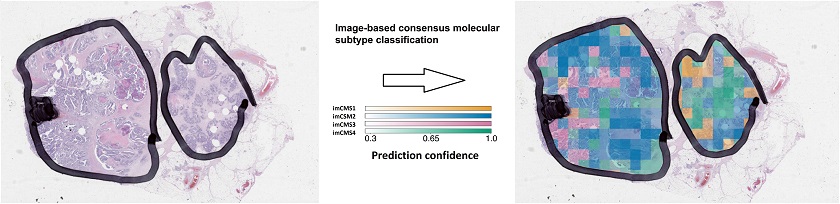
Treating physicians need information about the molecular subtype of the tumor if they are to provide targeted therapy for colorectal carcinoma. A research team from University Hospital Zurich and the University of Oxford have now developed a method to predict the molecular classification of colorectal cancer from digital pathology slides.

Colorectal cancer is the third most common malignant tumor in men and women with approximately 1.8 million new cases globally per year, including around 4,000 in Switzerland. Surgery, radiation and chemotherapy as well as precision therapeutics are the established treatment options, but are associated with relevant side effects. Precise information about the molecular subtype of the tumor using RNA sequencing can support patient stratification for personalized therapy. Yet cancer classification through RNA sequencing remains a resource-intensive, costly process: examining a single sample costs over CHF 1,000. Further, up to 20 percent of samples cannot be conclusively classified due to insufficient availability of material or ambiguous results. The image-based consensus molecular subtypes (imCMS) model can be used to predict the molecular classification of each individual image region in patient tumor samples. This process takes just a few minutes and requires no further patient material.{module In-article}
Research advances through image analysis and artificial intelligence
A research team led by Prof. Viktor Kölzer, Institute of Pathology and Molecular Pathology at University Hospital Zurich (UHZ), and Prof. Jens Rittscher, Institute of Biomedical Engineering at the University of Oxford, have now developed a much cheaper, faster method: they use artificial intelligence to analyze high-resolution images of histological slides. This allows the subclassification of colorectal tumors into one of four distinct transcriptional subtypes and gives an indication of optimal treatment strategies. Unlike RNA sequencing, which has been the gold standard thus far, this purely image-based procedure does not require any additional tissue material. It works even with very small tissue fragments and makes it possible to classify tissue samples that were previously inaccessible due to the technical limitations. The procedure also has the potential to lower costs considerably. Image-based procedures could therefore potentially revolutionize personalized therapy in colorectal cancer. Yet in order to use the new technology, the histological slides need to be appropriately prepared: “to use artificial intelligence for tumor analysis in daily diagnostic practice, we need to digitize pathology workflows,” says Prof. Kölzer.

Strategic importance for personalized medicine
In April this year, Prof. Kölzer accepted the post of Assistant Professor in Digital Pathology at UHZ. This professorship is the first of its kind in Switzerland with strategic importance for personalized medicine. Prof. Kölzer initialized this project on AI-supported cancer classification during his time at the University of Oxford, in a strong interdisciplinary collaboration with the pathologists, bioinformaticians, clinicians and statisticians of the multi-institutional Stratification in COloRecTal Cancer (S-CORT) Consortium. The study involved the analysis of 1,553 digital tissue slides with data on RNA expression, gene mutations and clinical progression using the latest machine vision and artificial intelligence technologies. This new technology was first published as a preprint in late May 2019 and is recommended for validation in prospective, randomized clinical trials. According to Prof. Kölzer, “After validation, we will be able to centralize the classification of colorectal tumors and release the technology for use.” Scans of histological slides could be sent to university centers, where they would be evaluated and the results returned electronically. In the long term, the method could also be used for other tumor types or even other diseases. Prof. Maughan, leader of the S:CORT consortium comments: “this research shows that, with the help of computer analysis, it is possible to detect complex biological patterns from the way the cancer looks under the microscope using routine ways to prepare tissue slides. This has great potential for providing information on how the cancer will behave in the individual and use this in the future to guide treatment decisions”.

UK astronomers help wage war on cancer using supercomputer models

Tyler O'Neal, Staff Editor GOVERNMENT July 3, 2019, 3:38 pm

Techniques developed by astronomers could help in the fight against breast and skin cancer. Charlie Jeynes at the University of Exeter will present his and Prof Tim Harries team's work today (3 July) at the RAS National Astronomy Meeting (NAM 2019) at the University of Lancaster.

A large part of astronomy depends on the detection and analysis of light. For example, scientists study the light scattered, absorbed and re-emitted in clouds of gas and dust, obtaining information on their interior.

Despite the vast differences in scale, the processes that light undergoes when travelling through the human body are very similar to those seen in space. And when things go wrong - when tissue becomes cancerous - that change should show up.

In the UK, nearly 60,000 women are diagnosed with breast cancer each year, and 12,000 die. Early diagnosis is key, with 90% of women diagnosed at the earliest stage surviving for at least five years, compared to 15% for women diagnosed with the most advanced stage. {module In-article}A computer model showing light following complex paths as it passes through tissue. Credit: Tim Harries
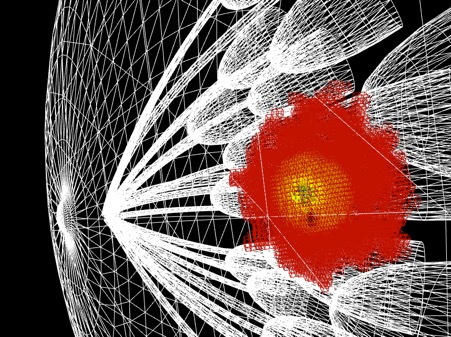
Cancer creates tiny deposits of calcium in breasts, detected through a shift in the wavelength of light as it passes through the tissue. The Exeter team realised that the supercomputer codes developed to study the formation of stars and planets could be applied to find these deposits.

Charlie commented: "Light is fundamental to a diverse range of medical advances, like measuring blood oxygenation in premature babies, or treating port-wine stains with lasers. So there is a natural connection with astronomy, and we're delighted to use our work to take on cancer."

Working with biomedical scientist Nick Stone, also at Exeter, the team are refining supercomputer models to better understand how detected light is affected by human tissue. They eventually expect to develop a rapid diagnostic test that avoids unnecessary biopsies, improving the prospects for survival for thousands of women. Work is already underway with clinicians at Exeter's RD&E hospital to pilot the technology and pave the way for larger clinical trials

In a second project, the Exeter team are using supercomputer models for a potential new treatment for non-melanoma skin cancer (NMSC). This is the most common type of cancer, with more than 80,000 cases reported in England each year. NMSC is expected to cost the NHS £180 million a year by 2020, a figure set to rise as the disease becomes more prevalent.

In a partnership with Alison Curnow of the University of Exeter Medical School, the scientists are using their code to develop a simulated 'virtual laboratory' for studying skin cancer treatment. The two-pronged attack looks at light-activated drugs (photodynamic therapy) and light-heated nanoparticles (photothermal therapy).

The simulation looks at how gold nanoparticles in a virtual skin tumour are heated by exposure to near-infrared light. After 1 second of irradiation, the tumour heats up by 3 degrees Celsius. After 10 minutes, the same tumour is heated by 20 degrees - enough to kill its cells. So far, photothermal therapy with nanoparticles has been effective in rats, but with the team's code to narrow down experimental conditions, they are working towards translating the technology for humans.

Charlie said: "Advances in fundamental science should never be seen in isolation. Astronomy is no exception, and though impossible to predict at the outset, its discoveries and techniques often benefit society. Our work is a great example of that, and I'm really proud that we're helping our medical colleagues wage war on cancer."

The next steps include using 3D- rendered models taken from images of real tumours, and simulating how these would respond to different treatment regimes. Data exists on how these tumours responded to treatment, which gives excellent 'ground truth' data against which to compare the models. In this way the team will be able to predict whether different types of treatment would be more effective for a particular tumour type, and enable clinicians to have more options when it comes to choosing a treatment plan.

NYU Tandon alumnus Erol Gelenbe decreed a Commander of the National Order of Merit of France

Tyler O'Neal, Staff Editor GOVERNMENT July 3, 2019, 3:16 pm

Class of 1968 graduate honored for track record as researcher, educator, and technology innovator

New York University Tandon School of Engineering alumus and noted computer scientist Erol Gelenbe ('68) today will be awarded the insignia of Commandeur de l'Ordre National du Merite (Commander of the National Order of Merit) of France by the decree of President Emanuel Macron, for services to higher education and research.

Since graduating from NYU Tandon (at the time Polytechnical Institute of Brooklyn) with master's and doctoral degrees in the field of computer science, Gelenbe has been celebrated for his pioneering work in computer systems and networks. He designed and patented the world's first packet-voice telephone switch some 20 years before Skype came into existence and designed and built the first random access Local Area Network that uses fiber optics connections some years before Ethernet became a de facto standard. Other fundamental contributions include his development of mathematical models known as G(elenbe)-networks for the analysis and optimization of communication networks with widespread applications like traffic re-routing and network optimization, the invention of the Random Neural Network with applications in deep learning, and adaptive network routing and anomaly detection both in networks and brain scans. New York University Tandon School of Engineering alumus and noted computer scientist Erol Gelenbe (’68) today will be awarded the insignia of Commandeur de l’Ordre National du Merite (Commander of the National Order of Merit) of France by the decree of President Emanuel Macron, for services to higher education and research.{module In-article}

Gelenbe – who founded and directed the Modeling and Performance Evaluation of Computer Systems research group at the renowned INRIA research institution in France – is now a professor in the Department of Electrical and Electronic Engineering at Imperial College, London. His many laurels include the insignia of Chevalier de la Légion d'Honneur (Knight of the Legion of Honor) from the French government, the Prix France-Telecom from the French Academy of Science (as the first computer scientist to garner the prize); the Association for Computer Machinery's (ACM) special interest group in performance evaluation's SIGMETRICS Achievement Award; the Mustafa Prize in Information and Communication Science and Technologies; the Oliver Lodge Medal from London's Institution of Engineering and Technology (IET); the Dennis Gabor Prize from the Hungarian Academy of Sciences; the Institute of Electrical and Electronics Engineers (IEEE) Meritorious Service Award and Computer Society Meritorious Service Award, and fellowships in the IEEE, ACM, and IET. Additionally, he is a Knight Commander of the Order of the Star of Italy and a Commander of Merit of the Republic of Italy, as well as a member of the Royal Academy of Sciences, Arts and Letters of Belgium; Polish Academy of Sciences; Hungarian Academy of Sciences; Turkish Academy of Sciences; National Academy of Technologies of France; and Academia Europaea, among others.

"We are proud to count Erol Gelenbe as an alumnus and congratulate him on this well-deserved honor from the government of France," said Associate Dean for Communications and Public Affairs Sayar Lonial. "His scientific rigor and many contributions to his field stand as examples to our current students, who will, I'm sure, be inspired to emulate him."

Gelenbe will be presented with the Commander of the National Order of Merit of France by French Minister of Higher Education, Research and Innovation Frédérique Vidal. 

  1. Keck Cosmic Web Imager data results in new cold-flow inspiral model of spiraling filaments feeding young galaxies
  2. Japanese researchers teleport information within a diamond

Page 83 of 85

  • 76
  • 77
  • 78
  • 79
  • 80
  • 81
  • 82
  • 83
  • 84
  • 85
POPULAR RIGHT NOW
  • AI supercharges the hunt for stronger magnets: Iowa State researchers launch a new era of intelligent materials discovery
    AI supercharges the hunt for stronger magnets: Iowa State researchers launch a new era of intelligent materials discovery
  • IBM's Historic stock collapse raises questions for the future of enterprise supercomputing
    IBM's Historic stock collapse raises questions for the future of enterprise supercomputing
  • Could a novel dark matter theory simultaneously resolve multiple cosmic enigmas? Supercomputer simulations provide a compelling, albeit currently unverified, potential solution
    Could a novel dark matter theory simultaneously resolve multiple cosmic enigmas? Supercomputer simulations provide a compelling, albeit currently unverified, potential solution
  • Melting icebergs may be reshaping Earth’s greatest ocean current
    Melting icebergs may be reshaping Earth’s greatest ocean current
  • Supercomputers replace ‘bathtub’ flood maps with physics-based digital twins of Britain’s coastline
    Supercomputers replace ‘bathtub’ flood maps with physics-based digital twins of Britain’s coastline
  • Supercomputers push neural quantum simulation beyond previous limits
    Supercomputers push neural quantum simulation beyond previous limits
  • Intel’s AI supercomputing revival: Q2 financial surge signals new era for CPU-powered HPC infrastructure
    Intel’s AI supercomputing revival: Q2 financial surge signals new era for CPU-powered HPC infrastructure
  • AI infrastructure financing fears shake semiconductor sector
    AI infrastructure financing fears shake semiconductor sector
  • AWS supercomputing investment reaches historic scale as Amazon’s AI strategy powers record financial results
    AWS supercomputing investment reaches historic scale as Amazon’s AI strategy powers record financial results
  • Catching the wave of the future: Supercomputers unlock the hidden dynamics of Venus
    Catching the wave of the future: Supercomputers unlock the hidden dynamics of Venus
THIS YEAR'S MOST READ
  • Wall Street wants to trade supercomputing power like oil
    Wall Street wants to trade supercomputing power like oil
  • Beamforming the future: BeammWave's 6G push signals the rise of orbital-terrestrial wireless networks
    Joakim Axmon
    Joakim Axmon
  • Cosmic ambition at scale: UK’s supercomputer unlocks a 2.5 petabytes universe
    Cosmic ambition at scale: UK’s supercomputer unlocks a 2.5 petabytes universe
  • Hidden order, revealed at scale: Supercomputing, electron ptychography uncover the inner workings of relaxor ferroelectrics
    Hidden order, revealed at scale: Supercomputing, electron ptychography uncover the inner workings of relaxor ferroelectrics
  • Intel's Q1 results signal supercomputing surge driving Xeon momentum
    Intel's Q1 results signal supercomputing surge driving Xeon momentum
  • When stars fall apart: Supercomputing reveals the hidden physics of black holes
    When stars fall apart: Supercomputing reveals the hidden physics of black holes
  • Multi-layer simulations reveal the hidden supply chain of solar prominences
    Multi-layer simulations reveal the hidden supply chain of solar prominences
  • Japanese scientists decode dolphin speed with supercomputing: Turbulence, vortices, and the hidden physics of propulsion
    Japanese scientists decode dolphin speed with supercomputing: Turbulence, vortices, and the hidden physics of propulsion
  • Cosmic feedback at scale: Supercomputing reveals how quasars regulate the early Universe
    Cosmic feedback at scale: Supercomputing reveals how quasars regulate the early Universe
  • Modeling life at the microscopic scale: A computational breakthrough in oxygen transport
    Modeling life at the microscopic scale: A computational breakthrough in oxygen transport
MOST READ OF ALL-TIME
  • Largest Computational Biology Simulation Mimics The Ribosome
    Details
    112127
    The amino acid (green) slithers into the chemical reaction center, moving through an evolutionarily ancient corridor of the ribosome (purple). The amino acid is delivered to the reaction core by the transfer RNA molecule (yellow).
    The amino acid (green) slithers into the chemical reaction center, moving through an evolutionarily ancient corridor of the ribosome (purple). The amino acid is delivered to the reaction core by the transfer RNA molecule (yellow).
  • Silicon 'neurons' may add a new dimension to chips
    Details
    81040
    Silicon 'neurons' may add a new dimension to chips
  • Linux Networx Accelerators Expected to Drive up to 4x Price/Performance
    Details
    75563
  • Complex Concepts That Really Add Up
    Details
    73693
    Complex Concepts That Really Add Up
  • Blue Sky Studios Donates Animation SuperComputer to Wesleyan
    Details
    68166
    Each rack holds 52 Angstrom Microsystem-brand “blades,” with a memory footprint of 12 or 24 gigabytes each. (Photos by Olivia Bartlett Drake)
    Each rack holds 52 Angstrom Microsystem-brand “blades,” with a memory footprint of 12 or 24 gigabytes each. (Photos by Olivia Bartlett Drake)
  • Humanities, HPC connect at NERSC
    Details
    57973
  • TeraGrid ’09 'Call for Participation'
    Details
    54976
  • Turbulence responsible for black holes' balancing act
    Details
    52339
  • Cray Wins $52 Million SuperComputer Contract
    Details
    50162
  • SDSC Researchers Accurately Predict Protein Docking
    Details
    46115
  • FRONTPAGE
  • LATEST
  • POPULAR
  • REGISTER
  • SOCIAL
  • VIDEO
  • SUBSCRIPTION
  • RSS
  • GUIDELINES
  • PRIVACY
  • TOS
  • ABOUT
  • +1 (816) 799-4488
  • editorial@supercomputingonline.com
© 2001 - 2026 SuperComputingOnline.com, LLC. All rights reserved. This material may not be published, broadcast, rewritten or redistributed without permission.
Sign In
  • FRONT PAGE
  • LATEST
    • MEDIA KIT
    • MOST READ
    • RSS FEED
    • ACADEMIA
    • AEROSPACE
    • APPLICATIONS
    • ASTRONOMY
    • AUTOMOTIVE
    • BIG DATA
    • BIOLOGY
    • CHEMISTRY
    • CLIENTS
    • CLOUD
    • DEFENSE
    • DEVELOPER TOOLS
    • EARTH SCIENCES
    • ECONOMICS
    • ENGINEERING
    • ENTERTAINMENT
    • HEALTH
    • INDUSTRY
    • INTERCONNECTS
    • GAMING
    • GOVERNMENT
    • MANUFACTURING
    • MIDDLEWARE
    • MOVIES
    • NETWORKS
    • OIL & GAS
    • PHYSICS
    • PROCESSORS
    • RETAIL
    • SCIENCE
    • STORAGE
    • SYSTEMS
    • VISUALIZATION
  • VIDEOS
    • ADD YOUR VIDEOS
    • MANAGE VIDEOS
  • COMMUNITY
    • TRADE SHOWS
    • SOCIAL NETWORK VIDEOS
    • SURVEYS
    • APPLICATIONS BROWSER
    • CONVERSATION INBOX
    • SOCIAL ADVERTISER
    • GROUPS
    • MARKETPLACE LISTINGS
    • PAGES
    • LEADERBOARD
    • POINTS LISTING
      • BADGES
    • PRIVACY CONFIRM REQUEST
    • PRIVACY CREATE REQUEST

Hey there! We noticed you’re using an ad blocker.