Japanese researchers build atomically precise models to improve understanding of fuel cells

Supercomputer simulations using models based on real-world atomic structures from microscope observations shed new light on the reaction pathways in fuel cells

Simulations from researchers in Japan provide new insights into the reactions occurring in solid-oxide fuel cells by using realistic atomic-scale models of the active site at the electrode based on microscope observations as the starting point. This better understanding could give clues on ways to improve performance and durability in future devices.

Extremely promising for the clean and efficient electricity generation, solid-oxide fuels cells produce electricity through the electrochemical reaction of a fuel with air, and they have already begun to find their way into homes and office buildings throughout Japan.

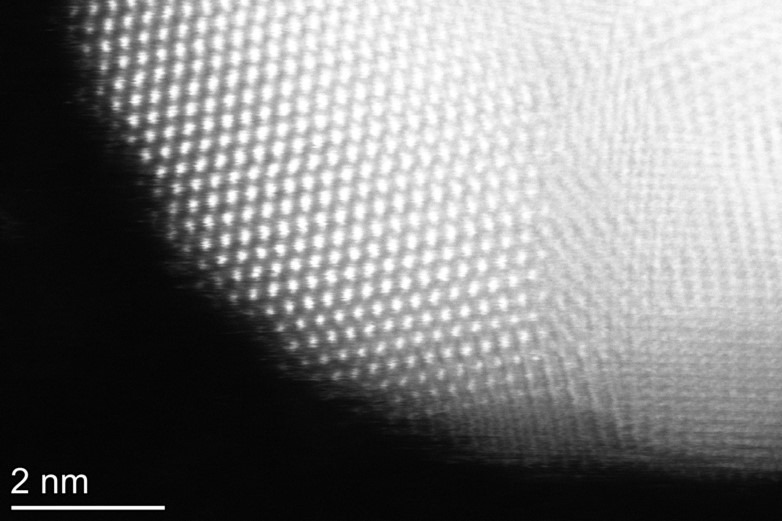
In a typical fuel cell, oxygen molecules on one side of the fuel cell first receive electrons and break up into oxide ions. The oxide ions then travel through an electrolyte to the other side of the device, where they react with the fuel and release their extra electrons. These electrons flow through outside wires back to the starting side, thereby completing the circuit and powering whatever is connected to the wires. CAPTION The initial positions of the atoms in this supercomputer model of a solid-oxide fuel cell were based on observations of the actual atomic configuration using electron microscopy. Simulations using this model revealed a previously unreported reaction (red path) in which an oxygen molecule from the yttria-stabilized zirconia layer (layer of red and light blue balls) moves through the bulk nickel layer (dark blue balls) before forming OH on the nickel surface.  CREDIT Michihisa Koyama, Kyushu University{module In-article}

Although this overall reaction is well known and relatively simple, the reaction step limiting the overall rate of the process remains controversial because the complicated structures of the electrodes--which are generally porous materials as opposed to simple, flat surfaces--hinder investigation of the phenomena at the atomic level.

Since detailed knowledge about the reactions occurring in the devices is vital for further improving the performance and durability of fuel cells, the challenge has been to understand how the microscopic structures--down to the alignment of the atoms at the different interfaces--affect the reactions.

"Computer simulations have played a powerful role in predicting and understanding reactions that we cannot easily observe on the atomic or molecular scale," explains Michihisa Koyama, the head of the group that led the research at Kyushu University's INAMORI Frontier Research Center.

"However, most studies have assumed simplified structures to reduce the computational cost, and these systems cannot reproduce the complex structures and behavior occurring in the real world."

Koyama's group aimed to overcome these shortcomings by applying simulations with refined parameters to realistic models of the key interfaces based on microscopic observations of the actual positions of the atoms at the active site of the electrode.

Leveraging the strength of Kyushu University's Ultramicroscopy Research Center, the researchers carefully observed the atomic structure of thin slices of the fuel cells using atomic-resolution electron microscopy. Based on these observations, the researchers then reconstructed supercomputer models with the same atomic structures for two representative arrangements that they observed.

Reactions between hydrogen and oxygen in these virtual fuel cells were then simulated with a method called Reactive Force Field Molecular Dynamics, which uses a set of parameters to approximate how atoms will interact--and even chemically react--with each other, without going into the full complexity of rigorous quantum chemical calculations. In this case, the researchers employed an improved set of parameters developed in collaboration with Yoshitaka Umeno's group at the University of Tokyo.

Looking at the outcome of multiple runs of the simulations on the different model systems, the researchers found that the desired reactions were more likely to occur in the layers with a smaller pore size.

Furthermore, they identified a new reaction pathway in which oxygen migrates through the bulk layers in a way that could potentially degrade performance and durability. Thus, strategies to avoid this potential reaction route should be consider as researchers work to design improved fuel cells.

"These are the kinds of insights that we could only get by looking at real-world systems," comments Koyama. "In the future, I expect to see more people using real-world atomic structures recreated from microscope observations for the basis of simulations to understand phenomena that we cannot easily measure and observe in the laboratory."

Free dataset archive helps researchers quickly find a needle in a haystack

UCR STAR visualizes public spatio-temporal datasets through an interactive map

Let's say you're doing research that requires millions of geotagged tweets. Or perhaps you're a journalist who wants to map murders in Chicago from 2001 to the present. You need to find large spatio-temporal datasets -- but where? 

While there are hundreds of publicly available datasets, locating them can take months of searching. When potential sources are found, they rarely provide enough information for a researcher to decide if the set actually contains the kind of data they need without downloading the often huge file and sorting through it first.

Thanks to a computer scientist at the University of California, Riverside, finding the right dataset is now as easy as bookmarking a website, and it costs absolutely nothing.  {module In-article}

Ahmed Eldawy, an assistant professor of computer science in the Marlan and Rosemary Bourns College of Engineering, and his group spent the last three years combing the internet for public spatio-temporal datasets, studying their attributes, and summarizing the results for each set on interactive maps that show the user exactly what they're getting.

"People who work on data science need datasets but can spend a lot of time finding them," Eldawy said. "I wanted to build an archive they can find easily."

Called the UCR Spatio-temporal Active Repository, or UCR STAR, the archive is made available as a service to the research community to provide easy access to large spatio-temporal datasets through an interactive exploratory interface. Users can search and filter those datasets as if shopping for their research, except that everything is free. 

"The map interface visualizes the data, so you can see if it's a good fit," Eldawy said. "It's like a catalog for datasets."

At the heart of UCR STAR, the map provides an interactive exploratory interface for the dataset. Similar to Google Maps or other web maps, users can zoom in and out and pan around to get a quick overview of the data distribution, coverage, and accuracy. 

Important details are displayed once a dataset is selected, such as the original homepage, a link to the original download source, size in bytes, number of records, file format, and other useful information. The subset download feature allows users to quickly download the data in a given geographical region, which reduces the download size. They can also embed their customized view on a webpage or share the link via social media and bookmark it to revisit later.

UCR STAR contains 102 datasets and 5 billion records. The datasets were mapped using Da Vinci, an open source framework built on top of Apache Spark that Eldawy designed to work with spatial data. The UCR STAR website is best accessed through a desktop browser but also has a limited mobile-friendly interface.

IBM Research Australia’s review evaluates how AI could boost the success of clinical trials

In a review publishing July 17 in the journal Trends in Pharmacological Sciences, researchers examined how artificial intelligence (AI) could affect drug development in the coming decade.

Big pharma and other drug developers are grappling with a dilemma: the era of blockbuster drugs is coming to an end. At the same time, adding new drugs to their portfolios is slow and expensive. It takes on average 10-15 years and $1.5-2B to get a new drug to market; approximately half of this time and investment is devoted to clinical trials. 

Although AI has not yet had a significant impact on clinical trials, AI-based models are helping trial design, AI-based techniques are being used for patient recruitment, and AI-based monitoring systems aim to boost study adherence and decrease dropout rates.  {module In-article}

"AI is not a magic bullet and is very much a work in progress, yet it holds much promise for the future of healthcare and drug development," says lead author and computer scientist Stefan Harrer, a researcher at IBM Research-Australia. 

As part of the review and based on their research, Harrer and colleagues reported that AI can potentially boost the success rate of clinical trials by:

  • Efficiently measuring biomarkers that reflect the effectiveness of the drug being tested
  • Identifying and characterizing patient subpopulations best suited for specific drugs. Less than a third of all phase II compounds advance to phase III, and one in three phase III trials fail-not because the drug is ineffective or dangerous, but because the trial lacks enough patients or the right kinds of patients.
  • Start-ups, large corporations, regulatory bodies, and governments are all exploring and driving the use of AI for improving clinical trial design, Harrer says. "What we see at this point are predominantly early-stage, proof-of-concept, and feasibility pilot studies demonstrating the high potential of numerous AI techniques for improving the performance of clinical trials," Harrer says.

The authors also identify several areas showing the most real-world promise of AI for patients. For example:

  • AI-enabled systems might allow patients more access to and control over their personal data.
  • Coaching via AI-based apps could occur before and during trials.
  • AI could monitor individual patients' adherence to protocols continuously in real time.
  • AI techniques could help guide patients to trials of which they may not have been aware 
  • In particular, Harrer says, the use of AI in precision-medicine approaches, such as applying technology to advance how efficiently and accurately professionals can diagnose, treat and manage neurological diseases, is promising. "AI can have a profound impact on improving patient monitoring before and during neurological trials," he says. 

The review also evaluated the potential implications for pharma, which included:

  • Computer vision algorithms that could potentially pinpoint relevant patient populations through a range of inputs from handwritten forms to digital medical imagery.
  • Applications of AI analysis to failed clinical trial data to uncover insights for future trial design.
  • The use of AI capabilities such as Machine Learning (ML), Deep Learning (DL), and Natural Language Processing (NLP) for correlating large and diverse data sets such as electronic health records, medical literature, and trial databases to help pharma improve trial design, patient-trial matching, and recruiting, as well as for monitoring patients during trials. 

The authors also identified several important takeaways for researchers: 

  • "Health AI" is a growing field connecting medicine, pharma, data science and engineering.
  • The next generation of health-related AI experts will need a broad array of knowledge in analytics, algorithm coding and technology integration.
  • Ongoing work is needed to assess data privacy, security and accessibility, as well as the ethics of applying AI techniques to sensitive medical information. 

Because AI methods have only begun to be applied to clinical trials in the past 5 to 8 years, it will most likely be another several years in a typical 10- to 15-year drug-development cycle before AI's impact can be accurately assessed.

In the meantime, rigorous research and development is necessary to ensure the viability of these innovations, Harrer says. "Major further work is necessary before the AI demonstrated in pilot studies can be integrated in clinical trial design," he says. "Any breach of research protocol or premature setting of unreasonable expectations may lead to an undermining of trust-and ultimately the success-of AI in the clinical sector."