SUPERCOMPUTING NEWS SUPERCOMPUTING NEWS
    • MEDIA KIT
    • MOST READ
    • RSS FEED
    • ACADEMIA
    • AEROSPACE
    • APPLICATIONS
    • ASTRONOMY
    • AUTOMOTIVE
    • BIG DATA
    • BIOLOGY
    • CHEMISTRY
    • CLIENTS
    • CLOUD
    • DEFENSE
    • DEVELOPER TOOLS
    • EARTH SCIENCES
    • ECONOMICS
    • ENGINEERING
    • ENTERTAINMENT
    • GAMING
    • GOVERNMENT
    • HEALTH
    • OIL & GAS
    • INDUSTRY
    • INTERCONNECTS
    • MANUFACTURING
    • MIDDLEWARE
    • MOVIES
    • NETWORKS
    • PHYSICS
    • PROCESSORS
    • RETAIL
    • SCIENCE
    • STORAGE
    • SYSTEMS
    • VISUALIZATION
    • AcyMailing subscription form

    • ADD YOUR VIDEOS
    • MANAGE VIDEOS
    • CONVERSATION INBOX
    • SOCIAL ADVERTISER
    • SOCIAL NETWORK VIDEOS
    • SURVEYS
    • GROUPS
    • PAGES
    • MARKETPLACE LISTINGS
    • APPLICATIONS BROWSER
    • PRIVACY CONFIRM REQUEST
    • PRIVACY CREATE REQUEST
    • LEADERBOARD
    • POINTS LISTING
      • BADGES
    • TRADE SHOWS
Sign In
Tyler O'Neal, Staff Editor MANUFACTURING April 13, 2020, 5:29 pm

New handle for controlling electromagnetic properties could enable spintronic supercomputing

The magnetic transition of troilite causes instabilities in the 'space metal's' structure that transforms it from a conductor to an insulator

Materials scientists at Duke University have shown the first clear example that a material's transition into a magnet can control instabilities in its crystalline structure that cause it to change from a conductor to an insulator.

If researchers can learn to control this unique connection between physical properties identified in hexagonal iron sulfide, it could enable new technologies such as spintronic supercomputing. The results appeared today April 13 in an academic journal. CAPTION A large, perfect crystal of iron sulfide that was painstakingly grown for the research experiments probing the change of atomic vibrations across magnetic transition.  CREDIT Haidong Zhou, University of Tennessee{module INSIDE STORY}
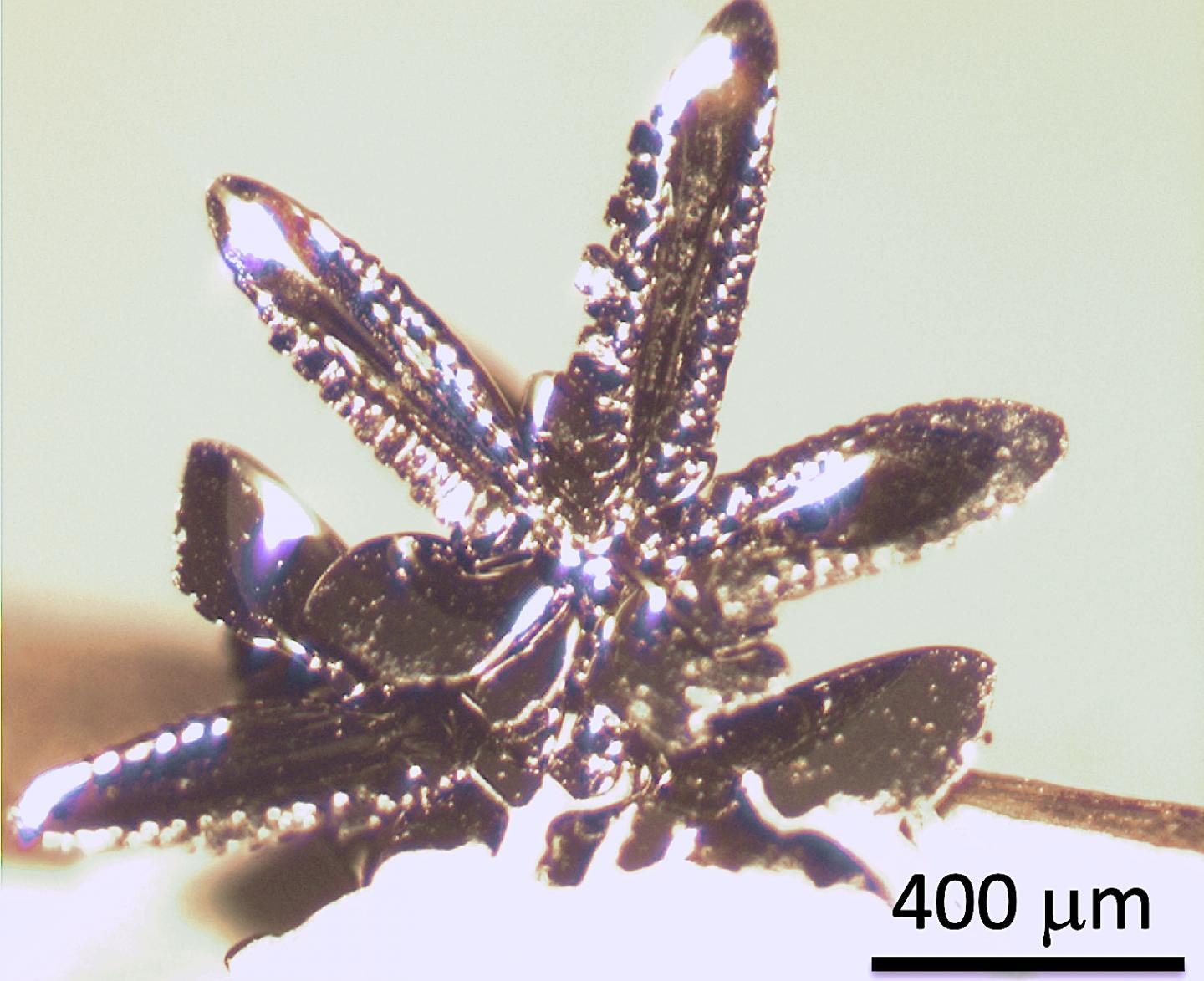
Commonly known as troilite, hexagonal iron sulfide can be found natively on Earth but is more abundant in meteorites, particularly those originating from the Moon and Mars. Rarely encountered in the Earth's crust, most troilite on Earth is believed to have originated from space.

Despite its relative rarity, troilite has been studied since 1862 without much fanfare. A recent theoretical paper, however, suggested that there might be novel physics at play between the temperatures of 289 and 602 degrees Fahrenheit -- the temperature range at which troilite becomes both magnetic and an insulator.

"The paper theorized that the way the atoms shift in their crystalline structure is impacting the mineral's properties through a pretty complicated effect that hasn't been seen before," said Olivier Delaire, associate professor of mechanical engineering and materials science, physics and chemistry at Duke. "The most important aspect is this interaction between magnetic properties and atomic dynamics, which is a subject that has not been investigated a lot before but is opening up new possibilities in computing technologies."

To get to the heart of the material's odd behavior, Delaire and his colleagues turned to Haidong Zhou, assistant professor of experimental condensed matter physics at the University of Tennessee, for the difficult task of growing perfect crystals of troilite. The researchers then took samples to Oak Ridge National Laboratory and Argonne National Laboratory to blast them with neutrons and x-rays, respectively.

When particles such as neutrons or x-rays bounce off the atoms inside a material, researchers can take this scattering information to reconstruct its atomic structure and dynamics. Because neutrons have their own internal magnetic moment, they can also reveal the direction of each atom's magnetic spin. But because neutrons interact weakly with atoms, x-rays are also very handy for resolving a material's atomic structure and atomic vibrations in tiny crystals. The researchers compared results from the two different scans using quantum mechanical models created on a supercomputer at Lawrence Berkeley National Laboratory to make sure they understood what was happening.

After watching the changes that occur through troilite's phase transformations, the researchers discovered previously unseen mechanisms at work. At high temperatures, the magnetic spins of troilite atoms point in random directions, making the material non-magnetic. But once the temperature drops below 602 degrees Fahrenheit, the magnetic moments naturally align and a magnet is born.

The alignment of those magnetic spins shifts the vibration dynamics of the atoms. That shift causes the entire crystalline atomic structure to deform slightly, which in turn creates a band gap that electrons cannot jump across. This causes the troilite to lose its ability to conduct electricity.

"This is the first clear example that the alignment of magnetic spins can control the instabilities of a material's crystal structure," said Delaire. "And because these instabilities lead to a connection between the crystal's magnetic and conductivity properties, this is the type of material that's exciting in terms of enabling new types of devices."

The ability to tune a material's magnetic state by applying electrical currents, and vice versa, would be essential for the realization of technologies such as spin electronics, Delaire said. Known as spintronics for short, this emerging field seeks to use an electron's intrinsic spin and associated magnetic moment to store and manipulate data. Combined with an electron's traditional role in computing, this would allow computer processors to become denser and more efficient.

Through this paper, Delaire and his colleagues have identified the magnetic controls of the distortion mechanisms of the crystal structure, giving researchers a handle to manipulate one with the other. While that handle is currently based in temperature changes, the next step for researchers is to look at applying external magnetic fields to see how they might affect the material's atomic dynamics.

Whether or not troilite becomes the new silicon for the next generation of computing technology, Delaire says finding this unique mechanism in such a well-known material is a good lesson for the entire field.

"It's surprising that, even though you have a compound that is relatively simple, you can have this fancy mechanism that could end up enabling new technologies," said Delaire. "In a sense, it's a wakeup call that we need to reconsider some of the simpler materials to look for similar effects elsewhere."
GW researchers develop fast, micrometer-size electro-optical modulator

Tyler O'Neal, Staff Editor MANUFACTURING April 13, 2020, 4:48 pm

Researchers developed and demonstrated for the first time a silicon-based electro-optical modulator that is smaller, as fast as and more efficient than state-of-the-art technologies. By adding indium tin oxide (ITO) - a transparent conductive oxide found in touchscreen displays and solar cells - to a silicon photonic chip platform, the researchers were able to create a compact device 1 micrometer in size and able to yield gigahertz-fast, or 1 billion times per second, signal modulation.

Electro-optical modulators are the workhorses of the internet. They convert electrical data from computers and smartphones to optical data streams for fiber optic networks, enabling modern data communications like video streaming. The new invention is timely since demand for data services is growing rapidly and moving towards next generation communication networks. Taking advantage of their compact footprint, electro-optic converters can be utilized as transducers in optical computing hardware such as optical artificial neural networks that mimic the human brain and a plethora of other applications for modern-day life.

Electro-optical modulators in use today are typically between 1 millimeter and 1 centimeter in size. Reducing their size allows increased packaging density, which is vital on a chip. While silicon often serves as the passive structure on which photonic integrated circuits are built, the light matter interaction of silicon materials induces a rather weak optical index change, requiring a larger device footprint. While resonators could be used to boost this weak electro-optical effect, they narrow devices' optical operating range and incur high energy consumption from required heating elements.

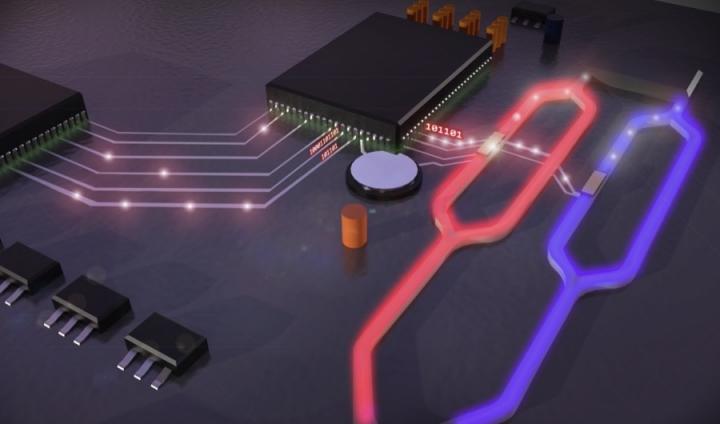
By heterogeneously adding a thin material layer of indium tin oxide to the silicon photonic waveguide chip, researchers at the George Washington University, led by Volker Sorger, an associate professor of electrical and computer engineering, have demonstrated an optical index change 1,000 times larger than silicon. Unlike many designs based on resonators, this spectrally-broadband device is stable against temperature changes and allows a single fiber-optic cable to carry multiple wavelengths of light, increasing the amount of data that can move through a system. CAPTION On this illustrated silicon chip (grey), electrical data (white) travels through the Mach-Zehnder interferometer (MZI) based electro-optical modulators, encoding electrical data into the optical domain by means of tunable plasmonic ITO-based phase shifters (golden patches atop both MZI sections) capable of operating at multiple wavelengths of light in the telecommunication-relevant C-band (red & purple). capable of operating at multiple wavelengths of light in the telecommunication-relevant C-band (red & purple), thus enhancing the speed and efficiency of optical applications such as data transmission or neural networks for artificial intelligence.  CREDIT Mario Miscuglio and Rubab Amin{module INSIDE STORY}

"We are delighted to have achieved this decade-long goal of demonstrating a GHz-fast ITO modulator. This sets a new horizon for next-generation photonic reconfigurable devices with enhanced performance yet reduced size," said Dr. Sorger.

New York Tech researchers develop computational simulations that reveal alarming abusive head trauma in impact study

Tyler O'Neal, Staff Editor MANUFACTURING April 11, 2020, 7:45 pm

Abusive head trauma (AHT), like that of Shaken Baby Syndrome, is the leading cause of fatal brain injuries in children under two. While children can suffer permanent neurological damage, developmental delay, and disability, the long-term effects of AHT are difficult to diagnose and predict. Now, researchers at the New York Institute of Technology have developed computational simulations to help clinicians and caregivers better understand the impact of these injuries.

Similar to whiplash, shaking produces an accelerated force that causes a baby's head to undergo multiple cycles of hyperextension and hyperflexion--snapping backward and rebounding to its original position. During a head injury, the cerebrospinal fluid (CSF), found in the central cavities and space surrounding the brain and spinal cord, cushions the brain and protects it from hitting the skull. Despite this protection, one in four shaken babies dies and 80 percent of survivors suffer permanent brain damage.

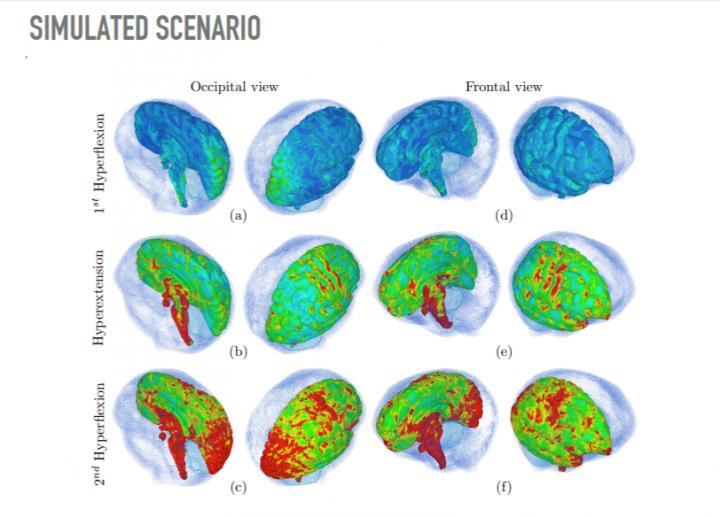
 Computational simulations can help physicians visualize the true impact of AHT and assist them in making a prognosis. However, existing simulations are insufficient, as they portray the fluid as an elastic solid and fail to replicate intricate brain anatomy and the interaction between the CSF and the brain. These deficiencies are addressed, as reported in the Journal of Pediatric Neurology, thanks to more precise simulations that reveal that the fluid's protection may last for only a single shake. The study was developed by researchers at the New York Institute of Technology's College of Engineering and Computing Sciences. CAPTION During hyperflexion on the second shake, the fluid did not have enough time to reach the affected areas. In other words, following the first shake, the CSF was unable to prevent the brain from colliding with the skull, suggesting that the fluid offers no protection at repeated frequencies.  CREDIT Milan Toma{module INSIDE STORY}

"One instance of abusive head trauma could include as many as 80 shakes. Our findings demonstrate that the cerebrospinal fluid is only 'designed' to protect the brain for the first shake," said lead author Milan Toma, Ph.D., assistant professor of mechanical engineering. "By considering simulations like these, clinicians can better predict the short- and long-term effects of abusive head trauma and more accurately assess the victim's health."

The researchers replicated the fluid's cushioning effect for multiple cycles. In the first shake, CSF traveled to the sites of hyperextension and hyperflexion, providing the anticipated cushioning effect. However, during hyperflexion on the second shake, the fluid did not have enough time to reach the affected areas. In other words, following the first shake, the CSF was unable to prevent the brain from colliding with the skull, suggesting that the fluid offers no protection at repeated frequencies.

"Even when a baby is shaken at the lowest frequency, one shake is already too many," said Alfonso Dehesa Baeza, an undergraduate mechanical engineering student at New York Tech and Toma's co-investigator. "We hope that these surprising revelations help raise awareness among clinicians and caregivers, and prevent future incidents of abusive head trauma."

"The known incidence of AHT in children less than a year old is approximately 35 cases per 100,000. Unfortunately, AHT is not only often misdiagnosed, but it is also under-diagnosed. This simulation allows a glimpse into the mechanism through which AHT occurs. Better knowledge of the brain and its response to trauma can help us to tailor treatment and possibly mitigate damage," said Rosalyn Chan-Akeley, M.D., M.P.H, OB/GYN research program manager at New York-Presbyterian Queens Lang Research Center, who was also an author on the study.

In continuing their work, New York Tech researchers aim to acquire pediatric data to refine their AHT models and also plan to add data on brain vasculature. Toma and his team of student researchers will also use their simulations to replicate nearly any head injury, test the effectiveness of protective helmets and replicate high-risk head injuries from automobile accidents and contact sports, including lacrosse, baseball, football, and ice hockey. Toma has also received a grant from the New York Thoroughbred Horsemen's Association to perform similar research on the efficacy of jockey helmets.

  1. UCF Prof del Barco's magnet research takes giant leap
  2. UC Davis supercomputer model predicts how drugs affect heart rhythm

Page 19 of 22

  • 13
  • 14
  • 15
  • 16
  • 17
  • 18
  • 19
  • 20
  • 21
  • 22
POPULAR RIGHT NOW
  • Supercomputers uncover a new class of cosmic explosions hidden in plain sight
    Supercomputers uncover a new class of cosmic explosions hidden in plain sight
  • AI supercharges the hunt for stronger magnets: Iowa State researchers launch a new era of intelligent materials discovery
    AI supercharges the hunt for stronger magnets: Iowa State researchers launch a new era of intelligent materials discovery
  • IBM's Historic stock collapse raises questions for the future of enterprise supercomputing
    IBM's Historic stock collapse raises questions for the future of enterprise supercomputing
  • Could a novel dark matter theory simultaneously resolve multiple cosmic enigmas? Supercomputer simulations provide a compelling, albeit currently unverified, potential solution
    Could a novel dark matter theory simultaneously resolve multiple cosmic enigmas? Supercomputer simulations provide a compelling, albeit currently unverified, potential solution
  • Melting icebergs may be reshaping Earth’s greatest ocean current
    Melting icebergs may be reshaping Earth’s greatest ocean current
  • Supercomputers replace ‘bathtub’ flood maps with physics-based digital twins of Britain’s coastline
    Supercomputers replace ‘bathtub’ flood maps with physics-based digital twins of Britain’s coastline
  • Supercomputers push neural quantum simulation beyond previous limits
    Supercomputers push neural quantum simulation beyond previous limits
  • Intel’s AI supercomputing revival: Q2 financial surge signals new era for CPU-powered HPC infrastructure
    Intel’s AI supercomputing revival: Q2 financial surge signals new era for CPU-powered HPC infrastructure
  • AI infrastructure financing fears shake semiconductor sector
    AI infrastructure financing fears shake semiconductor sector
  • AWS supercomputing investment reaches historic scale as Amazon’s AI strategy powers record financial results
    AWS supercomputing investment reaches historic scale as Amazon’s AI strategy powers record financial results
THIS YEAR'S MOST READ
  • Wall Street wants to trade supercomputing power like oil
    Wall Street wants to trade supercomputing power like oil
  • Cosmic ambition at scale: UK’s supercomputer unlocks a 2.5 petabytes universe
    Cosmic ambition at scale: UK’s supercomputer unlocks a 2.5 petabytes universe
  • Hidden order, revealed at scale: Supercomputing, electron ptychography uncover the inner workings of relaxor ferroelectrics
    Hidden order, revealed at scale: Supercomputing, electron ptychography uncover the inner workings of relaxor ferroelectrics
  • Beamforming the future: BeammWave's 6G push signals the rise of orbital-terrestrial wireless networks
    Joakim Axmon
    Joakim Axmon
  • Intel's Q1 results signal supercomputing surge driving Xeon momentum
    Intel's Q1 results signal supercomputing surge driving Xeon momentum
  • When stars fall apart: Supercomputing reveals the hidden physics of black holes
    When stars fall apart: Supercomputing reveals the hidden physics of black holes
  • Multi-layer simulations reveal the hidden supply chain of solar prominences
    Multi-layer simulations reveal the hidden supply chain of solar prominences
  • Japanese scientists decode dolphin speed with supercomputing: Turbulence, vortices, and the hidden physics of propulsion
    Japanese scientists decode dolphin speed with supercomputing: Turbulence, vortices, and the hidden physics of propulsion
  • Cosmic feedback at scale: Supercomputing reveals how quasars regulate the early Universe
    Cosmic feedback at scale: Supercomputing reveals how quasars regulate the early Universe
  • Modeling life at the microscopic scale: A computational breakthrough in oxygen transport
    Modeling life at the microscopic scale: A computational breakthrough in oxygen transport
MOST READ OF ALL-TIME
  • Largest Computational Biology Simulation Mimics The Ribosome
    Details
    112107
    The amino acid (green) slithers into the chemical reaction center, moving through an evolutionarily ancient corridor of the ribosome (purple). The amino acid is delivered to the reaction core by the transfer RNA molecule (yellow).
    The amino acid (green) slithers into the chemical reaction center, moving through an evolutionarily ancient corridor of the ribosome (purple). The amino acid is delivered to the reaction core by the transfer RNA molecule (yellow).
  • Silicon 'neurons' may add a new dimension to chips
    Details
    80990
    Silicon 'neurons' may add a new dimension to chips
  • Linux Networx Accelerators Expected to Drive up to 4x Price/Performance
    Details
    75537
  • Complex Concepts That Really Add Up
    Details
    73635
    Complex Concepts That Really Add Up
  • Blue Sky Studios Donates Animation SuperComputer to Wesleyan
    Details
    68140
    Each rack holds 52 Angstrom Microsystem-brand “blades,” with a memory footprint of 12 or 24 gigabytes each. (Photos by Olivia Bartlett Drake)
    Each rack holds 52 Angstrom Microsystem-brand “blades,” with a memory footprint of 12 or 24 gigabytes each. (Photos by Olivia Bartlett Drake)
  • Humanities, HPC connect at NERSC
    Details
    57945
  • TeraGrid ’09 'Call for Participation'
    Details
    54951
  • Turbulence responsible for black holes' balancing act
    Details
    52310
  • Cray Wins $52 Million SuperComputer Contract
    Details
    50139
  • SDSC Researchers Accurately Predict Protein Docking
    Details
    46078
  • FRONTPAGE
  • LATEST
  • POPULAR
  • REGISTER
  • SOCIAL
  • VIDEO
  • SUBSCRIPTION
  • RSS
  • GUIDELINES
  • PRIVACY
  • TOS
  • ABOUT
  • +1 (816) 799-4488
  • editorial@supercomputingonline.com
© 2001 - 2026 SuperComputingOnline.com, LLC. All rights reserved. This material may not be published, broadcast, rewritten or redistributed without permission.
Sign In
  • FRONT PAGE
  • LATEST
    • MEDIA KIT
    • MOST READ
    • RSS FEED
    • ACADEMIA
    • AEROSPACE
    • APPLICATIONS
    • ASTRONOMY
    • AUTOMOTIVE
    • BIG DATA
    • BIOLOGY
    • CHEMISTRY
    • CLIENTS
    • CLOUD
    • DEFENSE
    • DEVELOPER TOOLS
    • EARTH SCIENCES
    • ECONOMICS
    • ENGINEERING
    • ENTERTAINMENT
    • HEALTH
    • INDUSTRY
    • INTERCONNECTS
    • GAMING
    • GOVERNMENT
    • MANUFACTURING
    • MIDDLEWARE
    • MOVIES
    • NETWORKS
    • OIL & GAS
    • PHYSICS
    • PROCESSORS
    • RETAIL
    • SCIENCE
    • STORAGE
    • SYSTEMS
    • VISUALIZATION
  • VIDEOS
    • ADD YOUR VIDEOS
    • MANAGE VIDEOS
  • COMMUNITY
    • TRADE SHOWS
    • SOCIAL NETWORK VIDEOS
    • SURVEYS
    • APPLICATIONS BROWSER
    • CONVERSATION INBOX
    • SOCIAL ADVERTISER
    • GROUPS
    • MARKETPLACE LISTINGS
    • PAGES
    • LEADERBOARD
    • POINTS LISTING
      • BADGES
    • PRIVACY CONFIRM REQUEST
    • PRIVACY CREATE REQUEST

Hey there! We noticed you’re using an ad blocker.