

SUPERCOMPUTING NEWS SUPERCOMPUTING NEWS
    • MEDIA KIT
    • MOST READ
    • RSS FEED
    • ACADEMIA
    • AEROSPACE
    • APPLICATIONS
    • ASTRONOMY
    • AUTOMOTIVE
    • BIG DATA
    • BIOLOGY
    • CHEMISTRY
    • CLIENTS
    • CLOUD
    • DEFENSE
    • DEVELOPER TOOLS
    • EARTH SCIENCES
    • ECONOMICS
    • ENGINEERING
    • ENTERTAINMENT
    • GAMING
    • GOVERNMENT
    • HEALTH
    • OIL & GAS
    • INDUSTRY
    • INTERCONNECTS
    • MANUFACTURING
    • MIDDLEWARE
    • MOVIES
    • NETWORKS
    • PHYSICS
    • PROCESSORS
    • RETAIL
    • SCIENCE
    • STORAGE
    • SYSTEMS
    • VISUALIZATION
    • AcyMailing subscription form

    • ADD YOUR VIDEOS
    • MANAGE VIDEOS
    • CONVERSATION INBOX
    • SOCIAL ADVERTISER
    • SOCIAL NETWORK VIDEOS
    • SURVEYS
    • GROUPS
    • PAGES
    • MARKETPLACE LISTINGS
    • APPLICATIONS BROWSER
    • PRIVACY CONFIRM REQUEST
    • PRIVACY CREATE REQUEST
    • LEADERBOARD
    • POINTS LISTING
      • BADGES
    • TRADE SHOWS
Sign In
Tyler O'Neal, Staff Editor June 3, 2020, 7:35 am

UTokyo-IIS scientists develop a machine-learning algorithm to help design new materials

Researchers at the Institute of Industrial Science, The University of Tokyo (UTokyo-IIS) used artificial intelligence to rapidly infer the excited state of electrons in materials. This work can help material scientists study the structures and properties of unknown samples and assist with the design of new materials.

Ask any chemist, and they will tell you that the structures and properties of materials are primarily determined by the electrons orbiting around the molecules that make it up. To be specific, the outermost electrons, which are most accessible for participating in bonding and chemical reactions, are the most critical. These electrons can rest in their lowest energy "ground state," or be temporarily kicked into a higher orbit called an excited state. Having the ability to predict excited states from ground states would go a long way to helping researchers understand the structures and properties of material samples, and even design new ones. CAPTION Scientists at The University of Tokyo use machine learning to predict the excited electronic states of materials--research that can accelerate both the characterization of materials as well as the formulation of new useful compounds{module INSIDE STORY}
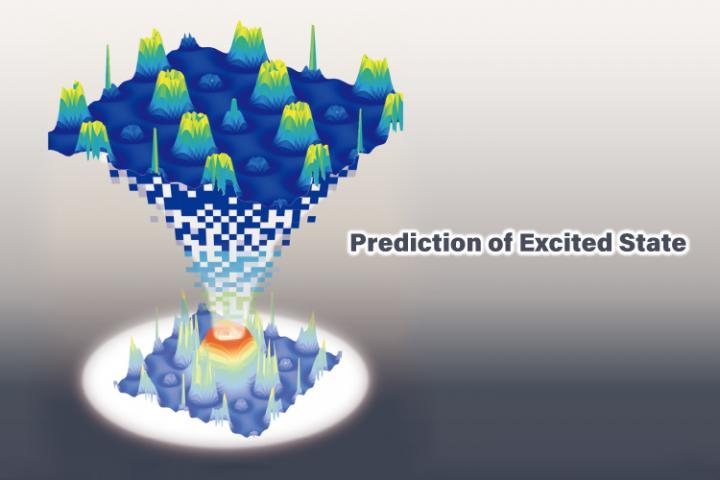
Now, scientists at UTokyo-IIS have developed a machine-learning algorithm to do just that. Using the power of artificial neural networks--which have already proven themselves useful for deciding if your latest credit card transaction was fraudulent or which movie to recommend streaming--the team showed how artificial intelligence can be trained to infer the excited state spectrum by knowing the ground states of the material.

"Excited states usually have atomic or electronic configurations that are different from their corresponding ground states," says first author Shin Kiyohara. To perform the training, scientists used data from core-electron absorption spectroscopy. In this method, a high energy X-ray or electron is used to knock out a core electron orbiting close to the atomic nucleus. Then, the core electron excites to unoccupied orbitals, absorbing the energy of the high energy X-ray/electron. Measuring this energy absorption reveals information about the atomic structures, chemical bonding, and properties of materials.

The artificial neural network took as input the ground state partial density of states, which can be easily computed, and was trained to predict the corresponding excited state spectra. One of the main benefits of using neural networks, as opposed to conventional computational methods, is the ability to apply the results from the training set to completely new situations.

"The patterns we discovered for one material showed excellent transferability to others," says senior author Teruyasu Mizoguchi. "This research in excited states can help scientists better understand chemical reactivity and material function in new or existing compounds."

Dutch astronomers predict bombardment from asteroids, comets in another planetary system

Tyler O'Neal, Staff Editor May 30, 2020, 7:58 am

The planetary system around star HR8799 is remarkably similar to our Solar System. A research team led by astronomers from the University of Groningen and SRON Netherlands Institute for Space Research has used this similarity to model the delivery of materials by asteroids, comets, and other minor bodies within the system. Their simulation shows that the four gas planets receive material delivered by minor bodies, just like in our Solar System. The results were published by the journal Astronomy & Astrophysics on 29 May.

Counting outwards from the Sun, our Solar System consists of four rocky planets, an asteroid belt, four gas giants, and another asteroid belt. The inner planets are rich in refractory materials such as metals and silicates, the outer planets are rich in volatiles such as water and methane. While forming, the inner planets had a hard time collecting a volatile atmosphere because the strong solar wind kept blowing the gas away. At the same time, the heat from the Sun evaporated any ice clumps, so it was harder to retain water. In the outer regions, there was less solar heat and wind, so the eventual gas giants could collect water ice and also gather large atmospheres filled with volatiles. CAPTION This is a cartoon to accompany the article 'Astronomers predict bombardment from asteroids and comets in another planetary system'  CREDIT Anastasia Kruchevska{module INSIDE STORY}

Simulation

Minor bodies, including asteroids, comets, and dust, fine-tuned this outcome later on by delivering refractories from the inner belt and both volatiles and refractories from the outer belt. A research team led by astronomers from the University of Groningen and SRON Netherlands Institute for Space Research wondered if the same delivery system applies to planetary systems around other stars. They created a simulation for the system around HR8799, which is similar to our Solar System with four gas giants plus an inner and outer belt, and possibly rocky planets inside the inner belt. Therefore the team could take some unknowns about HR8799 from our own Solar System.

Terrestrial planets

The simulation shows that just like in our Solar System, the four gas planets receive material delivered by minor bodies. The team predicts a total delivery of both material types of around half a millionth of the planets' masses. Future observations, for example by NASA's James Webb Space Telescope, will be able to measure the number of refractories in the volatile-rich gas giants. 'If telescopes detect the predicted amount of refractories, it means that these can be explained by a delivery from the belts as shown in the model', explains Kateryna Frantseva, first author of the paper. 'However, if they detect more refractories than predicted, the delivery process is more active than was assumed in the model, for example, because HR8799 is much younger than the Solar System. The HR8799 system may contain terrestrial planets, for which volatile delivery from the asteroid belts may be of astrobiological relevance.'

Ocean waves play a critical role in shaping our economy, weather, climate

Tyler O'Neal, Staff Editor May 22, 2020, 5:13 pm

Turns out, it's all in the water

The design of coastal structures, the safety of offshore shipping, the prediction of extreme weather, coastal flooding, and beach erosion--all depend on our ability to understand and predict ocean waves. Such an understanding requires detailed physical models of how waves interact with the environment, the statistical representation of waves and a capability to obtain global data on ocean waves. Ocean Wave Dynamics covers all these challenging areas in a single publication. 

As our understanding of ocean waves increases, we are gradually moving from empirical representations to detailed physical representations. The processes which govern the generation and evolution of ocean waves are extremely complex. Nevertheless, progress in understanding these processes has advanced significantly. This has resulted in a much-enhanced ability to predict waves both at global scale and regionally. Ocean Wave Dynamics outlines in a systematic manner our present understanding of each of these processes and how they result in an enhanced ability to model the complex dynamics of the ocean surface. {module INSIDE STORY}

Eight of the world's top researchers from the fields of physics, oceanography, meteorology, mathematics and engineering have come together to present a comprehensive understanding of research in this field. The most significant aspects of the book include: a detailed explanation of the key research topics in ocean wave dynamics, an explanation of the different approaches adopted in predicting ocean wave evolution and an understanding of areas where future research is required. This understanding will underpin the next generation of wave prediction tools and Metocean engineering methods. Such tools will combine our enhanced understanding of the nonlinear physical processes active, with advanced statistical methods and ever increasing computational power to enhance predictions of both extremes and climatology of ocean waves.

Ocean Wave Dynamics is an important reference for a broad range of potential readers, including ocean engineers, oceanographers, atmospheric scientists, supercomputer modelers, and graduate students. The book retails for US$138 / £120 (hardback) and is also available in electronic formats. To order or learn more about the book, visit http://www.worldscientific.com/worldscibooks/10.1142/11509.

  1. S&T researcher examines if AI have a mind of their own
  2. New gravitational-wave model can bring neutron stars into even sharper focus

Page 4 of 7

  • 1
  • 2
  • 3
  • 4
  • 5
  • 6
  • 7
POPULAR RIGHT NOW
  • Supercomputers uncover a new class of cosmic explosions hidden in plain sight
    Supercomputers uncover a new class of cosmic explosions hidden in plain sight
  • AI supercharges the hunt for stronger magnets: Iowa State researchers launch a new era of intelligent materials discovery
    AI supercharges the hunt for stronger magnets: Iowa State researchers launch a new era of intelligent materials discovery
  • IBM's Historic stock collapse raises questions for the future of enterprise supercomputing
    IBM's Historic stock collapse raises questions for the future of enterprise supercomputing
  • Could a novel dark matter theory simultaneously resolve multiple cosmic enigmas? Supercomputer simulations provide a compelling, albeit currently unverified, potential solution
    Could a novel dark matter theory simultaneously resolve multiple cosmic enigmas? Supercomputer simulations provide a compelling, albeit currently unverified, potential solution
  • Melting icebergs may be reshaping Earth’s greatest ocean current
    Melting icebergs may be reshaping Earth’s greatest ocean current
  • Supercomputers replace ‘bathtub’ flood maps with physics-based digital twins of Britain’s coastline
    Supercomputers replace ‘bathtub’ flood maps with physics-based digital twins of Britain’s coastline
  • Supercomputers push neural quantum simulation beyond previous limits
    Supercomputers push neural quantum simulation beyond previous limits
  • Intel’s AI supercomputing revival: Q2 financial surge signals new era for CPU-powered HPC infrastructure
    Intel’s AI supercomputing revival: Q2 financial surge signals new era for CPU-powered HPC infrastructure
  • AI infrastructure financing fears shake semiconductor sector
    AI infrastructure financing fears shake semiconductor sector
  • AWS supercomputing investment reaches historic scale as Amazon’s AI strategy powers record financial results
    AWS supercomputing investment reaches historic scale as Amazon’s AI strategy powers record financial results
THIS YEAR'S MOST READ
  • Wall Street wants to trade supercomputing power like oil
    Wall Street wants to trade supercomputing power like oil
  • Cosmic ambition at scale: UK’s supercomputer unlocks a 2.5 petabytes universe
    Cosmic ambition at scale: UK’s supercomputer unlocks a 2.5 petabytes universe
  • Hidden order, revealed at scale: Supercomputing, electron ptychography uncover the inner workings of relaxor ferroelectrics
    Hidden order, revealed at scale: Supercomputing, electron ptychography uncover the inner workings of relaxor ferroelectrics
  • Beamforming the future: BeammWave's 6G push signals the rise of orbital-terrestrial wireless networks
    Joakim Axmon
    Joakim Axmon
  • Intel's Q1 results signal supercomputing surge driving Xeon momentum
    Intel's Q1 results signal supercomputing surge driving Xeon momentum
  • When stars fall apart: Supercomputing reveals the hidden physics of black holes
    When stars fall apart: Supercomputing reveals the hidden physics of black holes
  • Multi-layer simulations reveal the hidden supply chain of solar prominences
    Multi-layer simulations reveal the hidden supply chain of solar prominences
  • Japanese scientists decode dolphin speed with supercomputing: Turbulence, vortices, and the hidden physics of propulsion
    Japanese scientists decode dolphin speed with supercomputing: Turbulence, vortices, and the hidden physics of propulsion
  • Cosmic feedback at scale: Supercomputing reveals how quasars regulate the early Universe
    Cosmic feedback at scale: Supercomputing reveals how quasars regulate the early Universe
  • Modeling life at the microscopic scale: A computational breakthrough in oxygen transport
    Modeling life at the microscopic scale: A computational breakthrough in oxygen transport
MOST READ OF ALL-TIME
  • Largest Computational Biology Simulation Mimics The Ribosome
    Details
    112107
    The amino acid (green) slithers into the chemical reaction center, moving through an evolutionarily ancient corridor of the ribosome (purple). The amino acid is delivered to the reaction core by the transfer RNA molecule (yellow).
    The amino acid (green) slithers into the chemical reaction center, moving through an evolutionarily ancient corridor of the ribosome (purple). The amino acid is delivered to the reaction core by the transfer RNA molecule (yellow).
  • Silicon 'neurons' may add a new dimension to chips
    Details
    80990
    Silicon 'neurons' may add a new dimension to chips
  • Linux Networx Accelerators Expected to Drive up to 4x Price/Performance
    Details
    75537
  • Complex Concepts That Really Add Up
    Details
    73635
    Complex Concepts That Really Add Up
  • Blue Sky Studios Donates Animation SuperComputer to Wesleyan
    Details
    68140
    Each rack holds 52 Angstrom Microsystem-brand “blades,” with a memory footprint of 12 or 24 gigabytes each. (Photos by Olivia Bartlett Drake)
    Each rack holds 52 Angstrom Microsystem-brand “blades,” with a memory footprint of 12 or 24 gigabytes each. (Photos by Olivia Bartlett Drake)
  • Humanities, HPC connect at NERSC
    Details
    57945
  • TeraGrid ’09 'Call for Participation'
    Details
    54951
  • Turbulence responsible for black holes' balancing act
    Details
    52310
  • Cray Wins $52 Million SuperComputer Contract
    Details
    50139
  • SDSC Researchers Accurately Predict Protein Docking
    Details
    46078
  • FRONTPAGE
  • LATEST
  • POPULAR
  • REGISTER
  • SOCIAL
  • VIDEO
  • SUBSCRIPTION
  • RSS
  • GUIDELINES
  • PRIVACY
  • TOS
  • ABOUT
  • +1 (816) 799-4488
  • editorial@supercomputingonline.com
© 2001 - 2026 SuperComputingOnline.com, LLC. All rights reserved. This material may not be published, broadcast, rewritten or redistributed without permission.
Sign In
  • FRONT PAGE
  • LATEST
    • MEDIA KIT
    • MOST READ
    • RSS FEED
    • ACADEMIA
    • AEROSPACE
    • APPLICATIONS
    • ASTRONOMY
    • AUTOMOTIVE
    • BIG DATA
    • BIOLOGY
    • CHEMISTRY
    • CLIENTS
    • CLOUD
    • DEFENSE
    • DEVELOPER TOOLS
    • EARTH SCIENCES
    • ECONOMICS
    • ENGINEERING
    • ENTERTAINMENT
    • HEALTH
    • INDUSTRY
    • INTERCONNECTS
    • GAMING
    • GOVERNMENT
    • MANUFACTURING
    • MIDDLEWARE
    • MOVIES
    • NETWORKS
    • OIL & GAS
    • PHYSICS
    • PROCESSORS
    • RETAIL
    • SCIENCE
    • STORAGE
    • SYSTEMS
    • VISUALIZATION
  • VIDEOS
    • ADD YOUR VIDEOS
    • MANAGE VIDEOS
  • COMMUNITY
    • TRADE SHOWS
    • SOCIAL NETWORK VIDEOS
    • SURVEYS
    • APPLICATIONS BROWSER
    • CONVERSATION INBOX
    • SOCIAL ADVERTISER
    • GROUPS
    • MARKETPLACE LISTINGS
    • PAGES
    • LEADERBOARD
    • POINTS LISTING
      • BADGES
    • PRIVACY CONFIRM REQUEST
    • PRIVACY CREATE REQUEST

Hey there! We noticed you’re using an ad blocker.