


SUPERCOMPUTING NEWS SUPERCOMPUTING NEWS
    • MEDIA KIT
    • MOST READ
    • RSS FEED
    • ACADEMIA
    • AEROSPACE
    • APPLICATIONS
    • ASTRONOMY
    • AUTOMOTIVE
    • BIG DATA
    • BIOLOGY
    • CHEMISTRY
    • CLIENTS
    • CLOUD
    • DEFENSE
    • DEVELOPER TOOLS
    • EARTH SCIENCES
    • ECONOMICS
    • ENGINEERING
    • ENTERTAINMENT
    • GAMING
    • GOVERNMENT
    • HEALTH
    • OIL & GAS
    • INDUSTRY
    • INTERCONNECTS
    • MANUFACTURING
    • MIDDLEWARE
    • MOVIES
    • NETWORKS
    • PHYSICS
    • PROCESSORS
    • RETAIL
    • SCIENCE
    • STORAGE
    • SYSTEMS
    • VISUALIZATION
    • AcyMailing subscription form

    • ADD YOUR VIDEOS
    • MANAGE VIDEOS
    • CONVERSATION INBOX
    • SOCIAL ADVERTISER
    • SOCIAL NETWORK VIDEOS
    • SURVEYS
    • GROUPS
    • PAGES
    • MARKETPLACE LISTINGS
    • APPLICATIONS BROWSER
    • PRIVACY CONFIRM REQUEST
    • PRIVACY CREATE REQUEST
    • LEADERBOARD
    • POINTS LISTING
      • BADGES
    • TRADE SHOWS
Sign In
NASA supercomputer powers groundbreaking black hole visualization
Tyler O'Neal, Staff Editor VISUALIZATION May 6, 2024, 12:00 pm

NASA supercomputer powers groundbreaking black hole visualization

A new NASA visualization created on a supercomputer allows viewers to take a virtual plunge into the event horizon of a supermassive black hole, with the potential to revolutionize our understanding of these enigmatic phenomena. The groundbreaking simulation, produced by astrophysicist Jeremy Schnittman at NASA’s Goddard Space Flight Center, offers an immersive experience of falling into a black hole and explains the complex principles of relativity in a visually engaging way.

The Power of Supercomputing and Collaborative Research

To achieve this level of cinematic fidelity, Schnittman worked alongside fellow scientist Brian Powell and harnessed the computational power of the Discover supercomputer at the NASA Center for Climate Simulation. The project consumed an impressive ten terabytes of data, equivalent to half of the text content in the Library of Congress. In just five days, they ran it on 0.3% of Discover's 129,000 processors, an accomplishment that would have taken years on a traditional laptop.

“People often ask about this, and simulating these difficult-to-imagine processes helps me connect the mathematics of relativity to actual consequences in the real universe,” Schnittman said. “So I simulated two different scenarios, one where a camera -- a stand-in for a daring astronaut -- just misses the event horizon and slingshots back out, and one where it crosses the boundary, sealing its fate.” This ambitious undertaking, with its potential for exciting discovery and innovative breakthroughs, required the input of experts from various fields working collaboratively.

Revolutionizing Our Understanding of Black Holes

The latest visualization offers a glimpse of a supermassive black hole, a monstrous entity weighing 4.3 million times the mass of our Sun, at the center of our galaxy, in an immersive experience. As the viewer takes a virtual trip, the glow from the accretion disk, photon rings, and the starry sky all become amplified, contributing to a more realistic portrayal of the experience of falling into a black hole.

“This is why astronomers originally referred to black holes as ‘frozen stars,’” Schnittman explained. “Once the camera crosses the horizon, its destruction by spaghettification is just 12.8 seconds away,” he added, referencing the process by which objects close to a black hole become elongated like spaghetti. The visualization both educates and entertains, making scientific principles more accessible to the general public.

A New Dawn of Discovery

By bringing scientific principles to life in an accessible and visually appealing way, the new visualization reveals the potential for groundbreaking discoveries, offering a glimpse into unexplored territories. With the power of supercomputing, the door opens to researching increasingly complex phenomena and understanding the mysteries of the universe beyond our field of view. The visualization underscores the potential for collaboration and innovative solutions to unlocking the doors of the cosmos.

The new NASA visualization uses collaboration to create compelling on-screen material that further lays the foundation for epic breakthroughs in astrophysics. As expert scientists continue to leverage advanced technologies and insights, the dawn of cosmic discovery continues to unfold.
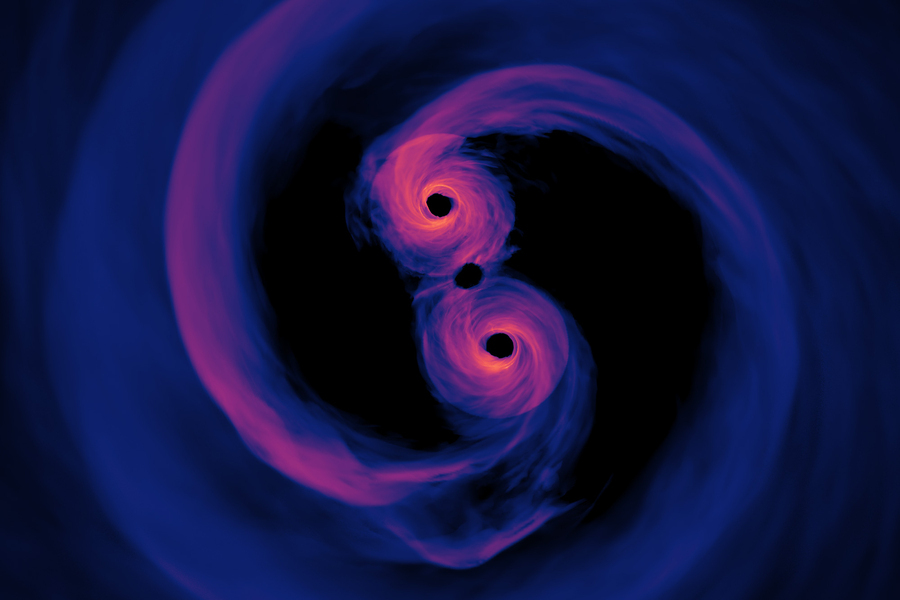
An MIT study finds that, for now, the catalog of known black hole binaries does not reveal anything fundamental about how black holes form. Pictured is a simulation of the light emitted by a supermassive black hole binary system where the surrounding gas is optically thin (transparent). Credits: NASA’s Goddard Space Flight Center

MIT physicists show black hole's origins can be spun in any direction

Tyler O'Neal, Staff Editor VISUALIZATION December 9, 2022, 8:00 am

Current measurements of black holes are not enough to nail down how the invisible giants form in the universe, MIT researchers say.

Clues to a black hole’s origins can be found in the way it spins. This is especially true for binaries, in which two black holes circle close together before merging. The spin and tilt of the respective black holes just before they merge can reveal whether the invisible giants arose from a quiet galactic disk or a more dynamic cluster of stars.

Astronomers are hoping to tease out which of these origin stories is more likely by analyzing the 69 confirmed binaries detected to date. But a new study finds that for now, the current catalog of binaries is not enough to reveal anything fundamental about how black holes form.

In a study appearing today in the journal Astronomy and Astrophysics Letters, MIT physicists show that when all the known binaries and their spins are worked into models of black hole formation, the conclusions can look very different, depending on the particular model used to interpret the data. 

A black hole’s origins can therefore be “spun” in different ways, depending on a model’s assumptions of how the universe works.

“When you change the model and make it more flexible or make different assumptions, you get a different answer about how black holes formed in the universe,” says study co-author Sylvia Biscoveanu, an MIT graduate student working in the LIGO Laboratory. “We show that people need to be careful because we are not yet at the stage with our data where we can believe what the model tells us.”

The study’s co-authors include Colm Talbot, an MIT postdoc; and Salvatore Vitale, an associate professor of physics and a member of the Kavli Institute of Astrophysics and Space Research at MIT.

A tale of two origins

Black holes in binary systems are thought to arise via one of two paths. The first is through “field binary evolution,” in which two stars evolve together and eventually explode in supernovae, leaving behind two black holes that continue circling in a binary system. In this scenario, the black holes should have relatively aligned spins, as they would have had time — first as stars, then black holes — to pull and tug each other into similar orientations. If a binary’s black holes have roughly the same spin, scientists believe they must have evolved in a relatively quiet environment, such as a galactic disk.

Black hole binaries can also form through “dynamical assembly,” where two black holes evolve separately, each with its distinct tilt and spin. By some extreme astrophysical processes, the black holes are eventually brought together, close enough to form a binary system. Such a dynamical pairing would likely occur not in a quiet galactic disk, but in a more dense environment, such as a globular cluster, where the interaction of thousands of stars can knock two black holes together. If a binary’s black holes have randomly oriented spins, they likely form in a globular cluster.

But what fraction of binaries form through one channel versus the other? The answer, astronomers believe, should lie in data, particularly, measurements of black hole spins.

To date, astronomers have derived the spins of black holes in 69 binaries, which have been discovered by a network of gravitational-wave detectors including LIGO in the U.S., and its Italian counterpart Virgo. Each detector listens for signs of gravitational waves — very subtle reverberations through space-time that are left over from extreme, astrophysical events such as the merging of massive black holes.

With each binary detection, astronomers have estimated the respective black hole’s properties, including their mass and spin. They have worked the spin measurements into a generally accepted model of black hole formation and found signs that binaries could have both a preferred, aligned spin, as well as random spins. That is, the universe could produce binaries in both galactic disks and globular clusters.

“But we wanted to know, do we have enough data to make this distinction?” Biscoveanu says. “And it turns out, things are messy and uncertain, and it’s harder than it looks.”

Spinning the data

In their new study, the MIT team tested whether the same data would yield the same conclusions when worked into slightly different theoretical models of how black holes form.

The team first reproduced LIGO’s spin measurements in a widely used model of black hole formation. This model assumes that a fraction of binaries in the universe prefer to produce black holes with aligned spins, whereas the rest of the binaries have random spins. They found that the data appeared to agree with this model’s assumptions and showed a peak where the model predicted there should be more black holes with similar spins.

They then tweaked the model slightly, altering its assumptions such that it predicted a slightly different orientation of preferred black hole spins. When they worked the same data into this tweaked model, they found the data shifted to line up with the new predictions. The data also made similar shifts in 10 other models, each with a different assumption of how black holes prefer to spin.

“Our paper shows that your result depends entirely on how you model your astrophysics, rather than the data itself,” Biscoveanu says.

“We need more data than we thought if we want to make a claim that is independent of the astrophysical assumptions we make,” Vitale adds.

Just how much more data will astronomers need? Vitale estimates that once the LIGO network starts back up in early 2023, the instruments will detect one new black hole binary every few days. Over the next year, that could add up to hundreds more measurements to add to the data.

“The measurements of the spins we have now are very uncertain,” Vitale says. “But as we build up a lot of them, we can gain better information. Then we can say, no matter the detail of my model, the data always tells me the same story — a story that we could then believe.”

This research was supported in part by the National Science Foundation.

COSEM tools

Tyler O'Neal, Staff Editor VISUALIZATION October 6, 2021, 8:17 pm
Using the COSEM tools, researchers can layer different organelle categories on top of each other to see how the structures fit together within the cell.Credit:COSEM Project Team
...

Read more https://www.supercomputingonline.com/categories-media/how-to-style/cosem-tools

  1. Researchers in Sweden develop light emitters for quantum circuits
  2. NOAA scientists unravel positional, structural errors in numerical weather forecast models

Page 1 of 14

  • 1
  • 2
  • 3
  • 4
  • 5
  • 6
  • 7
  • 8
  • 9
  • 10
POPULAR RIGHT NOW
  • Supercomputers uncover a new class of cosmic explosions hidden in plain sight
    Supercomputers uncover a new class of cosmic explosions hidden in plain sight
  • AI supercharges the hunt for stronger magnets: Iowa State researchers launch a new era of intelligent materials discovery
    AI supercharges the hunt for stronger magnets: Iowa State researchers launch a new era of intelligent materials discovery
  • IBM's Historic stock collapse raises questions for the future of enterprise supercomputing
    IBM's Historic stock collapse raises questions for the future of enterprise supercomputing
  • Could a novel dark matter theory simultaneously resolve multiple cosmic enigmas? Supercomputer simulations provide a compelling, albeit currently unverified, potential solution
    Could a novel dark matter theory simultaneously resolve multiple cosmic enigmas? Supercomputer simulations provide a compelling, albeit currently unverified, potential solution
  • Melting icebergs may be reshaping Earth’s greatest ocean current
    Melting icebergs may be reshaping Earth’s greatest ocean current
  • Supercomputers replace ‘bathtub’ flood maps with physics-based digital twins of Britain’s coastline
    Supercomputers replace ‘bathtub’ flood maps with physics-based digital twins of Britain’s coastline
  • Supercomputers push neural quantum simulation beyond previous limits
    Supercomputers push neural quantum simulation beyond previous limits
  • Intel’s AI supercomputing revival: Q2 financial surge signals new era for CPU-powered HPC infrastructure
    Intel’s AI supercomputing revival: Q2 financial surge signals new era for CPU-powered HPC infrastructure
  • AI infrastructure financing fears shake semiconductor sector
    AI infrastructure financing fears shake semiconductor sector
  • AWS supercomputing investment reaches historic scale as Amazon’s AI strategy powers record financial results
    AWS supercomputing investment reaches historic scale as Amazon’s AI strategy powers record financial results
THIS YEAR'S MOST READ
  • Wall Street wants to trade supercomputing power like oil
    Wall Street wants to trade supercomputing power like oil
  • Cosmic ambition at scale: UK’s supercomputer unlocks a 2.5 petabytes universe
    Cosmic ambition at scale: UK’s supercomputer unlocks a 2.5 petabytes universe
  • Hidden order, revealed at scale: Supercomputing, electron ptychography uncover the inner workings of relaxor ferroelectrics
    Hidden order, revealed at scale: Supercomputing, electron ptychography uncover the inner workings of relaxor ferroelectrics
  • Beamforming the future: BeammWave's 6G push signals the rise of orbital-terrestrial wireless networks
    Joakim Axmon
    Joakim Axmon
  • Intel's Q1 results signal supercomputing surge driving Xeon momentum
    Intel's Q1 results signal supercomputing surge driving Xeon momentum
  • When stars fall apart: Supercomputing reveals the hidden physics of black holes
    When stars fall apart: Supercomputing reveals the hidden physics of black holes
  • Multi-layer simulations reveal the hidden supply chain of solar prominences
    Multi-layer simulations reveal the hidden supply chain of solar prominences
  • Japanese scientists decode dolphin speed with supercomputing: Turbulence, vortices, and the hidden physics of propulsion
    Japanese scientists decode dolphin speed with supercomputing: Turbulence, vortices, and the hidden physics of propulsion
  • Cosmic feedback at scale: Supercomputing reveals how quasars regulate the early Universe
    Cosmic feedback at scale: Supercomputing reveals how quasars regulate the early Universe
  • Modeling life at the microscopic scale: A computational breakthrough in oxygen transport
    Modeling life at the microscopic scale: A computational breakthrough in oxygen transport
MOST READ OF ALL-TIME
  • Largest Computational Biology Simulation Mimics The Ribosome
    Details
    112107
    The amino acid (green) slithers into the chemical reaction center, moving through an evolutionarily ancient corridor of the ribosome (purple). The amino acid is delivered to the reaction core by the transfer RNA molecule (yellow).
    The amino acid (green) slithers into the chemical reaction center, moving through an evolutionarily ancient corridor of the ribosome (purple). The amino acid is delivered to the reaction core by the transfer RNA molecule (yellow).
  • Silicon 'neurons' may add a new dimension to chips
    Details
    80990
    Silicon 'neurons' may add a new dimension to chips
  • Linux Networx Accelerators Expected to Drive up to 4x Price/Performance
    Details
    75536
  • Complex Concepts That Really Add Up
    Details
    73635
    Complex Concepts That Really Add Up
  • Blue Sky Studios Donates Animation SuperComputer to Wesleyan
    Details
    68140
    Each rack holds 52 Angstrom Microsystem-brand “blades,” with a memory footprint of 12 or 24 gigabytes each. (Photos by Olivia Bartlett Drake)
    Each rack holds 52 Angstrom Microsystem-brand “blades,” with a memory footprint of 12 or 24 gigabytes each. (Photos by Olivia Bartlett Drake)
  • Humanities, HPC connect at NERSC
    Details
    57945
  • TeraGrid ’09 'Call for Participation'
    Details
    54951
  • Turbulence responsible for black holes' balancing act
    Details
    52310
  • Cray Wins $52 Million SuperComputer Contract
    Details
    50139
  • SDSC Researchers Accurately Predict Protein Docking
    Details
    46078
  • FRONTPAGE
  • LATEST
  • POPULAR
  • REGISTER
  • SOCIAL
  • VIDEO
  • SUBSCRIPTION
  • RSS
  • GUIDELINES
  • PRIVACY
  • TOS
  • ABOUT
  • +1 (816) 799-4488
  • editorial@supercomputingonline.com
© 2001 - 2026 SuperComputingOnline.com, LLC. All rights reserved. This material may not be published, broadcast, rewritten or redistributed without permission.
Sign In
  • FRONT PAGE
  • LATEST
    • MEDIA KIT
    • MOST READ
    • RSS FEED
    • ACADEMIA
    • AEROSPACE
    • APPLICATIONS
    • ASTRONOMY
    • AUTOMOTIVE
    • BIG DATA
    • BIOLOGY
    • CHEMISTRY
    • CLIENTS
    • CLOUD
    • DEFENSE
    • DEVELOPER TOOLS
    • EARTH SCIENCES
    • ECONOMICS
    • ENGINEERING
    • ENTERTAINMENT
    • HEALTH
    • INDUSTRY
    • INTERCONNECTS
    • GAMING
    • GOVERNMENT
    • MANUFACTURING
    • MIDDLEWARE
    • MOVIES
    • NETWORKS
    • OIL & GAS
    • PHYSICS
    • PROCESSORS
    • RETAIL
    • SCIENCE
    • STORAGE
    • SYSTEMS
    • VISUALIZATION
  • VIDEOS
    • ADD YOUR VIDEOS
    • MANAGE VIDEOS
  • COMMUNITY
    • TRADE SHOWS
    • SOCIAL NETWORK VIDEOS
    • SURVEYS
    • APPLICATIONS BROWSER
    • CONVERSATION INBOX
    • SOCIAL ADVERTISER
    • GROUPS
    • MARKETPLACE LISTINGS
    • PAGES
    • LEADERBOARD
    • POINTS LISTING
      • BADGES
    • PRIVACY CONFIRM REQUEST
    • PRIVACY CREATE REQUEST

Hey there! We noticed you’re using an ad blocker.