Figure 2. The background color image shows a map of the light intensity (redder color shows stronger emission) in the core region of the protogalactic cluster A2744ODz7p9, acquired with the NIRCam onboard JWST. The size of the image corresponds to about half of the radius of the Milky Way Galaxy. (Left) Contours show the distribution of light emitted by ionized oxygen, obtained with the NIRSpec instrument onboard JWST. 4 galaxies were identified at 13.14 billion light-years away. (Right) Contours show the distribution of dust emission from three of the four galaxies. The white circle in the lower left of the figure indicates the beam size of the ALMA data. Credit: JWST (NASA, ESA, CSA), ALMA (ESO/NOAJ/NRAO), T. Hashimoto et al.

The James Webb Space Telescope, ALMA capture the core of the most distant galaxy protocluster

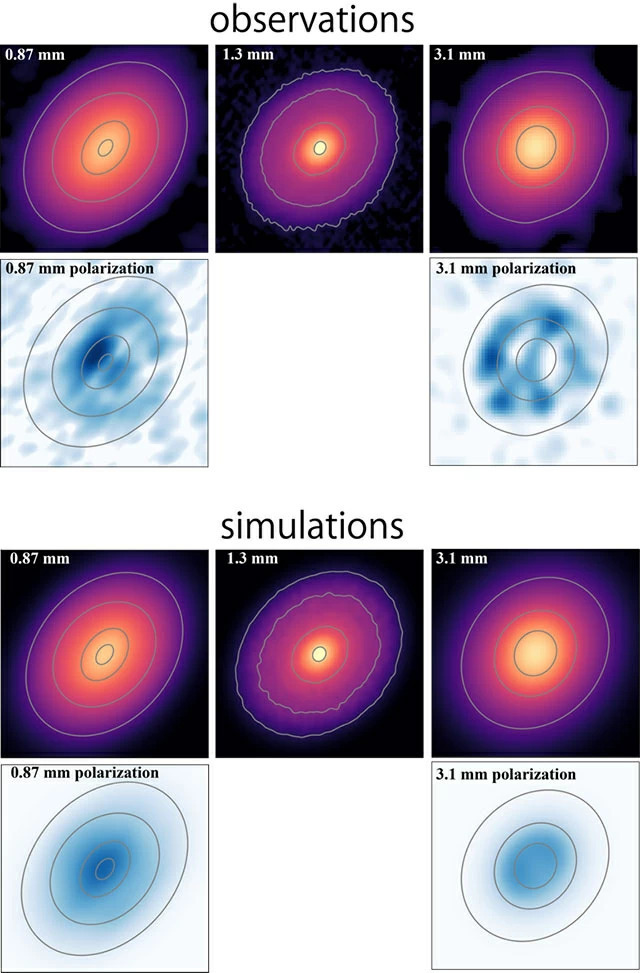
p20230920000100 en 2de95An international team of researchers, led by Assistant Professor Takuya Hashimoto from the University of Tsukuba in Japan and Researcher Javier Álvarez-Márquez from El Centro de Astrobiología (CAB, CSIC-INTA) in Spain, has used the James Webb Space Telescope and the Atacama Large Millimeter/submillimeter Array to observe the most distant galaxy protocluster to date, located 13.14 billion light-years away. The team has successfully captured the "core region" of the galaxy protocluster, which corresponds to a metropolitan area with a particularly high number density of galaxies. They discovered that many galaxies are concentrated in a small area and that the growth of galaxies is accelerated in this region. Additionally, the team used supercomputer simulations to predict the future of this metropolitan area and found that the region will merge into one larger galaxy in tens of millions of years. These findings are expected to shed light on the birth and growth of galaxies. The image describes simulations of the formation of a galaxy cluster similar to A2744z7p9OD, using a supercomputer model. The simulations show a region with high gas density at a cosmological age of 689 million years, and a closer view of the core region, which is observed by the James Webb Space Telescope (JWST). The color map indicates the distribution of oxygen ions. The simulations also show the gradual merging of the four galaxies in the region, which eventually evolve into a larger object. Credit: T. Hashimoto et al.

The study of individual stars' birth and death in galaxies, the birth of new stars from remnants of old ones, and how galaxies grow are important themes in astronomy. They provide insight into our roots in the Universe. Galaxy clusters, one of the largest structures in the Universe, are composed of more than 100 galaxies bound together by mutual gravitational force. Observations of nearby galaxies have shown that the growth of a galaxy depends on its environment. For instance, mature stellar populations are commonly observed in densely collected regions of galaxies. This phenomenon is referred to as the "environment effect." However, it is not well known when the effect first occurred in the history of the Universe. A key to understanding this is observing the ancestors of galaxy clusters soon after the Universe's birth, which are known as galaxy protoclusters or protoclusters. These assemblies consist of about ten distant galaxies. Fortunately, astronomy allows us to observe the distant Universe as it was in the past. For instance, light from a galaxy 13 billion light-years away takes 13 billion years to reach Earth. Therefore, what we observe now is what that galaxy looked like 13 billion years ago. However, light that travels 13 billion light-years becomes fainter, so telescopes that observe it must have high sensitivity and spatial resolution.

A team of researchers led by Assistant Professor Takuya Hashimoto from the University of Tsukuba, Japan, and researcher Javier Álvarez-Márquez from the Spanish Center for Astrobiology used two powerful telescopes, the James Webb Space Telescope (JWST) and the Atacama Large Millimeter/submillimeter Array (ALMA), to study the "core region" of the protocluster A2744z7p9OD. This cluster had been hailed as the most distant proto-cluster at 13.14 billion light-years away based on observations with the JWST by another group of researchers. However, Hashimoto's team discovered that they had not studied the entire core region, which is the metropolitan area with the largest number of galaxy candidates in this protocluster. It was unclear whether the environmental effects of galaxies had begun in this protocluster. Therefore, the team decided to focus their research on the core region. "We wanted to determine if the environmental effects of galaxies had started in the protocluster. Our study will help us better understand the formation and evolution of galaxies in the early universe," said Hashimoto.

During their research, the team utilized the JWST to observe the core region of a protocluster. They used an instrument called NIRSpec, which can observe spectra at wavelengths ranging from visible to near-infrared, to conduct integral field spectroscopy observations. This allowed them to simultaneously acquire spectra from all locations within the field of view. The team was able to detect ionized oxygen-ion light ([OIII] 5008 Å) from four galaxies in a quadrangle region measuring 36,000 light-years along a side. This is equivalent to half the radius of the Milky Way galaxy (Figure 2). The distance of the four galaxies from the Earth was identified as 13.14 billion light years based on the redshift of this light (the elongation of the wavelength due to cosmic expansion). "I was surprised when we identified four galaxies by detecting oxygen-ion emission at almost the same distance. The 'candidate galaxies' in the core region were indeed members of the most distant protocluster," says Yuma Sugahara (Waseda/NAOJ), who led the JWST data analysis.

The research team paid attention to the archival ALMA data, which had already been acquired for this region. This data captures radio emissions from cosmic dust in distant galaxies. After analyzing the data, they were able to detect dust emissions from three out of four galaxies in this region. This is the first time that dust emission has been detected in member galaxies of a protocluster this far back in time. Cosmic dust in galaxies is thought to be supplied by supernova explosions at the end of the evolution of massive stars, which provide material for new stars. Therefore, the presence of large amounts of dust in a galaxy indicates that many of the first-generation stars in the galaxy have already completed their lives and that the galaxy is growing. Professor Luis Colina from El Centro de Astrobiología (CAB, CSIC-INTA) describes the significance of the results: "Emission from cosmic dust was not detected in member galaxies of the protocluster outside the core region. The results indicate that many galaxies are clustered in a small region and that galaxy growth is accelerated, suggesting that environmental effects existed only ~700 million years after the Big Bang."

Additionally, the research team conducted a galaxy formation simulation to test how the four galaxies in the core region formed and evolved. The results showed that a region of dense gas particles existed around 680 million years after the Big Bang. The simulation also showed that four galaxies were formed, similar to the observed core region. To follow the evolution of these four galaxies, the simulation calculated physical processes such as the kinematics of stars and gas, chemical reactions, star formation, and supernovae. The simulations showed that the four galaxies merge and evolve into a single larger galaxy within a few tens of millions of years, which is a short time scale in the evolution of the Universe. Yurina Nakazato, a graduate student at the University of Tokyo who analyzed the simulation data, says "We successfully reproduced the properties of the galaxies in the core region owing to the high spatial resolution of our simulations and the large number of galaxy samples we have. In the future, we would like to explore the formation mechanism of the core region and its dynamical properties in more detail."

Javier Álvarez-Márquez from the Spanish Center for Astrobiology says, "We will conduct more sensitive observations of the proto-cluster A2744z7p9OD with ALMA to see if there are any galaxies that were not visible with the previous sensitivity. We will also apply the JWST and ALMA observations, which have proven to be very powerful, to more protoclusters to elucidate the growth mechanism of galaxies and explore our roots in the Universe."

The James Webb Space Telescope and ALMA have proven to be a powerful combination in exploring the universe. Their joint effort has enabled us to capture the core of the most distant galaxy protocluster ever discovered, providing us with a glimpse of the earliest stages of galaxy formation. This remarkable achievement is a testament to the power of human ingenuity and collaboration and serves as a reminder of the potential of science and technology to unlock the mysteries of the cosmos. With the continued development of these two powerful tools, we can look forward to even more remarkable discoveries in the future.

Eli Van Allen, MD
Eli Van Allen, MD

Deep learning at Dana-Farber unlocks the secrets of kidney cancer

Researchers at Dana-Farber have discovered a potential new way to evaluate certain features of clear cell renal cell carcinoma (ccRCC) using deep learning and image processing. Their AI-based assessment tool analyzes two-dimensional images of a tumor sample taken from a pathology slide and identifies previously unknown features, such as tumor microheterogeneity, that could help predict whether the tumor will respond to immunotherapy. This discovery suggests that pathology slides may contain valuable biological information about ccRCC tumors and other types of tumors, which could be useful in better understanding the biology of cancer.

The work, which is described in Cell Reports Medicine, is part of a broader effort at Dana-Farber to use AI in biologically grounded ways to transform cancer care and cancer discovery.

“This is an example of the growing convergence of AI and cancer biology,” says co-senior author Eliezer Van Allen, MD, Chief of the Division of Population Sciences at Dana-Farber. “It represents a major opportunity to measure key features of the tumor and its immune microenvironment at the same time. These measures could help drive not only biological discovery but also potentially guide cancer care.”

Renal cell carcinoma is a prevalent cancer type, ranking among the top 10 most common cancers globally. The clear cell subtype, specifically, accounts for about 75-80% of metastatic cases. While some tumors respond well to immune checkpoint inhibitors (ICIs), there is currently no reliable method to predict whether a ccRCC tumor will respond to immunotherapy with an ICI.

“We wanted to know what a tumor that responds to immunotherapy looks like,” says first author Jackson Nyman, Ph.D., who was a graduate student in Van Allen’s lab and is now at PathAI. “Is there anything in the pathology slide that might give us clues about what is different about the tumors?”

Pathologists analyze pathology slides of tumor samples that have been stained to reveal the structures of cells as part of the diagnosis process. A crucial measure that is taken into account is the nuclear grade, which indicates how much the tumor cells deviate from normal cells.

As part of a collaborative project, Nyman, Sabina Signoretti, MD, a pathologist at Dana-Farber, and Toni Choueiri, MD, Director of the Lank Center for Genitourinary Oncology at Dana-Farber, trained an AI model to assess a tumor's nuclear grade. The AI model not only successfully assessed the nuclear grade, but was also able to identify variations in grade across a tumor sample.

The team was inspired by their finding to expand their deep learning model. The model was developed to quantify tumor microheterogeneity and immune properties, such as immune infiltration, across the slide. Tumor microheterogeneity measures the degree to which the nuclear grade varies across the slide. Immune infiltration measures how deeply lymphocytes, the warriors of the immune system, have penetrated the tumor. Although pathologists can complete these measures, it is too time-consuming to do routinely.

When the team assessed a set of ccRCC pathology slides with their AI model, they found that some tumors were notably homogeneous while others had many different nuclear grades in various patterns. They also observed that lymphocytes were present in some tumors, while others lacked substantial infiltration.

“There was a visual difference in some patient images versus others that had not been obvious before,” says Nyman. “We wondered if certain patterns might be predictive of a response to immunotherapy.”

The team utilized an AI-based tool to examine pathology slides of tumors from patients who participated in the CheckMate 025 randomized phase 3 clinical trial, to answer a crucial question. The trial tested monotherapy with an ICI or an mTOR inhibitor in patients with ccRCC who had previously undergone standard therapy.

They discovered that certain features, such as tumor microheterogeneity and immune infiltration, were linked to improved overall survival among patients who were taking immune checkpoint inhibitors. The tumors that responded to ICIs had higher levels of tumor microheterogeneity and denser infiltration of lymphocytes in high-grade regions.

“These signals are hiding in plain sight,” says Van Allen. “They are just hard for pathologists to practically measure on individual slides. With AI, we have a scalable way to potentially squeeze a lot more information out of these slides.”

Although the tool is not yet suitable for clinical use, the team is in the process of testing it in an ongoing clinical trial. The trial involves the use of combination immunotherapy as a first-line treatment for patients with ccRCC. Additionally, the team plans to investigate whether these visual clues found in pathology slides are linked to specific molecular features of the tumor, such as gene alterations.

“The use of deep learning strategies to identify tumor and microenvironmental features from histopathology slides and determine their relationship to molecular and clinical states may have value across tumor types and therapeutic modalities,” says Van Allen.

The research conducted by the Dana-Farber Cancer Institute has shown that deep learning can help reveal valuable insights about kidney cancer from pathology slides. This finding has the potential to enhance the accuracy of diagnosis and treatment of kidney cancer, which may lead to better outcomes for patients.

Confocal microscopy image of nuclei, coloured by depth, of Trichoplax sp. H2, one of the four species of placozoan for which the authors of the study created a cell atlas for. Credit: Sebastian R. Najle

Sebe-Pedrós Lab utilizes deep learning to uncover the ancient origins of neurons, unlock their secrets

A recent study published in the journal Cell has shed new light on the evolution of neurons. Researchers from the Centre for Genomic Regulation in Barcelona have focused on placozoans, which are millimeter-sized marine animals. They found that the specialized secretory cells in these unique and ancient creatures may have given rise to neurons in more complex animals.

Placozoans are small creatures that are about the size of a large grain of sand. They feed on algae and microbes found on rocks and other substrates in warm and shallow seas. Despite their simplicity, they have been around for almost 800 million years and are one of the five main lineages of animals, along with Ctenophora (comb jellies), Porifera (sponges), Cnidaria (corals, sea anemones, and jellyfish), and Bilateria (all other animals).

To coordinate their behavior, sea creatures use peptidergic cells, which release small peptides that guide their feeding and movement. In a recent study, the authors used molecular techniques and computational models to understand how placozoan cell types evolved. They were able to piece together how our ancient ancestors might have looked and functioned, shedding light on the origin of these special cells.

The researchers created a map of the different types of cells in placozoans, annotating their characteristics across four species. Each cell type performs a specialized function due to specific sets of genes. The researchers used these maps, called 'cell atlases', to identify clusters or 'modules' of genes that regulate these different cell types, giving them a clear understanding of how each cell works and how they work together. Finally, they compared the cell types across different species to reconstruct their evolution over time.

Through this research, the scientists discovered that the nine main cell types in placozoans are connected by many transitional cell types that change from one type to another. These cells grow and divide, helping to maintain the delicate balance of cell types needed for the animal to move and eat. Additionally, the researchers identified fourteen different types of peptidergic cells, which were unique from all other cells. Unlike other cell types, they showed no evidence of any transitional types or growth and division.

Interestingly, the peptidergic cells share many similarities with neurons - a cell type that didn't appear until millions of years later in more advanced animals such as Bilateria. Cross-species analysis showed that these similarities are unique to placozoans and are not found in other early-branching animals such as sponges or comb jellies (ctenophores).

The study found similarities between peptidergic cells and neurons in three ways. Firstly, the researchers discovered that these placozoan cells differentiate from a group of progenitor epithelial cells through developmental signals that resemble neurogenesis seen in Cnidaria and Bilateria, the process by which new neurons are formed. Secondly, peptidergic cells have many gene modules that build the pre-synaptic scaffold, which is a part of a neuron that can send out messages. However, these cells lack the components required for the receiving end of a neuronal message or the components required for conducting electrical signals, indicating that they are far from being true neurons. Finally, the authors used deep learning techniques to show that placozoan cell types communicate with each other using a system in cells where specific proteins, called GPCRs (G-protein coupled receptors), detect outside signals and start a series of reactions inside the cell. These outside signals are mediated by neuropeptides, chemical messengers used by neurons in many different physiological processes.

This study reveals that the building blocks of neurons formed 800 million years ago in ancestral animals that grazed inconspicuously in the shallow seas of ancient Earth. Early neurons might have started as something similar to the peptidergic secretory cells of today's placozoans. These cells communicated using neuropeptides but eventually gained new gene modules that enabled the creation of post-synaptic scaffolds, axons, and dendrites, as well as ion channels that generate fast electrical signals. These innovations were critical for the dawn of the neuron around 100 million years after the ancestors of placozoans first appeared on Earth.

However, the complete evolutionary story of nerve systems is yet to be told. The first modern neuron is thought to have originated in the common ancestor of cnidarians and bilaterians around 650 million years ago. Although ctenophores have neuronal-like cells, they have important structural differences and lack the expression of most genes found in modern neurons. The presence of some of these neuronal genes in the cells of placozoans and their absence in ctenophores raises new questions about the evolutionary trajectory of neurons.

The study was led by the Sebe-Pedrós Lab with the collaboration of Luis Serrano’s lab (CRG), the Schierwater lab (Hannover University), and the Gruber-Vodicka lab (Kiel University), and with the support of the Proteomics Unit and the Advanced Light Microscopy Unit at the Centre for Genomic Regulation.

“Placozoans lack neurons, but we’ve now found striking molecular similarities with our neural cells. Ctenophores have neural nets, with key differences and similarities with our own. Did neurons evolve once and then diverge, or more than once, in parallel? Are they a mosaic, where each piece has a different origin? These are open questions that remain to be addressed”, says Dr. Xavier Grau-Bové, co-first author of the study and postdoctoral researcher at the Centre for Genomic Regulation.

The origins of neurons and the evolution of other cell types will become clearer as researchers sequence high-quality genomes from diverse species. “Cells are the fundamental units of life, so understanding how they come into being or change over time is key to explaining the evolutionary story of life. Placozoans, ctenophores, sponges, and other non-traditional model animals harbor secrets that we are only just beginning to unlock,” concludes ICREA Research Professor Arnau Sebé-Pedros, corresponding author of the study and Junior Group Leader at the Centre for Genomic Regulation.

The research carried out by Spanish scientists has shed light on the ancient origins of neurons, and the use of deep learning has proven to be an invaluable tool in this endeavor. This study has the potential to pave the way for new avenues of exploration in the field of neuroscience and could lead to a better understanding of how the human brain functions. It is a testament to the fact that technology can be harnessed to uncover secrets of the past and make discoveries about our world. With further research, we may be able to unravel the mysteries of the brain and tap into the full potential of the human mind.

Discern Security: Securing the future with AI-powered policy management

Discern Security has raised $3 million in funding to enhance cybersecurity tools, gain momentum with Fortune 500 companies, and establish partnerships with cybersecurity firms. 

Last year, global organizations invested over $150 billion in cybersecurity measures. Despite these efforts, the increasing number of cyberattacks has resulted in trillions of dollars in annual damages, making it clear that there is a critical need for cybersecurity innovation. Discern Security, a pioneering AI-driven policy management cybersecurity startup has emerged from stealth with $3 million in seed funding to address this existential threat.

The funding round was led by a diverse investor consortium including BoldCap, WestWave Capital, Cyber Mentor Fund, and Security Syndicate, along with influential Global Chief Information Security Officers (CISOs). This spread of investors underscores the opportunity Discern Security presents for the cybersecurity community. 

Discern Security was founded in 2023 by experienced entrepreneurs Sai Venkataraman, Santhosh Purathepparmbil, and Rohan Puri with a vision to revolutionize the cybersecurity landscape by utilizing the immense power of AI. The company operates as a "Policy Intelligence Hub," leveraging AI capabilities to monitor and optimize security controls across a diverse range of cybersecurity tools for its clients. This unique approach fosters the creation of a cohesive cybersecurity mesh architecture, enabling seamless integration among various security products.

Discern Security addresses three major challenges faced by the cybersecurity industry. Firstly, it helps organizations maximize the effectiveness of their security investments by improving the performance of existing products. Secondly, it helps to solve the industry-wide shortage of cybersecurity expertise by taking care of the operational heavy lifting, allowing teams to focus on more strategic initiatives. Lastly, it simplifies the complex configuration process of standalone security products, thus improving both security and productivity. With its Policy Intelligence Hub, Discern Security enables organizations to visualize and optimize their security configurations, ensuring continuous dynamic policy management throughout their cybersecurity tool arsenal. 

Discern Security's platform takes a different approach to cybersecurity compared to traditional security solutions. The platform uses AI to create a proactive and interconnected system for businesses. This approach allows companies to manage their security resources more efficiently and enhances their defenses against advanced cyber threats.

"The cybersecurity landscape demands perpetual innovation and fine-tuning, and our team at Discern Security is resolutely committed to ushering in a paradigm shift. With our platform, businesses gain the advantage of a comprehensive security strategy that not only mitigates risks but also optimizes their security investments. Our mission is to deliver world-class cybersecurity solutions transcending geographical boundaries, safeguarding organizations worldwide," said Sai Venkataraman, Co-founder and CEO at Discern Security.

Discern Security's solution has already gained considerable attention and success, forming partnerships with several Fortune 500 corporations and top-tier cybersecurity firms. 

The funds raised from this funding round will be utilized to expand the product line, integrate essential features, and continue recruiting a team of cybersecurity experts from around the globe. Discern Security is ready to extend these solutions to businesses worldwide, actively protecting their digital assets against ever-changing cyber threats.

"Security threats to organizations continually evolve, yet security policies and configurations at most organizations are infrequently updated, often once or twice a year. This leads to increased risk and vulnerability. Discern's AI-powered solution strategically addresses this need and is poised to create a new category and become a market leader in this space. We are delighted to lead their funding round," said Sathya Nellore Sampat, General Partner at BoldCap.

"Discern Security's innovative AI-driven approach to cybersecurity promises to make a significant impact in the industry. We believe that Sai, Santhosh, and Rohan's visionary leadership positions them as category creators, and we eagerly anticipate supporting their mission to fortify businesses against ever-evolving cyber threats," added Warren Weiss, Managing General Partner at WestWave Capital.

Discern Security has completed a funding round and launched the world's first AI-powered security policy management platform. This achievement highlights the company's commitment to offering advanced security solutions. With this innovative platform, organizations can now have more confidence in their security policies and focus on their core business objectives. Discern Security's customers can expect more cutting-edge security solutions as the company continues to innovate and develop new ways to protect their data.

What evidence did the NIH study provide to show that AI/ML can successfully diagnose Polycystic Ovary Syndrome?

A recent study by the National Institutes of Health found that Artificial intelligence (AI) and machine learning (ML) can be used to detect and diagnose Polycystic Ovary Syndrome (PCOS). PCOS is the most common hormone disorder among women between the ages of 15 and 45. The researchers reviewed published scientific studies that used AI/ML to analyze data to diagnose and classify PCOS. They concluded that AI/ML-based programs were successful in detecting PCOS.

“Given the large burden of under- and misdiagnosed PCOS in the community and its potentially serious outcomes, we wanted to identify the utility of AI/ML in the identification of patients that may be at risk for PCOS,” said Janet Hall, M.D., senior investigator and endocrinologist at the National Institute of Environmental Health Sciences (NIEHS), part of NIH, and a study co-author. “The effectiveness of AI and machine learning in detecting PCOS was even more impressive than we had thought.”

Polycystic ovary syndrome (PCOS) is a hormonal disorder that affects the proper functioning of the ovaries. In many cases, it is accompanied by higher levels of testosterone. This condition can lead to a range of symptoms, including irregular periods, acne, excessive facial hair growth, or baldness. Women with PCOS are more likely to develop type 2 diabetes, as well as sleep, psychological, cardiovascular, and other reproductive disorders such as uterine cancer and infertility.

“PCOS can be challenging to diagnose given its overlap with other conditions,” said Skand Shekhar, M.D., senior author of the study and assistant research physician and endocrinologist at the NIEHS.

“These data reflect the untapped potential of incorporating AI/ML in electronic health records and other clinical settings to improve the diagnosis and care of women with PCOS,” said Shekhar.

The diagnosis of polycystic ovary syndrome (PCOS) is based on standardized criteria that include clinical features, laboratory findings, and radiological evidence. However, PCOS is often difficult to diagnose because some of its symptoms can overlap with other conditions. To improve the accuracy of diagnosis, researchers suggest integrating large population-based studies with electronic health datasets and using machine learning (ML) to identify sensitive diagnostic biomarkers. ML is a type of artificial intelligence (AI) that can process large amounts of data, such as electronic health records. 

In a recent study, researchers conducted a systematic review of peer-reviewed studies published in the last 25 years that used AI/ML to diagnose PCOS. They screened 135 studies and included 31 in their analysis. The studies were all observational and assessed the use of AI/ML technologies for diagnosing PCOS. Ultrasound images were used in about half of the studies, and the average age of the participants was 29. 

The accuracy of PCOS diagnosis using AI/ML varied across the studies. Among the 10 studies that used standardized diagnostic criteria, the accuracy of detection ranged from 80-90%. The findings suggest that AI/ML can be a valuable tool for diagnosing difficult-to-diagnose disorders like PCOS.

“Across a range of diagnostic and classification modalities, there was an extremely high performance of AI/ML in detecting PCOS, which is the most important takeaway of our study,” said Shekhar. The use of AI/ML-based programs has the potential to significantly improve our ability to detect women with PCOS early, which can lead to cost savings and lessen the burden of PCOS on patients and the health system. Further studies with strong validation and testing practices will enable a smooth integration of AI/ML for chronic health conditions. NIEHS clinical studies are currently underway to understand and detect PCOS. To learn more, you can join an NIEHS study.

The findings of the NIH study are clear: AI/ML can be used to successfully diagnose Polycystic Ovary Syndrome. This is a major breakthrough in the medical field, as it demonstrates the potential of AI/ML to improve the accuracy and speed of diagnosis for this and other conditions. With further research and development, AI/ML could revolutionize the way medical professionals diagnose and treat patients.

Grants: This work was supported by the Intramural Research Program of the NIH/National Institute of Environmental Health Sciences (ZIDES102465 and ZIDES103323).