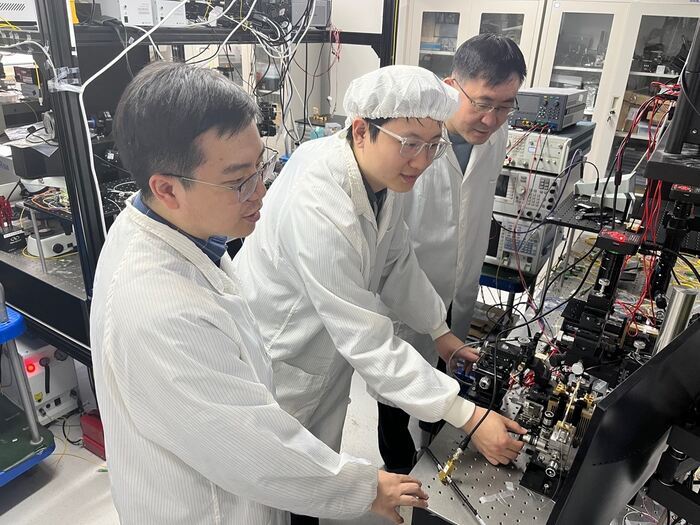
Experimental setup depicting the ferrimagnetic insulator yttrium iron garnet (YIG) wafer with nanomagnetic strips © LMGN EPFL

Swiss magnonics researchers demo spin waves for a new supercomputing architecture

EPFL researchers have sent and stored data using charge-free magnetic waves, rather than traditional electron flows. The discovery could solve the dilemma of energy-hungry computing technology in the age of big data.

Like electronics or photonics, magnonics is an engineering subfield that aims to advance information technologies when it comes to speed, device architecture, and energy consumption. A magnon corresponds to the specific amount of energy required to change the magnetization of a material via a collective excitation called a spin wave. 

Because they interact with magnetic fields, magnons can be used to encode and transport data without electron flows, which involve energy loss through heating (known as Joule heating) of the conductor used. As Dirk Grundler, head of the Lab of Nanoscale Magnetic Materials and Magnonics (LMGN) in the School of Engineering explains, energy losses are an increasingly serious barrier to electronics as data speeds and storage demands soar.

“With the advent of AI, the use of computing technology has increased so much that energy consumption threatens its development,” Grundler says. “A major issue is traditional computing architecture, which separates processors and memory. The signal conversions involved in moving data between different components slow down computation and waste energy.”

This inefficiency, known as the memory wall or Von Neumann bottleneck, has had researchers searching for new supercomputing architectures that can better support the demands of big data. And now, Grundler believes his lab might have stumbled on such a “holy grail.”

While doing other experiments on a commercial wafer of the ferrimagnetic insulator yttrium iron garnet (YIG) with nanomagnetic strips on its surface, LMGN Ph.D. student Korbinian Baumgaertl was inspired to develop precisely engineered YIG-nanomagnet devices. With the Center of MicroNanoTechnology‘s support, Baumgaertl was able to excite spin waves in the YIG at specific gigahertz frequencies using radiofrequency signals, and – crucially – to reverse the magnetization of the surface nanomagnets.

“The two possible orientations of these nanomagnets represent magnetic states 0 and 1, which allows digital information to be encoded and stored,” Grundler explains.

A route to in-memory computation

The scientists made their discovery using a conventional vector network analyzer, which sent a spin wave through the YIG-nanomagnet device. Nanomagnet reversal happened only when the spin wave hit a certain amplitude, and could then be used to write and read data.

“We can now show that the same waves we use for data processing can be used to switch the magnetic nanostructures so that we also have nonvolatile magnetic storage within the very same system,” Grundler explains, adding that “nonvolatile” refers to the stable storage of data over long periods without additional energy consumption.

It’s this ability to process and store data in the same place that gives the technique its potential to change the current computing architecture paradigm by putting an end to the energy-inefficient separation of processors and memory storage, and achieving what is known as in-memory computation.

Optimization on the horizon

Baumgaertl, Grundler, and the LMGN team are already working on optimizing their approach.

“Now that we have shown that spin waves write data by switching the nanomagnets from states 0 to 1, we need to work on a process to switch them back again – this is known as toggle switching,” Grundler says.

He also notes that theoretically, the magnonics approach could process data in the terahertz range of the electromagnetic spectrum (for comparison, current computers function in the slower gigahertz range). However, they still need to demonstrate this experimentally.

“The promise of this technology for more sustainable computing is huge. With this publication, we are hoping to reinforce interest in wave-based computation, and attract more young researchers to the growing field of magnonics."

black hole - lensing geometry

UK prof Nightingale uses gravitational lensing, supercomputing to discover one of the biggest black holes

The team, led by Durham University, UK, used gravitational lensing - where a foreground galaxy bends the light from a more distant object and magnifies it – and supercomputer simulations on the DiRAC HPC facility, which enabled the team to closely examine how light is bent by a black hole inside a galaxy hundreds of millions of light-years from Earth. 

They found an ultramassive black hole, an object over 30 billion times the mass of our Sun, in the foreground galaxy – a scale rarely seen by astronomers. 

{media id=303,layout=solo}

This is the first black hole found using the technique, whereby the team simulates light traveling through the Universe hundreds of thousands of times. Each simulation includes a different mass black hole, changing light’s journey to Earth.

When the researchers included an ultramassive black hole in one of their simulations the path taken by the light from the faraway galaxy to reach Earth matched the path seen in real images captured by the Hubble Space Telescope.

The lead writer Dr. James Nightingale, Department of Physics, Durham University, said: “This particular black hole, which is roughly 30 billion times the mass of our Sun, is one of the biggest ever detected and on the upper limit of how large we believe black holes can theoretically become, so it is an extremely exciting discovery.” An artist’s impression of a black hole, where the black hole’s intense gravitational field distorts the space around it. This warps images of background light, lined up almost directly behind it, into distinct circular rings. This gravitational "lensing" effect offers an observation method to infer the presence of black holes and measure their mass, based on how significant the light bending is. The Hubble Space Telescope targets distant galaxies whose light passes very close to the centers of intervening fore-ground galaxies, which are expected to host supermassive black-holes over a billion times the mass of the sun.  CREDIT ESA/Hubble, Digitized Sky Survey, Nick Risinger (skysurvey.org), N. Bartmann

A gravitational lens occurs when the gravitational field of a foreground galaxy appears to bend the light of a background galaxy, meaning that we observe it more than once.

Like a real lens, this also magnifies the background galaxy, allowing scientists to study it in enhanced detail.

Dr. Nightingale said: “Most of the biggest black holes that we know about are in an active state, where matter pulled in close to the black hole heats up and releases energy in the form of light, X-rays, and other radiation.

“However, gravitational lensing makes it possible to study inactive black holes, something not currently possible in distant galaxies. This approach could let us detect many more black holes beyond our local universe and reveal how these exotic objects evolved further back in cosmic time.”

The study, which also includes Germany’s Max Planck Institute, opens up the tantalizing possibility that astronomers can discover far more inactive and ultramassive black holes than previously thought, and investigate how they grew so large.

The story of this particular discovery started back in 2004 when fellow Durham University astronomer, Professor Alastair Edge, noticed a giant arc of a gravitational lens when reviewing images of a galaxy survey.

Fast forward 19 years and with the help of some extremely high-resolution images from NASA’s Hubble telescope and the DiRAC COSMA8 supercomputer facilities at Durham University, Dr. Nightingale and his team were able to revisit this and explore it further.

The team hopes that this is the first step in enabling deeper exploration of the mysteries of black holes, and that future large-scale telescopes will help astronomers study even more distant black holes to learn more about their size and scale.

The research was supported by the UK Space Agency, the Royal Society, the Science and Technology Facilities Council (STFC), part of UK Research and Innovation (UKRI), and the European Research Council.

This work used both the DiRAC Data Intensive Service (CSD3) and the DiRAC Memory Intensive Service (COSMA8), hosted by the University of Cambridge and Durham University on behalf of the DiRAC High-Performance Computing facility.

Gravitational Lensing

A video showing how Astronomers used gravitational lensing to discover a black hole 30 billion times the mass of the sun in a galaxy 2 billion light years away.

Read more

Image Caption: Probing where the protons go using synchrotron radiation. A computer rendering of the experiment. Using synchrotron radiation, and simulations via supercomputers and machine learning on top of thermogravimetric analysis, researchers were able to observe where protons are introduced in their perovskite based SOFC electrolyte. (Kyushu University/Yamazaki Lab)

Japanese prof Yamazaki probes where the protons go to develop better fuel cells

Unraveling the inner workings of solid oxide fuel cells through the integration of computational data and hands-on experimentation

Solid oxide fuel cells, or SOFC, is a type of electrochemical device that generates electricity using hydrogen as fuel, with the only 'waste' product being water. Naturally, as we strive to reduce our carbon output and mitigate the casualties of the climate crisis, both business and academia have taken a major interest in the development of SOFCs.

In what can potentially accelerate the development of more efficient SOFCs, a research team in Fukuoka, Japan, led by Kyushu University has uncovered the chemical inner workings of a perovskite-based electrolyte they developed for SOFCs. The duo combined synchrotron radiation analysis, large-scale supercomputer simulations, machine learning, and thermogravimetric analysis, to uncover the active site where hydrogen atoms are introduced within the perovskite lattice in its process to produce energy. The results were published in the journal Chemistry of Materials

At the fundamental level, a fuel cell is just a device that generates electricity by facilitating the split of a hydrogen atom into its positively charged proton and negatively charged electron. The electron is used to generate electricity, and then comes together with a proton and oxygen and produces water as a 'waste' product.

The material at the literal center of all this is the electrolyte. This material acts as an atomic sieve that facilitates the transfer of specific atoms across the fuel cell. Depending on the type of fuel cell, those atoms could be protons or oxygen.

While SOFCs may be an uncommon term to many people, the technology has already been commercialized in generators for single-family homes. Nonetheless, they remain expensive, with one of the most significant obstacles being their high operating temperature.

"Conventional SOFCs need to be at 700-1000℃ for the electrolyte to perform efficiently," explains Professor Yoshihiro Yamazaki at Kyushu University's Platform of Inter-/Transdisciplinary Energy Research, who led the research. "Naturally, there's a global race to develop SOFC electrolytes that can operate at lower temperatures of around 300-450℃. One such promising materials are perovskites."

Perovskites are a category of material with a specific crystalline structure that allows them to possess unique physical, optical, and even electrical properties. Moreover, since they can be artificially synthesized with different atoms, a large body of research focuses on developing and testing a near-infinite number of possible perovskites.

One such case is in developing better SOFC electrolytes.

"In our past work, we developed a Barium and Zirconium based perovskite with the chemical composition BaZrO3. By replacing the Zr site with a high concentration of Scandium, or Sc, we succeeded in making a high-performance electrolyte that can function at our target temperature of 400℃," explains Yamazaki. "Of course, that was only a part of what we wanted to find. We also were investigating a question that hadn't been solved for over three decades: where in the electrolyte's lattice do the protons get introduced?"

Probing the inner workings of SOFCs had been difficult due to its high operating temperature and changing pressure from the water, the fuel cell's source of hydrogen.

To get around these issues, the team conducted X-ray absorption spectroscopy experiments on their perovskite electrolyte using synchrotron radiation—the electromagnetic radiation emitted from particle accelerators—while the fuel cell was active at around 400℃.

"These results gave us insight into where in the material's chemical structure the protons would be incorporated. From there we applied machine learning, and using a supercomputer calculated possible structural configurations of the material," continued Yamazaki. "By carefully comparing the predicted results with experimental data we were able to clarify the structural changes the electrolyte undertakes when active."

 "Now that we have the fundamental inner workings of the electrolyte we can being optimizing its nanostructures and even propose new materials that can lead to more efficient fuel cells and even ones that work at wider temperature ranges," concludes Yamazaki.

The spike caption of SARS-CoV2, the virus that causes COVID-19. RIKEN researchers have found that the D614G mutation restructures the Spike protein toward a state that is primed for infecting cells. © LAGUNA DESIGN/SCIENCE PHOTO LIBRARY

Japan's RIKEN Fugaku supercomputer reveals how an early mutation in the COVID-19 virus helped it spread so fast

Molecular supercomputer modeling suggests structural consequences of an early protein mutation that promoted the viral transmission

The rapid spread of COVID-19 may have been partly due to changes in the structure of the SARS-CoV-2 virus wrought by an early mutation in its genome, a detailed analysis by RIKEN researchers suggests. The finding could help inform the development of next-generation vaccines and antiviral drugs.

Alpha, Delta, Omicron, and other variants of concern have been making news throughout the COVID-19 pandemic. But the most significant mutation may have occurred in the early days of the pandemic, and it might have enabled the virus to spread so rapidly.

Yuji Sugita of the RIKEN Center for Computational Science (R-CCS) and Hisham Dokainish, who was at R-CCS at the time of the study, investigated the effect of mutations on the viral structure. They did this by simulating the atomic positions of molecules found in different forms of the virus’s important spike protein—a tool coronaviruses use to bind and enter human cells.

They found that the substitution of a single amino acid altered this protein’s shape, helping SARS-CoV-2 to adapt to human hosts. This finding demonstrates how even tiny mutations—swapping a single amino acid in this case—can greatly affect protein dynamics.

To understand why the mutation proved so advantageous to the virus, the pair ran detailed simulations of the protein’s structure and stability. Their analysis, done using the RIKEN Fugaku supercomputer, one of the fastest in the world, revealed how the mutation (known as D614G) breaks an ionic bond with a second subunit of the Spike protein. It also changes the shape of a nearby loop structure, which alters the orientation of the entire protein, locking it into a form that makes it easier for the virus to enter cells (Fig. 1).

“A single and local change in an interaction within the molecule caused by a single mutation could affect the global structure of the spike protein,” explains Sugita, who is additionally affiliated with the RIKEN Center for Biosystems Dynamics Research. The resulting mutant proved better at replicating and transmitting between human hosts, and the D614Glineage quickly outcompeted its ancestral lineages and spread across the globe. It remains a fixture of every dominant variant that has followed.

Sugita’s team is now performing similar investigations of adaptive viral mutations that arose later in the course of the pandemic, including those found in the Omicron variant.

“Information obtained from our molecular dynamics simulations should help increase the opportunities for us to find effective drugs and other medicines,” he says.