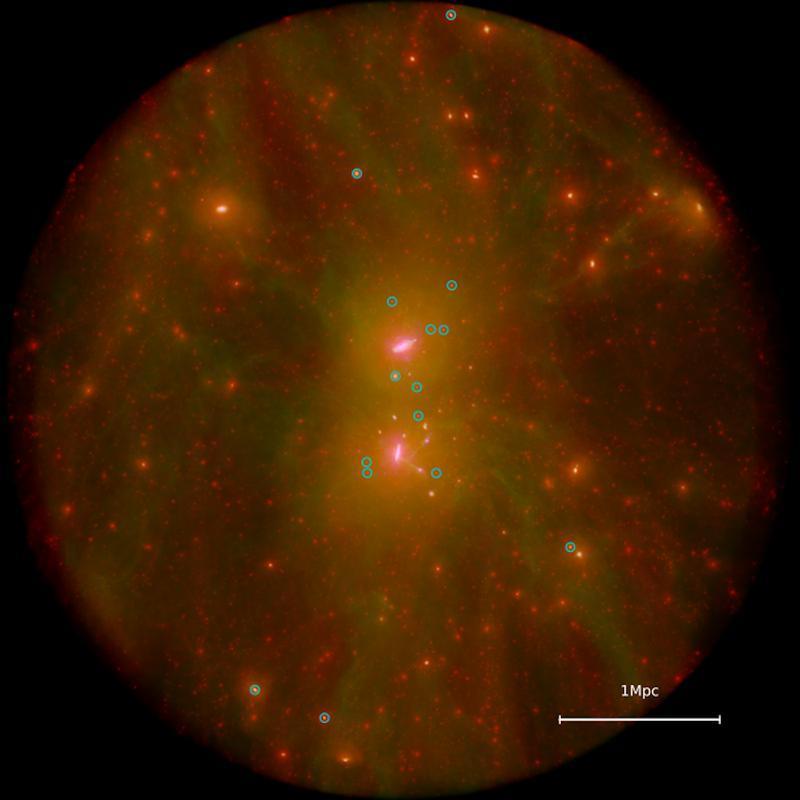
NASA, ESA, and M. Montes (University of New South Wales) Massive galaxy cluster Abell S1063 as captured by NASA's Hubble Space Telescope

Institute for Advanced Study astrophysicists deploy AI to show how to 'weigh' galaxy clusters

Scholars from the Institute for Advanced Study in Princeton, New Jersey, have used a machine learning algorithm known as “symbolic regression” to generate new equations that help solve a fundamental problem in astrophysics: inferring the mass of galaxy clusters.

Galaxy clusters are the most massive objects in the Universe: a single cluster contains anything from a hundred to many thousands of galaxies, alongside collections of plasma, hot X-ray emitting gas, and dark matter. These components are held together by the cluster’s gravity. Understanding such galaxy clusters is crucial to pinning down the origin and continuing evolution of our universe. Digvijay Wadekar The performance of the new equation from symbolic regression is shown in the middle panel, whereas that of the traditional method is shown in the top. The lower panel explicitly quantifies the reduction in the scatter.

Perhaps the most crucial quantity determining the properties of a galaxy cluster is its total mass. But measuring this quantity is difficult—galaxies cannot be “weighed” by placing them on a scale. The problem is further complicated by the fact that the dark matter that makes up much of a cluster’s mass is invisible. Instead, scientists infer the mass of a cluster from other observable quantities.

Previously, scholars considered a cluster’s mass to be roughly proportional to another, more easily measurable quantity called the “integrated electron pressure” (or the Sunyaev-Zel’dovich flux, often abbreviated to YSZ). The theoretical foundations of the Sunyaev-Zel’dovich flux were laid in the early 1970s by Rashid Sunyaev, a current Distinguished Visiting Professor in the Institute’s School of Natural Sciences, and his collaborator Yakov B. Zel’dovich.

However, the integrated electron pressure is not a reliable proxy for mass because it can behave inconsistently across different galaxy clusters. The outskirts of clusters tend to exhibit very similar YSZ, but their cores are much more variable. The YSZ/mass equivalence was problematic in that it gave equal weight to all parts of the cluster. As a result, a lot of “scatter” was observed, meaning that the error bars on the mass inferences were large.

Digvijay Wadekar, a current Member of the Institute’s School of Natural Sciences, has worked with collaborators across ten different institutions to develop an AI program to improve the understanding of the relationship between the mass and the YSZDigvijay Wadekar The trade-offs between different machine learning techniques. Symbolic regression is much less powerful than deep neural networks on high-dimensional datasets, but it is much more interpretable as it provides mathematical equations as output.

Wadekar and his collaborators “fed” their AI program with state-of-the-art cosmological simulations that have been developed by groups at the Harvard & Smithsonian Center for Astrophysics, and at the Flatiron Institute's Center for Computational Astrophysics (CCA) in New York. Their program searched for and identified additional variables that might make inferring the mass from the YSZ more accurate.

AI is useful for identifying new parameter combinations that could be overlooked by human analysts. While it is easy for human analysts to identify two significant parameters in a data set, AI is better able to parse through high volumes often revealing unexpected influencing factors.

More specifically, the AI method that Wadekar and his collaborators employed is known as symbolic regression. “Right now, a lot of the machine learning community focuses on deep neural networks,” Wadekar explained. “These are very powerful but the drawback is that they are almost like a black box. We cannot understand what goes on in them. In physics, if something is giving good results, we want to know why it is doing so. Symbolic regression is beneficial because it searches a given dataset and generates simple, mathematical expressions in the form of simple equations that you can understand. It provides an easily interpretable model.”

Their symbolic regression program (called PySR) handed them a new equation, which was able to better predict the mass of the galaxy cluster by augmenting YSZ with information about the cluster’s gas concentration. Wadekar and his collaborators then worked backward from this AI-generated equation and tried to find a physical explanation for it. They realized that gas concentration is correlated with the noisy areas of clusters where mass inferences are less reliable. Their new equation, therefore, improved mass inferences by providing a way for these noisy areas of the cluster to be “down-weighted”. In a sense, the galaxy cluster can be compared to a spherical doughnut. The new equation extracts the jelly at the center of the doughnut (that introduces larger errors), and concentrates on the doughy outskirts for more reliable mass inferences.

The new equations can provide observational astronomers engaged in upcoming galaxy cluster surveys with better insights into the mass of the objects that they observe. “There are quite a few surveys targeting galaxy clusters which are planned shortly,” Wadekar stated. “Examples include the Simons Observatory (SO), the Stage 4 CMB experiment (CMB-S4), and an X-ray survey called eROSITA. The new equations can help us in maximizing the scientific return from these surveys.”

He also hopes that this publication will be just the tip of the iceberg when it comes to using symbolic regression in astrophysics. “We think that symbolic regression is highly applicable to answering many astrophysical questions,” Wadekar added. “In a lot of cases in astronomy, people make a linear fit between two parameters and ignore everything else. But nowadays, with these tools, you can go further. Symbolic regression and other artificial intelligence tools can help us go beyond existing two-parameter power laws in a variety of different ways, ranging from investigating small astrophysical systems like exoplanets to galaxy clusters, the biggest things in the universe.”

Climate change is making outbreaks zoonotic diseases, such as dengue fever, more frequent in Chinese Taiwan. Leveraging climatic data and artificial intelligence models could be a convenient strategy to predict the most likely time and place of future outbreaks, helping local governments give out early warnings to potentially affected areas.

Japanese prof Anno trains ML model with climatic, epidemiology remote sensing data to predict the spatiotemporal distribution of disease outbreaks

Cases of dengue fever and other zoonotic diseases will keep increasing owing to climate change, and prevention via early warning is one of our best options against them. Recently, researchers combined a machine learning model with remote sensing climatic data and information on past dengue fever cases in Chinese Taiwan, to predict likely outbreak locations. Their findings highlight the hurdles to this approach and could facilitate more accurate predictive models.

Outbreaks of zoonotic diseases, which are those transmitted from animals to humans, are globally on the rise owing to climate change. In particular, the spread of diseases transmitted by mosquitoes is very sensitive to climate change, and Chinese Taiwan has seen a worrisome increase in the number of cases of dengue fever in recent years.

Like for most known diseases, the popular saying “an ounce of prevention is worth a pound of cure” also rings true for dengue fever. Since there is still no safe and effective vaccine for all on a global scale, dengue fever prevention efforts rely on limiting places where mosquitoes can lay their eggs and giving people an early warning when an outbreak is likely to happen. However, thus far, there are no mathematical models that can accurately predict the location of dengue fever outbreaks ahead of time.

To address this issue, a research team including Professor Sumiko Anno from Sophia University, Japan, sought to combine artificial intelligence (AI) with remote sensing data to predict the spatiotemporal distribution of dengue fever outbreaks in Chinese Taiwan. This work, which was published in Geo-spatial Information Science, was co-authored by Hirakawa Tsubasa, Satoru Sugita, and Shinya Yasumoto, all from Chubu University, Ming-An Lee from National Taiwan Ocean University, and Yoshinobu Sasaki and Kei Oyoshi from the Japan Aerospace Exploration Agency (JAXA), Japan.

First, the team gathered climatic data of Chinese Taiwan from 2002 to 2020, including data on rainfall, sea-surface temperature, and shortwave radiation. They also gathered information on the place of residence of all reported dengue fever cases registered in the Chinese Taiwan Centre for Disease Control. This enabled the researchers to prepare a labeled training dataset for the AI model, which should ideally be capable of finding hidden patterns between dengue fever cases and climatic parameters.

The AI model in question was a convolutional neural network (CNN) with a U-Net-based encoder–decoder architecture. “The U-Net model works with remarkably few training images and yields more precise semantic segmentation when provided with the location information,” explains Prof. Anno about the choice of AI model for their study. This well-established design usually performs well in image segmentation tasks, even when trained with few samples. After training the model, the team attempted to validate it using the remaining gathered data.

Unfortunately, the model did not perform as well as the researchers hoped it would. Most of the pixels on the map of Taiwan marked as predicted dengue fever outbreak locations did not match the original data. However, not all hope is lost for this approach, as Prof. Anno highlights: While most of the predicted outbreak pixels did not overlap with the ground truth, some of them were located quite close to actual outbreak locations. This implies that the spatiotemporal prediction of dengue fever outbreaks using remote sensing data is possible.

Despite the low accuracy of the AI model, this study brought to light some of the current challenges of using remote sensing data for predicting the spatiotemporal distribution of zoonotic disease outbreaks. The research team believes that using a different model architecture, finding a way of balancing the training dataset and gathering higher-resolution satellite data could all be promising ways to achieve the necessary performance. 

More work will be required before we can use machine learning as a tool to pinpoint potential disease outbreak zones based on climatic data, but we must not falter. “Spatiotemporal visualizations generated by deep learning models could potentially guide the implementation of effective measures against disease outbreaks at the optimal time and location for disease prevention and control,” concludes Prof. Anno, optimistically.

China aims to improve the capability of models in simulating key climate patterns of the Northern Hemisphere

The warm Arctic-cold Eurasia (WACE) climate pattern is the main feature of winter temperature in the Northern Hemisphere in the last 20 years. Extreme cold events related to this pattern have occurred frequently in the Northern Hemisphere.

The ability of climate models to simulate WACE directly affects the skill in simulating winter temperature. Past studies have shown that previous generations of climate models were poor at simulating midlatitude atmospheric response to sea ice, making them simulate a weaker-than-observed WACE.

Now, scientists from the Institute of Atmospheric Physics of the Chinese Academy of Sciences, China Meteorological Administration, and Nanjing University of Information Science and Technology have evaluated the ability of CMIP6 models (i.e., models participating in phase 6 of the Coupled Model Intercomparison Project) to simulate WACE and revealed the key factors influencing the differences in simulation capability.

Results showed that the CMIP6 multi-model ensemble mean was better able to simulate WACE, but there were still large gaps among individual models. Models with good ability in simulating climatic states and extremes of Eurasian winter temperatures also showed more skill in simulating WACE.

"The difference in the simulation of extremes was mainly reflected in the ability to simulate the warming anomalies in the Barents Sea-Kara Sea (BKS) region," said ZHAO Liang, co-author of the study.

Further analysis showed that the models' simulations of BKS warming anomalies were related to their reflection of the location and persistence of the Ural blocking (a large-scale anticyclone that occurs in the Ural Mountains region), which transmits heat northwards to the BKS, thereby warming the Arctic, strengthening the downstream westerly trough, and cooling central Eurasia. Therefore, the simulation of the Ural blocking is the key to improving the capability of climate models in simulating WACE.

Professor Peter McClintock with Professor Aneta Stefanovska, who led the group

Lancaster prof Stefanovska enables viz of electron dynamics on liquid helium

An international team led by Lancaster University in England has discovered how electrons can slither rapidly to and fro across a quantum surface when driven by external forces. 

The research, published in Physical Review B, has enabled the visualization of the motion of electrons on liquid helium for the first time.

The experiments, carried out in Riken, Japan, by Kostyantyn Nasyedkin (now at Oak Ridge National Laboratory, USA) in the lab of Kimitoshi Kono (now in Taiwan at Yang Ming Chiao Tung University) detected unusual oscillations whose frequencies varied in time. Although it was unclear how the electrons were moving in the darkness and extreme cold at the bottom of the cryostat, it was evident that the time variations were much like those seen in living systems.

Professor Kono said: “At very low temperatures, the surface of liquid helium is an exceptionally slippery place. Interesting things happen there, and it is important because of the potential for quantum computing using electrons on the helium surface.

“Such electrons move very easily because, with a slippery surface below and a vacuum above, there is nothing to slow them down.”

The Riken data were analyzed at Lancaster University using methods developed by Professor Aneta Stefanovska and her group, mainly for biological applications. Lancaster Ph.D. student Hala Siddiq (now at Jazan University, Saudi Arabia) applied these methods. She and her principal supervisor Professor Stefanovska interpreted the results in collaboration with Riken’s team and Lancaster experts in low-temperature physics, Dmitry Zmeev, Yuri Pashkin, and Peter McClintock.

The work has enabled the electrons’ motion to be visualized, showing how they slide around in part-circular and part-radial patterns of motion in the vacuum above the liquid surface. An additional complication revealed by Siddiq’s analysis is that the surface itself is moving gently in an up-and-down vertical motion. Moreover, her results indicate a combination of quantum and classical dynamics.

Professor Stefanovska said: “Appreciation of these features will be important for practical applications across wide areas of physics, life sciences, and even sociology. Namely, they provide a paradigmatic example of the physics of non-isolated systems and the mathematics of non-autonomous systems. Moreover, the experimental model can be used to study properties of living systems, and similar technical or societal systems, in a very controlled way.”

The compact radio jet in the center of the Teacup galaxy blows a lateral turbulent wind in the cold dense gas, as predicted by the simulations. Credit: HST/ ALMA/ VLA/ M. Meenakshi/ D. Mukherjee/ A. Audibert

Audibert discovers relativistic jets blowing bubbles in the central region of the Teacup Galaxy

A study led by Anelise Audibert, a researcher at the Instituto de Astrofísica de Canarias (IAC) in the Canary Islands, Spain, reveals a process that explains the peculiar morphology of the central region of the Teacup galaxy, a massive quasar located 1.3 billion light-years away from us. This object is characterized by the presence of expanding gas bubbles produced by winds emanating from its central supermassive black hole. The study confirms that a compact jet, only visible at radio waves, is altering the shape and increasing the temperature of the surrounding gas, blowing bubbles that expand laterally. These findings, based on observations from the ALMA telescope in Chile and hydrodynamical simulations, are published today in the journal Astronomy & Astrophysics Letters.

When matter falls into supermassive black holes in the centers of galaxies, it unleashes enormous amounts of energy and is called active galactic nuclei (or AGN). A fraction of AGN releases part of this energy as jets that are detectable in radio wavelengths that travel at velocities close to light speed. While the jet travels across the galaxy, it collides with the clouds and gas around it and in some cases may push this material away in the form of winds. However, which conditions preferentially trigger these winds to blow out the gas from galaxies is still poorly understood.

The effect of jets impacting the content of the galaxies, like the stars, dust, and gas, plays an important role in how galaxies evolve in the Universe. The most powerful radio jets, hosted in ´radio-loud’ galaxies, are responsible for drastically changing the fate of galaxies because they heat the gas, preventing new star formation and galaxy growth. Supercomputer simulations of relativistic jets piercing into disk galaxies predict that jets alter the shape of the surrounding gas by blowing bubbles as they penetrate further into the galaxy. One of the key elements in the simulations that make the jets efficient in driving winds is the angle between the gaseous disk and the jet’s direction of propagation. Surprisingly, less powerful jets, like the ones in ‘radio-quiet’ galaxies, are able to inflict more damage on the surrounding medium than the very powerful ones.

An international scientific team, led by the IAC researcher Anelise Audibert, discovered an ideal case in which to study the interaction of the radio jet with the cold gas around a massive quasar: the Teacup galaxy. The Teacup is a radio-quiet quasar located 1.3 billion light years from us and its nickname comes from the expanding bubbles seen in the optical and radio images, one of which is shaped like the handle of a teacup. In addition, the central region (around 3300 light-years in size) harbors a compact and young radio jet that has a small inclination relative to the galaxy disk. 

Effects on star formation

Using observations performed in the Chilean desert with the Atacama Large Millimeter/submillimeter Array (ALMA), the team was able to characterize with an unprecedented level of detail the cold, dense gas in the central part of the Teacup. In particular, they detected the emission of carbon monoxide molecules that can only exist under certain conditions of density and temperature. Based on these observations, the team found that the compact jet, despite its low power, is not only clearly disrupting the distribution of the gas and heating it, but also accelerating it in an unusual way. 

The team expected to detect extreme conditions in the impacted regions along the jet, but when they analyzed the observations, they found that the cold gas is more turbulent and warmer in the directions perpendicular to the jet propagation. “This is caused by the shocks induced by the jet-driven bubble, which heats up and blows the gas in its lateral expansion”, explains A. Audibert “Supported by the comparison with computer simulations, we believe that the orientation between the cold gas disk and the jet is a crucial factor in efficiently driving these lateral winds”, she adds.

“It was previously believed that low-power jets had a negligible impact on the galaxy, but works like ours show that, even in the case of radio-quiet galaxies, jets can redistribute and disrupt the surrounding gas, and this will have an impact on the galaxy's ability to form new stars”, says Cristina Ramos Almeida, an IAC researcher, and co-author of the study. 

The next step is to observe a larger sample of radio-quiet quasars with MEGARA, an instrument installed on the Gran Telescopio CANARIAS (GTC or Grantecan). The observations will help us to understand the impact of the jets on the more tenuous and hot gas, and to measure changes in star formation caused by winds. This is one of the goals of the QSOFEED project, developed by an international team led by C. Ramos Almeida at the IAC, whose aim is to discover how winds from supermassive black holes affect the galaxies that host them.