


SUPERCOMPUTING NEWS SUPERCOMPUTING NEWS
    • MEDIA KIT
    • MOST READ
    • RSS FEED
    • ACADEMIA
    • AEROSPACE
    • APPLICATIONS
    • ASTRONOMY
    • AUTOMOTIVE
    • BIG DATA
    • BIOLOGY
    • CHEMISTRY
    • CLIENTS
    • CLOUD
    • DEFENSE
    • DEVELOPER TOOLS
    • EARTH SCIENCES
    • ECONOMICS
    • ENGINEERING
    • ENTERTAINMENT
    • GAMING
    • GOVERNMENT
    • HEALTH
    • OIL & GAS
    • INDUSTRY
    • INTERCONNECTS
    • MANUFACTURING
    • MIDDLEWARE
    • MOVIES
    • NETWORKS
    • PHYSICS
    • PROCESSORS
    • RETAIL
    • SCIENCE
    • STORAGE
    • SYSTEMS
    • VISUALIZATION
    • AcyMailing subscription form

    • ADD YOUR VIDEOS
    • MANAGE VIDEOS
    • CONVERSATION INBOX
    • SOCIAL ADVERTISER
    • SOCIAL NETWORK VIDEOS
    • SURVEYS
    • GROUPS
    • PAGES
    • MARKETPLACE LISTINGS
    • APPLICATIONS BROWSER
    • PRIVACY CONFIRM REQUEST
    • PRIVACY CREATE REQUEST
    • LEADERBOARD
    • POINTS LISTING
      • BADGES
    • TRADE SHOWS
Sign In
Understanding the role of mutant proteins in cancer growth
Tyler O'Neal, Staff Editor ACADEMIA November 29, 2023, 5:00 am

Understanding the role of mutant proteins in cancer growth

In this article, we aim to shed light on the connection between mutant proteins and the growth of cancer. Understanding how these proteins function can help us develop more effective treatments for the disease.

We will explore the various types of mutant proteins that are known to be involved in cancer growth, as well as the mechanisms by which they promote tumor development. Additionally, we will discuss the implications of these findings for the development of new cancer therapies.

By delving deeper into the role of mutant proteins in cancer growth, we hope to contribute to the ongoing efforts to find a cure for this devastating disease. Investigators unravel how mutant protein drives cancer growth

Cancer is a complicated disease that is caused by various genetic and environmental factors. One of the significant contributors to tumor development and growth is mutations in the p53 protein. The primary responsibility of the p53 protein is to regulate cellular responses to DNA damage, which helps to prevent the formation of cancerous cells. However, mutations in this protein can cause a dysfunctional version that loses its ability to regulate cellular responses effectively. Therefore, a recent study by researchers from WEHI, Australia's oldest medical research institute, and Trento University aims to explore the specific function of mutant p53 proteins that fuel tumor growth.

Understanding the Role of p53 Mutations

The p53 protein acts as a defense mechanism against cancer development by either repairing or eliminating cells with compromised DNA. However, mutations in the p53 gene can occur due to environmental factors such as UV radiation or genetics. These mutations can result in two different types of dysfunctional p53 proteins: loss-of-function and gain-of-function.

Loss-of-function mutations cause a dysfunctional protein that fails to regulate cellular responses effectively, leading to tumor growth. On the other hand, gain-of-function mutations can produce a supercharged protein that supports the survival and proliferation of cancerous cells.

Researchers from WEHI and Trento University have published a groundbreaking study that sheds new light on the role of mutant p53 proteins in tumor growth. The study aimed to determine whether loss-of-function or gain-of-function mutations are the primary contributors to cancer growth.

Associate Professor Gemma Kelly, one of the co-corresponding authors of the study, emphasized the importance of understanding how these mutations contribute to cancer to develop effective treatment strategies. "Our study has provided the first evidence to show that it is the loss of function that impacts cancer growth. We found no evidence of gain-of-function contributing to cancer growth."

To investigate the function of mutant p53 proteins, the researchers used the powerful gene-editing tool CRISPR. They removed twelve different mutated versions of the protein that were reported to have gain-of-function effects but found no change in the behavior of cancer cells in terms of growth or response to chemotherapy.

Through a collaboration with the University of Trento, the research team was able to restore the normal functions of the p53 protein that were lost due to mutations. This restoration resulted in reduced cancer growth in pre-clinical models.

Dr. Zilu Wang, the first author of the study, used these models and data from the DepMap database to conduct an in-depth analysis of 157 different p53 mutations. This comprehensive analysis provides crucial insights for the development of new anti-cancer strategies.

The findings from this study have profound implications for the development of therapeutic approaches targeting mutant p53 proteins. Co-corresponding author Professor Andreas Strasser emphasizes that focusing on targeting gain-of-function traits may not be a fruitful avenue for treatment. Instead, he suggests that restoring the lost function and normal tumor suppressor ability of mutant p53 proteins should be the primary focus.

Identifying the key role of loss-of-function mutations in cancer growth opens up new possibilities for innovative treatments that aim to restore the normal function of mutant p53 proteins. This shift in approach could potentially save hundreds of millions of dollars wasted on developing ineffective drugs.

In conclusion, the study conducted by researchers at WEHI and Trento University provides valuable insights into the function of mutant p53 proteins in tumor growth. By utilizing advanced gene editing tools and conducting extensive data analysis, the researchers have demonstrated that loss-of-function mutations play a significant role in cancer development. These findings pave the way for the development of novel therapeutic strategies that focus on restoring the normal function of mutant p53 proteins, which could potentially revolutionize cancer treatment and improve patient outcomes.

Discovering the wonders of the Universe through accurate observations

Discovering the wonders of the Universe through accurate observations

Tyler O'Neal, Staff Editor ACADEMIA November 27, 2023, 11:03 am

Accurate and reliable observations are crucial for advancing our understanding of the universe and its celestial objects in modern astronomy. However, capturing observations of celestial objects across multiple telescope surveys poses a significant challenge. Different telescopes, operating under varying conditions, can introduce inaccuracies in measurements. Additionally, when multiple celestial objects are measured in proximity, observations can become intermingled, presenting a complex computational problem. To overcome these challenges, a team of researchers from Johns Hopkins University has developed a cutting-edge data science approach capable of matching observations from different surveys. This revolutionary tool has the potential to enhance the accuracy and reliability of astronomical catalogs, ultimately leading to deeper insights into the universe.

The challenge of matching celestial objects

In astronomy, observations from different telescopes and surveys are vital for gaining a comprehensive understanding of celestial objects. However, discrepancies in measurements and the potential for intermingled observations pose significant challenges. Traditional methods often fail to consider all possible combinations, leading to suboptimal matches with lower likelihoods. To address this challenge, the team at Johns Hopkins University sought to develop an approach that maximizes the accuracy of celestial object matching.

The sophisticated data science approach

The researchers at Johns Hopkins University devised a sophisticated data science approach to tackle the problem of celestial object matching. Their method involves assigning a "score" to each pair of observations from two separate surveys. This score represents the likelihood that the observations are of the same celestial object. The likelihood increases as the angular distance between the two observations decreases and rapidly decreases as the distance increases.

By assigning scores to each pair of observations, the researchers can effectively match observations from different surveys to maximize the combined likelihood that they correspond to the same object. This breakthrough not only dramatically speeds up the matching process but also enables the handling of vast datasets, making it invaluable for large-scale astronomical surveys.

The team at Johns Hopkins University has developed a new method that outperforms previous approaches in finding accurate matches between observations. Prior methods were fast but failed to consider all possible combinations, resulting in suboptimal matches. In contrast, the new approach guarantees both speed and accuracy by considering all possible combinations, delivering superior results when applied to real datasets. This has the potential to revolutionize celestial object matching in astronomy.

Accurate and reliable observations are crucial for our understanding of the universe. These observations form the foundation for building theories, from the smallest particles to the vast cosmos. By matching observations across time and telescopes, researchers can extract more knowledge from the same data, contributing to a deeper understanding of the cosmos.

Although the potential of this new method is evident, its broader adoption and integration into astronomical research practices will depend on further validation and consensus within the astronomy community. However, the approach developed by the researchers at Johns Hopkins University opens up exciting possibilities for improving the precision of celestial object matching in astronomy. With further enhancements, this method can handle a much larger number of surveys, extending beyond the current limit of 50 to 100 catalogs. The researchers are dedicated to refining and expanding this tool to process a broader range of datasets, making it the first exact method fast enough to be applied to real-world catalogs.

The development of this sophisticated data science approach by the researchers at Johns Hopkins University marks a significant advancement in the field of astronomy. By improving the accuracy and reliability of celestial object matching, this revolutionary tool has the potential to unlock deeper insights into the universe and its celestial bodies. Accurate observations are essential for building theories and advancing our understanding of the cosmos. As further validation and consensus are achieved within the astronomy community, this method is poised to become an indispensable asset in astronomical research practices. With its ability to handle vast datasets and deliver accurate matches, the future of celestial object matching is brighter than ever before.

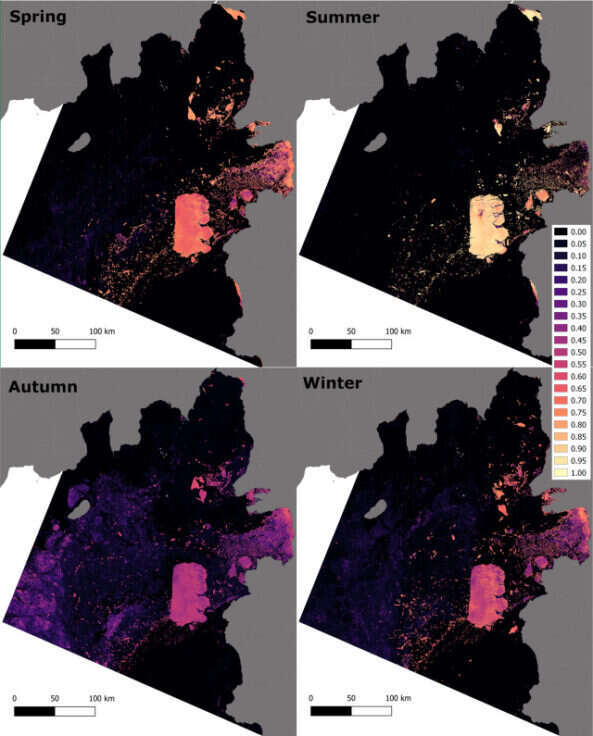
Frequencies of iceberg prediction within 50 run ensembles for four austral seasons. Note contrasting ranges of values. Contains modified Copernicus Sentinel data 2019–2020.

UK study uses SAR images, machine learning to detect icebergs in sea ice

Tyler O'Neal, Staff Editor ACADEMIA November 24, 2023, 2:00 pm

Icebergs located in the Southern Ocean have always been a subject of interest and concern for scientists. These enormous pieces of ice play a significant role in ocean dynamics, affecting everything from the creation of sea ice to primary productivity. Furthermore, icebergs pose a danger to ships, making it vital to have accurate and up-to-date information about their locations and sizes.

In recent times, researchers have made remarkable progress in detecting and tracking icebergs through the use of advanced technologies such as machine learning and radar imaging. A groundbreaking study published in the Remote Sensing of the Environment journal highlights a new AI tool that leverages automated Bayesian classification and radar data to detect and track icebergs in the Southern Ocean. This tool has the potential to transform our understanding of iceberg dynamics and contribute to better management of these natural phenomena.

Understanding the Importance of Iceberg Monitoring

Before we delve into the specifics of this AI tool, let us first understand why it is essential to monitor icebergs. Icebergs, which break off the Antarctic Ice Sheet, release freshwater and nutrients into the ocean as they melt. This process significantly affects primary productivity, ocean circulation, and the formation and break-up of sea ice. By tracking icebergs throughout their lifecycle, scientists can gain valuable insights into these complex interactions and their broader implications for the marine ecosystem.

Moreover, having accurate information about the location of icebergs is crucial for maritime safety. Ships need to navigate around these hazards, and real-time data about iceberg positions can help prevent accidents and ensure safe passage through icy waters. Therefore, advancements in iceberg detection technology are of great significance for both scientific research and practical applications.

The AI Tool for Iceberg Detection

The AI tool developed by a team of researchers from the British Antarctic Survey (BAS) AI Lab, funded by The Alan Turing Institute, leverages synthetic aperture radar (SAR) data from Sentinel-1 satellites. SAR transmits microwave signals from space and measures the intensity of the reflected radiation. Icebergs, with their crystalline ice and snow surfaces, reflect microwaves strongly, making them stand out as bright signals in satellite images.

This AI tool takes advantage of the unique reflectivity of icebergs to detect and track them in environments with heavy sea ice coverage, which was previously not possible. By analyzing SAR images, the tool can identify icebergs when they calve and monitor them throughout their lifecycle until they eventually melt into the ocean.

Advantages of the AI Approach

One significant advantage of using AI technology for iceberg detection is its ability to operate day or night, and even through cloud cover, which is prevalent over the Southern Ocean. Unlike traditional methods that rely on human interpretation of images, the AI algorithm can process large amounts of data rapidly and without human input. This scalability and efficiency make the tool suitable for near-real-time monitoring of icebergs over vast areas, enabling scientists to gather comprehensive and up-to-date information.

Additionally, the AI tool's performance has been extensively tested and demonstrated to be as accurate as, if not better than, alternative iceberg-detection methods. Its high accuracy, combined with the ability to analyze Synthetic Aperture Radar (SAR) images, makes it a powerful tool for studying iceberg dynamics and their response to climate change.

Case Study: Amundsen Sea Embayment

The researchers chose the Amundsen Sea Embayment in West Antarctica as their study site to showcase the capabilities of the AI tool. This region offers a diverse mix of open water, sea ice, and a high concentration of icebergs, making it an ideal location to test the tool's effectiveness.

Understanding the dynamics of the West Antarctic Ice Sheet, particularly the area near the calving front of Thwaites Glacier, is crucial for predicting future sea level rise. Therefore, by focusing on this region, the researchers aimed to gain insights into how icebergs in the area may change and contribute to sea level rise.

Performance of the AI Tool

During a 12-month study period between October 2019 and September 2020, the AI tool successfully identified nearly 30,000 icebergs in the Amundsen Sea Embayment. Most of these icebergs were relatively small, measuring 1km² or less. The tool's accuracy and ability to detect icebergs in environments with heavy sea ice coverage were confirmed through extensive analysis of the SAR images.

The researchers are currently analyzing all available data since the start of the Sentinel-1 mission in 2014 to identify any long-term trends or changes in iceberg populations, sizes, and pathways. This comprehensive analysis will provide valuable insights into the impact of climate change on iceberg dynamics and their contribution to rising sea levels.

Future Applications and Implications

The successful development and implementation of the AI tool for iceberg detection open up numerous possibilities for future research and practical applications. Here are some potential areas where this technology can make a difference:

  1. Operational Iceberg Monitoring: The AI tool's unsupervised machine learning approach serves as a basis for scalable and operational iceberg monitoring and tracking. By automating the detection process, scientists can gather continuous and up-to-date data on iceberg populations, sizes, and movements.
  2. Climate Change Studies: As climate change continues to impact the Antarctic region, it is crucial to monitor how icebergs respond to these changes. The AI tool can help identify shifts in iceberg numbers, sizes, and pathways, providing valuable information about the complex interactions between the ocean, ice, and atmosphere.
  3. Maritime Safety: Accurate and real-time information about iceberg locations is vital for maritime safety. By integrating the AI tool into existing monitoring systems, ships can navigate around icebergs more effectively, reducing the risk of accidents and ensuring safe passage through icy waters.
  4. Environmental Management: Understanding iceberg dynamics is essential for effective environmental management in the Southern Ocean. By tracking the release of freshwater and nutrients from melting icebergs, scientists can better comprehend the impact on primary productivity, ocean circulation, and the overall marine ecosystem.

Conclusion

The development of an AI tool for automated iceberg detection and monitoring marks a significant advancement in the study of icebergs in the Southern Ocean. By utilizing Synthetic Aperture Radar (SAR) data and employing unsupervised machine learning techniques, this tool can accurately detect and track icebergs, providing valuable insights into their dynamics and response to climate change.

The successful implementation of this AI tool in the Amundsen Sea Embayment demonstrates its potential for scalable and operational iceberg monitoring. With the ability to analyze large amounts of SAR data, the tool can contribute to ongoing research on climate change, maritime safety, and environmental management in the Southern Ocean.

As scientists continue to analyze and refine the tool's performance using extensive datasets, its applications and implications are likely to expand. The combination of advanced technology and deepening knowledge about icebergs will undoubtedly enhance our understanding of these majestic and impactful natural phenomena.

  1. UH develops a revolutionary method for detecting elbow erosion in pipelines
  2. Discovering a real-world model of rogue waves with machine learning

Page 22 of 123

  • 17
  • 18
  • 19
  • 20
  • 21
  • 22
  • 23
  • 24
  • 25
  • 26
POPULAR RIGHT NOW
  • Supercomputers uncover a new class of cosmic explosions hidden in plain sight
    Supercomputers uncover a new class of cosmic explosions hidden in plain sight
  • AI supercharges the hunt for stronger magnets: Iowa State researchers launch a new era of intelligent materials discovery
    AI supercharges the hunt for stronger magnets: Iowa State researchers launch a new era of intelligent materials discovery
  • IBM's Historic stock collapse raises questions for the future of enterprise supercomputing
    IBM's Historic stock collapse raises questions for the future of enterprise supercomputing
  • Could a novel dark matter theory simultaneously resolve multiple cosmic enigmas? Supercomputer simulations provide a compelling, albeit currently unverified, potential solution
    Could a novel dark matter theory simultaneously resolve multiple cosmic enigmas? Supercomputer simulations provide a compelling, albeit currently unverified, potential solution
  • Melting icebergs may be reshaping Earth’s greatest ocean current
    Melting icebergs may be reshaping Earth’s greatest ocean current
  • Supercomputers replace ‘bathtub’ flood maps with physics-based digital twins of Britain’s coastline
    Supercomputers replace ‘bathtub’ flood maps with physics-based digital twins of Britain’s coastline
  • Supercomputers push neural quantum simulation beyond previous limits
    Supercomputers push neural quantum simulation beyond previous limits
  • Intel’s AI supercomputing revival: Q2 financial surge signals new era for CPU-powered HPC infrastructure
    Intel’s AI supercomputing revival: Q2 financial surge signals new era for CPU-powered HPC infrastructure
  • AI infrastructure financing fears shake semiconductor sector
    AI infrastructure financing fears shake semiconductor sector
  • AWS supercomputing investment reaches historic scale as Amazon’s AI strategy powers record financial results
    AWS supercomputing investment reaches historic scale as Amazon’s AI strategy powers record financial results
THIS YEAR'S MOST READ
  • Wall Street wants to trade supercomputing power like oil
    Wall Street wants to trade supercomputing power like oil
  • Cosmic ambition at scale: UK’s supercomputer unlocks a 2.5 petabytes universe
    Cosmic ambition at scale: UK’s supercomputer unlocks a 2.5 petabytes universe
  • Hidden order, revealed at scale: Supercomputing, electron ptychography uncover the inner workings of relaxor ferroelectrics
    Hidden order, revealed at scale: Supercomputing, electron ptychography uncover the inner workings of relaxor ferroelectrics
  • Beamforming the future: BeammWave's 6G push signals the rise of orbital-terrestrial wireless networks
    Joakim Axmon
    Joakim Axmon
  • Intel's Q1 results signal supercomputing surge driving Xeon momentum
    Intel's Q1 results signal supercomputing surge driving Xeon momentum
  • When stars fall apart: Supercomputing reveals the hidden physics of black holes
    When stars fall apart: Supercomputing reveals the hidden physics of black holes
  • Multi-layer simulations reveal the hidden supply chain of solar prominences
    Multi-layer simulations reveal the hidden supply chain of solar prominences
  • Japanese scientists decode dolphin speed with supercomputing: Turbulence, vortices, and the hidden physics of propulsion
    Japanese scientists decode dolphin speed with supercomputing: Turbulence, vortices, and the hidden physics of propulsion
  • Cosmic feedback at scale: Supercomputing reveals how quasars regulate the early Universe
    Cosmic feedback at scale: Supercomputing reveals how quasars regulate the early Universe
  • Modeling life at the microscopic scale: A computational breakthrough in oxygen transport
    Modeling life at the microscopic scale: A computational breakthrough in oxygen transport
MOST READ OF ALL-TIME
  • Largest Computational Biology Simulation Mimics The Ribosome
    Details
    112108
    The amino acid (green) slithers into the chemical reaction center, moving through an evolutionarily ancient corridor of the ribosome (purple). The amino acid is delivered to the reaction core by the transfer RNA molecule (yellow).
    The amino acid (green) slithers into the chemical reaction center, moving through an evolutionarily ancient corridor of the ribosome (purple). The amino acid is delivered to the reaction core by the transfer RNA molecule (yellow).
  • Silicon 'neurons' may add a new dimension to chips
    Details
    80993
    Silicon 'neurons' may add a new dimension to chips
  • Linux Networx Accelerators Expected to Drive up to 4x Price/Performance
    Details
    75538
  • Complex Concepts That Really Add Up
    Details
    73637
    Complex Concepts That Really Add Up
  • Blue Sky Studios Donates Animation SuperComputer to Wesleyan
    Details
    68141
    Each rack holds 52 Angstrom Microsystem-brand “blades,” with a memory footprint of 12 or 24 gigabytes each. (Photos by Olivia Bartlett Drake)
    Each rack holds 52 Angstrom Microsystem-brand “blades,” with a memory footprint of 12 or 24 gigabytes each. (Photos by Olivia Bartlett Drake)
  • Humanities, HPC connect at NERSC
    Details
    57947
  • TeraGrid ’09 'Call for Participation'
    Details
    54952
  • Turbulence responsible for black holes' balancing act
    Details
    52311
  • Cray Wins $52 Million SuperComputer Contract
    Details
    50140
  • SDSC Researchers Accurately Predict Protein Docking
    Details
    46079
  • FRONTPAGE
  • LATEST
  • POPULAR
  • REGISTER
  • SOCIAL
  • VIDEO
  • SUBSCRIPTION
  • RSS
  • GUIDELINES
  • PRIVACY
  • TOS
  • ABOUT
  • +1 (816) 799-4488
  • editorial@supercomputingonline.com
© 2001 - 2026 SuperComputingOnline.com, LLC. All rights reserved. This material may not be published, broadcast, rewritten or redistributed without permission.
Sign In
  • FRONT PAGE
  • LATEST
    • MEDIA KIT
    • MOST READ
    • RSS FEED
    • ACADEMIA
    • AEROSPACE
    • APPLICATIONS
    • ASTRONOMY
    • AUTOMOTIVE
    • BIG DATA
    • BIOLOGY
    • CHEMISTRY
    • CLIENTS
    • CLOUD
    • DEFENSE
    • DEVELOPER TOOLS
    • EARTH SCIENCES
    • ECONOMICS
    • ENGINEERING
    • ENTERTAINMENT
    • HEALTH
    • INDUSTRY
    • INTERCONNECTS
    • GAMING
    • GOVERNMENT
    • MANUFACTURING
    • MIDDLEWARE
    • MOVIES
    • NETWORKS
    • OIL & GAS
    • PHYSICS
    • PROCESSORS
    • RETAIL
    • SCIENCE
    • STORAGE
    • SYSTEMS
    • VISUALIZATION
  • VIDEOS
    • ADD YOUR VIDEOS
    • MANAGE VIDEOS
  • COMMUNITY
    • TRADE SHOWS
    • SOCIAL NETWORK VIDEOS
    • SURVEYS
    • APPLICATIONS BROWSER
    • CONVERSATION INBOX
    • SOCIAL ADVERTISER
    • GROUPS
    • MARKETPLACE LISTINGS
    • PAGES
    • LEADERBOARD
    • POINTS LISTING
      • BADGES
    • PRIVACY CONFIRM REQUEST
    • PRIVACY CREATE REQUEST

Hey there! We noticed you’re using an ad blocker.