

SUPERCOMPUTING NEWS SUPERCOMPUTING NEWS
    • MEDIA KIT
    • MOST READ
    • RSS FEED
    • ACADEMIA
    • AEROSPACE
    • APPLICATIONS
    • ASTRONOMY
    • AUTOMOTIVE
    • BIG DATA
    • BIOLOGY
    • CHEMISTRY
    • CLIENTS
    • CLOUD
    • DEFENSE
    • DEVELOPER TOOLS
    • EARTH SCIENCES
    • ECONOMICS
    • ENGINEERING
    • ENTERTAINMENT
    • GAMING
    • GOVERNMENT
    • HEALTH
    • OIL & GAS
    • INDUSTRY
    • INTERCONNECTS
    • MANUFACTURING
    • MIDDLEWARE
    • MOVIES
    • NETWORKS
    • PHYSICS
    • PROCESSORS
    • RETAIL
    • SCIENCE
    • STORAGE
    • SYSTEMS
    • VISUALIZATION
    • AcyMailing subscription form

    • ADD YOUR VIDEOS
    • MANAGE VIDEOS
    • CONVERSATION INBOX
    • SOCIAL ADVERTISER
    • SOCIAL NETWORK VIDEOS
    • SURVEYS
    • GROUPS
    • PAGES
    • MARKETPLACE LISTINGS
    • APPLICATIONS BROWSER
    • PRIVACY CONFIRM REQUEST
    • PRIVACY CREATE REQUEST
    • LEADERBOARD
    • POINTS LISTING
      • BADGES
    • TRADE SHOWS
Sign In
Tyler O'Neal, Staff Editor APPLICATIONS September 30, 2022, 1:00 pm

New Japanese built simulations show a day at the beach for life in other worlds

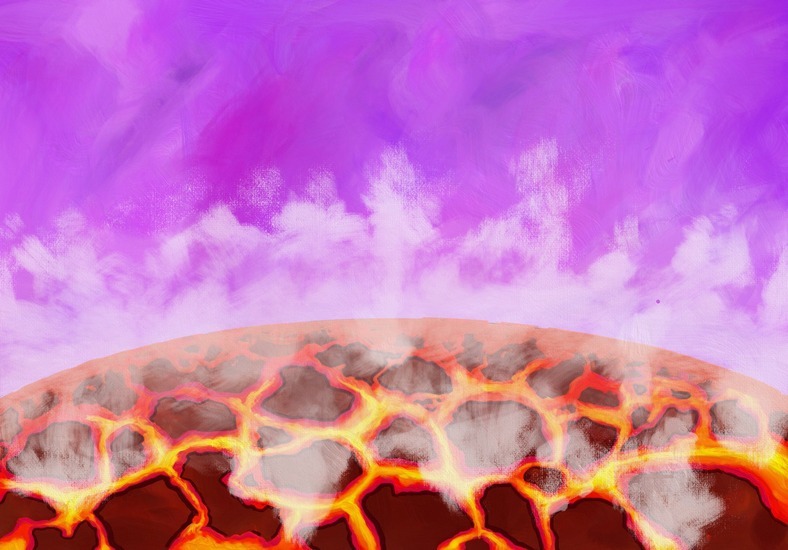
 Artist’s impression of the molten surface of a young planet reacting with its atmosphere to form water vapor.(Credit: Tadahiro Kimura)New supercomputer simulations show that truly Earth-like exoplanets with oceans and continents, and beaches along the boundaries, may be much more common around red dwarfs than previously expected. This means ongoing and future exoplanet survey missions can expect to find multiple Earth-analogs for further study before the end of the decade.

The “habitable zone” is defined as the range of orbits around a star where the temperature would be right for an exoplanet to have liquid water on its surface. This doesn’t necessarily mean that there is life or even water on the planet. In fact, for most exoplanets in the habitable zone, life on the planet would be “no day at the beach.” On Earth, both the oceans and the continents play vital roles in the geochemical carbon cycle which helps maintain a temperate climate where liquid water and life can exist. So to look for potentially habitable Earth-like planets, exactly what we need is “a day at the beach,” where the land and sea can coexist.

Previous research had warned that such beach-friendly planets could be extremely rare, even in the habitable zones around the most common types of stars (namely red dwarfs). This is because there is a distinct difference in the water content of rocky materials found in the inner and outer parts of a protoplanetary disk where planets form, leading to the formation of planets with either too much or too little water in most cases. But new numerical simulations conducted by Tadahiro Kimura from the University of Tokyo and Masahiro Ikoma from the National Astronomical Observatory of Japan provide a sunnier view. By taking into consideration water produced from interactions between the still molten surface of a young planet and its primordial atmosphere, the team found that a wide range in final water content is expected. And within that range, several percent of roughly-Earth-sized planets in habitable zones should have appropriate amounts of water for a temperate climate. This is a high enough percentage that ongoing and future exoplanet survey missions like TESS and PLATO can expect to find multiple examples of truly Earth-like exoplanets with beaches in the 2020s.
South Korean researcher demos deteriorating safety on frozen lakes in a warming world

Tyler O'Neal, Staff Editor APPLICATIONS September 30, 2022, 10:55 am

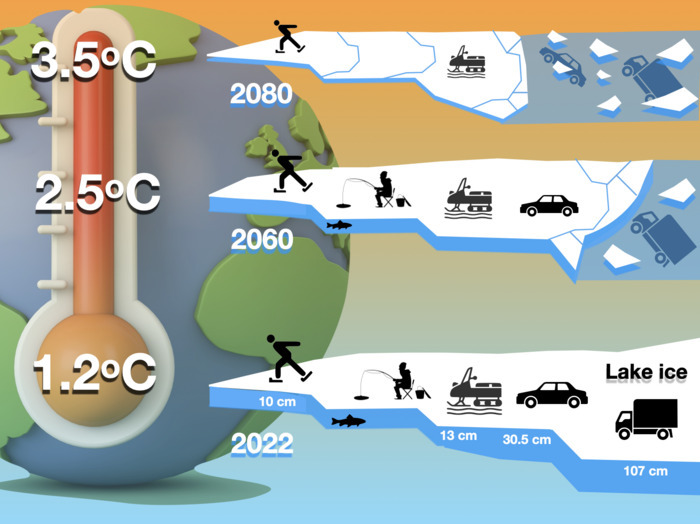
Schematic illustration of the effects of Global Warming on future lake-ice conditions and anticipated impacts on transportation and recreational activities. Warming levels are given relative to the long-term climate mean of 1900-1929 (Background graphics, licensed from Shutterstock.com).Millions of international viewers enjoyed watching the reality TV show “Ice Road Truckers”, in which experienced truck drivers were expected to master scary challenges, such as transporting heavy supplies across frozen lakes in the remote Arctic. According to a new study published in the prestigious journal Earth’s Future by an international team of climate and lake scientists, crossing frozen lakes with heavy trucks may soon be a matter of the past.
The study is based on one of the most comprehensive future climate change model simulations to date (the Community Earth System Model ver. 2 Large Ensemble) to determine at which warming levels and unsafe ice conditions will be reached regionally with regard to transportation and recreational activities, including ice-fishing or ice-skating.

The conclusion of the study is straightforward, namely that global warming will make lake ice much less safe (Figure). This is likely to affect indigenous communities in the Arctic as well as regional economies, where people rely on ice roads as a means for fast and comparatively cheap transportation and supply during winter. Thinning future ice conditions also threaten unique lake ecosystems that have adapted to recurring frozen lake conditions over tens of thousands of years.

“Our results demonstrate that the duration of safe ice over the next 80 years will shorten by 2-3 weeks depending on the future warming level. In regions where lakes are used as ice roads to transport heavy goods and supplies, the number of days with safe ice conditions will decline by more than 90%, even for moderate warming of 1.5°C above early 20th Century conditions”, says Dr. Lei Huang, corresponding author of the study and former postdoctoral researcher at the IBS Center for Climate Physics (ICCP), in Busan, South Korea.

“According to our computer model simulations, many densely populated regions in the mid-latitudes are projected to experience a large deterioration in safe ice conditions for recreational activities. Already a 1.5°C warming above early 20th Century conditions can lead to more than 60% loss in the duration of safe lake ice. This will negatively impact local communities that rely on the ice recreation industry.” says Dr. Iestyn Woolway from Bangor University, in the UK, the first author of the study.

Dr. Sapna Sharma from York University in Canada, one of the lead authors, added, “Given that our planet has already warmed by 1.2°C since the beginning of industrialization, it is time to implement proper regional adaptation strategies in affected communities to mitigate economic losses and to avoid loss of lives.”

Oxford discovers new nanowire assembly process could enable more powerful chips

Tyler O'Neal, Staff Editor APPLICATIONS September 29, 2022, 1:00 pm

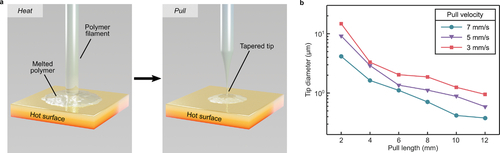
Tapering of a polymer monofilament. a) Schematic of the heat-and-pull setup designed for fabricating the nano-crane. A polymer filament (PET, a diameter of 200 µm) is attached on an automated micromanipulator and melted on a clean and polished hot surface at 240 °C. By pulling operation, the melted polymer on the surface instantly cools down and forms a taper. b) Graph showing the characterization of the heat-and-pull setup for various pull lengths and velocities. Increasing pull length and velocity decreases the tip diameter down to sub-micron levels (≈0.4 µm). In a newly-published study, a team of researchers in Oxford University’s Department of Materials led by Harish Bhaskaran, Professor of Applied Nanomaterials, describe a breakthrough approach to pick up single nanowires from the growth substrate and place them on virtually any platform with sub-micron accuracy.

The innovative method uses novel tools, including ultra-thin filaments of polyethylene terephthalate (PET) with tapered nanoscale tips that are used to pick up individual nanowires. At this fine scale, adhesive van der Waals (tiny forces of attraction that occur between atoms and molecules) cause the nanowires to ‘jump’ into contact with the tips. The nanowires are then transferred to a transparent dome-shaped elastic stamp mounted on a glass slide. This stamp is then turned upside down and aligned with the device chip, with the nanowire then printed gently onto the surface.

Deposited nanowires showed strong adhesive qualities, remaining in place even when the device was immersed in liquid. The research team was also able to place nanowires on fragile substrates, such as ultra-thin 50-nanometre membranes, demonstrating the delicacy and versatility of the stamping technique.

In addition, the researchers used the method to build an optomechanical sensor (an instrument that uses laser light to measure vibrations) that was 20 times more sensitive than existing nanowire-based devices.

Nanowires, materials with diameters 1000 times smaller than human hair and fascinating physical properties, could enable major advancements in many different fields, from energy harvesters and sensors to information and quantum technologies. In particular, their minuscule size could allow the development of smaller transistors and miniaturized computer chips. A major obstacle, however, to realizing the full potential of nanowires has been the inability to precisely position them within devices.

Most electronic device manufacturing techniques cannot tolerate the conditions needed to produce nanowires. Consequently, nanowires are usually grown on a separate substrate and then mechanically or chemically transferred to the device. In all existing nanowire transfer techniques, however, the nanowires are placed randomly onto the chip surface, which limits their application in commercial devices.

DPhil student Utku Emre Ali (Department of Materials), who developed the technique, said: ‘This new pick-and-place assembly process has enabled us to create first-of-its-kind devices in the nanowire realm. We believe that it will inexpensively advance nanowire research by allowing users to incorporate nanowires with existing on-chip platforms, be it electronic or photonic, unlocking physical properties that have not been attainable so far. Furthermore, this technique could be fully automated, making full-scale fabrication of high-quality nanowire-integrated chips a real possibility.’

Professor Harish Bhaskaran (Department of Materials) added: ‘This technique is readily scalable to larger areas, and brings the promise of nanowires to devices made on any substrate and using any process. This is what makes this technique so powerful.’

The full paper, A Universal Pick-and-Place Assembly for Nanowires, is published in Small: https://onlinelibrary.wiley.com/doi/10.1002/smll.202201968

The work was funded by EPSRC via the Fellowships in Manufacturing (Grant no. EP/R001677/1).

  1. Do people think computers make fair decisions?
  2. Japanese researchers focus on complex waves

Page 28 of 66

  • 23
  • 24
  • 25
  • 26
  • 27
  • 28
  • 29
  • 30
  • 31
  • 32
POPULAR RIGHT NOW
  • Supercomputers uncover a new class of cosmic explosions hidden in plain sight
    Supercomputers uncover a new class of cosmic explosions hidden in plain sight
  • AI supercharges the hunt for stronger magnets: Iowa State researchers launch a new era of intelligent materials discovery
    AI supercharges the hunt for stronger magnets: Iowa State researchers launch a new era of intelligent materials discovery
  • IBM's Historic stock collapse raises questions for the future of enterprise supercomputing
    IBM's Historic stock collapse raises questions for the future of enterprise supercomputing
  • Could a novel dark matter theory simultaneously resolve multiple cosmic enigmas? Supercomputer simulations provide a compelling, albeit currently unverified, potential solution
    Could a novel dark matter theory simultaneously resolve multiple cosmic enigmas? Supercomputer simulations provide a compelling, albeit currently unverified, potential solution
  • Melting icebergs may be reshaping Earth’s greatest ocean current
    Melting icebergs may be reshaping Earth’s greatest ocean current
  • Supercomputers replace ‘bathtub’ flood maps with physics-based digital twins of Britain’s coastline
    Supercomputers replace ‘bathtub’ flood maps with physics-based digital twins of Britain’s coastline
  • Supercomputers push neural quantum simulation beyond previous limits
    Supercomputers push neural quantum simulation beyond previous limits
  • Intel’s AI supercomputing revival: Q2 financial surge signals new era for CPU-powered HPC infrastructure
    Intel’s AI supercomputing revival: Q2 financial surge signals new era for CPU-powered HPC infrastructure
  • AI infrastructure financing fears shake semiconductor sector
    AI infrastructure financing fears shake semiconductor sector
  • AWS supercomputing investment reaches historic scale as Amazon’s AI strategy powers record financial results
    AWS supercomputing investment reaches historic scale as Amazon’s AI strategy powers record financial results
THIS YEAR'S MOST READ
  • Wall Street wants to trade supercomputing power like oil
    Wall Street wants to trade supercomputing power like oil
  • Cosmic ambition at scale: UK’s supercomputer unlocks a 2.5 petabytes universe
    Cosmic ambition at scale: UK’s supercomputer unlocks a 2.5 petabytes universe
  • Hidden order, revealed at scale: Supercomputing, electron ptychography uncover the inner workings of relaxor ferroelectrics
    Hidden order, revealed at scale: Supercomputing, electron ptychography uncover the inner workings of relaxor ferroelectrics
  • Beamforming the future: BeammWave's 6G push signals the rise of orbital-terrestrial wireless networks
    Joakim Axmon
    Joakim Axmon
  • Intel's Q1 results signal supercomputing surge driving Xeon momentum
    Intel's Q1 results signal supercomputing surge driving Xeon momentum
  • When stars fall apart: Supercomputing reveals the hidden physics of black holes
    When stars fall apart: Supercomputing reveals the hidden physics of black holes
  • Multi-layer simulations reveal the hidden supply chain of solar prominences
    Multi-layer simulations reveal the hidden supply chain of solar prominences
  • Japanese scientists decode dolphin speed with supercomputing: Turbulence, vortices, and the hidden physics of propulsion
    Japanese scientists decode dolphin speed with supercomputing: Turbulence, vortices, and the hidden physics of propulsion
  • Cosmic feedback at scale: Supercomputing reveals how quasars regulate the early Universe
    Cosmic feedback at scale: Supercomputing reveals how quasars regulate the early Universe
  • Modeling life at the microscopic scale: A computational breakthrough in oxygen transport
    Modeling life at the microscopic scale: A computational breakthrough in oxygen transport
MOST READ OF ALL-TIME
  • Largest Computational Biology Simulation Mimics The Ribosome
    Details
    112108
    The amino acid (green) slithers into the chemical reaction center, moving through an evolutionarily ancient corridor of the ribosome (purple). The amino acid is delivered to the reaction core by the transfer RNA molecule (yellow).
    The amino acid (green) slithers into the chemical reaction center, moving through an evolutionarily ancient corridor of the ribosome (purple). The amino acid is delivered to the reaction core by the transfer RNA molecule (yellow).
  • Silicon 'neurons' may add a new dimension to chips
    Details
    80994
    Silicon 'neurons' may add a new dimension to chips
  • Linux Networx Accelerators Expected to Drive up to 4x Price/Performance
    Details
    75538
  • Complex Concepts That Really Add Up
    Details
    73637
    Complex Concepts That Really Add Up
  • Blue Sky Studios Donates Animation SuperComputer to Wesleyan
    Details
    68141
    Each rack holds 52 Angstrom Microsystem-brand “blades,” with a memory footprint of 12 or 24 gigabytes each. (Photos by Olivia Bartlett Drake)
    Each rack holds 52 Angstrom Microsystem-brand “blades,” with a memory footprint of 12 or 24 gigabytes each. (Photos by Olivia Bartlett Drake)
  • Humanities, HPC connect at NERSC
    Details
    57947
  • TeraGrid ’09 'Call for Participation'
    Details
    54952
  • Turbulence responsible for black holes' balancing act
    Details
    52311
  • Cray Wins $52 Million SuperComputer Contract
    Details
    50140
  • SDSC Researchers Accurately Predict Protein Docking
    Details
    46079
  • FRONTPAGE
  • LATEST
  • POPULAR
  • REGISTER
  • SOCIAL
  • VIDEO
  • SUBSCRIPTION
  • RSS
  • GUIDELINES
  • PRIVACY
  • TOS
  • ABOUT
  • +1 (816) 799-4488
  • editorial@supercomputingonline.com
© 2001 - 2026 SuperComputingOnline.com, LLC. All rights reserved. This material may not be published, broadcast, rewritten or redistributed without permission.
Sign In
  • FRONT PAGE
  • LATEST
    • MEDIA KIT
    • MOST READ
    • RSS FEED
    • ACADEMIA
    • AEROSPACE
    • APPLICATIONS
    • ASTRONOMY
    • AUTOMOTIVE
    • BIG DATA
    • BIOLOGY
    • CHEMISTRY
    • CLIENTS
    • CLOUD
    • DEFENSE
    • DEVELOPER TOOLS
    • EARTH SCIENCES
    • ECONOMICS
    • ENGINEERING
    • ENTERTAINMENT
    • HEALTH
    • INDUSTRY
    • INTERCONNECTS
    • GAMING
    • GOVERNMENT
    • MANUFACTURING
    • MIDDLEWARE
    • MOVIES
    • NETWORKS
    • OIL & GAS
    • PHYSICS
    • PROCESSORS
    • RETAIL
    • SCIENCE
    • STORAGE
    • SYSTEMS
    • VISUALIZATION
  • VIDEOS
    • ADD YOUR VIDEOS
    • MANAGE VIDEOS
  • COMMUNITY
    • TRADE SHOWS
    • SOCIAL NETWORK VIDEOS
    • SURVEYS
    • APPLICATIONS BROWSER
    • CONVERSATION INBOX
    • SOCIAL ADVERTISER
    • GROUPS
    • MARKETPLACE LISTINGS
    • PAGES
    • LEADERBOARD
    • POINTS LISTING
      • BADGES
    • PRIVACY CONFIRM REQUEST
    • PRIVACY CREATE REQUEST

Hey there! We noticed you’re using an ad blocker.