

SUPERCOMPUTING NEWS SUPERCOMPUTING NEWS
    • MEDIA KIT
    • MOST READ
    • RSS FEED
    • ACADEMIA
    • AEROSPACE
    • APPLICATIONS
    • ASTRONOMY
    • AUTOMOTIVE
    • BIG DATA
    • BIOLOGY
    • CHEMISTRY
    • CLIENTS
    • CLOUD
    • DEFENSE
    • DEVELOPER TOOLS
    • EARTH SCIENCES
    • ECONOMICS
    • ENGINEERING
    • ENTERTAINMENT
    • GAMING
    • GOVERNMENT
    • HEALTH
    • OIL & GAS
    • INDUSTRY
    • INTERCONNECTS
    • MANUFACTURING
    • MIDDLEWARE
    • MOVIES
    • NETWORKS
    • PHYSICS
    • PROCESSORS
    • RETAIL
    • SCIENCE
    • STORAGE
    • SYSTEMS
    • VISUALIZATION
    • AcyMailing subscription form

    • ADD YOUR VIDEOS
    • MANAGE VIDEOS
    • CONVERSATION INBOX
    • SOCIAL ADVERTISER
    • SOCIAL NETWORK VIDEOS
    • SURVEYS
    • GROUPS
    • PAGES
    • MARKETPLACE LISTINGS
    • APPLICATIONS BROWSER
    • PRIVACY CONFIRM REQUEST
    • PRIVACY CREATE REQUEST
    • LEADERBOARD
    • POINTS LISTING
      • BADGES
    • TRADE SHOWS
Sign In
Tyler O'Neal, Staff Editor APPLICATIONS September 29, 2022, 12:00 pm

Do people think computers make fair decisions?

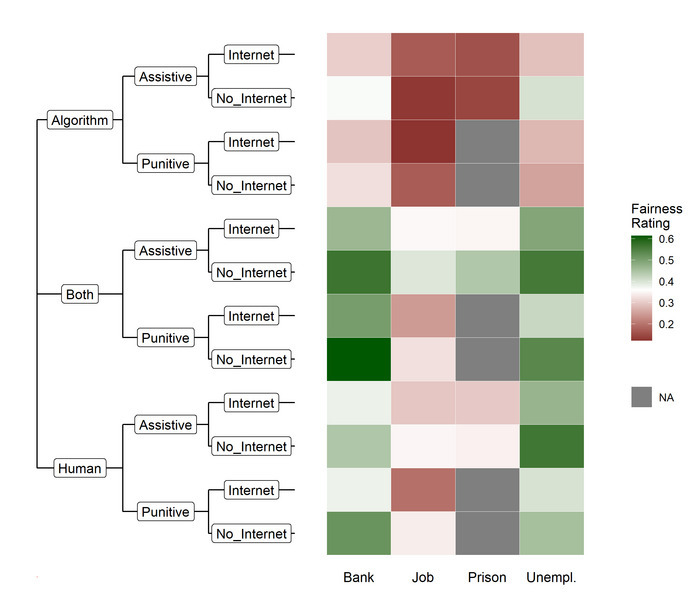
The heatmap shows relative frequencies of respondents that rated a scenario as “Fair” (i.e., either “Somewhat fair” or “Very fair”). The color scale is centered at the average fairness rating over all experiments.  CREDIT Patterns/Gordon and Kern et al.Today, machine learning helps determine the loan we qualify for, the job we get, and even who goes to jail. But when it comes to these potentially life-altering decisions, can computers make a fair call? In a study published today in the journal Patterns, researchers from Germany showed that with human supervision, people think a computer’s decision can be as fair as a decision primarily made by humans.

“A lot of the discussion on fairness in machine learning has focused on technical solutions, like how to fix unfair algorithms and how to make the systems fair,” says computational social scientist and co-author Ruben Bach of the University of Mannheim, Germany. “But our question is, what do people think is fair? It’s not just about developing algorithms. They need to be accepted by society and meet normative beliefs in the real world.”

Automated decision-making, where a conclusion is made solely by a computer, excels at analyzing large datasets to detect patterns. Computers are often considered objective and neutral compared with humans, whose biases can cloud judgments. Yet, bias can creep into computer systems as they learn from data that reflects discriminatory patterns in our world. Understanding fairness in computer and human decisions is crucial to building a more equitable society.

To understand what people consider fair in automated decision-making, the researchers surveyed 3,930 individuals in Germany. The researchers gave them hypothetical scenarios related to the bank, job, prison, and unemployment systems. Within the scenarios, they further compared different situations, including whether the decision leads to a positive or negative outcome, where the data for evaluation comes from, and who makes the final decision—human, computer, or both.

“As expected, we saw that completely automated decision-making was not favored," says computational social scientist and co-first author Christoph Kern of the University of Mannheim. “But what was interesting is that when you have human supervision over the automated decision-making, the level of perceived fairness becomes similar to human-centered decision-making.” The results showed that humans perceive a decision as fairer when involved.

People also had more concerns over fairness when decisions related to the criminal justice system or job prospects, where the stakes are higher. Possibly viewing the weight of losses greater than the weight of gains, the participants deemed decisions that can lead to positive outcomes fairer than negative ones. Compared with systems that only rely on scenario-related data, those that draw on additional unrelated data from the internet were considered less fair, confirming the importance of data transparency and privacy. Together, the results showed that context matters. Automated decision-making systems need to be carefully designed when concerns for fairness arise.

While hypothetical situations in the survey may not fully translate to the real world, the team is already brainstorming the next steps to understand fairness better. They plan on taking the study further to understand how different people define fairness. They also want to use similar surveys to ask more questions about ideas such as distributive justice, and the fairness of resource allocation among the community.

“In a way, we hope that people in the industry can take these results as food for thought and as things they should check before developing and deploying an automated decision-making system,” says Bach. “We also need to ensure that people understand how the data is processed and decisions are made based on it.”

Japanese researchers focus on complex waves

Tyler O'Neal, Staff Editor APPLICATIONS September 29, 2022, 5:00 am

japanesewaves 85a43Extreme nonlinear wave group dynamics in directional wave states
Understanding the unpredictable behaviors of ocean waves can be a matter of survival for seafarers. Deep-water wave groups have been known to be unstable and become rogue, causing unsuspecting boats to tip over.

This rogue wave behavior results from modulation instability, which generally occurs only for uni-directional waves. Wave focusing -- the amplification of waves -- is also expected to weaken when interacting with other wave systems.

Now, a team led by Kyoto University has demonstrated that such unstable wave groups propagate independently regardless of interference.

"Our results seem to support the concept of an unperturbed nonlinear water wave group focusing in the presence of counter-propagating waves, implying that the wave states are directional," says lead author Amin Chabchoub.

Using a water wave tank, the team performed experiments validating results from supercomputer simulations based on the coupled nonlinear Schrödinger equation. This nonlinear wave equation model accounts for complex interactions of waves propagating from two different directions.

The team's findings demonstrate that the model agrees well with the experiments, including rogue and counter-propagating wave dynamics.

Fields such as offshore engineering, nonlinear optics, electrical engineering, and plasma physics, as well as the study of extreme ocean waves, stand to benefit from a better understanding of the role of nonlinearity.

"Our study may further motivate theoretical and experimental studies to improve our understanding of such dynamics in the cacophony of different wave systems," Chabchoub concludes.

UK prof Nawaz deploys new algorithm for reconstructing particles at the LHC

Tyler O'Neal, Staff Editor APPLICATIONS September 28, 2022, 6:00 am

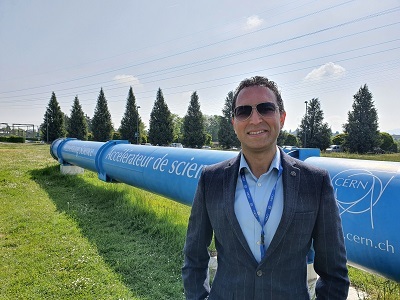
Professor Nawaz on a visit to CERNThe Large Hadron Collider (LHC) is the most powerful particle accelerator ever built which sits in a tunnel 100 meters underground at CERN, the European Organisation for Nuclear Research, near Geneva in Switzerland. It is the site of long-running experiments which enable physicists worldwide to learn more about the nature of the Universe.

The project is part of the Compact Muon Solenoid (CMS) experiment – one of seven installed experiments that use detectors to analyze the particles produced by collisions in the accelerator.

The subject of a new study on in high occupancy imaging calorimeters with graph neural networks, the project has been carried out ahead of the high luminosity upgrade of the Large Hadron Collider. The High Luminosity Large Hadron Collider (HL-LHC) project aims to crank up the performance of the LHC to increase the potential for discoveries after 2029. The HL-LHC will increase the number of proton-proton interactions in an event from 40 to 200.

Professor Raheel Nawaz, Pro Vice-Chancellor for Digital Transformation, at Staffordshire University, has supervised the research. He explained: “Limiting the increase of computing resource consumption at large pileups is a necessary step for the success of the HL-LHC physics program and we are advocating the use of modern machine learning techniques to perform particle reconstruction as a possible solution to this problem.”

He added: “This project has been both a joy and a privilege to work on and is likely to dictate the future direction of research on particle reconstruction by using more advanced AI-based solution.”

Dr. Jan Kieseler from the Experimental Physics Department at CERN added: "This is the first single-shot reconstruction of about 1000 particles from and in an unprecedentedly challenging environment with 200 simultaneous interactions each proton-proton collision. Showing that this novel approach, combining dedicated graph neural network layers (GravNet) and training methods (Object Condensation), can be extended to such challenging tasks while staying within resource constraints represents an important milestone towards future particle reconstruction.”

Shah Rukh Qasim, leading this project as part of his Ph.D. at CERN and Manchester Metropolitan University, said: "The amount of progress we have made on this project in the last three years is truly remarkable. It was hard to imagine we would reach this milestone when we started!"

Professor Martin Jones, Vice-Chancellor and Chief Executive at Staffordshire University, added: “CERN is one of the world’s most respected centers for scientific research and I congratulate the researchers on this project which is effectively paving the way for even greater discoveries in years to come.

“Artificial Intelligence is continuously evolving to benefit many different industries and to know that academics at Staffordshire University and elsewhere are contributing to the research behind such advancements is both exciting and significant.”

  1. University of Oregon develops models of the edge waves, continental shelf that fueled the 2021 Acapulco Bay tsunami
  2. South Korean President Yoon visits University of Toronto for AI roundtable

Page 29 of 66

  • 24
  • 25
  • 26
  • 27
  • 28
  • 29
  • 30
  • 31
  • 32
  • 33
POPULAR RIGHT NOW
  • Supercomputers uncover a new class of cosmic explosions hidden in plain sight
    Supercomputers uncover a new class of cosmic explosions hidden in plain sight
  • AI supercharges the hunt for stronger magnets: Iowa State researchers launch a new era of intelligent materials discovery
    AI supercharges the hunt for stronger magnets: Iowa State researchers launch a new era of intelligent materials discovery
  • IBM's Historic stock collapse raises questions for the future of enterprise supercomputing
    IBM's Historic stock collapse raises questions for the future of enterprise supercomputing
  • Could a novel dark matter theory simultaneously resolve multiple cosmic enigmas? Supercomputer simulations provide a compelling, albeit currently unverified, potential solution
    Could a novel dark matter theory simultaneously resolve multiple cosmic enigmas? Supercomputer simulations provide a compelling, albeit currently unverified, potential solution
  • Melting icebergs may be reshaping Earth’s greatest ocean current
    Melting icebergs may be reshaping Earth’s greatest ocean current
  • Supercomputers replace ‘bathtub’ flood maps with physics-based digital twins of Britain’s coastline
    Supercomputers replace ‘bathtub’ flood maps with physics-based digital twins of Britain’s coastline
  • Supercomputers push neural quantum simulation beyond previous limits
    Supercomputers push neural quantum simulation beyond previous limits
  • Intel’s AI supercomputing revival: Q2 financial surge signals new era for CPU-powered HPC infrastructure
    Intel’s AI supercomputing revival: Q2 financial surge signals new era for CPU-powered HPC infrastructure
  • AI infrastructure financing fears shake semiconductor sector
    AI infrastructure financing fears shake semiconductor sector
  • AWS supercomputing investment reaches historic scale as Amazon’s AI strategy powers record financial results
    AWS supercomputing investment reaches historic scale as Amazon’s AI strategy powers record financial results
THIS YEAR'S MOST READ
  • Wall Street wants to trade supercomputing power like oil
    Wall Street wants to trade supercomputing power like oil
  • Cosmic ambition at scale: UK’s supercomputer unlocks a 2.5 petabytes universe
    Cosmic ambition at scale: UK’s supercomputer unlocks a 2.5 petabytes universe
  • Hidden order, revealed at scale: Supercomputing, electron ptychography uncover the inner workings of relaxor ferroelectrics
    Hidden order, revealed at scale: Supercomputing, electron ptychography uncover the inner workings of relaxor ferroelectrics
  • Beamforming the future: BeammWave's 6G push signals the rise of orbital-terrestrial wireless networks
    Joakim Axmon
    Joakim Axmon
  • Intel's Q1 results signal supercomputing surge driving Xeon momentum
    Intel's Q1 results signal supercomputing surge driving Xeon momentum
  • When stars fall apart: Supercomputing reveals the hidden physics of black holes
    When stars fall apart: Supercomputing reveals the hidden physics of black holes
  • Multi-layer simulations reveal the hidden supply chain of solar prominences
    Multi-layer simulations reveal the hidden supply chain of solar prominences
  • Japanese scientists decode dolphin speed with supercomputing: Turbulence, vortices, and the hidden physics of propulsion
    Japanese scientists decode dolphin speed with supercomputing: Turbulence, vortices, and the hidden physics of propulsion
  • Cosmic feedback at scale: Supercomputing reveals how quasars regulate the early Universe
    Cosmic feedback at scale: Supercomputing reveals how quasars regulate the early Universe
  • Modeling life at the microscopic scale: A computational breakthrough in oxygen transport
    Modeling life at the microscopic scale: A computational breakthrough in oxygen transport
MOST READ OF ALL-TIME
  • Largest Computational Biology Simulation Mimics The Ribosome
    Details
    112108
    The amino acid (green) slithers into the chemical reaction center, moving through an evolutionarily ancient corridor of the ribosome (purple). The amino acid is delivered to the reaction core by the transfer RNA molecule (yellow).
    The amino acid (green) slithers into the chemical reaction center, moving through an evolutionarily ancient corridor of the ribosome (purple). The amino acid is delivered to the reaction core by the transfer RNA molecule (yellow).
  • Silicon 'neurons' may add a new dimension to chips
    Details
    80994
    Silicon 'neurons' may add a new dimension to chips
  • Linux Networx Accelerators Expected to Drive up to 4x Price/Performance
    Details
    75538
  • Complex Concepts That Really Add Up
    Details
    73637
    Complex Concepts That Really Add Up
  • Blue Sky Studios Donates Animation SuperComputer to Wesleyan
    Details
    68141
    Each rack holds 52 Angstrom Microsystem-brand “blades,” with a memory footprint of 12 or 24 gigabytes each. (Photos by Olivia Bartlett Drake)
    Each rack holds 52 Angstrom Microsystem-brand “blades,” with a memory footprint of 12 or 24 gigabytes each. (Photos by Olivia Bartlett Drake)
  • Humanities, HPC connect at NERSC
    Details
    57947
  • TeraGrid ’09 'Call for Participation'
    Details
    54952
  • Turbulence responsible for black holes' balancing act
    Details
    52311
  • Cray Wins $52 Million SuperComputer Contract
    Details
    50140
  • SDSC Researchers Accurately Predict Protein Docking
    Details
    46079
  • FRONTPAGE
  • LATEST
  • POPULAR
  • REGISTER
  • SOCIAL
  • VIDEO
  • SUBSCRIPTION
  • RSS
  • GUIDELINES
  • PRIVACY
  • TOS
  • ABOUT
  • +1 (816) 799-4488
  • editorial@supercomputingonline.com
© 2001 - 2026 SuperComputingOnline.com, LLC. All rights reserved. This material may not be published, broadcast, rewritten or redistributed without permission.
Sign In
  • FRONT PAGE
  • LATEST
    • MEDIA KIT
    • MOST READ
    • RSS FEED
    • ACADEMIA
    • AEROSPACE
    • APPLICATIONS
    • ASTRONOMY
    • AUTOMOTIVE
    • BIG DATA
    • BIOLOGY
    • CHEMISTRY
    • CLIENTS
    • CLOUD
    • DEFENSE
    • DEVELOPER TOOLS
    • EARTH SCIENCES
    • ECONOMICS
    • ENGINEERING
    • ENTERTAINMENT
    • HEALTH
    • INDUSTRY
    • INTERCONNECTS
    • GAMING
    • GOVERNMENT
    • MANUFACTURING
    • MIDDLEWARE
    • MOVIES
    • NETWORKS
    • OIL & GAS
    • PHYSICS
    • PROCESSORS
    • RETAIL
    • SCIENCE
    • STORAGE
    • SYSTEMS
    • VISUALIZATION
  • VIDEOS
    • ADD YOUR VIDEOS
    • MANAGE VIDEOS
  • COMMUNITY
    • TRADE SHOWS
    • SOCIAL NETWORK VIDEOS
    • SURVEYS
    • APPLICATIONS BROWSER
    • CONVERSATION INBOX
    • SOCIAL ADVERTISER
    • GROUPS
    • MARKETPLACE LISTINGS
    • PAGES
    • LEADERBOARD
    • POINTS LISTING
      • BADGES
    • PRIVACY CONFIRM REQUEST
    • PRIVACY CREATE REQUEST

Hey there! We noticed you’re using an ad blocker.