

SUPERCOMPUTING NEWS SUPERCOMPUTING NEWS
    • MEDIA KIT
    • MOST READ
    • RSS FEED
    • ACADEMIA
    • AEROSPACE
    • APPLICATIONS
    • ASTRONOMY
    • AUTOMOTIVE
    • BIG DATA
    • BIOLOGY
    • CHEMISTRY
    • CLIENTS
    • CLOUD
    • DEFENSE
    • DEVELOPER TOOLS
    • EARTH SCIENCES
    • ECONOMICS
    • ENGINEERING
    • ENTERTAINMENT
    • GAMING
    • GOVERNMENT
    • HEALTH
    • OIL & GAS
    • INDUSTRY
    • INTERCONNECTS
    • MANUFACTURING
    • MIDDLEWARE
    • MOVIES
    • NETWORKS
    • PHYSICS
    • PROCESSORS
    • RETAIL
    • SCIENCE
    • STORAGE
    • SYSTEMS
    • VISUALIZATION
    • AcyMailing subscription form

    • ADD YOUR VIDEOS
    • MANAGE VIDEOS
    • CONVERSATION INBOX
    • SOCIAL ADVERTISER
    • SOCIAL NETWORK VIDEOS
    • SURVEYS
    • GROUPS
    • PAGES
    • MARKETPLACE LISTINGS
    • APPLICATIONS BROWSER
    • PRIVACY CONFIRM REQUEST
    • PRIVACY CREATE REQUEST
    • LEADERBOARD
    • POINTS LISTING
      • BADGES
    • TRADE SHOWS
Sign In
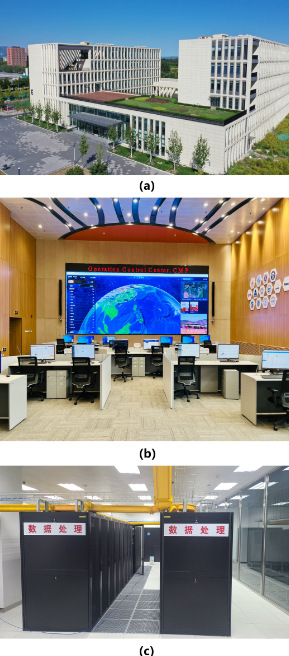
(a) The Information and Operation Control Center Building, (b) The Operation Control Center hall, and (c) The Data and Supercomputing Center Facility.
Tyler O'Neal, Staff Editor SCIENCE August 26, 2024, 6:28 am

China develops a new space weather monitoring network with cutting-edge data system

The Chinese Meridian Project (CMP) has introduced a groundbreaking network that integrates data from approximately 300 instruments to monitor space weather from the Sun to Earth's atmosphere. The focus is on the CMP's Data and Communication System, which includes data transmission network facilities and a supercomputing center. These components handle data transmission, storage, processing, and distribution services, improving the network's effectiveness.

The Data and Communication System is crucial for transmitting, storing, and processing data from the monitoring instruments in the network. It accommodates and manages data from different layers of the solar-terrestrial space environment, allowing for faster detection and accurate forecasting of space weather events such as solar storms.

The system's data transmission network facilities seamlessly transfer information from the monitoring instruments across the solar-terrestrial system. It is supported by a robust data storage infrastructure, ensuring the safety of the large volumes of data necessary for space weather monitoring.

In addition, the inclusion of a supercomputing center within the Data and Communication System advances the processing and analysis of the extensive data sets acquired by the CMP. It enables complex data processing and analysis to extract valuable insights from the information collected by the network's instruments.

Furthermore, the Data and Communication System serves as a gateway for disseminating the project's findings to the international scientific community. It shares processed data and research outcomes, contributing to a collective understanding of space weather phenomena and promoting collaboration in this critical domain.

The CMP’s Data and Communication System plays a pivotal role in the success and impact of space weather monitoring. Its integration represents a significant leap in our capabilities to monitor and understand the solar-terrestrial environment, promoting enhanced preparedness and resilience against potential adverse space weather events.

The introduction of this cutting-edge Data and Communication System within the CMP marks a new era in space weather monitoring, offering a promising trajectory for global efforts to comprehend and adapt to the influence of space weather phenomena on Earth's vital systems and infrastructure.
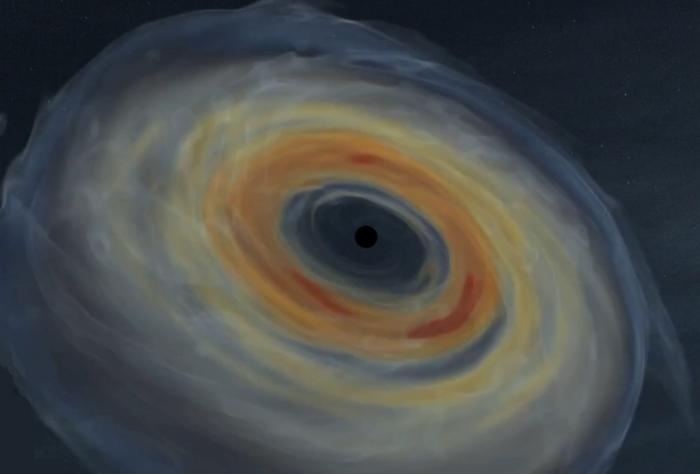
After a massive, spinning star dies, a disk of material forms around the central black hole. As the material cools and falls into the black hole, new research suggests that detectable gravitational waves are created.  Credit: Ore Gottlieb
After a massive, spinning star dies, a disk of material forms around the central black hole. As the material cools and falls into the black hole, new research suggests that detectable gravitational waves are created. Credit: Ore Gottlieb

Flatiron Institute announces new detectable gravitational wave source from collapsing stars, as predicted by simulations

Tyler O'Neal, Staff Editor SCIENCE August 22, 2024, 12:52 pm

In a recent study, researchers from the Flatiron Institute present simulations indicating that detectable gravitational waves could originate from the cataclysmic collapse of massive spinning stars. If proven true, this revelation could potentially revolutionize our understanding of the cosmos and the nature of black holes. However, these unprecedented claims have left many in the scientific community skeptical and cautious about embracing such paradigm-shifting assertions.

The study's bold assertions are based on the utilization of cutting-edge computational simulations. The simulations purportedly demonstrate the emergence of detectable gravitational waves following the dramatic deaths of rapidly rotating stars, offering a tantalizing prospect of expanding the horizons of gravitational wave astronomy.

While the potential implications of these findings are undeniably profound, the underlying fragility and speculative nature of simulations render the research subject to intense scrutiny. It is imperative to acknowledge that simulations, no matter how sophisticated, are inherently simplifications of complex physical phenomena.

Lead researcher Ore Gottlieb, a research fellow at the Flatiron Institute’s Center for Computational Astrophysics, is assertive in his claims that these gravitational waves could be detectable with instruments such as LIGO, the Laser Interferometer Gravitational-Wave Observatory. The predictions even suggest that current datasets might already contain evidence of these elusive signals.

However, the scientific community remains skeptical about the feasibility and robustness of these simulations. The boldness of the claims – presenting the possibility of fundamentally altering our understanding of black holes and the inner workings of collapsing stars – invites cautious contemplation.

The study's acknowledgements of the limitations of simulations reinforce the need for healthy skepticism. Gottlieb himself admits the challenge of capturing the variability and complexity of massive stars' collapse through simulations, illustrating the inherent uncertainties and assumptions in the endeavor.

Moreover, the proposal for detecting these gravitational waves raises pertinent questions about the capability of existing instruments and the potential biases in interpreting observational data. The complexities and subtleties of detecting elusive signals from celestial events demand a rigorous and vigilant approach that is far from guaranteed by relying solely on the outcomes of computational simulations.

While the study’s attempts to shed light on hitherto unexplored aspects of astrophysics are commendable, the scientific community should approach these claims with skepticism and scrutiny. The steadfast reliance on simulations demands a thorough validation process that adheres to the rigors of empirical evidence and observational corroboration.

As we confront these grand claims stemming from meticulously designed simulations, it becomes paramount to exercise caution and temper our enthusiasm with the sobering reality of the complexities inherent in modeling complex astrophysical phenomena. True scientific progress can only be achieved through the meticulous testing and validation of hypotheses, especially when they are based on the speculative outcomes of computational simulations.

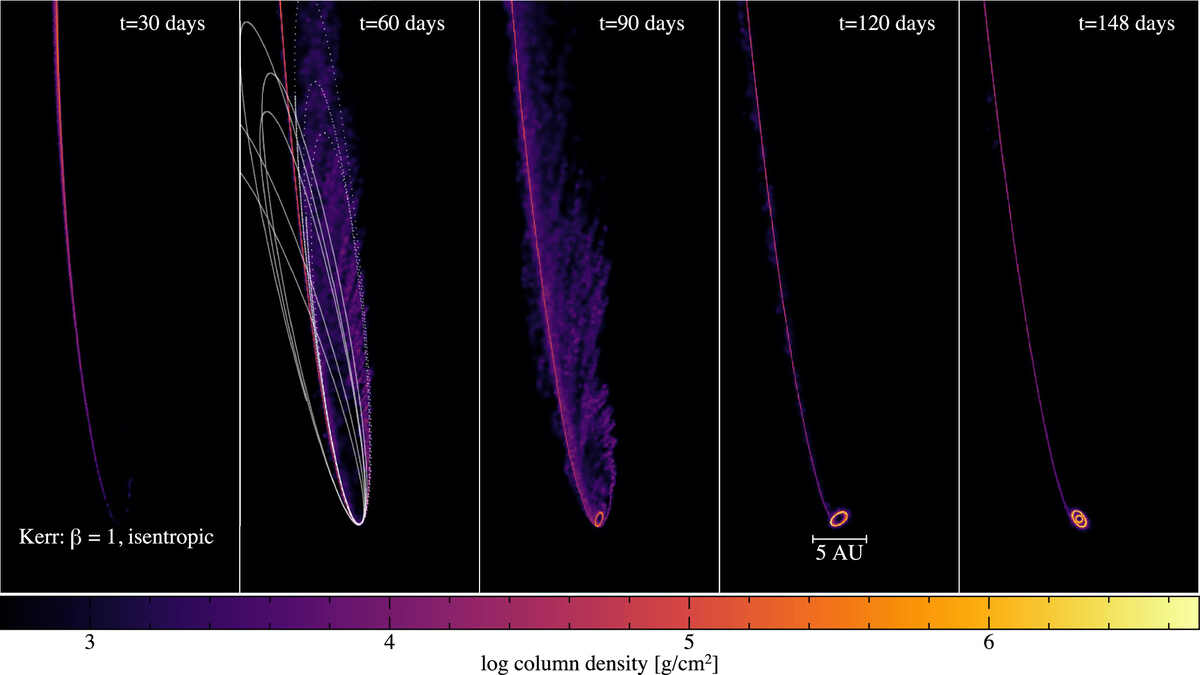
Disk formation in an isentropic simulation (radiatively efficient cooling) with a spinning black hole (a = 0.99, θ = 60°). The disk in this case is formed after 90 days and undergoes differential precession, which "tears" the disk into independent rings.

Supercomputer simulations illuminate tidal disruption events

Tyler O'Neal, Staff Editor SCIENCE August 20, 2024, 4:52 pm

Astrophysics recently achieved a significant milestone with groundbreaking supercomputer simulations that explain what happens to stars when they are torn apart by supermassive black holes. A research article published in The Astrophysical Journal Letters provides vital insights into these cataclysmic events.

The study, led by Daniel J. Price and his team, explores the complexities of simulating what happens after a star encounters a supermassive black hole. In the past, it has been challenging to capture the destruction of a star and the subsequent evolution of the returning debris due to the different timescales involved. Despite this, the researchers have successfully overcome these obstacles through a series of advanced simulations, revealing the formation of an expanding, lopsided bubble of material—an outflowing Eddington envelope extending hundreds of astronomical units.

An important aspect of the study is the unprecedented generation of an outflowing Eddington envelope within the simulations. This phenomenon was previously hypothesized but had never been realized in prior studies. This achievement holds promise for improving our understanding of optical and ultraviolet emissions in tidal disruption events, addressing longstanding differences between theoretical predictions and observational data.

The study's use of high-fidelity supercomputer simulations to capture the full range of processes involved in the tidal disruption of stars by supermassive black holes is noteworthy. The intricate interplay of gravitational forces, relativistic effects, and hydrodynamics has been carefully reproduced within these simulations, leading to a deeper understanding of these cosmic events.

Additionally, the researchers emphasize the critical role of these supercomputer simulations in addressing the limitations of existing models related to the optical emissions observed in tidal disruption events. By matching the observed light curves with low temperatures, faint luminosities, and specific line widths, the simulations provide a strong foundation for refining theoretical frameworks and deepening our understanding of these mysterious phenomena.

In a field where observations are often limited by the vast expanse of the cosmos and the unpredictability of celestial events, the use of advanced supercomputer simulations marks a transformative development. Through the intricate and high-fidelity models crafted in this study, astrophysicists now have the opportunity to gain profound insights into the dynamics of tidal disruption events, offering a glimpse into the underlying mechanisms that govern these awe-inspiring cosmic encounters.

The implications of these pioneering simulations extend beyond astrophysics, potentially impacting a range of scientific disciplines. The combination of theoretical frameworks and advanced computational capabilities has yielded a wealth of knowledge, promising to unlock some of the most profound mysteries of the universe.

As the research community continues to expand the boundaries of knowledge in astrophysics, the monumental progress made through supercomputer simulations offers a glimpse of the boundless potential of human ingenuity in unraveling the cosmic tapestry that surrounds us.

This groundbreaking research demonstrates the fusion of theoretical explanation and computational power, heralding a new era of discovery in astrophysics. The combination of visionary research and cutting-edge technology has ushered in a paradigm shift in our understanding of tidal disruption events, shedding light on the unexplored frontiers of the cosmos.

  1. A new explanation for X-ray emission from black holes met with skepticism
  2. Advances in computational methodology are transforming predictions of nanostructures

Page 4 of 61

  • 1
  • 2
  • 3
  • 4
  • 5
  • 6
  • 7
  • 8
  • 9
  • 10
POPULAR RIGHT NOW
  • Meta’s next frontier may not be social media; it may be supercomputing
    Meta’s next frontier may not be social media; it may be supercomputing
  • The future of cancer research runs on supercomputers
    Jill Mesirov, PhD
    Jill Mesirov, PhD
  • Rebuilding a lost continent: Supercomputers reveal Antarctica before the ice
    Antarctic ice meets the rocky coastline. Researchers traced landscape features from the two-kilometre-high coastal escarpment of Dronning Maud Land to the subglacial Gamburtsev Mountains, buried beneath 1–3 km of ice  Credit Matt Palmer
    Antarctic ice meets the rocky coastline. Researchers traced landscape features from the two-kilometre-high coastal escarpment of Dronning Maud Land to the subglacial Gamburtsev Mountains, buried beneath 1–3 km of ice Credit Matt Palmer
  • Supercomputers uncover a new class of cosmic explosions hidden in plain sight
    Supercomputers uncover a new class of cosmic explosions hidden in plain sight
  • AI supercharges the hunt for stronger magnets: Iowa State researchers launch a new era of intelligent materials discovery
    AI supercharges the hunt for stronger magnets: Iowa State researchers launch a new era of intelligent materials discovery
  • IBM's Historic stock collapse raises questions for the future of enterprise supercomputing
    IBM's Historic stock collapse raises questions for the future of enterprise supercomputing
  • Could a novel dark matter theory simultaneously resolve multiple cosmic enigmas? Supercomputer simulations provide a compelling, albeit currently unverified, potential solution
    Could a novel dark matter theory simultaneously resolve multiple cosmic enigmas? Supercomputer simulations provide a compelling, albeit currently unverified, potential solution
  • Melting icebergs may be reshaping Earth’s greatest ocean current
    Melting icebergs may be reshaping Earth’s greatest ocean current
  • Supercomputers replace ‘bathtub’ flood maps with physics-based digital twins of Britain’s coastline
    Supercomputers replace ‘bathtub’ flood maps with physics-based digital twins of Britain’s coastline
  • Supercomputers push neural quantum simulation beyond previous limits
    Supercomputers push neural quantum simulation beyond previous limits
MOST READ THIS YEAR
  • Cosmic ambition at scale: UK’s supercomputer unlocks a 2.5 petabytes universe
    Cosmic ambition at scale: UK’s supercomputer unlocks a 2.5 petabytes universe
  • Intel's Q1 results signal supercomputing surge driving Xeon momentum
    Intel's Q1 results signal supercomputing surge driving Xeon momentum
  • When stars fall apart: Supercomputing reveals the hidden physics of black holes
    When stars fall apart: Supercomputing reveals the hidden physics of black holes
  • FRONTPAGE
  • LATEST
  • POPULAR
  • REGISTER
  • SOCIAL
  • VIDEO
  • SUBSCRIPTION
  • RSS
  • GUIDELINES
  • PRIVACY
  • TOS
  • ABOUT
  • +1 (816) 799-4488
  • editorial@supercomputingonline.com
© 2001 - 2026 SuperComputingOnline.com, LLC. All rights reserved. This material may not be published, broadcast, rewritten or redistributed without permission.
Sign In
  • FRONT PAGE
  • LATEST
    • MEDIA KIT
    • MOST READ
    • RSS FEED
    • ACADEMIA
    • AEROSPACE
    • APPLICATIONS
    • ASTRONOMY
    • AUTOMOTIVE
    • BIG DATA
    • BIOLOGY
    • CHEMISTRY
    • CLIENTS
    • CLOUD
    • DEFENSE
    • DEVELOPER TOOLS
    • EARTH SCIENCES
    • ECONOMICS
    • ENGINEERING
    • ENTERTAINMENT
    • HEALTH
    • INDUSTRY
    • INTERCONNECTS
    • GAMING
    • GOVERNMENT
    • MANUFACTURING
    • MIDDLEWARE
    • MOVIES
    • NETWORKS
    • OIL & GAS
    • PHYSICS
    • PROCESSORS
    • RETAIL
    • SCIENCE
    • STORAGE
    • SYSTEMS
    • VISUALIZATION
  • VIDEOS
    • ADD YOUR VIDEOS
    • MANAGE VIDEOS
  • COMMUNITY
    • TRADE SHOWS
    • SOCIAL NETWORK VIDEOS
    • SURVEYS
    • APPLICATIONS BROWSER
    • CONVERSATION INBOX
    • SOCIAL ADVERTISER
    • GROUPS
    • MARKETPLACE LISTINGS
    • PAGES
    • LEADERBOARD
    • POINTS LISTING
      • BADGES
    • PRIVACY CONFIRM REQUEST
    • PRIVACY CREATE REQUEST

Hey there! We noticed you’re using an ad blocker.