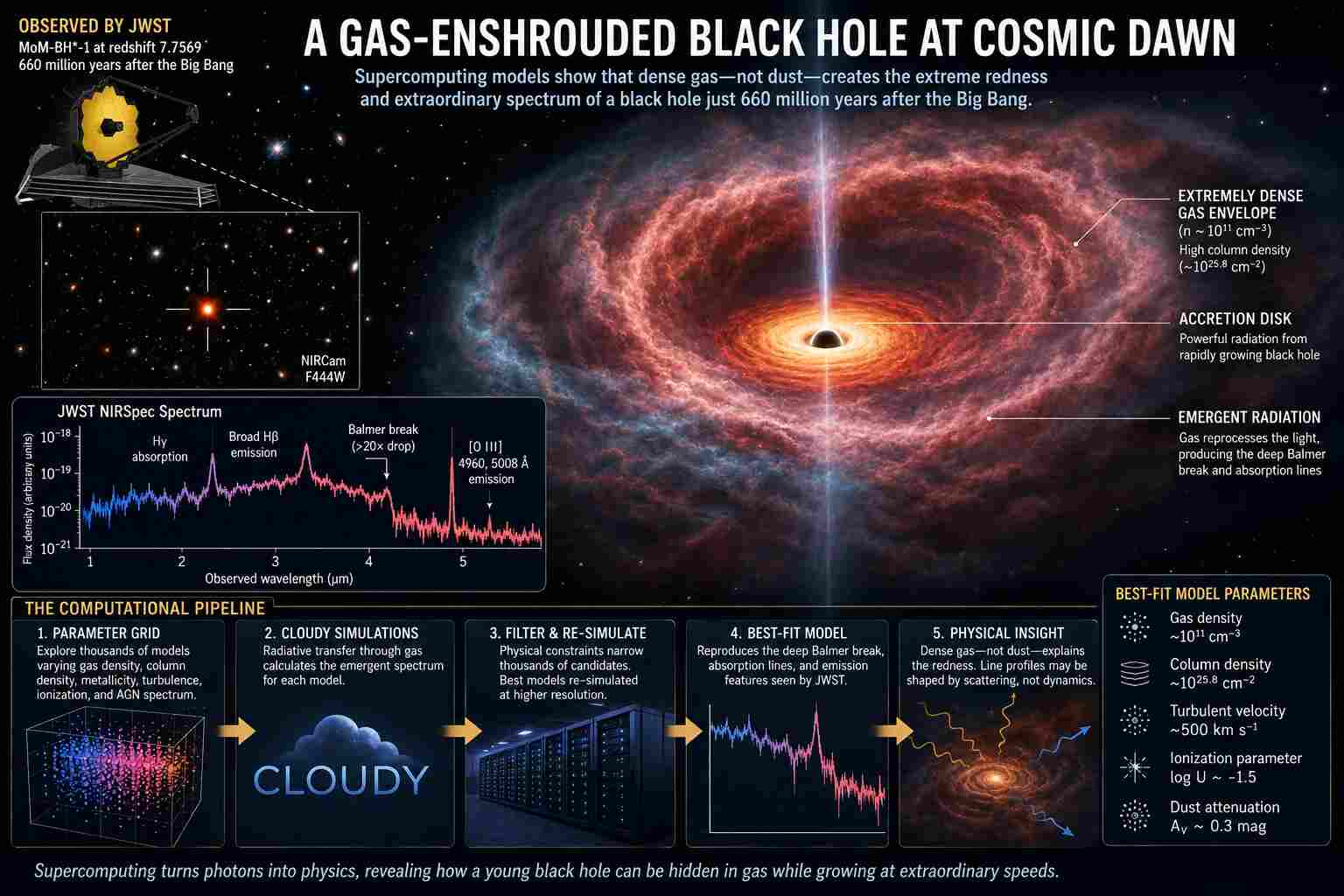
JWST observations of an extraordinary “little red dot” have forced astronomers to model a high-density, high-opacity environment around a young black hole. Thousands of Cloudy simulations and radiative-transfer calculations show how dense gas can reproduce a spectrum that dust alone cannot explain.
The James Webb Space Telescope has revolutionized our observational access to the first billion years of cosmic history, yet the data it returns often presents as much mystery as clarity. For the most enigmatic objects, such as the peculiar little red dot known as MoM-BH-1*, observed roughly 660 million years after the Big Bang, merely capturing the light is insufficient. Interpreting these unique spectral signatures requires a shift toward rigorous computational physics, where researchers must reconstruct the environments that produced the light we see today. The recent Nature https://www.nature.com/articles/s41586-026-10846-4 study of MoM-BH-1* highlights this challenge, as the object’s spectrum features an exceptionally strong Balmer break alongside unusual hydrogen absorption and emission characteristics that existing models of unobscured active galactic nuclei cannot explain.
To move beyond isolated anomalies, the research team utilized sophisticated tools like Cloudy to simulate an accreting black hole embedded within an extremely dense, high-opacity gaseous envelope. By conducting a massive parameter sweep, varying gas density, column density, metallicity, and ionization parameters, the researchers were able to demonstrate that the extraordinary spectral appearance is a product of gas reprocessing rather than the standard dust-obscuration narratives. This work is a compelling testament to the power of modern high-performance computing in astrophysics: it transforms raw JWST spectra into a dynamic, laboratory-like simulation that bridges the gap between microscopic atomic-level physics and galaxy-scale observations. Ultimately, this approach proves that as we probe the earliest moments of the Universe, our ability to compute the physical environment is just as vital as the telescope’s ability to detect the distant signal, providing a necessary framework for challenging old assumptions about black-hole masses and cosmic evolution.
From JWST spectrum to computational physics
MoM-BH*-1 belongs to the growing population of faint, compact objects known as little red dots, or LRDs. Their spectra have presented astronomers with a fundamental modeling problem. The objects are extremely red, yet conventional dust-obscuration scenarios do not necessarily reproduce their characteristic spectral shapes.
MoM-BH*-1 is particularly extreme. Its Balmer break is exceptionally strong, while the source is faint in the ultraviolet. The researchers therefore considered whether the observed spectrum could instead be produced by an active black hole surrounded by a dense gaseous envelope.
That hypothesis cannot be tested simply by looking at the image. It requires solving the physics of radiation interacting with gas. And that is where the computation begins.
Building a numerical model of the black hole environment
The researchers used Cloudy, a widely used astrophysical plasma and spectral-synthesis code, to construct models of the gas surrounding the central source. The model begins with an intrinsic AGN spectral-energy distribution represented by a series of power laws and a “big bump” temperature.
That radiation is then passed through a surrounding cloud characterized by several physical parameters:
- gas density;
- column density;
- metallicity;
- turbulent velocity; and
- ionization parameter.
The calculations also include a dust screen as a post-processing operation. This is important computationally. The researchers are not simply adjusting the color of an artificial spectrum until it resembles JWST data.
The radiation is being physically reprocessed by a modeled gas environment, producing absorption, emission, and continuum changes that can be compared against the observations.
Searching a high-dimensional parameter space
This is where the study becomes particularly interesting from a computational perspective. The parameter space is large and highly degenerate. Different combinations of density, column density, metallicity, turbulence, ionization, and intrinsic AGN spectrum can produce related observational signatures. The researchers therefore constructed a broad parameter grid rather than relying on one hand-selected model. They imposed multiple observational constraints simultaneously.
Candidate models had to reproduce:
- net Hβ emission with an equivalent width between 30 and 45 Å;
- Hγ absorption;
- a strong Balmer break;
- a high optical-to-ultraviolet flux ratio; and
- the observed MIRI fluxes within their uncertainties.
The initial computational search produced a few thousand models satisfying those constraints.
Those candidates were then re-simulated at higher resolution, retaining the hydrogen levels relevant to the key spectral features in order to reduce computational complexity and improve efficiency.
That is a textbook example of an efficient scientific-computing workflow:
broad parameter sweep → physical filtering → higher-resolution re-simulation → detailed model selection.
Instead of spending maximum computational resources on every possible model, the researchers progressively narrowed the search.
Why the gas matters
The resulting model provides a striking explanation for the object’s unusual appearance.
The best-fit configuration places the black hole inside a column of dense gas extending roughly 40 astronomical units.
The central engine produces the underlying continuum.
As that radiation propagates outward, the surrounding gas absorbs and reprocesses it.
The result is a spectrum with a deep Balmer break and strong absorption features that resemble what JWST observes.
The model is especially interesting because it does not require the extreme spectral shape to be generated primarily by dust.
The paper’s Extended Data analysis shows that a significant population of hydrogen atoms in the n = 2 state develops within the dense gas. That population is crucial for producing the deep Balmer absorption.
In computational terms, the simulation is resolving the microscopic state of the gas well enough to connect atomic-level physics to a galaxy-scale astronomical observation.
The emergent spectrum changes with depth
One of the most revealing aspects of the calculation is that the spectrum is not treated as something generated at one location.
The researchers examine the emergent spectrum at different depths within the modeled cloud.
The incident power-law continuum enters the gas.
As it propagates through the envelope, interactions with the material progressively reshape it.
The result is a transformed spectrum containing the Balmer break and absorption signatures seen by JWST.
This is fundamentally a radiative-transfer problem.
The observed photons carry information not just about the source producing them, but about everything they encountered before escaping the system.
The computation effectively reconstructs that journey.
A Surprising Result for Hβ
The modeling produces another important insight.
Astronomers often use the width of broad emission lines such as Hβ to estimate black-hole masses.
But the simulations suggest that assumption may fail in this extreme environment.
The modeled Hβ emission originates primarily close to the surface of the gas envelope, where processes including collisions contribute to its production.
It therefore may not faithfully trace the kinematics of gas deep inside the system.
That creates a significant computational consequence.
A conventional black-hole mass estimate can depend on interpreting an observed line width as a velocity measurement.
But if radiative transfer changes the line profile before the photons escape, the observed width may not represent the underlying orbital velocity.
The computer model therefore isn’t merely explaining the spectrum.
It is challenging the assumptions used to extract physical parameters from that spectrum.
Simulating resonant scattering
The researchers also performed a separate set of simplified radiative-transfer calculations to explore the unusual double-peaked Hβ profile.
Their shell model shows that Hβ can behave in ways analogous to resonantly scattered Lyα radiation when particular radiative-decay pathways are suppressed.
A relatively narrow intrinsic line can be scattered into a double-peaked profile.
The calculation also demonstrates how dust, inflow, outflow, and shell geometry can alter the relative strengths of those peaks.
The authors stress that this is a simplified model and does not reproduce all of the broad wings in the observed profile.
But computationally, it demonstrates something important:
The observed spectral line may be the product of radiative transfer rather than a straightforward picture of gas motion.
Computation changes the black-hole mass estimate
That distinction has major consequences.
If standard local scaling relations are applied to the observed Hβ properties, the inferred black-hole mass can be around 10⁸ solar masses.
But the researchers show that the assumptions behind such estimates may not hold for this extreme environment.
Accounting for negligible dust attenuation produces a substantially different estimate, while considering resonant scattering can drive the inferred mass still lower. Their Cloudy-based modeling yields another estimate of around 2 × 10⁶ solar masses, assuming near-Eddington accretion.
The enormous spread is not simply an observational uncertainty.
It illustrates the importance of physics-aware computational modeling.
If the environment surrounding the black hole changes how radiation escapes, then applying empirical formulas developed for very different astrophysical systems can produce misleading answers.
The simulation provides a way to test those assumptions.
The model is powerful and the authors are careful
The researchers are careful not to present the computational model as a definitive reconstruction.
The parameter space they explore is high-dimensional and degenerate, while the intrinsic spectra of early active galactic nuclei remain uncertain.
They explicitly caution that the calculations should be interpreted primarily as demonstrating the feasibility of a broad physical picture: an accretion disk embedded in dense gas.
That scientific caution is important.
Computational models can explore enormous parameter spaces, but they cannot manufacture information that observations do not contain.
The goal is to identify physically plausible solutions and determine which observations would discriminate between them.
An open computational ecosystem
The work also illustrates how modern astrophysics increasingly depends on an ecosystem of specialized scientific software.
The paper identifies publicly available tools used in the analysis, including:
msaexp, grizli, Astropy, Cloudy, SpectRes, pysersic, COLT, and NumPyro.
That software stack spans several computational tasks, from JWST spectral processing and astronomical data analysis to radiative-transfer modeling and statistical inference.
This is increasingly characteristic of modern computational astrophysics.
The scientific workflow isn’t one program.
It is a chain of numerical tools, each solving a different part of the problem.
Why this is a supercomputing story
There is an important distinction between this research and a conventional observational astronomy paper.
JWST provided the critical measurements.
But the telescope alone cannot tell researchers exactly how those photons were produced.
The computational models provide the missing physical experiment.
Scientists can vary the gas density.
They can change the column density.
They can alter metallicity.
They can introduce turbulence.
They can modify the ionization state.
They can change the assumed AGN continuum.
Then they can calculate what spectrum should emerge.
That is something the real Universe will not allow astronomers to do experimentally.
The computer becomes the laboratory.
From atomic physics to cosmic dawn
Perhaps the most impressive aspect of the calculation is its range of scales.
The model connects the atomic structure of hydrogen to the radiation field surrounding a black hole and ultimately to a spectrum observed from an object more than 13 billion years ago.
At the microscopic level, the calculation tracks populations of hydrogen energy states.
At the gas-cloud level, it follows absorption, emission, and scattering.
At the astronomical level, it produces a synthetic spectral-energy distribution.
And at the observational level, that synthetic spectrum is compared with JWST measurements.
The computation creates a bridge between atomic physics and cosmology.
A different picture of the first black holes
The modeling also points toward an intriguing possibility for the evolution of early black holes.
The researchers argue that MoM-BH*-1 could represent a black hole in an unusually dense gaseous environment, potentially during a period of rapid or even super-Eddington growth.
The paper discusses scenarios in which high opacity could trap accretion radiation or transport it through convection, allowing gravitational accretion to overcome the usual radiative-feedback barrier. Under some interpretations, the source could be experiencing an accretion rate of several times the Eddington limit.
If similar objects prove common, such environments could become important pieces of the puzzle surrounding the rapid emergence of massive black holes in the early Universe.
But once again, computation is essential.
Astronomers cannot travel to cosmic dawn.
They can only observe its surviving radiation and construct physical models capable of explaining it.
The next generation of computational astronomy
The study represents a direction that is likely to become increasingly important as JWST and future observatories produce more high-resolution spectra.
More observations will create more complicated physical puzzles.
More complicated puzzles will require larger model grids.
Larger model grids will require more efficient numerical methods.
And eventually, automated inference systems may explore parameter spaces far beyond what researchers can reasonably investigate manually.
The computational challenge will therefore move from simply generating a spectrum to systematically exploring millions or billions of possible physical configurations.
That is where high-performance computing, accelerated computing and statistical inference can become increasingly important.
The computer Is reading the light
The extraordinary discovery here is not simply that JWST has found another distant black hole.
It is that the object’s light contains enough structure to force scientists into a detailed computational reconstruction of its environment.
The spectrum is effectively a compressed record of the physical conditions surrounding the black hole.
The numerical model attempts to decompress that record.
Gas density leaves a signature.
Hydrogen excitation leaves a signature.
Turbulence leaves a signature.
Radiative transfer leaves a signature.
And the challenge for computational astrophysics is to determine how those signatures combine into the spectrum arriving at Earth.
That is an enormously difficult inverse problem.
But modern scientific computing gives researchers a way to attack it.
Supercomputing turns a spectrum into a physical experiment
MoM-BH*-1 demonstrates why computational astrophysics is becoming indispensable to observational astronomy. The James Webb Space Telescope can capture photons from an object at cosmic dawn. But Cloudy and complementary radiative-transfer calculations can ask what those photons had to travel through to look the way they do.
In this case, the numerical evidence points toward an extraordinarily dense gaseous environment surrounding the black hole, one capable of producing a deep Balmer break, suppressing ultraviolet emission and reshaping hydrogen emission lines without requiring conventional dust obscuration to explain the entire phenomenon.
The researchers are careful about the remaining uncertainties, and rightly so. The parameter space is complex, the early-Universe AGN population remains poorly understood, and the current observations cannot uniquely determine every property of the system. But that is precisely what makes the computational work valuable. The simulation doesn’t close the mystery. It defines it.
And as JWST continues to expose increasingly strange objects from the first billion years of cosmic history, the ability to run detailed radiative-transfer calculations, explore high-dimensional parameter spaces, and connect atomic physics with cosmological observations may prove just as important as the telescope itself. At cosmic dawn, the Universe was already running its most extreme astrophysical experiments. Now, more than 13 billion years later, supercomputing is giving astronomers a laboratory in which to recreate the physics.