

SUPERCOMPUTING NEWS SUPERCOMPUTING NEWS
    • MEDIA KIT
    • MOST READ
    • RSS FEED
    • ACADEMIA
    • AEROSPACE
    • APPLICATIONS
    • ASTRONOMY
    • AUTOMOTIVE
    • BIG DATA
    • BIOLOGY
    • CHEMISTRY
    • CLIENTS
    • CLOUD
    • DEFENSE
    • DEVELOPER TOOLS
    • EARTH SCIENCES
    • ECONOMICS
    • ENGINEERING
    • ENTERTAINMENT
    • GAMING
    • GOVERNMENT
    • HEALTH
    • OIL & GAS
    • INDUSTRY
    • INTERCONNECTS
    • MANUFACTURING
    • MIDDLEWARE
    • MOVIES
    • NETWORKS
    • PHYSICS
    • PROCESSORS
    • RETAIL
    • SCIENCE
    • STORAGE
    • SYSTEMS
    • VISUALIZATION
    • AcyMailing subscription form

    • ADD YOUR VIDEOS
    • MANAGE VIDEOS
    • CONVERSATION INBOX
    • SOCIAL ADVERTISER
    • SOCIAL NETWORK VIDEOS
    • SURVEYS
    • GROUPS
    • PAGES
    • MARKETPLACE LISTINGS
    • APPLICATIONS BROWSER
    • PRIVACY CONFIRM REQUEST
    • PRIVACY CREATE REQUEST
    • LEADERBOARD
    • POINTS LISTING
      • BADGES
    • TRADE SHOWS
Sign In
AWS surges 39%, but Amazon’s $220 billion AI spending plan puts returns under the microscope
Featured
Tyler O'Neal, Staff Editor LATEST October 29, 2026, 5:37 pm

AWS surges 39%, but Amazon’s $220 billion AI spending plan puts returns under the microscope

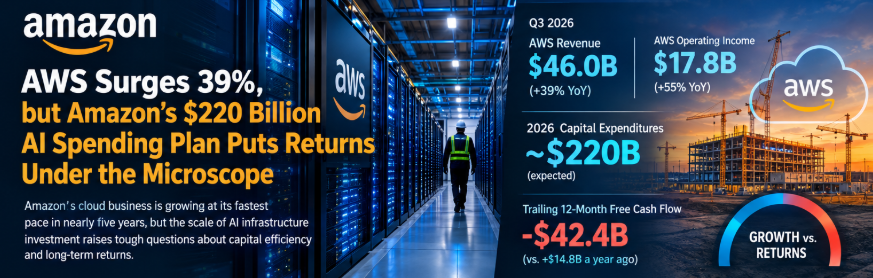
Amazon’s cloud business is growing at its fastest pace in nearly five years. Still, a $42.4 billion trailing-year free cash flow outflow underscores the financial stakes of building the next generation of AI infrastructure.

Amazon’s cloud business is accelerating, yet the infrastructure required to sustain this growth represents an increasingly significant financial commitment.

During the third quarter of 2026, Amazon reported $201.9 billion in revenue, with Amazon Web Services (AWS) contributing $46.0 billion, a 39% year-over-year increase. The company noted that AWS has achieved a $184 billion annualized revenue run rate, with operating income climbing to $17.8 billion, up from $11.4 billion in the prior year.

While these figures solidify AWS as a primary beneficiary of the surging demand for cloud computing and AI infrastructure, the current balance sheet and cash flow trajectory pose a critical question for the high-performance computing industry: how effectively can hyperscalers transform massive infrastructure investments into sustainable, profitable revenue?

Amazon maintains a capital expenditure forecast of approximately $220 billion for 2026. Concurrently, free cash flow for the trailing 12 months ending September 30 shifted to a $42.4 billion outflow, down from a $14.8 billion inflow during the same period last year, a deterioration Amazon attributes primarily to AI-driven investments in property and equipment.

Although Amazon retains strong operating momentum, the fundamental challenge remains: determining the extent of the productive capacity generated by this spending, the speed of its deployment, and whether the resulting returns will ultimately justify the scale of the investment.

AWS growth is accelerating

AWS revenue rose from $33.0 billion in the third quarter of 2025 to approximately $46.0 billion in the third quarter of 2026. The 39% increase was the segment’s fastest growth in nearly five years, according to Amazon.

Operating income increased approximately 55%, reaching $17.8 billion. AWS therefore remains a major profit engine for Amazon, not merely a business expanding its infrastructure footprint.

The results also point to demand extending beyond conventional cloud hosting. Amazon reported rapid growth in its Bedrock inference service, with year-over-year token volume increasing nearly 17-fold. The company said Fortune 500 customer spending on Bedrock was nearly seven times higher than a year earlier.

These figures suggest that enterprise AI workloads are becoming a more important component of cloud consumption. Inference services, managed model platforms and agent-based applications can generate recurring demand for compute, memory, storage, networking and data movement.

Yet token volume is not a direct measure of computing efficiency or profitability. The amount of hardware, energy, and memory bandwidth required to produce a given number of tokens depends on the model, precision, batching strategy, serving architecture, utilization, and service-level requirements. A rapid increase in token volume can indicate adoption, but it does not independently establish how profitably the workload is being served.

Amazon's reported financial performance is stronger evidence of commercial traction than token counts alone. The next question is whether that performance can keep pace with the capital required to deliver additional capacity.

The infrastructure bill is enormous

Amazon says it continues to expect approximately $220 billion in cash capital expenditures for 2026. The figure encompasses the company's capital investment program and should not be interpreted as an AWS-only or AI-only spending total.

Nevertheless, Amazon explicitly linked the recent increase in property and equipment purchases primarily to AI investment.

For a hyperscale computing provider, capital expenditures can encompass data-center buildings, electrical infrastructure, backup systems, cooling equipment, networking, servers, accelerators and other computing equipment. The specific mix matters because each category has different deployment timelines, depreciation profiles, capacity constraints, and useful lives.

AI infrastructure is especially demanding. Large accelerator clusters require high-bandwidth interconnects, sufficient memory capacity, carefully engineered power delivery and cooling systems capable of handling dense thermal loads. Scaling a cluster is not simply a matter of purchasing more processors: the surrounding infrastructure must deliver power, move data, and keep the system operating reliably.

The financial risk is that capital spending and monetization do not necessarily arrive on the same schedule. Equipment can be purchased before a facility is fully commissioned, while power availability, network integration, supply-chain constraints or customer deployment schedules can delay productive utilization.

A completed data center is not automatically a fully utilized data center. Installed accelerator capacity does not guarantee that customers will consume enough compute to produce the expected return.

Amazon's results show that demand is growing strongly today. They do not, by themselves, establish the eventual utilization rate or return on every dollar invested in the expansion.

Free cash flow turns negative as investment accelerates

Amazon generated $168.3 billion in operating cash flow over the trailing 12 months, up 29% year over year. That is a substantial increase in cash generated by the business.

But purchases of property and equipment, net of sales proceeds and incentives, reached $210.7 billion over the same period. Amazon's defined free cash flow, operating cash flow minus those purchases, consequently became a $42.4 billion outflow.

The comparison with the previous year is stark. Free cash flow moved from a positive $14.8 billion to a negative $42.4 billion, a swing of more than $57 billion.

That is not proof that the investment strategy is failing. Infrastructure-heavy businesses can experience periods when spending precedes revenue, particularly during major technology transitions. Amazon's growing operating income and AWS profitability provide meaningful support for its investment case.

But the cash flow figures show why revenue growth alone is an inadequate measure of the health of the AI infrastructure boom.

Investors and customers should be watching the relationship among capital expenditures, operating cash flow, depreciation, infrastructure utilization, and incremental operating profit. The key question is not just how much AWS revenue grows, but how much additional profit and cash the company generates for each additional unit of deployed capacity.

The system-level challenge: useful compute, not just installed compute

For HPC engineers and infrastructure architects, Amazon's expansion reflects a familiar systems problem. Performance depends on the behavior of the complete platform, not the theoretical capability of its most powerful component.

Accelerators can deliver high peak throughput, but useful application performance depends on memory bandwidth, interconnect topology, communication overhead, storage access, software optimization, and workload scheduling. At hyperscale, power and cooling can constrain the number of systems that can be installed and operated within a given facility.

The same principle applies commercially. A large investment in GPUs or custom AI accelerators creates value only when the systems are brought online, customers can access them, workloads run efficiently, and the resulting service earns sufficient revenue.

Metrics such as accelerator utilization, delivered performance per watt, cost per useful token, time to deploy new capacity, and revenue generated per unit of installed infrastructure would help assess that efficiency. Amazon's earnings release does not provide a comprehensive public breakdown of these measures across its AI infrastructure fleet.

That absence does not negate the reported growth. It does limit how confidently outside observers can assess the underlying efficiency of the investment program.

Amazon sees years of growth ahead

Amazon CEO Andy Jassy said the company's AWS investment in functionality and infrastructure was working and projected growth rates above 40% in both 2027 and 2028.

Those projections would imply sustained demand for additional capacity. They also make execution more important: the company must continue expanding infrastructure while managing supply, power availability, equipment deployment, operating costs, and the possibility that customer demand or the economics of AI workloads could change.

Amazon's fourth-quarter guidance calls for net sales between $240 billion and $247 billion, with operating income between $28.5 billion and $33.5 billion. The company also noted that its forecasts are subject to uncertainty, including energy prices, resource and supply volatility, memory-chip availability and customer demand.

For the HPC sector, the memory and energy references are particularly relevant. Advanced compute capacity is constrained by more than processor supply. High-bandwidth memory, networking components, electrical equipment and data-center construction all influence how quickly a theoretical capacity plan becomes a working system.

The verdict: strong demand, unfinished ROI story

Amazon's third-quarter results confirm that AWS is experiencing robust growth and generating significant operating income. Simultaneously, these results indicate that the company’s infrastructure investment has reached a magnitude that materially impacts cash flow.

These factors must be evaluated in tandem. A $220 billion annual capital expenditure plan may be rational, provided that demand continues to escalate and new capacity yields attractive returns. However, the scale of this investment renders execution risk, utilization, and capital efficiency critical strategic priorities rather than mere accounting details.

For SuperComputingOnline News’ readers, the primary narrative is not simply that Amazon is investing heavily in AI, but that hyperscale computing is entering a phase where power, facilities, memory, networking, and accelerator deployment must scale in alignment, all while the long-term financial returns remain to be demonstrated.

While the 39% growth in AWS revenue serves as a strong indicator of market demand, the resulting negative free cash flow underscores the significant cost of meeting it. Consequently, the new benchmark for the AI infrastructure race should move beyond aggregate capital expenditure or announced compute capacity; instead, focus should shift toward the delivery of useful, efficiently utilized computing capacity that can be converted into durable, long-term returns.

Thwaites Glacier: Why better physics matters more than finer meshes in supercomputing
Featured

Thwaites Glacier: Why better physics matters more than finer meshes in supercomputing

CHRIS O'NEAL, PUBLISHER LATEST October 28, 2026, 10:00 am

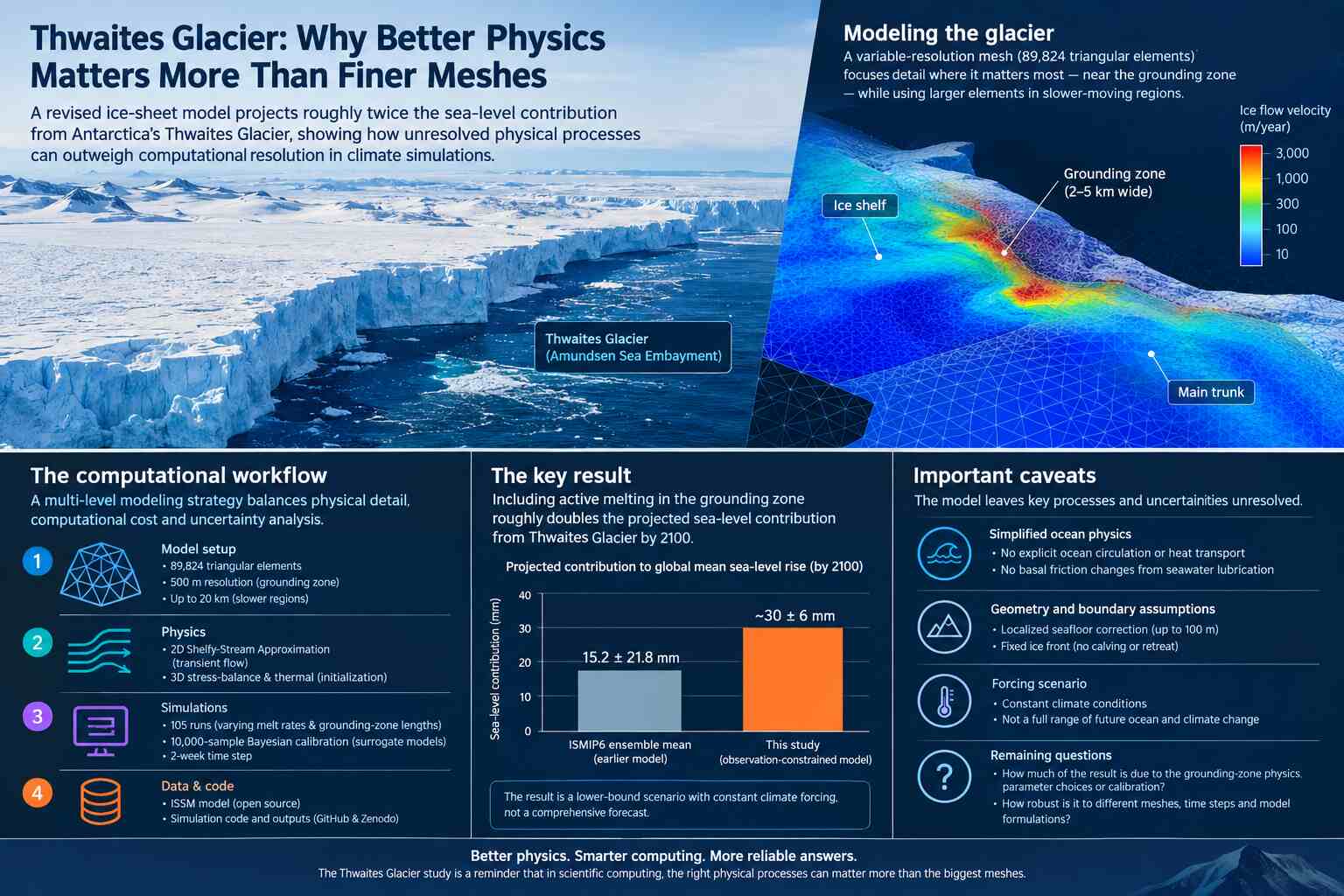
A revised ice sheet model projects roughly twice the sea-level contribution from Antarctica’s Thwaites Glacier, highlighting how unresolved physical processes can outweigh computational resolution in climate simulations.

A supercomputer can solve an enormous set of equations at high spatial resolution, but that does not guarantee the model captures the physical processes that matter most. A new study published in Nature Communications https://www.nature.com/articles/s41467-026-77976-1 illustrates that distinction with a consequential revision to projections of Thwaites Glacier, one of Antarctica’s most closely watched ice systems.

The researchers report that incorporating active melting in the glacier’s grounding zone, the transition where grounded ice begins to float, approximately doubles Thwaites Glacier's modeled contribution to global mean sea-level rise by 2100 compared with the mean of a widely used earlier model ensemble.

The finding is significant not simply because the projected number is larger, but because it exposes a modeling problem: a process operating across a relatively narrow region can influence the behavior of an entire glacier system. For the high-performance computing community, the study offers a case study in the relationship between numerical resolution, physical parameterization, observational calibration, and uncertainty.

It is also a result that warrants careful qualification. The reported projection comes from a particular model configuration and forcing scenario, not a definitive forecast of how much sea level Thwaites Glacier will contribute under every plausible future climate.

The grounding zone becomes a computational priority

Thwaites Glacier drains a substantial portion of the West Antarctic Ice Sheet. Its future behavior depends on interacting processes, including ice deformation, basal conditions, ocean-driven melting, the geometry of the bed beneath the ice, and changes in the glacier’s grounding line.

The grounding zone is especially challenging to represent numerically. It is where ice transitions from resting on bedrock to floating in seawater, and where ocean water can intrude beneath the grounded ice. Melting in this region can alter the boundary conditions governing ice flow and retreat.

In the study, the researchers incorporated active melting across grounding zones approximately 2 to 5 kilometers wide. The parameterization represents seawater intrusion and melting beneath ice that remains grounded, a process that conventional model configurations may not adequately capture.

That scale creates an important computational challenge. A model must represent a localized process without losing the larger-scale dynamics that determine how the glacier responds over decades.

The team used the Ice-sheet and Sea-level System Model (ISSM), a numerical framework for simulating ice-sheet evolution. Its mesh contains 89,824 triangular elements, with spatial resolution reaching approximately 500 meters near the grounding zone and becoming progressively coarser, up to 20 kilometers, in slower-moving regions.

This variable-resolution approach allocates computational effort where the modeled physics is most sensitive. It is a familiar strategy in scientific computing: concentrate degrees of freedom in regions with strong gradients or complex boundary behavior while using larger elements where the solution varies more gradually.

But mesh refinement alone cannot compensate for a missing physical process. The study’s central implication is that how the grounding zone is represented can matter as much as, or more than, simply increasing the number of grid elements.

A multilevel modeling strategy

The researchers combined several numerical approaches to represent glacier dynamics at different levels of complexity.

For much of the transient glacier-flow calculation, they used the Shelfy-Stream Approximation, a two-dimensional treatment commonly applied to ice flow dominated by horizontal motion and longitudinal stresses. Higher-order, three-dimensional stress-balance and thermal calculations were used during model initialization.

The distinction matters. Full three-dimensional stress and thermal calculations can be computationally demanding, particularly when models must be run repeatedly to explore parameter sensitivity and calibrate against observations. Using a less expensive approximation for the transient phase can make larger experimental ensembles feasible, but it also means that the model’s results depend on the adequacy of the selected approximation for the processes being studied.

The researchers conducted 105 numerical simulations spanning different melt rates and grounding-zone lengths. They then used Bayesian calibration against observations of retreat, thinning, and acceleration over approximately 1996–2023.

Their calibration procedure included a prior ensemble of 10,000 samples evaluated using surrogate models. Surrogate modeling is a common technique for reducing the cost of uncertainty analysis: an approximation of the expensive simulation is used to explore parameter combinations that would otherwise require many more full model runs.

The simulations used a fixed transient time step of two weeks. This is a modeling choice, not proof by itself that every relevant physical timescale is resolved. Temporal accuracy depends on the numerical scheme, model dynamics, and the timescales of the processes being represented.

Taken together, the workflow reflects a practical tension in computational glaciology. Researchers need sufficient physical detail to represent important mechanisms, but they also need a tractable modeling system that can be calibrated, tested and run across a meaningful range of uncertain parameters.

The projection: approximately twice the earlier ensemble mean

The study projects that Thwaites Glacier could contribute up to approximately 30 ± 6 millimeters of global mean sea-level rise by 2100 under the specified constant-climate-forcing scenario.

The researchers compare that result with a mean contribution of approximately 15.2 ± 21.8 millimeters in the earlier ISMIP6 ensemble. The comparison indicates a substantial increase in the modeled contribution when grounding-zone melting is represented.

The figures should not be read as two directly interchangeable forecasts with identical assumptions and uncertainty structures. The ensemble mean and spread describe a different modeling framework, while the new result is associated with a particular observation-constrained model configuration and scenario.

Nor does the phrase “up to” mean that 30 millimeters is the most likely outcome under every future climate trajectory. It is a conditional projection arising from the study’s selected assumptions.

The authors characterize their result as a lower-bound scenario because it isolates the effect of grounding-zone melting rather than incorporating all possible future increases in ocean warming. That distinction is important: a result designed to isolate one physical mechanism cannot, by itself, quantify the full range of future glacier response.

For scientific computing, the more consequential point is the sensitivity of the projection to the representation of a process that occupies a comparatively narrow part of the modeled domain. A change in physical formulation produced a materially different long-term result without requiring the conclusion that a vastly larger mesh alone would have delivered the same improvement.

What the model still leaves unresolved

The study is not a complete simulation of every ocean–ice interaction that could influence Thwaites Glacier. Its grounding-zone melt treatment uses a simplified parameterization rather than explicitly resolving ocean circulation and heat transport throughout the cavities beneath the ice shelves.

That is a significant limitation. The melt rate imposed by such a parameterization cannot capture every possible feedback between ocean dynamics, heat delivery, cavity geometry, and ice retreat. The model’s results therefore remain sensitive to how grounding-zone melting is specified.

The study also does not model changes in basal friction caused by seawater lubrication. Such changes could affect how grounded ice slides over its bed. The model applies a localized correction to seafloor elevation of up to 100 meters, making bathymetric uncertainty another relevant consideration.

In addition, the ice front is held fixed, excluding calving and ice-front retreat from the modeled evolution. The forcing scenario maintains constant climate conditions and does not include interannual variability in thermal forcing through the end of the century.

These choices do not invalidate the study. They define the experiment the researchers conducted. Isolating a particular mechanism can be scientifically useful, especially when the aim is to determine whether that mechanism materially changes a model’s behavior. But the resulting projection should not be interpreted as a complete accounting of the glacier’s future.

The uncertainties also raise a broader modeling question: how much of the revised projection comes from the new grounding-zone physics, how much from its parameter choices, and how much from the observational calibration? Understanding those contributions is essential if the result is to inform the next generation of ice-sheet simulations.

Observations constrain the model, but do not eliminate uncertainty

Calibrating against observed retreat, thinning, and acceleration provides an important check against unconstrained forward simulations. It links model behavior to the glacier’s documented evolution over recent decades.

However, fitting observations from the historical period does not guarantee that the same parameterization will remain accurate as boundary conditions change. Several combinations of uncertain parameters can sometimes produce similar historical behavior while diverging under future conditions.

Bayesian calibration offers a formal framework for representing parameter uncertainty, but it does not automatically account for every form of model structural error. If a physical process is omitted or simplified, uncertainty in its representation can remain even when model parameters are well calibrated.

That distinction is particularly important when a study reports a narrower uncertainty range for a specific model result than the spread of a broad multimodel ensemble. The ranges may describe different sources of uncertainty and should not be compared as though they measure the same thing.

The practical next step is not simply to accept the larger number or reject it because the model is simplified. It is to test how robust the result remains when grounding-zone length, melt parameterization, bed geometry, basal conditions and alternative model formulations are varied systematically.

Reproducibility and the HPC opportunity

The work also presents a useful computational research pattern. A variable-resolution mesh concentrates effort near a critical boundary; a hierarchy of numerical approximations controls simulation cost; parameter sweeps explore sensitivity; and surrogate models support a larger calibration exercise.

That combination is relevant beyond glaciology. Similar trade-offs arise in computational fluid dynamics, combustion modeling, materials science, and multiphysics engineering. In each case, the highest-value improvement may come from representing the right mechanism rather than uniformly increasing spatial resolution or allocating more compute hours to an unchanged model.

The study’s availability of ISSM and the grounding-zone parameterization through GitHub and Zenodo, along with reproduction code and model outputs on Zenodo, offers other researchers a route to inspect and test the computational approach.

For the HPC community, useful follow-up work would include independent reproduction of the reported simulations, sensitivity studies across mesh and time-step choices, comparisons with alternative ice-flow formulations, and quantified tests of how uncertainty in bathymetry and grounding-zone melting propagates into sea-level estimates.

Performance profiling would also help establish where the computational burden lies: in transient flow calculations, higher-order initialization, ensemble execution, or surrogate-model construction. The published mesh and run counts provide a starting point, but they do not by themselves establish the study’s wall-clock cost, scaling efficiency or hardware requirements. Those details should not be inferred without benchmark data.

Better physics before bigger machines?

The study regarding the Thwaites Glacier underscores that model formulation should be a primary consideration in scientific computing. Its findings suggest that omitting or underrepresenting localized physical processes can significantly alter long-term projections, even within frameworks that utilize spatially refined meshes and sophisticated numerical methods.

While computational resolution remains critical, as grounding-zone dynamics and ocean-ice coupling may indeed require finer spatial and temporal treatment, the utility of such computational investment is contingent upon the adequacy of the underlying physics and boundary conditions. 

Consequently, this revised projection should be viewed as a significant, observation-constrained result rather than a definitive forecast of the glacier's contribution to sea-level rise. The broader methodological takeaway for the high-performance computing community is that increased simulation scale does not inherently guarantee greater fidelity, nor does model calibration eliminate structural uncertainty. 

As climate models grow in ambition, the primary benchmarks for success should extend beyond grid size, floating-point performance, or the volume of simulations; they must prioritize the accurate representation of governing mechanisms, the transparency of assumptions, and the reproducibility of results. Ultimately, the next frontier in computational science depends as much on the refinement of encoded physical processes as it does on the advancement of the supercomputing infrastructure utilized to solve them.

Anthropic’s $63 billion compute deal raises a harder question: Who carries the risk?
Featured

Anthropic’s $63 billion compute deal raises a harder question: Who carries the risk?

Deckard, Staff Editor LATEST October 27, 2026, 12:00 pm

This landmark financing arrangement integrates Broadcom hardware, Wall Street capital, and long-term AI compute demand into a complex, high-stakes equation. While the underlying technology is undoubtedly essential, the long-term economic viability remains to be demonstrated.

Anthropic’s expanding artificial intelligence business creates a challenge that goes well beyond model development: how do you finance enough computing infrastructure to keep growing without locking the company into obligations that become hard to sustain?

A $63 billion financing arrangement announced October 26 by Bank of America, Blackstone, Citi and Morgan Stanley offers a revealing answer. The financial institutions will provide committed financing through a newly formed special-purpose vehicle (SPV) to purchase Broadcom XPU accelerators and networking equipment, which will then be leased to Anthropic. Equipment deliveries are expected to begin in 2027.

The structure is designed to mobilize huge amounts of capital for AI computing without requiring the equipment to be financed through a conventional, direct purchase by Anthropic alone.

But it also raises a more consequential question for the supercomputing industry: What happens if the computing capacity being financed becomes more expensive to operate, less valuable than expected, or harder to monetize than the contracts assume?

This arrangement does not necessarily indicate a failure of Anthropic’s business model; rather, it underscores that financing next-generation AI infrastructure has evolved into a sophisticated endeavor involving hardware suppliers, financial institutions, investment firms, and complex leasing structures. Analyzing these complex, interdependent financial and operational structures is critical to properly assessing the true economic viability of the current AI infrastructure expansion.

A $63 billion bet on computing capacity

The financing vehicle will purchase Broadcom’s XPU AI accelerators and networking solutions and lease them to Anthropic. Bank of America, Citi and Morgan Stanley are arranging the first-lien financing, while Blackstone is the sole provider of the committed portion of the second-lien financing. Broadcom is providing residual-value support to the SPV in an amount equivalent to the first-lien financing.

The arrangement places several distinct interests around the same pool of computing hardware.

Anthropic needs access to compute capacity. Broadcom supplies the accelerators and networking technology. The financial institutions provide capital to acquire the equipment. The SPV owns the financed hardware and leases it to Anthropic. Broadcom’s residual-value support is intended to protect the financing structure against a shortfall in the equipment’s value relative to the senior debt, subject to terms that have not been fully disclosed.

That last point matters. A guarantee or residual-value commitment can reduce a lender’s exposure, but its actual protection depends on contractual conditions, valuation methods, exclusions and limits. The announced structure does not, by itself, establish that every party is protected against every possible loss.

Nor should the $63 billion figure be mistaken for Broadcom revenue, Anthropic revenue or a measure of computing capacity already delivered. It represents the scale of the committed financing arrangement. Hardware procurement, delivery, installation and lease commencement still matter.

The first equipment deliveries are expected in 2027. Until the systems are deployed and operational, the announcement remains a financing commitment tied to future infrastructure.

Broadcom’s multiple roles deserve scrutiny

The broader relationship between Anthropic and Broadcom is more complicated than a conventional chip purchase.

Anthropic’s registration-related disclosures, as summarized in secondary reporting reviewed for this article, describe a separate convertible-note facility of up to $42 billion involving Broadcom or a designated financing partner. The notes reportedly carry 9% interest paid in kind, meaning accrued interest is added to the outstanding balance rather than paid in cash.

That facility must be distinguished from the $63 billion SPV.

Under the note arrangement described in the reporting, Anthropic could borrow money to help fund quarterly lease payments. The SPV, by contrast, is designed to finance the purchase of equipment that will be leased to Anthropic. The two structures have different purposes, counterparties, and risk mechanics.

The available information does not confirm that the banks participating in the SPV are the designated financing partner referenced in Anthropic’s disclosures. That relationship should not be presented as fact.

Nevertheless, the broader structure raises a legitimate question about concentration of commercial influence. Broadcom supplies the hardware, participates in the leasing relationship and has a role in financing arrangements. It also provides residual-value support for the SPV’s senior financing.

This does not establish misconduct or prove that the arrangement is unsound. It does mean that pricing, hardware availability, financing terms, and equipment values are linked in ways that deserve careful examination.

For HPC operators, this is a reminder that the cost of compute is determined by more than the accelerator’s purchase price. Contract terms, financing costs, deployment schedules, networking infrastructure, and the availability of replacement hardware can all affect the economics of a large computing installation.

The hardware must earn its keep

For supercomputing professionals, the most important question is not simply whether Anthropic can obtain enough accelerators. It is whether the resulting infrastructure can be operated efficiently and generate sufficient economic value over the life of the commitments.

An AI compute installation is a tightly coupled system. Accelerators must communicate efficiently across high-speed interconnects, access model parameters and training data, and operate within the power and cooling limits of the facility. Network congestion, memory bottlenecks, underutilized accelerators, and inefficient workload scheduling can all reduce effective throughput.

The financial implications are direct.

A cluster that delivers high sustained utilization and strong useful throughput can spread infrastructure costs across a large volume of productive work. A cluster that is delayed, poorly utilized, or constrained by power, cooling, networking, or software efficiency can leave expensive hardware generating less value than anticipated.

The same distinction applies to inference. The number of tokens generated is not, by itself, a sufficient measure of economic performance. The relevant metrics include useful throughput, latency, workload mix, cost per unit of service, energy consumption, and the revenue the service ultimately supports.

The public announcement does not disclose enough technical detail to calculate Anthropic’s expected utilization, cost per token, accelerator-hours, or return on the equipment financed by the SPV. It would therefore be premature to declare the transaction economically attractive or unattractive on the basis of its headline size alone.

But these are precisely the measurements that will determine whether the arrangement succeeds.

Fixed commitments meet uncertain demand

The central financial tension is straightforward: AI revenue can fluctuate, while long-term equipment leases and minimum-capacity commitments can be difficult to cancel.

The research reviewed for this article in the secondary reporting on Anthropic’s registration disclosures as showing $16.3 billion in revenue for the first half of 2026 and approximately $112.4 billion in cash at June 30, alongside $19.3 billion in short-term investments. It also reports a substantial increase in compute costs compared with the prior year.

Those figures suggest a company operating at extraordinary scale, with significant financial resources and substantial infrastructure needs. They do not eliminate the risks associated with future commitments.

The same briefings describe multiple categories of future compute obligations involving cloud providers, equipment suppliers and other counter parties. The reported totals vary because they cover different scopes, including minimum payments, broader commitments and optional capacity. They must not be added together as though they represented a single, verified liability.

That distinction is crucial. A minimum payment obligation is not the same as an optional capacity reservation. A lease payment is not the same as an equipment purchase. A financing commitment is not the same as a cash outflow already incurred.

Even so, the underlying exposure deserves attention. If a company commits to paying for capacity regardless of whether it uses that capacity, demand must remain sufficiently strong, or the infrastructure must support other economically valuable workloads, to justify the obligation.

If model efficiency improves and less compute is needed for a given task, that could lower operating costs. It could also change how much infrastructure a company needs to reserve. Conversely, more capable models, agentic workloads and rising customer adoption could increase demand. The direction is not predetermined.

The risk lies in the timing and mismatch: infrastructure commitments are made today against assumptions about technology, demand and revenue over several years.

The $80.7 billion loss requires context

Anthropic’s reported financial results also require more care than a single headline number can provide.

The research brief cites secondary reporting of an $80.7 billion net loss for the first half of 2026, much of it attributed to non-cash revaluation charges associated with convertible notes and similar instruments. The same reporting describes a first-half operating loss of approximately $693 million and an operating profit in the second quarter.

These are different measures of financial performance.

A non-cash revaluation charge can substantially affect reported net income without representing an equivalent cash payment during the period. Operating profit or loss offers another view of business performance, while cash flow and contractual payment schedules are essential to assessing liquidity.

None of these measures should be used in isolation.

The appropriate questions are how much cash the company consumes to operate and expand, how much additional capital it may need, what obligations fall due and whether revenue growth translates into durable operating economics.

The full registration statement should be examined directly before definitive conclusions are drawn from the reported figures. The research available for this article relied in part on secondary summaries of the filing, so the distinctions and figures attributed to those summaries should be verified against the original disclosure.

Who bears the downside?

The SPV structure distributes different kinds of risk among its participants, but the details matter more than the headline amount.

Anthropic faces the operating and contractual challenge of using the leased infrastructure to generate enough value to justify its payments. The lenders face credit and collateral risks under the financing structure. Blackstone’s second-lien position has a different priority from the senior financing. Broadcom faces its own contractual exposure through its residual-value support and its broader commercial relationship with Anthropic.

The equipment itself also presents a valuation problem. Accelerators and networking systems can be highly productive assets, but their resale value depends on their generation, condition, compatibility, energy efficiency, and usefulness in the market when they are eventually sold or redeployed.

Rapid technological change creates uncertainty. Newer accelerators may offer better performance per watt or lower costs for particular workloads. Older equipment may remain useful for inference or other workloads, but that depends on the economics and technical requirements at the time.

A residual-value guarantee can help address this uncertainty. Its effectiveness, however, cannot be judged without understanding its precise terms and the financial capacity of the party providing the support.

The critical unanswered questions include the guarantee’s limits, the valuation methodology for the equipment, the lenders’ assumptions about collateral recovery and the consequences if Anthropic defaults or the equipment becomes less valuable than expected.

Those are not reasons to assume the transaction will fail. They are the questions that distinguish a genuinely resilient financing arrangement from one whose apparent security depends on optimistic assumptions.

Governance adds another layer

The reported registration disclosures also describe an unusual governance structure that gives founders and a long-term-benefit trust substantial influence over voting and board composition.

That arrangement is relevant because public investors may have limited ability to change the company’s strategic direction even if they disagree with its risk tolerance or infrastructure spending.

The details should be evaluated separately from the financing transaction. Governance arrangements do not prove that management will make poor decisions, just as a large financing commitment does not establish that the underlying investment is imprudent.

Still, investors considering an AI infrastructure business need to understand who controls capital allocation, how competing interests are balanced, and what mechanisms exist to challenge major commitments.

For a company operating at this scale, governance and infrastructure economics are closely related. Decisions about model development, computing capacity, hardware suppliers and long-term contracts can shape financial performance for years.

What HPC operators should watch next

The most revealing milestones will arrive as the transaction moves from financing announcement to physical deployment.

First, the expected 2027 equipment deliveries will show whether the financing structure can translate committed capital into operational computing capacity on schedule.

Second, the industry should watch for evidence about utilization and infrastructure efficiency. Sustained accelerator utilization, useful workload throughput, energy efficiency, and cost per unit of AI service will matter far more than the amount of hardware purchased.

Third, the terms of Broadcom’s residual-value support and the distinction between the $63 billion SPV and the separate convertible-note facility warrant continued scrutiny. Further disclosures could clarify how much risk remains with the lenders, Broadcom and Anthropic.

Finally, the broader AI infrastructure market will provide a test of whether similar financing structures become commonplace. If the model spreads, investors and operators will need to distinguish productive financing that accelerates deployment from arrangements that depend on continuously rising demand and asset values.

The key question is not whether AI needs more computing power. The industry has strong reasons to expect continued demand for advanced compute. The question is whether the capital structures supporting that demand can withstand slower growth, changing hardware economics, or periods of lower utilization.

The real test is operational and financial

Anthropic’s $63 billion compute financing deal highlights a shift toward complex infrastructure leasing. While the headline figure demonstrates massive scale, long-term success depends on operational efficiency and sustained economic value rather than initial capital. The primary risk lies in balancing fixed, long-term lease commitments against the unpredictable future demand for AI compute capacity.

  1. Kazakhstan wants to turn energy into intelligence: NVIDIA’s 45,000 GPU bet faces a power test
  2. The protein design supercomputer gets smarter, but the real test is in the lab
  3. The Sun’s spinning jets may be an illusion; supercomputing is helping reveal why
  4. NVIDIA wants AI factories online in 14 days, but the infrastructure bottlenecks haven’t disappeared
  5. Amazon’s €16 billion Germany pledge has a €4.8 billion AI question: Where is the new compute?
  6. The $90 billion AI compute gamble: Nscale’s Anthropic expansion raises questions about delivery
  7. NVIDIA’s Nordic AI supercomputer is real. Its gigawatt ambition is another matter.

Page 2 of 74

  • 1
  • 2
  • 3
  • 4
  • 5
  • 6
  • 7
  • 8
  • 9
  • 10
POPULAR RIGHT NOW
  • Alibaba’s superintelligence ambition puts supercomputing at the center of the AI race
    Alibaba’s superintelligence ambition puts supercomputing at the center of the AI race
  • AI’s trillion dollar compute race hits a hard limit: There isn’t enough power
    AI’s trillion dollar compute race hits a hard limit: There isn’t enough power
  • AI agents search 1.9 billion protein clusters, discover a new biological system
    AI agents search 1.9 billion protein clusters, discover a new biological system
  • Japan's AI supercomputer strategy starts with 400 MW of power
    Japan's AI supercomputer strategy starts with 400 MW of power
  • Supercomputing turns dark-matter waves into a testable prediction
    Artist's impression illustrating how wave-like density patterns produced by ultralight dark matter could warp space and alter the path of light from a distant source. As the light travels past the lensing object on its way to Earth, it follows a distorted path shaped by the surrounding mass distribution. The reflective sphere symbolizes the still-unknown nature of dark matter. The image was created using 3D computer graphics software. Credit: Amruth Alfred
    Artist's impression illustrating how wave-like density patterns produced by ultralight dark matter could warp space and alter the path of light from a distant source. As the light travels past the lensing object on its way to Earth, it follows a distorted path shaped by the surrounding mass distribution. The reflective sphere symbolizes the still-unknown nature of dark matter. The image was created using 3D computer graphics software. Credit: Amruth Alfred
  • Supercomputing the first stars: How MEGATRON reconstructed the chemical fingerprints of the early universe
    Supercomputing the first stars: How MEGATRON reconstructed the chemical fingerprints of the early universe
  • 15.6 Microseconds, 156 simulations: Supercomputing maps the moving machinery of an enzyme
    15.6 Microseconds, 156 simulations: Supercomputing maps the moving machinery of an enzyme
  • Who owns the AI supercomputer? Amazon may sell $8 billion of Nvidia Grace Blackwell chips, lease them back
    Who owns the AI supercomputer? Amazon may sell $8 billion of Nvidia Grace Blackwell chips, lease them back
  • The AI supercomputer has a new bottleneck: The community it needs to run in
    The AI supercomputer has a new bottleneck: The community it needs to run in
  • The AI supercomputer’s power problem is moving inside the rack: Delta pushes 800 VDC toward NVIDIA’s next generation
    The AI supercomputer’s power problem is moving inside the rack: Delta pushes 800 VDC toward NVIDIA’s next generation
THIS YEAR'S MOST READ
  • Wall Street wants to trade supercomputing power like oil
    Wall Street wants to trade supercomputing power like oil
  • Beamforming the future: BeammWave's 6G push signals the rise of orbital-terrestrial wireless networks
    Joakim Axmon
    Joakim Axmon
  • Silicon spintronics brings the P-computer closer to reality
    Microscope image of a semiconductor-integrated spintronic test chip developed by researchers at Tohoku University and NIST. The device demonstrates the first silicon-integrated probabilistic bit (p-bit), a key building block for future large-scale probabilistic computers designed for AI and optimization workloads.
    Microscope image of a semiconductor-integrated spintronic test chip developed by researchers at Tohoku University and NIST. The device demonstrates the first silicon-integrated probabilistic bit (p-bit), a key building block for future large-scale probabilistic computers designed for AI and optimization workloads.
  • AI breaks conservation barriers: Australia’s Wildlife Observatory leverages supercomputing to protect biodiversity
    AI breaks conservation barriers: Australia’s Wildlife Observatory leverages supercomputing to protect biodiversity
  • Hidden order, revealed at scale: Supercomputing, electron ptychography uncover the inner workings of relaxor ferroelectrics
    Hidden order, revealed at scale: Supercomputing, electron ptychography uncover the inner workings of relaxor ferroelectrics
  • Physics-trained ‘Digital Super Brain’ learns from supercomputers to accelerate discovery
    Physics-trained ‘Digital Super Brain’ learns from supercomputers to accelerate discovery
  • Cosmic ambition at scale: UK’s supercomputer unlocks a 2.5 petabytes universe
    Cosmic ambition at scale: UK’s supercomputer unlocks a 2.5 petabytes universe
  • Memory has become the new compute: Why Micron, SK Hynix crossing $1 trillion matters to supercomputing
    Memory has become the new compute: Why Micron, SK Hynix crossing $1 trillion matters to supercomputing
  • Huawei’s Tau Scaling ambition tests the limits of post-Moore semiconductor reality
    He Tingbo from HUAWEI delivered a keynote speech titled "New Semiconductor Path in Practice"
    He Tingbo from HUAWEI delivered a keynote speech titled "New Semiconductor Path in Practice"
  • Intel's Q1 results signal supercomputing surge driving Xeon momentum
    Intel's Q1 results signal supercomputing surge driving Xeon momentum
  • FRONTPAGE
  • LATEST
  • POPULAR
  • REGISTER
  • SOCIAL
  • VIDEO
  • SUBSCRIPTION
  • RSS
  • GUIDELINES
  • PRIVACY
  • TOS
  • ABOUT
  • +1 (816) 799-4488
  • editorial@supercomputingonline.com
© 2001 - 2026 SuperComputingOnline.com, LLC. All rights reserved. This material may not be published, broadcast, rewritten or redistributed without permission.
Sign In
  • FRONT PAGE
  • LATEST
    • MEDIA KIT
    • MOST READ
    • RSS FEED
    • ACADEMIA
    • AEROSPACE
    • APPLICATIONS
    • ASTRONOMY
    • AUTOMOTIVE
    • BIG DATA
    • BIOLOGY
    • CHEMISTRY
    • CLIENTS
    • CLOUD
    • DEFENSE
    • DEVELOPER TOOLS
    • EARTH SCIENCES
    • ECONOMICS
    • ENGINEERING
    • ENTERTAINMENT
    • HEALTH
    • INDUSTRY
    • INTERCONNECTS
    • GAMING
    • GOVERNMENT
    • MANUFACTURING
    • MIDDLEWARE
    • MOVIES
    • NETWORKS
    • OIL & GAS
    • PHYSICS
    • PROCESSORS
    • RETAIL
    • SCIENCE
    • STORAGE
    • SYSTEMS
    • VISUALIZATION
  • VIDEOS
    • ADD YOUR VIDEOS
    • MANAGE VIDEOS
  • COMMUNITY
    • TRADE SHOWS
    • SOCIAL NETWORK VIDEOS
    • SURVEYS
    • APPLICATIONS BROWSER
    • CONVERSATION INBOX
    • SOCIAL ADVERTISER
    • GROUPS
    • MARKETPLACE LISTINGS
    • PAGES
    • LEADERBOARD
    • POINTS LISTING
      • BADGES
    • PRIVACY CONFIRM REQUEST
    • PRIVACY CREATE REQUEST

Hey there! We noticed you’re using an ad blocker.