SUPERCOMPUTING NEWS SUPERCOMPUTING NEWS
    • MEDIA KIT
    • MOST READ
    • RSS FEED
    • ACADEMIA
    • AEROSPACE
    • APPLICATIONS
    • ASTRONOMY
    • AUTOMOTIVE
    • BIG DATA
    • BIOLOGY
    • CHEMISTRY
    • CLIENTS
    • CLOUD
    • DEFENSE
    • DEVELOPER TOOLS
    • EARTH SCIENCES
    • ECONOMICS
    • ENGINEERING
    • ENTERTAINMENT
    • GAMING
    • GOVERNMENT
    • HEALTH
    • OIL & GAS
    • INDUSTRY
    • INTERCONNECTS
    • MANUFACTURING
    • MIDDLEWARE
    • MOVIES
    • NETWORKS
    • PHYSICS
    • PROCESSORS
    • RETAIL
    • SCIENCE
    • STORAGE
    • SYSTEMS
    • VISUALIZATION
    • AcyMailing subscription form

    • ADD YOUR VIDEOS
    • MANAGE VIDEOS
    • CONVERSATION INBOX
    • SOCIAL ADVERTISER
    • SOCIAL NETWORK VIDEOS
    • SURVEYS
    • GROUPS
    • PAGES
    • MARKETPLACE LISTINGS
    • APPLICATIONS BROWSER
    • PRIVACY CONFIRM REQUEST
    • PRIVACY CREATE REQUEST
    • LEADERBOARD
    • POINTS LISTING
      • BADGES
    • TRADE SHOWS
Sign In
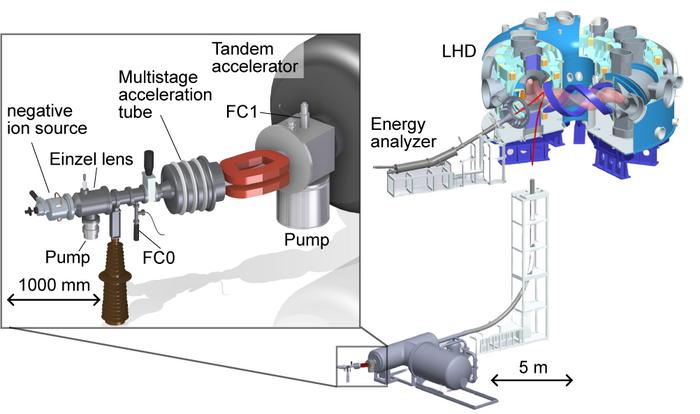
The Large Helical Device (LHD) and the heavy ion beam probe (HIBP) system.
Tyler O'Neal, Staff Editor LATEST November 13, 2025, 11:29 am

Supercomputers help scientists decode turbulent plasma behaviors in fusion reactors

A new international study, published in Nuclear Fusion and announced through a press release, offers one of the most detailed looks yet at plasma behavior inside fusion reactors, thanks to modern supercomputers. The research highlights the central role of high-performance computing (HPC) in advancing fusion energy science.

A Breakthrough in Plasma Modeling

Japanese researchers led a team that used state-of-the-art numerical simulations to capture how micro-scale plasma turbulence interacts with large-scale flows inside tokamak confinement systems. These interactions have long puzzled physicists because they contribute to unexpected energy losses, undermining reactor performance.
 
The new simulations reveal coupling mechanisms that had not been directly observed before. By resolving turbulence, particle transport, and fast-ion behavior simultaneously, the researchers were able to build a more complete picture of how fusion plasmas evolve under reactor-relevant conditions.
 
According to the study, these insights may guide improvements in the design and operation of future fusion devices.

Powered by Supercomputers

The research leveraged massive computational resources, including GPU-accelerated clusters and petascale CPU hours, to capture plasma behavior across multiple spatial and temporal scales. Advanced techniques, such as domain decomposition, hybrid MPI/OpenMP parallelization, and fine-mesh refinement, enabled the simulation of sub-millimeter turbulence while still modeling the full evolution of a reactor-scale plasma.
 
The authors emphasize that without supercomputer-level performance, such multiscale modeling would be impossible. In essence, HPC is becoming a “virtual reactor,” allowing scientists to test physics theories and device configurations in silico before real-world experiments.

SC25 in St. Louis

The timing of this publication is noteworthy, as the global supercomputing community will convene next week in St. Louis for SC25, the premier HPC conference. While the study directly relates to high-performance computing and could be discussed informally at SC25, there's no confirmation that it will be officially presented. Nonetheless, the study's themes of extreme-scale computation, energy modeling, and plasma physics align with key SC25 tracks, making it an ideal meeting point for researchers and vendors.

A Step Toward Fusion’s Future

Fusion holds immense promise for clean, abundant energy, but understanding plasma behavior presents a significant hurdle. This research helps bridge the gap between theory and experiment by providing predictive tools that can improve reactor design and operational strategies.
 
With new supercomputing tech, researchers anticipate the ability to simulate entire fusion devices under reactor conditions, potentially expediting the path to practical fusion energy. 
 
For now, this work serves as a compelling illustration of how supercomputing is transforming one of the world’s most challenging scientific frontiers.

The Cocos Islands in the Indian Ocean between Australia and Sri Lanka.

Continents peeling from below: Supercomputers reveal the hidden hand shaping Earth’s oceans

Tyler O'Neal, Staff Editor LATEST November 12, 2025, 2:38 pm
When continents undergo separation, the effects are not limited to the surface. A gradual revolution is occurring beneath our feet, detectable only through the utilization of the world's most advanced supercomputers. Researchers from the UK's University of Southampton and Germany's GFZ Helmholtz Centre for Geosciences have discovered that the Earth's continents are undergoing a "peeling" process from below, thereby triggering volcanic activity across the ocean floor. Their recent study suggests that this deep churning of the planet's mantle may be responsible for many of the volcanic islands scattered across our oceans, including the Indian Ocean's Christmas Island seamounts and the Atlantic's Walvis Ridges.

Peeling Continents, Boiling Oceans

The team's simulations, powered by high-performance computing models, demonstrate that as continents stretch and fracture, their thick roots of ancient rock (the subcontinental lithospheric mantle) are eroded by organized "chains" of convective currents. These instabilities act like conveyor belts, transporting chemically enriched material from deep beneath the continents into the oceanic mantle, where it can later erupt as seafloor volcanoes.
 
Over tens of millions of years, this subterranean process moves vast amounts of continental material outward, enriching the mantle in patterns that match the timing and chemistry of known oceanic volcanic provinces. “It’s as if the continents shed their skin into the sea,” said lead author Dr. Tom Gernon of Southampton. “We’ve uncovered a missing piece of Earth’s deep recycling system.”

Supercomputing the Deep Earth

To capture this invisible movement, the researchers relied on ASPECT, a powerful geodynamic modeling tool that simulates rock behavior under extreme pressures and temperatures. These thermomechanical simulations, run on supercomputers in the UK and Germany, tracked the flow of molten rock and heat through the mantle over spans exceeding 100 million years.
 
Such calculations require enormous computational power, similar to that used in climate modeling or astrophysical simulations, because they solve complex equations of energy, mass, and momentum at microscopic scales within a planet-sized domain. The models revealed that continental "peeling" begins within a few million years of tectonic breakup and peaks approximately 50 million years later, a finding that aligns with isotope data from Indian Ocean volcanoes.
 
These insights wouldn’t have been possible without advances in high-performance computing (HPC). This area has been prominently showcased at recent supercomputing gatherings, such as the COP30-linked climate and Earth system sessions in Brazil. As global attention turns toward planetary resilience, HPC has become a bridge between climate science, energy modeling, and now, deep-Earth geodynamics, allowing researchers to model entire planetary systems in silico.

Rethinking Oceanic Volcanism

Traditionally, scientists attributed oceanic volcanism to deep mantle plumes, columns of hot rock rising from near the Earth’s core. But this new study proposes a more surface-linked mechanism: the long-term “convective erosion” of continental roots. It explains why enriched volcanic rocks often appear along continental margins and even billions of years after the continents split apart.
 
This finding also has implications for the global carbon cycle, as the peeling and melting of carbon-rich rocks could regulate the release of greenhouse gases from deep within the Earth. It hints at a feedback loop between the planet’s tectonic heartbeat and its atmospheric chemistry, a process both ancient and ongoing.

The New Frontier Beneath Us

The Southampton team's discovery adds a fascinating layer to our understanding of planetary evolution. Beneath the seemingly stable crust, continents are quietly dissolving from below, feeding a slow planetary respiration that shapes the chemistry of oceans, the formation of islands, and perhaps even the stability of climate over eons.
 
It’s a humbling reminder that the ground beneath us is not still, merely patient. And with the help of supercomputers, we’re finally starting to hear its pulse.
Supercomputers simulate the ‘impossible’ black hole merger, but do they really explain it?

Supercomputers simulate the ‘impossible’ black hole merger, but do they really explain it?

Tyler O'Neal, Staff Editor LATEST November 11, 2025, 5:30 pm
When gravitational-wave detectors picked up the signal known as GW231123, astronomers were stunned. Two black holes, far too massive and spinning far too fast, merged in a way that standard stellar evolution shouldn’t allow. One scientist summed up the global reaction: "Those black holes should not exist."
 
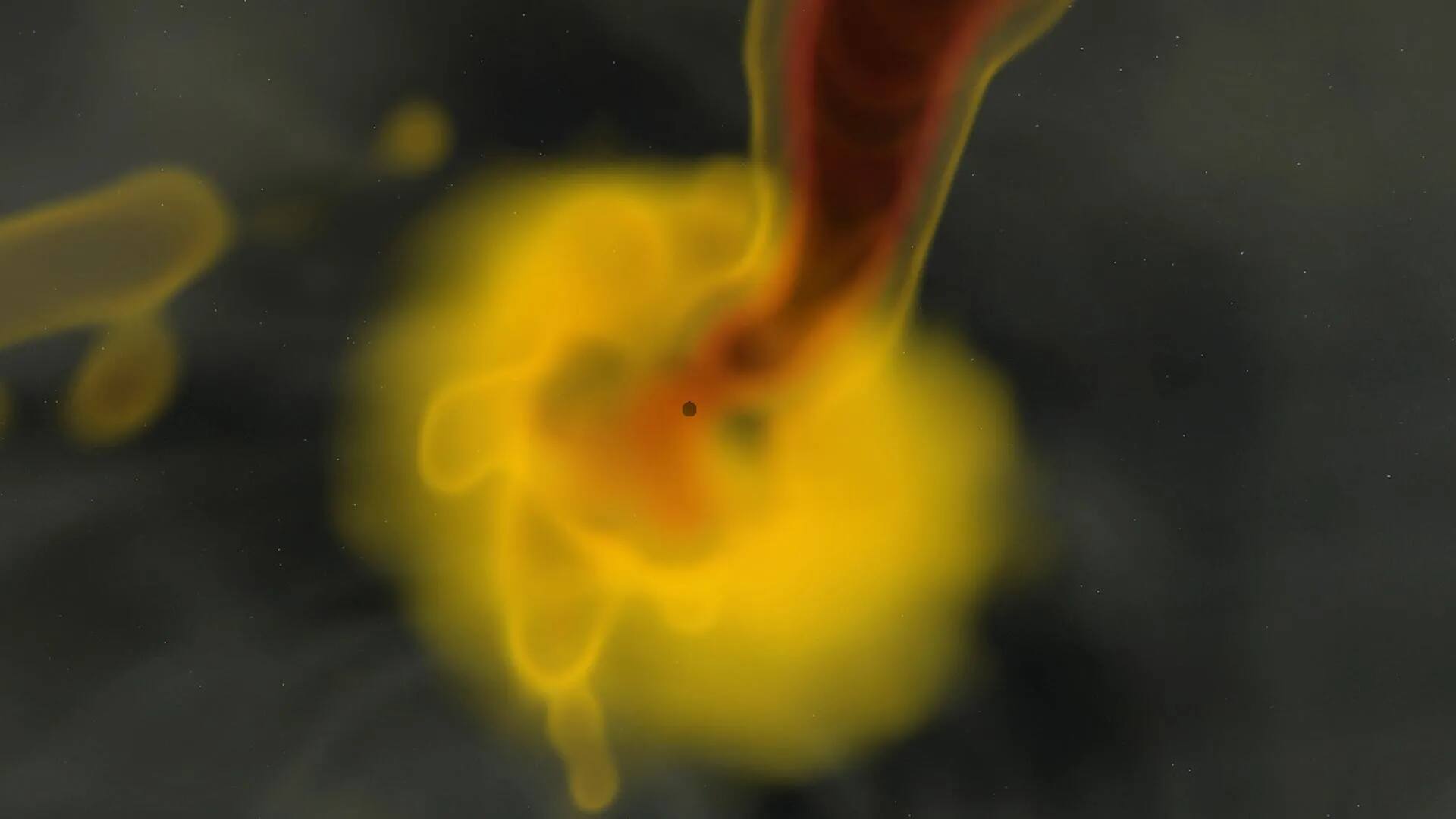
Now, researchers supported by the Simons Foundation believe they have an answer. Their new paper in The Astrophysical Journal Letters proposes that these massive black holes were born not from earlier mergers, but directly from the collapse of enormous, rapidly rotating stars, no supernova, no explosion, just a straight plunge into darkness. To test this idea, they turned to supercomputing. But does the model truly explain the mystery, or are we simply forcing the data to fit a convenient narrative?

The simulations

The research team employed state-of-the-art, end-to-end general-relativistic magnetohydrodynamic simulations (GRMHD), representing the most advanced black-hole formation simulations currently available. These models were executed on the supercomputers from the U.S. Department of Energy, specifically including the Argonne and NERSC clusters.
 
Unlike previous models that averaged out messy physics or assumed idealized collapse, these simulations:
  • Track a massive star from the late burning stage → collapse → black hole birth.
  • Include magnetic fields, rotation, and the feedback between jets and accretion disks.
  • Model how much mass falls into the black hole and how much is blasted away.

The key claim:
A 250-solar-mass helium star collapses into a black hole of ~40 solar masses, then accretes or blows off the rest, depending on how magnetic fields choke or feed the flow. With a moderate magnetic field, the simulation produced a final black hole around ~100 solar masses with high spin, strikingly similar to GW231123.

 
In other words: rotation + magnetic fields + gravitational collapse = black holes that shouldn’t exist, suddenly… exist.

The “mass gap” problem

There’s a no-man’s-land of black hole masses, from ~70 to ~140 solar masses, called the pair-instability mass gap. In current theory, stars in this mass band explode violently before they can ever form a black hole. So how did GW231123 contain two of them?
 
The paper posits that rapid rotation quells the explosive instability, directing mass toward the black hole. Magnetic fields then regulate mass accretion and ejection; too weak, and the black hole overgrows, while too strong, and it expels its own fuel. Only a "Goldilocks" magnetic field produces the massive, high-spin black holes observed.
 
The work is a tour de force of supercomputing and theoretical astrophysics. But skepticism is warranted.
  1. Too many knobs to turn. Rotation rate, magnetic strength, metallicity, tweak any one of these, and you get a different outcome. A perfect match may say more about parameter tuning than about nature.
  2. Assumptions stacked on assumptions. The model assumes these hyper-massive stars existed, paired in binaries, both rotating rapidly and with finely tuned magnetic fields. We have hints that such stars might exist, not proof.
  3. The simulation freezes spacetime. The GRMHD code evolves matter and magnetic fields but does not dynamically evolve the black hole itself; its mass and spin are adjusted afterward in post-processing. That means the most spectacular claim, reproducing the final mass and spin, comes partially from inference, not direct simulation.
  4. Explanations arrive after the observation. The merger was first called “impossible;” the theory arrived later. That’s classic scientific back-filling, plausible, but unproven.
Supercomputers are powerful, but they can turn into wish-fulfillment engines if we’re not careful.

What we can say with confidence

  • The event is real.
  • The black holes are too massive and too fast-spinning for standard models.
  • Supercomputing is the only way we can model the collapse with full magnetic, relativistic detail.
Whether this simulation reflects what nature actually does, or simply what our models are capable of doing, remains open.

The bottom line

A breakthrough? Possibly. A closed case? Not even close.
 
Supercomputers do not provide definitive truths; instead, they offer potential explanations. The validation of these possibilities rests on future observational data and the discovery of analogous black hole mergers.
  1. Supercomputers unveil a new frontier: Could there be different types of black holes?
  2. Japanese researchers use MD simulations to understand RNA folding
  3. New supercomputing-enabled model offers fresh hope, but climate clock keeps ticking
  4. Antarctica’s cry, and the supercomputer answers: a grim forecast
  5. Beam me up: From Earth to orbit; Aussie scientists unlock new quantum leap
  6. Increased polar ocean turbulence observed in supercomputer simulations of a warming planet
  7. RiverMamba: Advancements in flood forecasting

Page 44 of 62

  • 39
  • 40
  • 41
  • 42
  • 43
  • 44
  • 45
  • 46
  • 47
  • 48
POPULAR RIGHT NOW
  • Supercomputers replace ‘bathtub’ flood maps with physics-based digital twins of Britain’s coastline
    Supercomputers replace ‘bathtub’ flood maps with physics-based digital twins of Britain’s coastline
  • Supercomputers push neural quantum simulation beyond previous limits
    Supercomputers push neural quantum simulation beyond previous limits
  • Intel’s AI supercomputing revival: Q2 financial surge signals new era for CPU-powered HPC infrastructure
    Intel’s AI supercomputing revival: Q2 financial surge signals new era for CPU-powered HPC infrastructure
  • AI infrastructure financing fears shake semiconductor sector
    AI infrastructure financing fears shake semiconductor sector
  • AWS supercomputing investment reaches historic scale as Amazon’s AI strategy powers record financial results
    AWS supercomputing investment reaches historic scale as Amazon’s AI strategy powers record financial results
  • Catching the wave of the future: Supercomputers unlock the hidden dynamics of Venus
    Catching the wave of the future: Supercomputers unlock the hidden dynamics of Venus
  • NCAR supercomputers run planet scale climate experiments impossible in the real world
    NCAR supercomputers run planet scale climate experiments impossible in the real world
  • AI hunts the cosmos: Machine learning helps astronomers discover the first ‘Wandering’ supermassive black hole caught destroying a star
    AI hunts the cosmos: Machine learning helps astronomers discover the first ‘Wandering’ supermassive black hole caught destroying a star
  • Supercomputing for the masses: Meta's vision of a personal superintelligence for everyone
    Supercomputing for the masses: Meta's vision of a personal superintelligence for everyone
  • NVIDIA helps turn AI compute into a new asset class as Wall Street mobilizes $500 billion
    NVIDIA helps turn AI compute into a new asset class as Wall Street mobilizes $500 billion
THIS YEAR'S MOST READ
  • Beamforming the future: BeammWave's 6G push signals the rise of orbital-terrestrial wireless networks
    Joakim Axmon
    Joakim Axmon
  • Wall Street wants to trade supercomputing power like oil
    Wall Street wants to trade supercomputing power like oil
  • Cosmic ambition at scale: UK’s supercomputer unlocks a 2.5 petabytes universe
    Cosmic ambition at scale: UK’s supercomputer unlocks a 2.5 petabytes universe
  • Hidden order, revealed at scale: Supercomputing, electron ptychography uncover the inner workings of relaxor ferroelectrics
    Hidden order, revealed at scale: Supercomputing, electron ptychography uncover the inner workings of relaxor ferroelectrics
  • Intel's Q1 results signal supercomputing surge driving Xeon momentum
    Intel's Q1 results signal supercomputing surge driving Xeon momentum
  • Huawei’s Tau Scaling ambition tests the limits of post-Moore semiconductor reality
    He Tingbo from HUAWEI delivered a keynote speech titled "New Semiconductor Path in Practice"
    He Tingbo from HUAWEI delivered a keynote speech titled "New Semiconductor Path in Practice"
  • When stars fall apart: Supercomputing reveals the hidden physics of black holes
    When stars fall apart: Supercomputing reveals the hidden physics of black holes
  • MIT develops computational framework to probe dark matter via gravitational waves
    MIT develops computational framework to probe dark matter via gravitational waves
  • Memory has become the new compute: Why Micron, SK Hynix crossing $1 trillion matters to supercomputing
    Memory has become the new compute: Why Micron, SK Hynix crossing $1 trillion matters to supercomputing
  • AI breaks conservation barriers: Australia’s Wildlife Observatory leverages supercomputing to protect biodiversity
    AI breaks conservation barriers: Australia’s Wildlife Observatory leverages supercomputing to protect biodiversity
  • FRONTPAGE
  • LATEST
  • POPULAR
  • REGISTER
  • SOCIAL
  • VIDEO
  • SUBSCRIPTION
  • RSS
  • GUIDELINES
  • PRIVACY
  • TOS
  • ABOUT
  • +1 (816) 799-4488
  • editorial@supercomputingonline.com
© 2001 - 2026 SuperComputingOnline.com, LLC. All rights reserved. This material may not be published, broadcast, rewritten or redistributed without permission.
Sign In
  • FRONT PAGE
  • LATEST
    • MEDIA KIT
    • MOST READ
    • RSS FEED
    • ACADEMIA
    • AEROSPACE
    • APPLICATIONS
    • ASTRONOMY
    • AUTOMOTIVE
    • BIG DATA
    • BIOLOGY
    • CHEMISTRY
    • CLIENTS
    • CLOUD
    • DEFENSE
    • DEVELOPER TOOLS
    • EARTH SCIENCES
    • ECONOMICS
    • ENGINEERING
    • ENTERTAINMENT
    • HEALTH
    • INDUSTRY
    • INTERCONNECTS
    • GAMING
    • GOVERNMENT
    • MANUFACTURING
    • MIDDLEWARE
    • MOVIES
    • NETWORKS
    • OIL & GAS
    • PHYSICS
    • PROCESSORS
    • RETAIL
    • SCIENCE
    • STORAGE
    • SYSTEMS
    • VISUALIZATION
  • VIDEOS
    • ADD YOUR VIDEOS
    • MANAGE VIDEOS
  • COMMUNITY
    • TRADE SHOWS
    • SOCIAL NETWORK VIDEOS
    • SURVEYS
    • APPLICATIONS BROWSER
    • CONVERSATION INBOX
    • SOCIAL ADVERTISER
    • GROUPS
    • MARKETPLACE LISTINGS
    • PAGES
    • LEADERBOARD
    • POINTS LISTING
      • BADGES
    • PRIVACY CONFIRM REQUEST
    • PRIVACY CREATE REQUEST

Hey there! We noticed you’re using an ad blocker.