These data will support evaluation of restoration projects and coastal resilience.

Woolpert secures $13 million contract to gather bathymetric lidar data for Florida's seafloor mapping project

The data collected by the Florida Department of Environmental Protection will aid in assessing the effectiveness of restoration projects and promoting resilience along the coast. Woolpert has been commissioned by the Florida Department of Environmental Protection to utilize lidar technologies for acquiring bathymetric survey data. This supports the Florida Seafloor Mapping Initiative (FSMI) and its goal of creating a detailed, accessible, and high-resolution model of Florida's coastal waters by 2026.

Bathymetric survey data appears as a digital map, with varying shades of blue and green representing the depths of Florida's coastal waters. The details are incredibly precise, with every nook and cranny of the seafloor mapped out.

The FSMI project is a continuation of the Florida Coastal Mapping Program (FCMaP), which involved collaboration from various federal and state agencies as well as community stakeholders to gather detailed seafloor data spanning 171,780 square kilometers along Florida's coastline. Once finished, the FSMI data will be integrated with the existing terrestrial lidar. This valuable information will assist federal and state agencies in comprehending the coastal vulnerability and effects of hurricanes in the region, assessing the success of restoration initiatives, and aiding in ongoing efforts to promote coastal resilience and map flood risks.

As part of this task order, Woolpert will be responsible for collecting bathymetric lidar data along Florida's southern coast, including the Florida Keys, and extending southwest to Dry Tortugas National Park. The data will cover a total area of 23,418 square kilometers.

According to Rick Householder, Program Director at Woolpert, the data collection will take place in two phases. Phase I will involve acquiring topographic and bathymetric lidar data up to a depth of 20 meters using aircraft. Phase II will include the use of marine vessels equipped with multibeam sonar to collect data beyond 20 meters up to 200 meters in depth.

Householder emphasized the significance of this project and its potential impact on various aspects such as assessing the health of marine habitats, disaster response, and resiliency efforts. He stated that the wealth of information gathered through this initiative will have long-term effects on the state of Florida. Additionally, Householder believes that this project can serve as a model for future seafloor mapping initiatives across the continental U.S.

The entire dataset is expected to be collected by May next year and delivered by summer 2024. The contract is currently in progress.

This was evident in the aftermath of the 2023 earthquake in Taroudant Province, Morocco, as captured by alyaoum24 on Wikimedia Commons.

Unusual deep slip: Morocco earthquake modeling

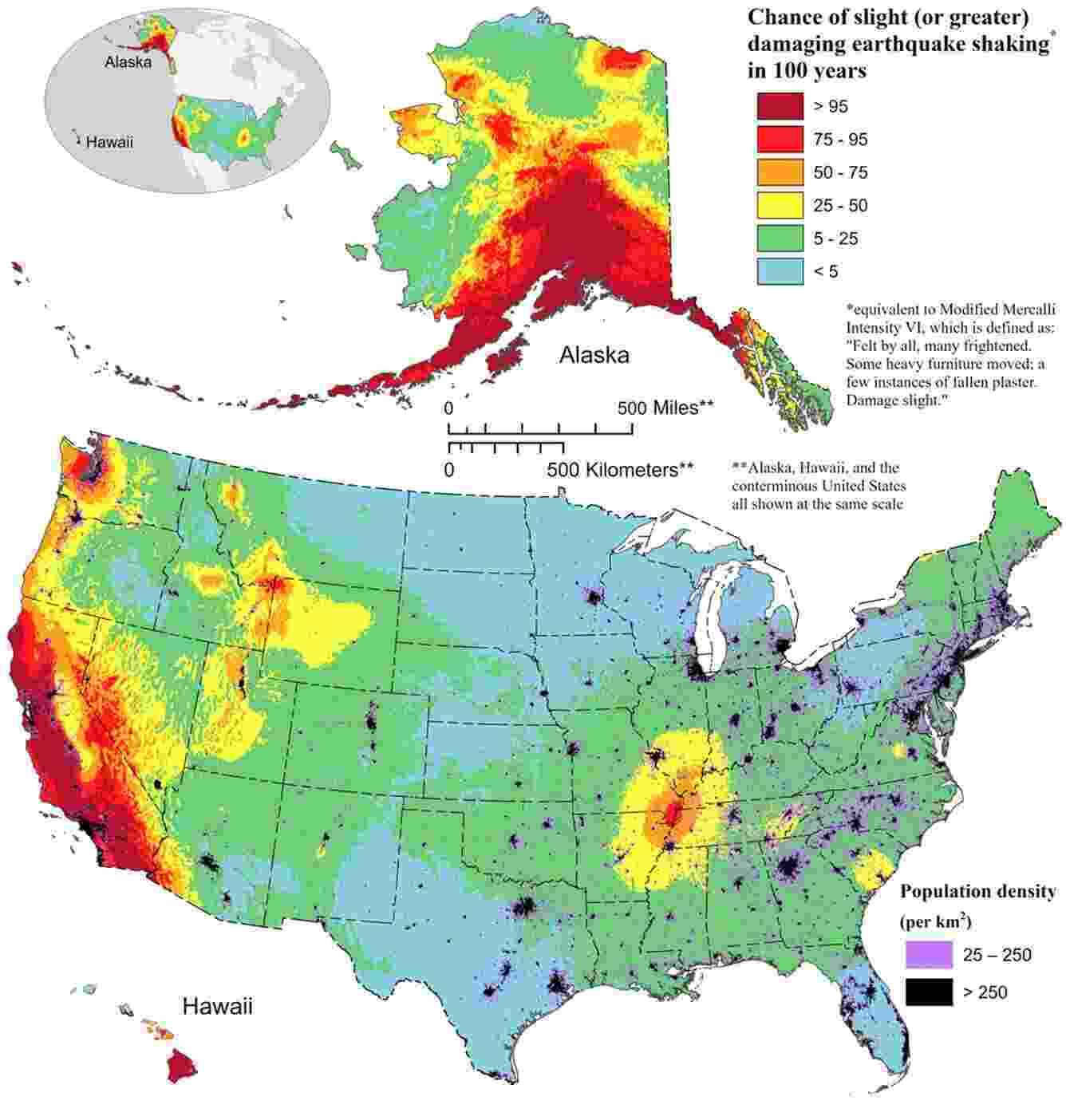
The Al Haouz earthquake occurred on September 8th and measured 6.8 on the Richter scale. According to the National Earthquake Information Center (NEIC) at the U.S. Geological Survey, the epicenter of the quake was located approximately 25 kilometers below the Earth's surface. Their analysis revealed that the earthquake had a compact fault with movement taking place between depths of 15 and 35 kilometers. This is deeper than usual for the region and has made it difficult to determine the usual characteristics of large earthquakes in the Atlas Mountains region.

The earthquake occurred in an area that has a limited history of recorded earthquakes, making it challenging to understand the potential threat of future earthquakes. Unfortunately, there were no visible ruptures or significant aftershocks, making it challenging to pinpoint which faults were involved.

The earthquake was named after the province in Morocco that experienced the strongest shaking, especially in Marrakesh. Over 3,000 deaths and 5,500 injuries were reported, along with significant damage to buildings and structures.

To analyze the earthquake, researchers from USGS used teleseismic data collected from stations across the world. The closest station was located 100 kilometers away from the epicenter, and only three other stations within a radius of 500 kilometers had openly available real-time data. In addition to this, they also incorporated satellite data from InSAR which tracks changes in ground deformation. By combining these different sources of data, the researchers were able to create multiple models of the earthquake source.

U.S. Geological Survey seismologist William Yeck explained that studying the aftershocks is crucial for understanding faulting in the region, but there may be some uncertainty about where exactly the slip occurred without enough aftershock data. The researchers emphasize the importance of global seismic networks and data exchange standards for sharing real-time information, especially when it comes to earthquakes in remote regions with limited monitoring capabilities.

ALICE uses ML to determine charm & beauty dynamics in quark-gluon plasma

New data from ALICE sheds light on the behavior of charm and beauty particles in quark-gluon plasma. When lead ions collide at high energies in the LHC, they create a super-hot and dense state called quark-gluon plasma where quarks and gluons are no longer bound inside hadrons. This extreme environment is believed to have existed for a brief moment just after the Big Bang before quickly expanding and cooling down. As it cools, the quarks and gluons form back into hadrons which can be detected by particle detectors.

The study conducted by ALICE involved lead-lead collisions at non-direct angles. They compared the elliptic flow of "prompt" D mesons (produced immediately after the collision) to that of "non-prompt" D mesons (produced during the decay of B mesons). Charm quarks combine with light quarks to form D mesons while beauty quarks form B mesons. Previous studies have shown that the elliptic flow of "prompt" D mesons is nearly as strong as that of the lightest hadrons, and pions. However, it is expected that the elliptic flow of B mesons will be weaker than that of prompt D mesons due to the predicted longer thermalization time for beauty quarks compared to charm quarks.

In the recent analysis of off-center lead-lead collisions during Run 2 of the LHC, ALICE measured the elliptic flow of B mesons by examining the flow of "non-prompt" D mesons that originate from B meson decays. This was possible through the use of machine-learning techniques, which helped distinguish between products of non-prompt and prompt D meson decays and suppress background particle processes that imitate D meson production and decay.

The latest measurement reveals a significant difference in the elliptic flow of non-prompt D mesons compared to their prompt counterparts, confirming previous expectations. This discovery provides valuable insights into the thermalization process of beauty quarks within the quark-gluon plasma and sets the stage for future ALICE investigations using data from Run 3 of the LHC. The increased sample of lead-lead collisions obtained in 2023 will pave the way for a deeper analysis of charm and beauty particles, unraveling further mysteries surrounding their behavior within the quark-gluon plasma.

CoreWeave deploys Dell to provide greater access to supercomputing power for GenAI

Dell Technologies has made an announcement that is causing a stir in the industry. They have disclosed that CoreWeave, a specialized cloud provider for NVIDIA GPU-accelerated workloads, has acquired thousands of Dell PowerEdge servers. This partnership will greatly increase access to supercomputing power for organizations looking to use AI and generative AI (GenAI) technologies.

CoreWeave will be using Dell PowerEdge XE9860 servers, equipped with NVIDIA H100 Tensor Core GPUs, for their cloud solutions. This advanced technology will provide the necessary computing capabilities for AI, machine learning (ML), visual effects (VFX) rendering, and large-scale simulations.

According to Brian Venturo, co-founder and chief technology officer of CoreWeave, the demand for high-performance cloud solutions is growing rapidly due to the rapid development of AI. As a result, they are committed to providing top-of-the-line infrastructure that can support these compute-intensive workloads. With their custom-built and modern cloud infrastructure, they aim to deliver the best possible performance for every workload. And by collaborating with Dell Technologies, they can now do so on an even greater scale, solidifying their position as a leader in this field.

CoreWeave stands at the forefront of the cloud computing field with its innovative approach to hardware engineering and proprietary software stack. Their cutting-edge technology is specifically designed to handle the most complex and intensive workloads with ease.

With their latest agreement, CoreWeave customers all over the globe will now have access to thousands of accelerated Dell servers within seconds, providing lightning-fast speeds for compute-intensive tasks.

"AI has become a game-changing tool for businesses of all sizes, but it's only effective with the right IT foundation," stated Jeff Clarke, chief operating officer and vice chairman of Dell Technologies. This partnership with CoreWeave allows us to provide our most powerful Dell PowerEdge servers equipped with NVIDIA H100 Tensor Core GPUs, meeting the growing demand for advanced computing capabilities on a large scale."

The Dell PowerEdge XE9680 has been built specifically for extreme acceleration of AI, machine learning, and deep learning training. With its high GPU memory, bandwidth, and security features, this system is perfect for deploying AI computing initiatives. It also boasts a compact design, making it ideal for environments where space is limited.

To ensure maximum uptime and performance from their new systems, CoreWeave will be utilizing Dell ProSupport services. Additionally, dedicated Dell managers will be on hand to maintain the environment, further solidifying this collaboration between two leaders in technological innovation.

Jeroen Rietjens is pictured in the Goddard cleanroom with the PACE satellite. He expressed his pride at being able to pose with the fully assembled and tested PACE satellite, which hosts their small SPEXone instrument. The instrument is neatly wrapped in grey thermal blankets and still has the red radiator cover in place. Rietjens finds it surreal to realize that in just a few months, it will be staring at the Earth and collecting multi-angle spectro-polarimetric data. This data will enable scientists to infer the amount and type of aerosols in the Earth's atmosphere, contributing to a better understanding of the effects of aerosols on climate. The credit for the photo goes to NASA/Denny Henry.

NASA set to launch new satellite that helps unravel mysteries about clouds, aerosols

NASA will launch a new satellite named PACE, which aims to unravel mysteries surrounding clouds and aerosols. Scientists hope to gain a deeper understanding of cloud formation and the impact of tiny particles known as aerosols by studying the behavior of light and optics in the atmosphere. The PACE mission will observe airborne particles, including sea salt, smoke, pollutants, and dust to provide important insights into their interactions with light. This data will help answer crucial questions about how aerosols affect cloud formation and distinguish between ice clouds and liquid clouds, which is essential for better understanding changes in climate and air quality.

The PACE mission will use two advanced polarimeters named HARP2 and SPEXone to study aerosols and clouds. Once launched, the mission will observe the Earth and collect data on the chemical composition, movement, and interaction of these atmospheric components. These cutting-edge instruments capture light properties that are both visible and invisible to the human eye, such as color and polarization, respectively. Polarization is not something we can perceive with our eyes, but it can be seen through sensors like those on PACE. If we could see polarization, rainbows would be everywhere in our view of the world, according to Kirk Knobelspiesse, who leads the polarimetry efforts at NASA's Goddard Space Flight Center in Greenbelt, Maryland.

Light from the Sun travels in all directions like a wave, which is known as unpolarized light. However, when it encounters an object such as a cloud or aerosol particle, the movement of light can become more concentrated in one direction, creating polarized light. This unique behavior of light can provide valuable information for scientists studying aerosols and water droplets in the atmosphere. By using polarimeters, researchers can measure the angle at which the light is polarized and gather data on the size, makeup, abundance, and other characteristics of particles present in the air.

The polarimeters, HARP2, and SPEXone complement each other in measuring different aspects of Earth's atmosphere. PACE will provide high-quality data from multiple vantage points, scanning Earth every two days to gather information on aerosols and clouds. Measuring aerosol properties is essential to understand their impact on climate. They reflect and absorb light, affecting how much energy reaches Earth's surface and influencing cloud formation. PACE data will provide valuable insights into these relationships and improve air quality for humans, according to Professor Loría-Salazar from the University of Oklahoma's School of Meteorology, who is an early adopter of PACE data integration into practical science applications.

Scientists can not only identify aerosols but also decipher their impact on air quality using PACE. The polarimeters on board PACE will also contribute to our understanding of Earth's climate. By incorporating atmospheric data from PACE into supercomputer models, scientists can replace current estimations used to fill data gaps with more accurate measurements. Kirk Knobelspiesse hopes that this data will reduce uncertainty in models and lead to better predictions for how our climate will evolve in the coming decades and centuries.