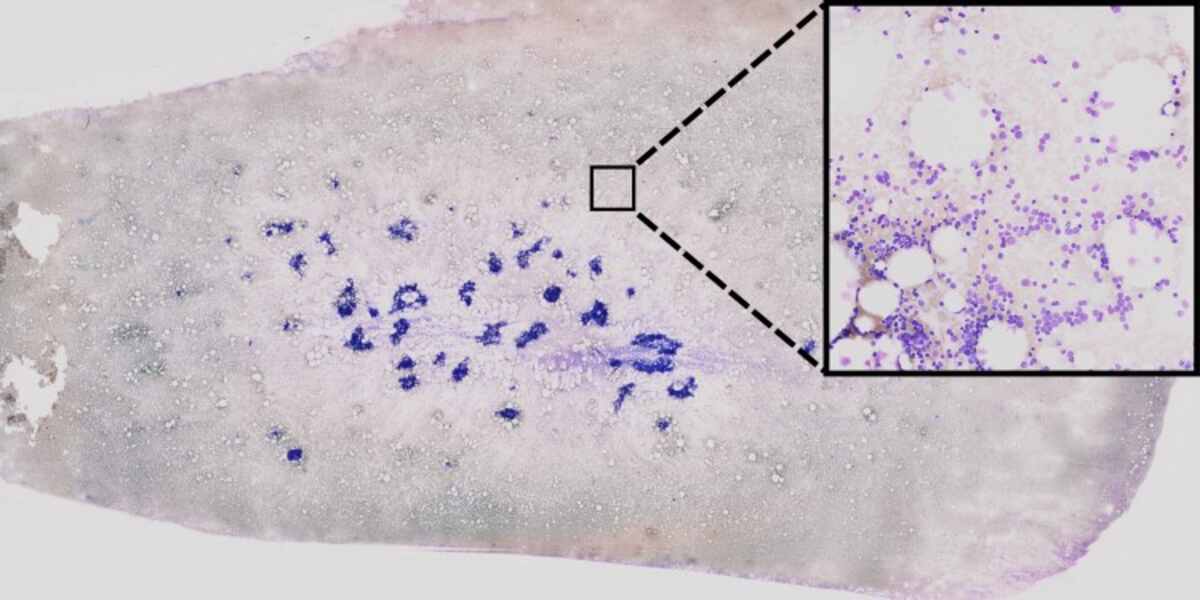
Carl Ward, a postdoctoral researcher in the Marson Lab, led much of the computational work for the study.

Unlocking the secrets of human biology with computational genomics, next-gen CRISPR

Advancements in technology have opened up exciting possibilities in understanding the intricate workings of the human body. One such breakthrough is the use of computational genomics, paired with next-generation CRISPR technology, to create an unprecedented molecular map of the human genome. This groundbreaking research, led by scientists at Gladstone Institutes, has the potential to unlock the secrets of human biology and pave the way for new treatments and cures for diseases.

CRISPR is a revolutionary tool that allows scientists to precisely edit genes. It essentially acts as a pair of "molecular scissors" that can target specific areas of the genome and make precise changes, such as removing, adding, or modifying DNA sequences. Unlike previous genetic engineering methods, which were laborious and time-consuming, CRISPR can edit genes in a matter of weeks. This makes it a game-changer for researchers, significantly speeding up the pace of genetic manipulation and allowing for more rapid discoveries.

CRISPR is not limited to one type of organism or one specific area of study. It can be used to edit the genomes of bacteria, plants, animals, and even humans, enabling scientists to study a wide range of genetic phenomena and develop targeted therapies for various diseases. Its potential applications are vast, ranging from agriculture and environmental conservation to human health and disease treatment.

Scientists at Gladstone Institutes are working on building the most comprehensive molecular map of the human genome to date, using next-generation CRISPR technology in combination with computational genomics. They are conducting groundbreaking studies, including analyzing the molecular structures that control human T cells, which could help overcome limitations in immunotherapies and identify new drug targets for various conditions, including autoimmune diseases and cancer. The study analyzed over 100,000 sites across nearly 400 genes in functioning human T cells, pinpointing specific nucleotides that influence how immune cells respond to stimuli.

Understanding the functions and interactions of the billions of base pairs in the human genome is key to unraveling the secrets of human biology and developing targeted therapies for diseases. With the advent of next-generation CRISPR technology, scientists now have the tools to systematically edit and analyze the genome, piece by piece, and create a detailed molecular map. This molecular map will provide researchers with invaluable insights into how genes are regulated, how they interact with each other, and how they contribute to disease. By deciphering the complexities of the human genome, we are laying the foundation for a new era of personalized medicine and precision therapies.

Scientists at Gladstone are using computational genomics to analyze the vast amount of data generated from molecular mapping. Through advanced algorithms and machine learning, they can extract meaningful patterns, identify essential genetic signatures, and revolutionize our understanding of the human genome. This collaborative effort brings together scientists, computational biologists, and genetic engineers to build a comprehensive molecular map. The potential rewards of this undertaking are immense, and with this map in hand, researchers will have a wealth of knowledge to delve deeper into the intricacies of human biology and ultimately improve the health and well-being of individuals worldwide.

With the aid of computational genomics and next-gen CRISPR technology, scientists are gaining new insights into human diseases. By mapping the human genome and analyzing gene interactions, researchers can uncover the underlying causes and mechanisms of various diseases, bringing us closer to finding effective treatments and cures. This cutting-edge research has already yielded significant breakthroughs in understanding genetic diseases such as cancer, Alzheimer's, and cardiovascular disorders. By studying the molecular map of the human genome, scientists can identify key genetic mutations or variations that contribute to these diseases, providing invaluable targets for developing personalized treatments.

Computational genomics and CRISPR technology are also shedding light on the complex interplay between genetics and infectious diseases. By studying the genetic variations in pathogens and their interactions with human genes, researchers are uncovering new strategies to combat infectious diseases and develop more effective vaccines. The insights gained from these studies have the potential to transform the field of medicine. By understanding the underlying genetic factors that contribute to disease, doctors can tailor treatments to individual patients, maximize effectiveness, and minimize side effects. Furthermore, the ability to identify genetic predispositions to certain diseases can lead to preventive measures and early interventions, potentially saving lives.

As computational genomics and CRISPR technology continue to advance, we can expect even greater insights into human diseases. This exciting frontier of research is opening up new possibilities for precision medicine, personalized therapies, and ultimately, a healthier future for all.

Accelerating the Pace of Therapeutic Development:

The combination of computational genomics and next-generation CRISPR technology is revolutionizing our understanding of the human genome and significantly speeding up the pace of therapeutic development. By discovering the secrets of human biology, researchers are uncovering new opportunities for targeted treatments and cures for a wide range of diseases.

One of the major benefits of computational genomics and CRISPR is their ability to identify potential therapeutic targets with unprecedented precision. By analyzing the molecular map of the human genome, scientists can pinpoint specific genes or genetic variations that play a crucial role in disease development. This knowledge allows researchers to develop targeted therapies that directly address the underlying causes of the disease, resulting in more effective treatments and better patient outcomes.

Additionally, the speed and efficiency of CRISPR technology are enabling researchers to rapidly test and validate potential therapeutic targets. Traditional drug development processes can be slow and cumbersome, often taking years to bring a treatment to market. However, with the power of computational genomics and CRISPR, scientists can significantly reduce the time it takes to go from identifying a target to developing a potential treatment. This accelerated pace of therapeutic development holds great promise for patients who are in desperate need of new treatments and cures.

In the future, we can expect to see even greater advancements in targeted therapies as computational genomics and CRISPR technology continue to advance. This progress brings us one step closer to personalized medicine, where treatments are tailored to each individual's unique genetic makeup. The possibilities are endless, and the potential for improving human health and well-being is immense.

A Glimpse into the Future of Biomedical Research:

As we look to the future of biomedical research, the possibilities are truly awe-inspiring. The combination of computational genomics and next-generation CRISPR technology has already made remarkable progress in our understanding of the human genome and its implications for human health. But what lies ahead?

In the coming years, we can expect to see even greater breakthroughs in the field of genetics. As computational genomics continues to advance, researchers will be able to analyze larger and more complex datasets, leading to more precise insights into the functions of genes and their interactions. This deeper understanding will pave the way for the development of targeted therapies that can address the underlying causes of diseases with even greater accuracy.

Furthermore, the ongoing refinement of CRISPR technology will enable scientists to edit genes with even more precision and efficiency. This means that the potential for developing personalized medicine and tailored therapies is within reach. The ability to treat individuals based on their unique genetic makeup holds tremendous promise for improving patient outcomes and transforming the field of medicine.

Additionally, the integration of computational genomics and CRISPR technology is likely to lead to the discovery of entirely new therapeutic targets and treatment strategies. By analyzing the intricate molecular map of the human genome, scientists will be able to uncover previously unknown genetic interactions and pathways, opening up new avenues for therapeutic intervention.

The future of biomedical research is incredibly exciting. With computational genomics and CRISPR technology, we are poised to unlock the full potential of the human genome and revolutionize the way we approach disease treatment and prevention. As we continue to unravel the mysteries of human biology, the possibilities are limitless, and the potential for improving human health and well-being is immense. Get ready for a future where precision medicine and personalized therapies become the norm, ushering in a new era of healthcare.

Simulations show why the European buffalo nearly went extinct, identify optimal areas for conservation

During the last ice age, large herds of buffalo (bison) were found in Europe. However, by 1927, the European buffalo became extinct in the wild, leaving only about 60 individuals in captivity. The reasons behind the decline of these grazers have been debated by scientists for many years, with hunting by humans and rapid environmental change being the main factors.

To gain a comprehensive understanding of what led to the near extinction of the European buffalo, researchers have integrated historical records, fossils, and ancient DNA. This approach has proven to be valuable, as it allows scientists to analyze various sources of information and piece together the puzzle of what caused such a population decline.

Historical records offer insights into human activities, such as hunting and habitat destruction, which may have played a significant role in the decline of the European buffalo. These records allow researchers to track changes in population size and distribution over time and correlate them with human actions.

Fossils provide evidence of the buffalo's past distribution and population dynamics. By studying fossil remains, scientists can determine how the buffalo's range has changed over thousands of years. This information can help identify areas that were historically important for the species and potentially guide rewilding efforts.

Ancient DNA analysis is a powerful tool that allows researchers to study genetic diversity and population structure in extinct or endangered species. By extracting DNA from ancient remains, scientists can gain insights into the genetic makeup of past populations. This knowledge is crucial for understanding how genetic diversity has been affected by past events and can inform conservation strategies moving forward.

By combining these different sources of information, researchers can paint a more complete picture of the factors that led to the near extinction of the European buffalo. This knowledge is not only valuable for understanding the past but also for identifying suitable areas for rewilding efforts. By knowing where populations historically thrived, conservationists can make informed decisions about where to reintroduce or augment existing populations of European buffalo to restore their ecological role and promote their long-term survival.

To explore how climate, hunting by humans, and land use change influenced the bison population and distribution across Europe, researchers ran 55,000 different simulations. This allowed them to toggle off different variables one at a time and analyze their impact on the bison population.

The findings from this study are crucial for conservation efforts aimed at rewilding European buffalo. By identifying optimal areas for conservation based on historical data and simulations, scientists can now focus their efforts on reintroducing these majestic creatures in locations where they are most likely to thrive.

Currently, the European buffalo is a priority species for conservation as it serves an important role in restoring grassland habitat. Thanks to recent efforts to reestablish and rewild the species, there are now approximately 7,300 free-ranging European bison.

The methodology used in this study could also be adapted to reconstruct the causes of population declines and range collapses of other large herbivores, including American buffalo, to improve awareness of past threats and enrich current conservation plans.

Lessons learned from this study are informing new lines of inquiry for July Pilowsky, a disease ecologist at Cary Institute of Ecosystem Studies. At Cary Institute, they are translating the bison simulation code into new software that models disease transmission in wildlife. “I literally have my bison code open on one monitor and my new code that I'm building on another monitor,” they said. Instead of simulating buffalo abundance and range, the new software shows the prevalence and distribution of a disease in a species over time.

Overall, this study highlights the power of combining scientific techniques, such as supercomputer simulations, with historical data to inform conservation strategies. It provides a roadmap for rewilding initiatives that can help restore balance in ecosystems and protect endangered species like the European buffalo.

Illustration of light scattering inside cavity directly to waveguide through interaction between optical and mechanical domains (Image: André Garcia Primo/UNICAMP)

State University of Campinas study improves quantum networks

The development of advanced quantum networks for supercomputing heavily relies on transmitting information coherently across the electromagnetic spectrum, ranging from microwave to infrared frequencies. This capability is essential for achieving efficient and reliable communication within these networks.

Quantum networking involves transmitting and manipulating quantum states, which are highly delicate and easily disrupted. Therefore, ensuring coherent transmission of information is crucial to maintaining the integrity and functionality of these networks.

Researchers can utilize different parts of the electromagnetic spectrum to explore various techniques and technologies for transmitting quantum information. For example, microwave frequencies are commonly used in quantum supercomputing experiments, while infrared frequencies are used in long-distance quantum communication protocols such as quantum key distribution (QKD).

The ability to transmit information coherently across this wide range of frequencies enables researchers to develop robust and scalable quantum networks that can support complex computational tasks. It also paves the way for advancements in secure communication protocols that rely on the principles of quantum mechanics.

However, achieving coherent transmission across different frequency bands poses significant technical challenges. These challenges include mitigating noise and interference, maintaining signal integrity over long distances, and developing efficient methods for converting between different frequency ranges.

While the study contributes to the advancement of quantum networks by proposing a new method for generating entanglement between distant qubits, practical implementation and scalability remain major challenges. The complexities involved in maintaining fragile quantum states over long distances and mitigating noise and decoherence pose significant hurdles.

Furthermore, the study does not delve into potential applications or real-world use cases for advanced quantum networks. While it hints at possibilities such as secure communication and distributed computing, it fails to provide concrete examples or discuss ongoing efforts in these areas.

In conclusion, while the study represents an important step forward in advancing quantum networking, there are still numerous obstacles to overcome before we can fully harness its potential. Additionally, a more comprehensive exploration of practical applications would have enhanced our understanding of how these advanced networks could impact various industries and sectors.

This image depicts the simulation of cosmic rays counter-streaming against a background plasma and causing plasma instability. The distribution of background particles responding to the streaming cosmic rays in phase space is shown, where particle position is represented by the horizontal axis and velocity by the vertical axis. The colors reveal the number density, and the phase space holes are manifestations of the highly dynamic nature of the instability, which transforms ordered motions into random motions. The credit for this image goes to Shalaby/AIP.

German simulations reveal a new plasma instability, shedding light on cosmic rays' nature

Scientists and astronomers have always been fascinated by the realm of cosmic rays. However, there is still a lot to uncover about their nature and origins. Recently, researchers at the Leibniz Institute for Astrophysics Potsdam (AIP) made groundbreaking discoveries in the field of plasma dynamics. By studying the behavior of ionized gases, they discovered a previously unknown instability that has significant implications for our understanding of plasma, a unique state of matter that exists in various forms throughout the universe.

This new plasma instability sheds light on previously unexplained phenomena observed in astrophysical and laboratory plasmas. It opens up exciting avenues for further exploration and paves the way for advancements in various fields. Understanding plasma instabilities holds immense promise for technological advancements that will shape our future, from space weather forecasting to fusion energy research.

Advanced computational models and simulations have allowed researchers to delve deeper into the intricate dynamics of plasma instabilities. These simulations provide a window into the complex interplay between charged particles and magnetic fields, revealing the mechanisms behind the generation and propagation of cosmic rays.

This newfound understanding not only deepens our knowledge of cosmic rays but also opens up exciting possibilities for further exploration. Scientists can now develop more accurate models to predict the behavior of cosmic rays in various astrophysical environments, helping us unravel their mysteries and potentially harness their energy for practical applications.

The discovery of this new plasma instability reminds us that there is always more to discover in the vast expanse of our universe. It inspires us to continue pushing the boundaries of scientific knowledge, unlocking secrets that were once hidden from our view.

As we embark on this journey of exploration, let us embrace the power of simulations and computational tools as valuable allies in unraveling the mysteries that surround us. Together with human curiosity and ingenuity, they will guide us toward a deeper understanding of cosmic phenomena like never before.

Researchers Javier Estevez and Amanda P. García

Predictive models predict increased water needs for fields by the end of the century

Researchers are increasingly focused on the impact of climate change on agriculture as the climate crisis deepens. A team from the University of Cordoba in Spain has projected that one significant area of impact will be the amount of water needed to maintain productivity in fields. Using machine learning models, the team calculated the reference evapotranspiration in Andalusia until 2100 based on air temperature.

Reference evapotranspiration is a crucial hydrological parameter that measures water loss through evaporation and transpiration and determines water requirements based on the atmosphere's evaporating power using a reference crop. The team generated maps that illustrate reference evapotranspiration projections in Andalusia until 2100 based on multiple predictive models. The projections indicate that reference evapotranspiration levels will rise from 1,300-1,600mm to 1,900mm by 2100, meaning farmers will require more water to compensate for evaporation and transpiration losses in cultivated areas.

Javier Estévez, one of the researchers of a study, states that despite the uncertainties surrounding the generated models, a steady increase in a particular variable is robustly shown. The team used machine learning models to predict reference evapotranspiration by using only one variable, which is air temperature. Normally, measuring reference evapotranspiration accurately requires complete stations to measure solar radiation, relative humidity, air temperature, and wind speed at a single point, making it a costly and high-maintenance process. However, relying on air temperature as the only variable is a cheaper and more reliable method.

To generate these predictions, the team trained their machine learning models with data from 122 weather stations scattered throughout Andalusia from 1999-2022. They then applied the models to create maps from 2023-2100, based on the predicted air temperature data according to the RCP scenarios of greenhouse gas emissions and concentrations adopted by the Intergovernmental Panel on Climate Change. The results show that reference evapotranspiration will continue to increase throughout the southern region of Spain.

This research openly shares the data and models so that they can be utilized by both the research and agricultural communities. By providing tools to forecast the changes caused by the climate crisis, this work helps farmers prepare for future adaptation and mitigation.