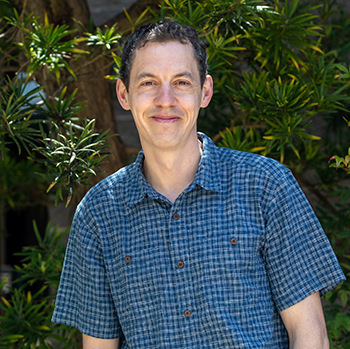
Mahmoud Moradi
Mahmoud Moradi

Prof Moradi builds supercomputer models to determine drug candidate’s ability to bind to proteins

Combing computational physics with experimental data, University of Arkansas researchers have developed supercomputer models for determining a drug candidate’s ability to target and bind to proteins within cells.

If accurate, such an estimator could computationally demonstrate binding affinity and thus prevent experimental researchers from needing to investigate millions of chemical compounds. The work could substantially reduce the cost and time associated with developing new drugs.

“We developed a theoretical framework for estimating ligand-protein binding,” said Mahmoud Moradi, associate professor of chemistry and biochemistry at the Fulbright College of Arts and Sciences. “The proposed method assigns an effective energy to the ligand at every grid point in a coordinate system, which has its origin at the most likely location of the ligand when it is in its bound state.”

A ligand is a substance — an ion or molecule — such as a drug that binds to another molecule, such as a protein, to form a complex system that may cause or prevent a biological function.

Moradi’s research focuses on computational simulations of diseases, including coronavirus. For this project, he collaborated with Suresh Thallapuranam, professor of biochemistry and the Cooper Chair of Bioinformatics Research.

Moradi and Thallapuranam used biased simulations — as well as non-parametric re-weighting techniques to account for the bias — to create a binding estimator that was computationally efficient and accurate. They then used a mathematically robust technique called orientation quaternion formalism to further describe the ligand’s conformational changes as it bound to targeted proteins.

The researchers tested this approach by estimating the binding affinity between human fibroblast growth factor 1 — a specific signaling protein — and heparin hexasaccharide 5, a popular medication.

The project was conceived because Moradi and Thallapuranam were studying human fibroblast growth factor 1 protein and its mutants in the absence and presence of heparin. They found strong qualitative agreement between simulations and experimental results.

“When it came to binding affinity, we knew that the typical methods we had at our disposal would not work for such a difficult problem,” Moradi said. “This is why we decided to develop a new method. We had a joyous moment when the experimental and computational data were compared with each other, and the two numbers matched almost perfectly.”

Moradi previously received attention for developing computational simulations of the behavior of SARS-CoV-2 spike proteins prior to fusion with human cell receptors. SARS-CoV-2 is the virus that causes COVID-19.

VIDEO: Neutron Star Merger Simulation with Gamma-ray Observations

This animation follows the gravitational wave and density changes in a simulated neutron star merger and compares them to measurements of a short gamma-ray burst observed by NASA's Compton mission on July 11, 1991. Dark purple colors represent the lowest-density material, while yellow-white shows the highest. An audible tone and a visual frequency scale (at left) track the steady rise in the frequ...

Read more

Astronauts imaged the Compton Gamma Ray Observatory during its deployment from space shuttle Atlantis in April 1991. Credit: NASA/STS-37 crew

NASA’s retired Compton mission discovers superheavy neutron stars

Astronomers studying archival observations of powerful explosions called short gamma-ray bursts (GRBs) have detected light patterns indicating the brief existence of a superheavy neutron star shortly before it collapsed into a black hole. This fleeting, massive object likely formed from the collision of two neutron stars. 

“We looked for these signals in 700 short GRBs detected with NASA’s Neil Gehrels Swift ObservatoryFermi Gamma-ray Space Telescope, and the Compton Gamma Ray Observatory,” explained Cecilia Chirenti, a researcher at NASA’s Goddard Space Flight Center in Greenbelt, Maryland. “We found these gamma-ray patterns in two bursts observed by Compton in the early 1990s.”

A neutron star forms when the core of a massive star runs out of fuel and collapses. This produces a shock wave that blows away the rest of the star in a supernova explosion. Neutron stars typically pack more mass than our Sun into a ball about the size of a city, but above a certain mass, they must collapse into black holes. In this animation, a neutron star (blue sphere) spins in the center of a colorful disk of gas, some of which follows the magnetic field (blue lines) and flows (blue-white arcs) onto the object’s surface. One interpretation of the quasiperiodic oscillations seen in X-rays in these systems is the formation of a hot spot (white oval) near the disk's inner edge, which expands and contracts as its properties change. Because of this irregular orbit, the hot spot emission varies within a range of frequencies. Credits: NASA's Goddard Space Flight Center Conceptual Image Lab

Both the Compton data and supercomputer simulations showed mega neutron stars tipping the scales by 20% more than the most massive, precisely measured neutron star known – dubbed J0740+6620 – which weighs in at nearly 2.1 times the Sun’s mass. Superheavy neutron stars also have nearly twice the size of a typical neutron star or about twice the length of Manhattan Island.

The mega neutron stars spin nearly 78,000 times a minute – almost twice the speed of J1748–2446ad, the fastest pulsar on record. This rapid rotation briefly supports the objects against further collapse, allowing them to exist for just a few tenths of a second, after which they proceed to form a black hole faster than the blink of an eye.

“We know that short GRBs form when orbiting neutron stars crash together, and we know they eventually collapse into a black hole, but the precise sequence of events is not well understood,” said Cole Miller, a professor of astronomy at UMCP and a co-author of the paper. “At some point, the nascent black hole erupts with a jet of fast-moving particles that emits an intense flash of gamma rays, the highest-energy form of light, and we want to learn more about how that develops.”

Short GRBs typically shine for less than two seconds yet unleash energy comparable to what’s released by all the stars in our galaxy over one year. They can be detected more than a billion light-years away. Merging neutron stars also produce gravitational waves, ripples in space-time that can be detected by a growing number of ground-based observatories.

Supercomputer simulations of these mergers show that gravitational waves exhibit a sudden jump in frequency – exceeding 1,000 hertz – as the neutron stars coalesce. These signals are too fast and faint for existing gravitational wave observatories to detect. But Chirenti and her team reasoned that similar signals could appear in the gamma-ray emission from short GRBs. 

{media id=295,layout=solo}

Astronomers call these signals quasiperiodic oscillations, or QPOs for short. Unlike, say, the steady ringing of a tuning fork, QPOs can be composed of several close frequencies that vary or dissipate over time. Both the gamma-ray and gravitational wave QPOs originate in the maelstrom of swirling matter as the two neutron stars coalesce.

While no gamma-ray QPOs materialized in the Swift and Fermi bursts, two short GRBs recorded by Compton’s Burst And Transient Source Experiment (BATSE) on July 11, 1991, and Nov. 1, 1993, fit the bill.

The larger area of the BATSE instrument gave it the upper hand in finding these faint patterns – the tell-tale flickering that revealed the presence of mega neutron stars. The team rates the combined odds of these signals occurring by chance alone at less than 1 in 3 million.

“These results are very important as they set the stage for future measurements of hypermassive neutron stars by gravitational wave observatories,” said Chryssa Kouveliotou, chair of the physics department at George Washington University in Washington, who was not involved in the work.

By the 2030s, gravitational wave detectors will be sensitive to kilohertz frequencies, providing new insights into the short lives of supersized neutron stars. Until then, sensitive gamma-ray observations and supercomputer simulations remain the only available tools for exploring them. 

Compton’s BATSE instrument was developed at NASA's Marshall Space Flight Center in Huntsville, Alabama, and provided the first compelling evidence that gamma-ray bursts occurred far beyond our galaxy. After operating for almost nine years, the Compton Gamma Ray Observatory was deorbited on June 4, 2000, and destroyed as it entered Earth’s atmosphere.

Goddard manages both the Swift and Fermi missions.

Alcatel-Lucent Enterprise launches OmniVista Network Advisor, its AI network operations companion

Today in Paris, Alcatel-Lucent Enterprise has released a new AIOps service: OmniVista Network Advisor. It's an intelligent, autonomous system providing real-time network monitoring, alerts of potential risks, and instant mitigation of network issues.

The solution is built with ALE intelligence to provide new and existing customers with real-time network monitoring and alerts. OmniVista Network Advisor aims to simplify and accelerate the troubleshooting process, reducing network downtime and improving the Quality of Experience.

The technology provides proactive protection for network infrastructure, designed to significantly reduce the time from issue detection to resolution while simplifying the network administrator’s day-to-day operations.

OmniVista Network Advisor gives administrators a choice on who is notified and what measures should be taken to resolve the issue. Leveraging the unique capabilities of Alcatel-Lucent Enterprise’s Rainbow CPaaS platform, the application triggers a smart alerting system on an intuitive interface and proposes clear, immediate action as soon as a threat or anomaly is detected. The new system aims to fix network issues with one tap, detecting unexpected system errors and allowing network administrators to apply the solution instantaneously from any smart device, anywhere. With OmniVista Network Advisor, issues are resolved much faster, substantially reducing the need for engineers to be on site.

Through Artificial Intelligence (AI) and Machine Learning (ML) capabilities, OmniVista Network Advisor will gradually expand its capabilities to detect and anticipate issues/anomalies by reviewing historical data to understand network behavior. This means that even intermittent problems can be caught, logged, and resolved much faster. The system also aims to detect unknown patterns, employing automated log collection to aid the remediation of new problems without lengthy troubleshooting.

Michael See, CTO of Alcatel-Lucent Enterprise Network Business Division commented, “Enterprises increasingly rely on an Autonomous Network. OmniVista Network Advisor accelerates real-time reactions to anomalies so that our customers can have peace of mind that their connectivity and mission-critical operations will remain secure and uninterrupted. Typically, only 5% of issues reported to ALE Customer Support are new, so our experience and intelligence are built into the tool to immediately identify the root cause of any issues and provide solutions that can be implemented automatically.”

Overall, ALE’s OmniVista Network Advisor aims to improve the efficiency of network administrators’ teams, reducing the time between a problem occurring, and the problem is solved. It will be available to all customers using ALE OmniSwitches or OmniAccess Stellar access points.

The future evolution of OmniVista Network Advisor, associated with the Alcatel-Lucent Enterprise Rainbow CPaaS platform, facilitates integration with third-party systems. Examples of such integration include the automated creation of tickets in the company's IT Service Management system, collaboration in real-time with other specialists, or interfacing with other AI platforms. This powerful combination optimizes processes and enables faster resolution of threats or issues associated with the network.

The James Webb Space Telescope is prepared for testing at NASA's Johnson Space Center in Houston. It successfully launched into space on Dec. 25, 2021. Photo courtesy of NASA/Chris Gunn.

Mizzou astronomers use JWST data to discover more galaxies formed in the early universe

In a new study, a team of astronomers led by Haojing Yan at the University of Missouri used data from NASA’s James Webb Space Telescope (JWST) Early Release Observations and discovered 87 galaxies that could be the earliest known galaxies in the universe.

The finding moves astronomers one step closer to finding out when galaxies first appeared in the universe — about 200-400 million years after the Big Bang, said Yan, associate professor of physics and astronomy at MU and lead author on the study. Haojing Yan

“Finding such a large number of galaxies in the early parts of the universe suggests that we might need to revise our previous understanding of galaxy formation,” Yan said. “Our finding gives us the first indication that a lot of galaxies could have been formed in the universe much earlier than previously thought.”

In the study, the astronomers searched for potential galaxies at “very high redshifts.” Yan said the concept of redshifts in astronomy allows astronomers to measure how far away distant objects are in the universe — like galaxies — by looking at how the colors change in the waves of light that they emit.

“If a light-emitting source is moving toward us, the light is being ‘squeezed,’ and that shorter wavelength is represented by blue light or blueshift,” Yan said. “But if that source [of light] is moving away from us, the light it produces is being ‘stretched,’ and changes to a longer wavelength that is represented by red light, or redshift.”

Yan said Edwin Hubble’s discovery in the late 1920s that our universe is ever-expanding is key to understanding how redshifts are used in astronomy.

“Hubble confirmed that galaxies external to our Milky Way galaxy are moving away from us, and the more distant they are, the faster they are moving away,” Yan said. “This relates to redshifts through the notion of distances — the higher the redshift an object is at, such as a galaxy, the further away it is from us.”

Therefore, Yan said the search for galaxies at very high redshifts gives astronomers a way to construct the early history of the universe.

“The speed of light is finite, so it takes time for light to travel over a distance to reach us,” Yan said. “For example, when we look at the sun, we aren’t looking at it as what it looks like in the present, but rather what it looked like some eight minutes ago. That’s because that’s how long it takes for the sun’s radiation to reach us. So, when we are looking at galaxies which are very far away, we are looking at their images from a long time ago.” A pair of color composite images from the galaxy cluster SMACS 0723-27 and its surrounding area taken by NASA’s James Webb Space Telescope through its Early Release Observations (ERO). A team of astronomers led by Haojing Yan at the University of Missouri used the data from these images to identify the objects of interest for their study. These include galaxies that could be the earliest known galaxies in the universe — about 200-400 million years after the Big Bang. The location of each object of interest is indicated by one of three different colored circles — blue, green or red — on the color images. These colors correspond with the range of redshifts where they were found — high (blue), very high (green), or extremely high (red). Graphic by Haojing Yan and Bangzheng Sun. Photos courtesy of NASA, European Space Agency, Canadian Space Agency and the Space Telescope Science Institute.

Using this concept, Yan’s team analyzed the infrared light captured by the JWST to identify the galaxies.

“The higher the redshift a galaxy is at, the longer it takes for the light to reach us, so a higher redshift corresponds to an earlier view of the universe,” Yan said. “Therefore, by looking at galaxies at higher redshifts, we are getting earlier snapshots of what the universe looked like long ago.”